



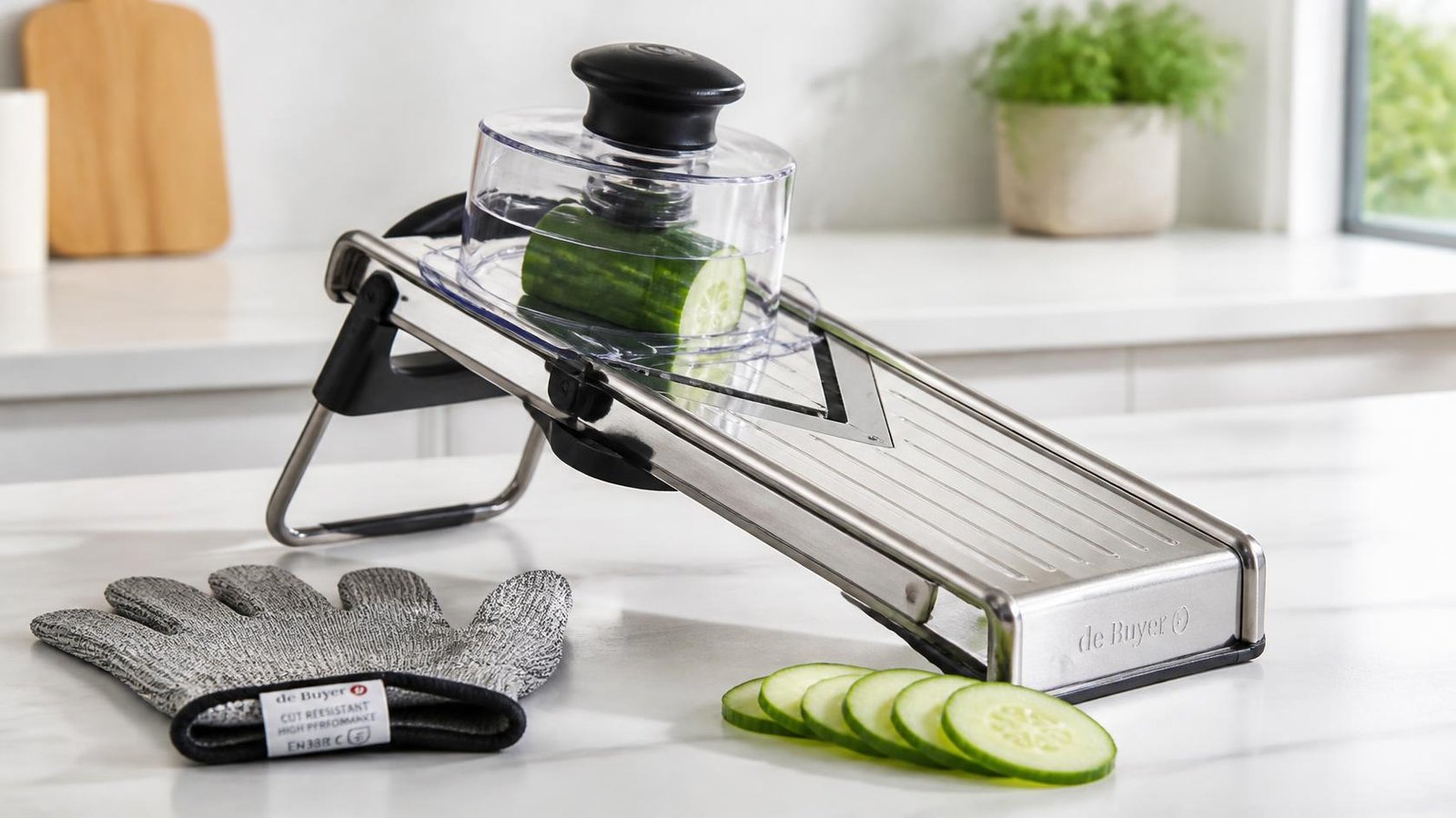
Mandoline Guide: Safer Slicing, Better Results
A mandoline is one of the simplest ways to produce thin, repeatable slices without relying on knife precision alone. It can turn a pile of potatoes into evenly sliced gratin layers, create clean cucumber ribbons for salads, or prepare julienne carrots for slaw in minutes. But its exposed blade demands a deliberate setup. We get the best results when we treat it as a precision cutting tool, not a shortcut to rush through.
Table of Contents
Guide Sections
- Key Takeaways
- How a Mandoline Works and How to Choose One
- How to Use a Mandoline Safely and Consistently
- Cleaning, Storage, and Blade Care
- Frequently Asked Questions
Quick Route
If we need only thin cucumber, onion, or potato slices, a basic straight blade mandoline may be enough. If we regularly make slaw, garnishes, vegetable chips, or layered bakes, an adjustable model with a stable base and useful blade options is usually a better fit. Safety features should be considered essential rather than optional.
Key Takeaways
What Matters Most
- A mandoline creates uniform slices by moving food across a fixed, exposed blade.
- The best model depends on ingredient size, available counter space, desired cut styles, and how often we need to change thickness settings.
- A food guard and a cut resistant glove serve different purposes. Using both adds protection, especially near the end of an ingredient.
- Stable footing, dry hands, a clear work area, and stopping before food becomes too small are more important than slicing speed.
The Practical Buying Priority
When choosing a mandoline, prioritize safety and control before extra attachments. A wide cutting surface, secure feet, an easy thickness adjustment, and a food holder that grips firmly will generally matter more in everyday use than a long list of specialty blades.
A mandoline is most useful when consistency affects cooking, texture, or presentation. It is not automatically the right tool for every cutting task.
How a Mandoline Works and How to Choose One
The Cutting Mechanism
A mandoline has a flat track and a blade positioned across that track. Food moves over the blade in repeated strokes, removing a thin layer with each pass. The result is a series of slices with nearly identical thickness, assuming the food is held at a consistent angle and pressure.
Which? explains the basic mandoline track, food holder, thickness settings, and handheld versus freestanding construction. That construction explains why the tool can be so efficient: the blade remains in one position while the food moves, rather than requiring us to reproduce the same knife angle for every cut.
Thickness adjustment changes the distance between the food surface and the blade. On a dial based model, the blade position shifts incrementally. On other designs, we insert a different cutting blade or plate. A small adjustment can make a large difference. A thin setting works for potato chips, shaved radish, or quick pickles, while a thicker setting is better for roasted vegetables or a substantial gratin.
Food Network notes that mandolines can offer straight slicing, wavy slicing, shredding, grating, and julienne functions, with some reviewed models ranging from paper thin slices to roughly one half inch depending on the design. Its overview of mandoline thickness ranges and attachment options is useful context when comparing feature sets. More functions are not always better, though. Each extra blade requires safe handling, cleaning, and storage.
Choosing the Right Style
The right mandoline is the one that fits our ingredients and working habits. A narrow handheld unit can be compact and affordable, but it may feel less controlled with wide vegetables. A freestanding model takes more room but can provide a more stable work platform.
| Mandoline style | Best for | Main advantage | Watch for |
|---|---|---|---|
| Handheld | Small kitchens, occasional slicing, bowl based prep | Compact and easy to store | Less support for large or heavy ingredients |
| Freestanding | Frequent prep and larger batches | Stable countertop position | Requires more storage space |
| Continuously adjustable | Recipes needing several slice thicknesses | Quick setting changes | Adjustment controls should lock securely |
| Interchangeable blade | Julienne, crinkle cuts, and specialty prep | Multiple cutting styles | Loose blades require careful storage |
Ingredient width deserves more attention than it often receives. A large onion, broad tomato, or oversized potato can extend beyond a narrow slicing surface. That does not always make the mandoline unusable, but it can force awkward positioning. In a community discussion, users noted that ingredient size can exceed the face of some models and that angling food may be necessary. The same discussion includes community observations about mandoline width, blade systems, gloves, and large ingredient limitations.
If we routinely slice large produce, a wider cutting bed is usually the simpler answer. Angling a large onion can work, but it changes the pressure path and can reduce control. For soft tomatoes, a sharp blade and a light, even stroke matter more than force. Pressing down hard tends to crush soft flesh before the blade cuts cleanly.
Adjustable Blade or Interchangeable Blades?
An adjustable straight blade is often the most practical feature for daily prep. It lets us move from thin cucumber slices to thicker potato rounds without removing a sharp component. Interchangeable blades make more sense when a kitchen truly uses julienne, crinkle, or grating cuts often enough to justify the extra setup.
We should also consider what happens after months of use. A dull blade can drag, tear delicate produce, and encourage extra force. Some community members value models with removable blades because the blades may be easier to sharpen or replace. That long term consideration appears in this discussion of removable and potentially sharpenable mandoline blades. Replacement availability varies by manufacturer, so it is sensible to check before treating sharpenability as a deciding feature.
How to Use a Mandoline Safely and Consistently
Set Up Before the First Stroke
The safest use pattern begins before food touches the blade. Put a freestanding mandoline on a dry, level counter. If using a handheld model, position it securely over a stable bowl or cutting vessel so it cannot slide. Clear away dish towels, packaging, and clutter that could catch the handle or distract us mid stroke.
Prepare ingredients to suit the tool:
- Trim round vegetables to create a stable flat side when possible.
- Peel produce only when the recipe requires it or when the skin interferes with a clean slice.
- Cut unusually long items into manageable sections.
- Pat wet produce dry enough to reduce slipping.
- Choose a thickness setting before attaching the food guard.
A flat side is especially helpful with potatoes, zucchini, and eggplant. Round food tends to roll. If it rolls while passing over the blade, slice thickness changes and the guard can lose its grip.
Use the Guard and Glove as a System
A food guard is designed to hold the ingredient while keeping fingers above and away from the blade. It is the primary handling tool for the main portion of the ingredient. A cut resistant glove is a secondary layer of protection for the hand that may be closest to the cutting path, particularly during awkward handling or cleanup.
They are not interchangeable. A glove does not create a stable grip or prevent a vegetable from skidding. A guard does not eliminate every risk if it loses purchase on a small, irregular piece of food. We get a more controlled workflow when the guard holds the food and the glove protects against an unexpected slip.
Use this sequence:
- Attach the food firmly to the guard, checking that its prongs or teeth have penetrated securely.
- Hold the guard so fingers remain behind its protective surface, never below it.
- Push food over the blade with smooth, moderate strokes. Avoid fast sawing motions.
- Check the remaining food size after several passes.
- Stop when the food becomes too short, narrow, soft, or unstable for the guard to hold securely.
That final step is where many preventable cuts occur. The last small piece is not worth forcing through the blade. It can be diced with a knife, saved for stock, or discarded. Fair warning: a mandoline does not reward finishing every last slice.
Fix Uneven Slices and Common Problems
Uneven slices usually signal a handling or ingredient issue rather than a defective tool. The food may not be making full contact with the slicing surface, the pressure may be changing from one stroke to the next, or the ingredient may be too soft for the selected setting.
| Problem | Likely cause | Practical recovery |
|---|---|---|
| Slices vary in thickness | Uneven pressure or food is tilting | Reattach food to the guard and use full, level strokes |
| Food catches on the blade | Ingredient is soft, wet, or damaged | Dry it, chill it briefly if appropriate, and use lighter pressure |
| Tomato slices tear | Blade may be dull or pressure is too heavy | Use a sharper blade and steady forward movement |
| Julienne strips break | Produce is too soft or strips are too fine | Use firmer produce or choose a wider julienne setting |
| Mandoline slides | Counter, bowl, or feet are unstable | Stop and reset on a dry, secure surface |
A mandoline works best on ingredients with some firmness. Potatoes, carrots, radishes, onions, cabbage, cucumbers, and apples usually offer predictable resistance. Very ripe tomatoes, soft avocados, cooked vegetables, and delicate fruit may need a sharp knife instead. The goal is not to make every ingredient fit the tool. It is to select the tool that gives us control.
When a Knife or Food Processor Is Better
A mandoline does not replace every prep tool. A chef’s knife is better for irregular shapes, tiny quantities, and tasks requiring careful trimming. A food processor may be more efficient for large volumes of shredding, although the resulting cut can be less precise depending on the attachment.
Epicurious distinguishes among beginner, user friendly, and experienced cook models in its editorial testing of mandolines for different comfort levels and use cases. That distinction is useful because the safest model is not necessarily the most complex one. For a new user, a stable platform, easy guard, visible settings, and uncomplicated blade changes can be more valuable than maximum versatility.
Cleaning, Storage, and Blade Care
Clean It Without Reaching Across the Blade
Clean the mandoline promptly after use, before starch, vegetable fibers, or food residue dries onto the track. But do not wipe the blade casually with a sponge held in the palm. That motion brings fingers directly across the cutting edge.
A safer cleaning routine is:
- Remove detachable parts only after setting the mandoline flat on the counter.
- Rinse loose food away from the blade path using a directed stream of water.
- Use a dish brush to clean the track and blade area, brushing away from the sharp edge.
- Wash the food guard separately, checking its prongs for trapped food.
- Dry every component fully before storage to reduce moisture around metal parts.
Manufacturer instructions should always control whether a specific model is dishwasher safe. Even when a dishwasher is permitted, hand washing may make it easier to inspect the blade and remove fine food residue. The key point is simple: never test sharpness with a fingertip, and never leave the blade submerged where someone might reach into the sink.
Store It Like a Sharp Tool
Storage is part of safety. A mandoline should not sit loose in a crowded utensil drawer with the blade exposed. If it includes a blade cover, use it. If blades are removable, place them in their designated holder or protective case before storing the body of the tool.
For a folding model, confirm that folding does not leave a cutting edge accessible. For a compact handheld mandoline, consider a shelf bin or container that prevents contact when reaching for other equipment. The best storage arrangement makes the sharp part obvious and inaccessible, rather than hidden among ordinary utensils.
Know When Maintenance Is Needed
A clean, sharp blade should cut with modest pressure. If food begins to tear, bend, or snag repeatedly, inspect for residue first. Persistent poor cutting after cleaning may suggest blade wear or damage.
We should not assume every mandoline blade can be sharpened safely at home. Some are designed for replacement; others may require specialized service; some may not have a practical sharpening path at all. Before purchasing, check whether replacement parts are available and whether the manufacturer provides instructions for blade maintenance. This matters more for a frequently used tool than for one brought out a few times a year.
Frequently Asked Questions
What is a mandoline used for?
A mandoline is used to create repeated slices or strips with consistent thickness. Common uses include thin potato slices, onion rounds, cucumber slices, cabbage for slaw, julienne carrots, and crinkle cut vegetables. It is particularly useful when even thickness affects cooking time or presentation.
Is a mandoline faster than a knife?
For repeated slices of the same thickness, it can be faster because the blade setting stays fixed. A knife is often faster for a small amount of food, irregular shapes, or tasks requiring trimming and precision cuts. Speed should never override stable setup and safe handling.
Should I use a food holder, a cut resistant glove, or both?
Use the food holder whenever it can securely grip the ingredient. A cut resistant glove adds protection but should not replace the holder. Using both is a sensible approach when slicing larger batches or handling food that is becoming too small to control confidently.
Is a handheld or freestanding mandoline better?
Handheld models suit compact kitchens and occasional use. Freestanding models are generally better for larger batches because their feet or base can provide a more stable working position. Choose based on storage space, batch size, ingredient width, and confidence with the tool.
Can a mandoline slice tomatoes, onions, potatoes, and carrots?
Yes, provided the blade is sharp and the ingredient is stable. Potatoes, onions, and carrots are generally firm enough for predictable slices. Tomatoes require a very sharp blade and gentle pressure. If a tomato is extremely ripe or soft, a serrated knife may produce cleaner slices.
Why is my mandoline making uneven slices?
The most common causes are inconsistent pressure, food that is tilting in the guard, a wet or rounded ingredient, or a blade that needs cleaning or replacement. Reset the food in the holder, stabilize the work surface, and use slow full strokes instead of short rushed movements.
How thin can a mandoline slice?
This depends on the model. Some mandolines are designed for nearly transparent slices, while others have fewer thickness settings. Use the thinnest setting only when the ingredient remains stable and the recipe benefits from it, such as chips, shaved salads, or delicate garnishes.
Sources and References
Editorial Reviews
- Food Network + “5 Best Mandoline Slicers of 2026, Tested and Reviewed” — https://www.foodnetwork.com/how-to/packages/shopping/product-reviews/best-mandoline-slicers
- Epicurious + “Best Mandoline Slicers (2025) Tested and Reviewed” — https://www.epicurious.com/expert-advice/best-mandoline-slicer-article
- Which? + “Best mandoline slicers 2026” — https://www.which.co.uk/reviews/kitchen-utensils/article/best-mandoline-slicers-aoMWJ8v68gu1
Community Discussions
- Reddit r/Cooking + “Mandoline slicer” — https://www.reddit.com/r/Cooking/comments/oraotz/mandoline_slicer/
- Reddit r/BuyItForLife + “Best Mandoline Slicer for making perfect, consistent vegetable cuts?” — https://www.reddit.com/r/BuyItForLife/comments/1gtnvuq/
Recent Posts

Leave a Comment
Your email address will not be published. Required fields are marked *