




New vs Used vs Restored Commercial Kitchen Equipment
New vs Used vs Restored Commercial Kitchen Equipment
Choosing between new vs used vs restored commercial kitchen equipment is not simply a price comparison. The better purchase depends on what the equipment does, how costly a failure would be during service, whether replacement parts remain available, and what installation requires. A stainless prep table and a high-volume commercial dishwasher may both be available used, but they do not carry the same operational risk.
The most practical approach is to match the equipment’s condition to its role in the kitchen. Buy reliability where downtime would stop service. Buy value where wear is visible, repairable, and unlikely to create a food-safety or compliance problem.
Table of Contents
- Key Takeaways
- How New, Used, and Restored Equipment Compare
- How to Evaluate Risk, Cost, and Installation
- Frequently Asked Questions
- Sources and References
Key Takeaways
- New equipment is usually the safer choice for refrigeration, dishwashing, high-output cooking equipment, and any unit where failure would close part of the operation.
- Used equipment can be an excellent value for durable, simple items such as stainless work tables, shelving, sinks, racks, and some manually operated equipment.
- Restored or refurbished equipment can be a sensible middle option only when the seller can explain what was repaired, replaced, cleaned, tested, and warranted.
- The purchase price is only one line in the budget. Delivery, utility modifications, ventilation, installation, energy use, service calls, downtime, and replacement parts can change the winner.
- Labels such as certified used, refurbished, and reconditioned are not universal condition grades. Compare the documented process and warranty, not the label alone.
A low purchase price is not a bargain if the equipment fails during a busy service, cannot be repaired promptly, or does not fit the kitchen’s existing gas, electrical, plumbing, or ventilation setup.
How New, Used, and Restored Equipment Compare
The practical difference between the three condition tiers
New commercial kitchen equipment is unused equipment sold with the manufacturer’s current specifications and warranty terms. It normally provides the clearest baseline for expected performance, current safety features, and parts support. New does not mean maintenance-free, but it reduces uncertainty about prior use, abuse, and repair history.
Used equipment is sold after prior ownership and operation. Its condition may range from lightly used surplus equipment to heavily worked units removed from a closing kitchen. Some used inventory comes from restaurant upgrades and is then cleaned, reconditioned, and tested before resale, as described by Babak Food Equipment’s used-equipment process. That process may improve confidence, but the buyer still needs unit-specific information.
Restored equipment generally refers to used equipment that has received more work before resale. The depth of that work matters. A polished exterior is not the same as a rebuilt refrigeration system or a replacement of worn gas controls. Some sellers use refurbished, reconditioned, restored, and certified used interchangeably, so I would treat each term as a starting point for questions rather than proof of condition.
| Equipment condition | Typical value proposition | Main strength | Main limitation | Best fit |
|---|---|---|---|---|
| New | Highest upfront investment | Current warranty, predictable history, current model support | Higher capital cost and possible lead time | Critical production equipment and long-term operations |
| Used | Lowest initial cost | Strong savings on simple, durable equipment | Variable wear, limited records, possible repair exposure | Noncritical equipment with inspectable condition |
| Restored | Mid-range investment | Potentially better reliability than ordinary used equipment | Restoration quality varies by seller and model | Equipment with documented repairs, testing, and warranty |
| Scratch-and-dent | Discounted near-new alternative | Cosmetic discount without necessarily buying an older unit | Damage must be evaluated carefully | Buyers who can accept appearance flaws |
A fourth category is worth considering: scratch-and-dent or outlet equipment. It can be a better value than used when the unit is current, fully functional, and discounted for cosmetic reasons rather than age. Central Restaurant Products describes outlet inventory as potentially including returns, mis-ships, minor freight damage, or refurbished items that can still be fully functioning. For front-of-house display equipment, visible dents may be unacceptable. For a back-of-house reach-in refrigerator, a cosmetic side-panel flaw may have little operational consequence.
Restoration has levels, and appearance is the weakest level
The word restored sounds comprehensive. It may be, but the actual work can vary substantially. Before comparing restored units, separate restoration into three practical levels.
| Restoration level | What may be included | What it does not prove | Buyer response |
|---|---|---|---|
| Cosmetic reconditioning | Deep cleaning, polishing, paint touch-up, replacement knobs | Internal reliability, sanitation performance, utility safety | Ask for test results and repair records |
| Functional repair | Repair of known faults, replacement of select worn parts, operational test | That every age-sensitive component has been renewed | Identify which major components remain original |
| Component-level rebuilding | Replacement or overhaul of critical assemblies such as controls, seals, burners, valves, pumps, or selected refrigeration components | Equivalent service life to a new unit | Compare warranty scope and excluded parts |
For example, a restored convection oven may look excellent after exterior polishing and interior cleaning. That does not answer whether the door gasket seals properly, the fan motor is quiet, the thermostat holds temperature, the igniter lights consistently, or the control board is still supported. Those details determine whether the oven will perform reliably at the dinner rush.
Certified-used programs can add useful structure, but they are still seller-defined. SilverChef Canada’s certified-used equipment description states that units are inspected, refurbished, cleaned, and sold with a warranty. That is more meaningful than an untested private listing, particularly when documentation explains the work performed. Still, ask whether the warranty covers labor, travel, refrigerant work, electronics, and replacement parts, or only specific components.
Which category fits each equipment class?
The right buying decision changes by equipment class because the failure mechanisms differ. Stainless steel can show cosmetic wear for years without affecting function. Refrigeration, electronics, pumps, compressors, and high-heat components have more ways to fail and can be harder to assess from a quick inspection.
| Equipment class | Often safest choice | When used or restored can make sense | Common red flags |
|---|---|---|---|
| Work tables, shelving, racks | Used | Nearly always, if structurally sound and cleanable | Bent frames, sharp edges, unstable legs, severe pitting |
| Sinks and basic stainless fixtures | Used or restored | If dimensions, drain placement, and condition fit | Leaks, damaged welds, missing legs, inaccessible seams |
| Smallwares and manual prep tools | Used selectively | When complete, cleanable, and not heavily worn | Cracked plastic, damaged guards, missing components |
| Gas ranges, grills, fryers | New or documented restored | Lower-volume applications with local service and available parts | Burner corrosion, gas leaks, warped grates, inconsistent ignition |
| Ovens and combi ovens | New or strong restored | Only with detailed functional testing and support history | Control faults, fan noise, steam leaks, unavailable boards |
| Refrigeration and ice machines | Usually new | Used only with strong service records, tested performance, and parts support | Compressor noise, gasket failure, corrosion, temperature instability |
| Commercial dishwashers | Usually new or thoroughly restored | When sanitation cycles, pumps, heaters, and installation needs are verified | Leaks, scale buildup, weak final rinse, pump noise, missing chemical setup |
A simple rule helps: the more a unit depends on sealed systems, sensors, controls, pumps, or high heat, the more valuable a new warranty becomes. That does not make restored equipment automatically unsuitable. It means the restoration premium must buy documented risk reduction.
How to Evaluate Risk, Cost, and Installation
Build the comparison around total cost, not sticker price
The purchase price is visible. The more expensive costs often arrive later: a service call, a missing electrical upgrade, a failed compressor, an incompatible hood connection, or a lost service period while waiting for a part.
Use this total-cost model before approving a purchase:
Total cost of ownership = purchase price + delivery + installation + utility changes + expected maintenance + expected repair exposure + energy use + downtime cost − expected resale value
Exact figures will differ by city, kitchen layout, service availability, and operating volume. The model is still useful because it forces the correct questions.
Consider two reach-in refrigerators. A used unit may be substantially cheaper than a new unit at purchase. But if it needs new door gaskets, a controller repair, a service visit, and an electrical change, the gap narrows quickly. If it fails while holding high-value inventory, the business may also face food loss and emergency replacement costs. In that situation, the new unit’s warranty and known history may justify its price.
Now consider a used stainless work table. If it is stable, free of sharp damage, cleanable, and correctly sized, its repair exposure is low. A used table may remain the rational choice even after delivery costs because its failure would rarely halt service.
When restored is irrational: restoration can be a poor value when the premium approaches the cost of new equipment but the warranty remains short, key components remain original, and parts support is uncertain. A restored dishwasher with a brief seller warranty may not offer enough protection if a pump, heater, or control issue would create immediate sanitation and service problems.
Use a parts-availability test before paying a deposit
A working used unit can still be a poor purchase if it cannot be repaired. Parts availability should be checked before delivery, not after a failure.
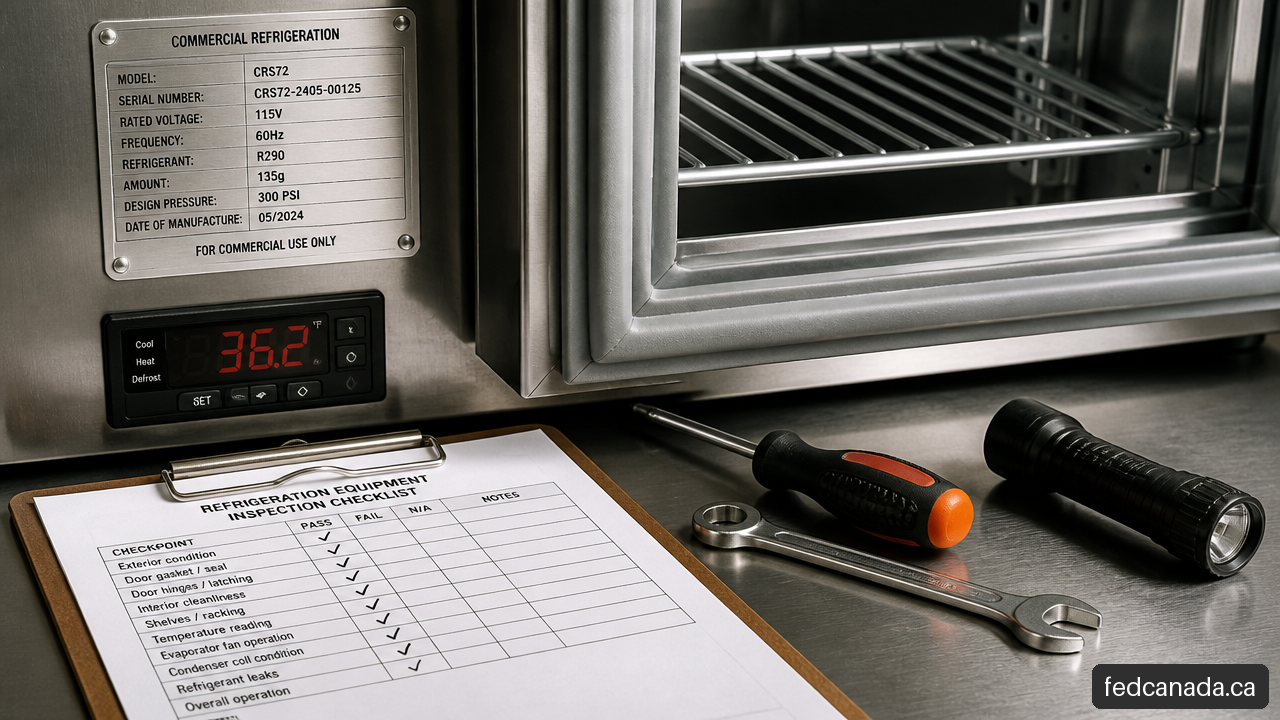
Ask the seller for the manufacturer, full model number, serial number, approximate production date if known, and a list of repairs or replacement parts. Then use this sequence:
- Identify the high-wear components. For refrigeration, this may include gaskets, controllers, fan motors, sensors, and compressor-related parts. For cooking equipment, focus on burners, valves, ignition components, thermostats, fan motors, and control boards.
- Confirm OEM and serviceable alternatives. Find out whether original equipment manufacturer parts are still obtainable and whether a qualified local technician can service the model. Generic components can sometimes be substituted, but proprietary boards and specialized assemblies may not be easily replaced.
- Ask what is original and what is new. A restored unit with new gaskets and a cleaned cabinet is different from one with a new pump, rebuilt controls, or replaced burner components.
- Check accessory completeness. Missing racks, trays, doors, legs, drain components, baskets, chemical dispensers, and guards can add unexpected cost or make a unit unusable on arrival.
- Price uncertainty into the deal. If documentation is incomplete, negotiate for a lower price, a longer warranty, delivery, installation support, or a documented functional test before pickup.
Fair warning: a seller saying “parts are available” is not enough. Availability can mean a replacement part exists somewhere, not that it is stocked, affordable, or quickly shipped to your location.
Verify compliance, utilities, and performance before delivery
Used equipment can fail the budget before it fails mechanically. A unit may be too wide for the doorway, require a different voltage, lack the required gas configuration, exceed the hood’s capacity, or need plumbing and drainage changes. These are not small details. They are often the difference between equipment that is useful and equipment that sits in storage.
Before final payment, confirm the following in writing:
- Exterior dimensions, clearance needs, weight, and delivery path
- Gas type, gas connection requirements, electrical voltage, phase, amperage, and plug or hardwire requirements
- Plumbing inlet, drain, floor drain, water pressure, and chemical-dispensing needs for dishwashing equipment
- Ventilation, hood, fire-suppression, and clearance requirements for cooking equipment
- Equipment certification marks and whether local inspectors, landlords, or insurers have additional requirements
- Whether delivery includes placement, uncrating, removal of packaging, hookup, startup, or only curbside drop-off
Canadian requirements can vary by province, municipality, building, and inspection authority. There is no single rule that makes all used equipment acceptable or unacceptable. The practical step is to verify the planned installation with the relevant local authorities and qualified installers before purchase, especially for gas appliances, electrical equipment, ventilation-connected units, and dishwashers.
Performance testing should be specific to the equipment. A refrigerator should demonstrate stable operating temperature with doors closed and loaded conditions considered. A fryer should heat consistently and recover appropriately for expected volume. A dishwasher should complete cycles without leaks and meet the operation expected for its sanitizing method. A short power-on demonstration is not the same as a meaningful test.
Frequently Asked Questions
What is the difference between new, used, and restored commercial kitchen equipment?
New equipment has no operating history and is normally sold with the manufacturer’s current warranty. Used equipment has prior operating history and may be sold as-is or after basic testing. Restored equipment is used equipment that has been cleaned, repaired, and sometimes rebuilt or tested before resale. The key difference is not the label; it is the documentation showing what condition the unit is in and what work was completed.
Is restored equipment the same as refurbished equipment?
Not necessarily. Sellers often use the terms interchangeably, but neither term has one universal industry definition. I would ask for a written restoration scope: what was cleaned, which parts were replaced, what functions were tested, and what warranty applies. Cosmetic cleaning alone should not be treated as a functional rebuild.
Which commercial kitchen equipment should usually be bought new?
New is generally the safer choice for refrigeration, ice machines, commercial dishwashers, combi ovens, and heavily used cooking equipment when a breakdown would interrupt service or create food-safety concerns. It is also preferable when equipment must meet exact utility, capacity, or efficiency requirements for a new build-out.
Which commercial kitchen items are safest to buy used?
Used equipment is often lowest risk for stainless tables, shelving, racks, sinks, basic storage equipment, and other items with simple construction. Inspect for stability, corrosion, sharp edges, damaged welds, and cleanability. These items usually do not rely on compressors, pumps, electronics, or proprietary controls.
Should refrigeration be bought new or used?
For most operators, new refrigeration is the lower-risk decision because temperature stability and repairability matter continuously. A used or restored unit can make sense when there is a strong test record, a credible warranty, available parts, good door seals, and a service plan. Avoid buying based only on whether the unit feels cold during a brief viewing.
What warranty should I expect on used or restored equipment?
Warranty terms vary widely. Some seller-backed programs provide a warranty after inspection and refurbishment, while private sales may offer none. Short warranties can be useful but should not be mistaken for long-term protection. Review covered components, exclusions, labor coverage, travel charges, claim procedures, and whether installation by a qualified technician is required to keep coverage valid.
When is scratch-and-dent better than used equipment?
Scratch-and-dent is often the better choice when the unit is current, carries a manufacturer or seller warranty, and the damage is cosmetic rather than structural or functional. It is especially attractive for back-of-house equipment where appearance has little value. Inspect dents near doors, hinges, seals, control panels, refrigeration lines, and structural corners more carefully because location matters.
Recent Posts


Leave a Comment
Your email address will not be published. Required fields are marked *