


Budget Food Equipment: Buy Smart Without Cutting Corners
Budget Food Equipment is not simply the lowest-priced mixer, refrigerator, or fryer on a product page. I recommend treating it as equipment that can safely support your menu, production volume, and available utilities without creating a larger bill later through repairs, delays, or replacement.
Table of Contents
- Start With Capacity, Not Sticker Price
- Build a Budget Equipment Plan That Works
- Compare New, Used, and Lower-Cost Commercial Options
- Key Takeaways
- Frequently Asked Questions
- Sources
Start With Capacity, Not Sticker Price
The best budget purchase is usually the smallest piece of commercial kitchen equipment that can handle peak demand with reasonable room for growth. That sounds obvious, but many food businesses buy based on bowl size, shelf count, or advertised output without converting those specifications into a real service period.
A 20 quart mixer might be affordable and completely suitable for a small café producing a limited number of muffins or cookie batches. It may be the wrong choice for a bakery that needs several dough batches before opening, especially if the machine must run repeatedly with heavy dough. The issue is not just capacity. It is the duty cycle: how much work the equipment can do, how often, and under what load.
Translate Your Menu Into Equipment Demand
Before comparing products, I would map the equipment to one day of production. Begin with the busiest hour or busiest prep window, not the average day. Average volume can hide the moment when a line forms, cold storage fills up, or prep backs up.
Use these questions to build a practical estimate:
- How many portions must be produced during the busiest hour?
- How much prep can happen before service begins?
- Which menu item creates the highest equipment demand?
- How long does one batch, cook cycle, or chilling cycle take?
- Can staff safely clean, reload, and restart the equipment during service?
- What happens if one unit is unavailable for a day?
For example, a food truck that sells 40 orders in an hour does not necessarily need a fryer sized for 40 individual loads. If fries can be cooked in four portions per basket and each cook cycle takes a few minutes, calculate the number of baskets needed during that hour. Then allow time for recovery between loads. A fryer that technically meets daily volume but cannot recover heat fast enough during a rush can slow every order.
Match Equipment Type to the Actual Task
Versatility often creates the strongest value in a tight budget. A stainless steel prep table can support portioning, packaging, assembly, and cooling racks. A commercial immersion blender can handle soups, sauces, and purées without consuming the counter space or upfront cost of several specialized appliances.
That does not mean one item should do everything. A multiuse tool is a poor bargain if it becomes a daily bottleneck. Consider the difference between these decisions:
| Business need | Budget-friendly starting point | When to step up | What can go wrong if undersized |
|---|---|---|---|
| Sandwich assembly | Basic prep table plus separate refrigeration | Refrigerated prep station for frequent service access | Excess walking, warm ingredients, cluttered prep flow |
| Small-batch sauces | Commercial immersion blender | Countertop processor for repeated chopping or shredding | Slow prep and motor overload |
| Baking small batches | Entry-level planetary mixer | Larger mixer for dense dough or multiple daily batches | Overheating, long production time, inconsistent dough |
| Dry storage | Open shelving and labeled bins | Enclosed storage where dust or contamination is a concern | Lost inventory and difficult cleaning |
| Fried menu items | Compact commercial fryer | Higher-capacity or second fryer for rush periods | Long ticket times and poor oil recovery |
Specialized units deserve extra scrutiny because the purchase price can climb quickly. For example, FED Canada’s commercial listings show refrigerated prep stations ranging from roughly CAD 1,500 to more than CAD 3,000, depending on size, configuration, controls, and brand. That can be worthwhile when cold ingredients must be within reach during service. For a low-volume operation with prep completed ahead of time, separate refrigeration and a plain prep table may offer more flexibility for less initial cost.
Separate Purchase Price From Total Cost of Ownership
I recommend writing down the full cost before calling an item affordable. The listed price is only one part of the commitment.
A low equipment price is useful only when the machine can be installed, operated, maintained, and repaired within the same budget.
Your total cost of ownership may include:
- Delivery, freight access, liftgate service, or placement inside the building
- Electrical circuits, receptacles, gas connections, ventilation, or plumbing work
- Stands, shelves, pans, baskets, guards, casters, and other required accessories
- Cleaning supplies, water filters, oil filtration, gaskets, blades, or replacement parts
- Energy and water use during normal operation
- Service calls, downtime, and temporary workarounds if equipment fails
A CAD 900 appliance that requires a new circuit may cost more to put into service than a CAD 1,300 unit compatible with existing power. There is no universal installation allowance because buildings, municipalities, and equipment specifications vary. The useful action is to get the appliance’s exact voltage, plug type, wattage, gas type, dimensions, and ventilation requirements before ordering.
Build a Budget Equipment Plan That Works
The most reliable way to control spending is to buy in production order. Start with the equipment that receives, stores, prepares, cooks, holds, and serves your most profitable menu items. Delay nice-to-have pieces that do not directly reduce a constraint.
Prioritize the Equipment That Protects Revenue
For many small food businesses, the first budget should cover food safety, usable work space, and the core production method. That can look different for a bakery, café, caterer, or food truck, but the principle is the same: protect the operation’s ability to produce and sell.
A practical order of priority is:
- Safe storage: Refrigeration, freezer capacity where needed, dry shelving, food containers, and thermometers.
- Cleanable prep: Prep tables, sinks where required by the facility plan, cutting boards, smallwares, and ingredient storage.
- Core cooking or production: The oven, range, fryer, griddle, mixer, processor, or other appliance that makes the primary menu.
- Holding and service: Warming, display, packaging, racks, or service equipment needed to get food to the customer in good condition.
- Efficiency upgrades: Secondary appliances, duplicate equipment, specialty tools, and presentation pieces.
This sequence helps avoid a common mismatch: buying an attractive cooking appliance before confirming there is adequate cold storage, prep surface, or electrical capacity to support it.
Screen Electrical, Gas, and Space Requirements First
Product listings often show voltage, wattage, horsepower, BTU input, plug type, and dimensions. These details are not decoration. They determine whether an appliance can work in the intended location.
FED’s commercial equipment catalogue illustrates how widely electrical, gas, capacity, and price specifications can vary across commercial equipment. I would use that variation as a reminder to compare specifications line by line rather than assuming two similar-looking units have the same installation needs.
Before purchase, verify these points with the equipment documentation and qualified local professionals where appropriate:
- Available electrical service, circuit capacity, receptacle type, and whether the plug matches
- Gas type and connection requirements for gas-fired equipment
- Ventilation or hood requirements for cooking equipment
- Doorways, hallways, elevator access, turning clearances, and final placement dimensions
- Drainage, water supply, and floor load considerations for equipment that needs them
- Clearance around the unit for airflow, cleaning, and service access
Fair warning: an appliance can fit on a floor plan and still be impractical. A reach-in refrigerator pushed tightly against a wall may lack adequate airflow or leave no room for cleaning and repair access. A countertop oven may fit the counter but overload a circuit when other equipment is running.
Know When Household Equipment Is the Wrong Economy
Household appliances can appear attractive because they are widely available and initially inexpensive. They may be suitable for limited home use, product testing, or a very small operation where local rules and the facility’s requirements permit them. But suitability for selling food is not guaranteed by the fact that an appliance works in a home kitchen.
Commercial food equipment is generally designed around more frequent use, faster cleaning, replaceable components, and foodservice workflows. That does not mean every commercial model is automatically better for every job. It means the workload and intended setting matter.
Avoid relying on household equipment when:
- It would run repeatedly for long periods during production
- A failure would stop daily sales
- The appliance is difficult to clean thoroughly around food-contact areas
- The manufacturer’s warranty excludes commercial use
- The operation needs predictable replacement parts or local service support
- Local health, fire, building, or landlord requirements call for specific equipment features or approvals
For instance, a domestic stand mixer may be fine for recipe development. Using it for repeated dense dough batches in a busy production schedule can create a mismatch between the appliance’s intended workload and the actual demand. In that case, a smaller commercial mixer or outsourced dough production may be less risky than repeatedly replacing consumer equipment.
Compare New, Used, and Lower-Cost Commercial Options
New, used, open-box, scratch-and-dent, clearance, and financed equipment can all make sense. The right choice depends on how costly downtime would be and how easy the unit will be to inspect, service, and replace.
Decide What Can Safely Be Bought Used
Used equipment can reduce upfront spending, especially for relatively simple items such as work tables, shelving, racks, and some manual preparation tools. Foodservice Equipment Depot’s listed value categories include workstations, racks, manual food processors, meat equipment, and planetary mixers, showing that lower-cost entry points can exist beyond major cooking appliances.
The trade-off is uncertainty. A scratched worktable may be mostly a cosmetic concern if it remains smooth, stable, cleanable, and free of severe corrosion. A used refrigerator, fryer, mixer, or oven has more hidden systems that may affect performance.
| Equipment category | Used purchase can be sensible when | Buy new or seek stronger protection when |
|---|---|---|
| Shelving and prep tables | Surfaces are stable, cleanable, and not severely corroded | Welds, legs, edges, or food-contact surfaces are damaged |
| Racks and storage | Casters, welds, and shelves are sound | The unit is bent, unstable, or difficult to sanitize |
| Refrigeration | Temperature performance can be verified and service support is available | Cooling is inconsistent, seals are poor, or parts are uncertain |
| Mixers and processors | Motor, controls, bowl, guards, and attachments can be tested | Heavy-load performance cannot be demonstrated |
| Fryers and ovens | Heat controls, recovery, safety components, and fuel setup can be inspected | There is no safe way to test operation before purchase |
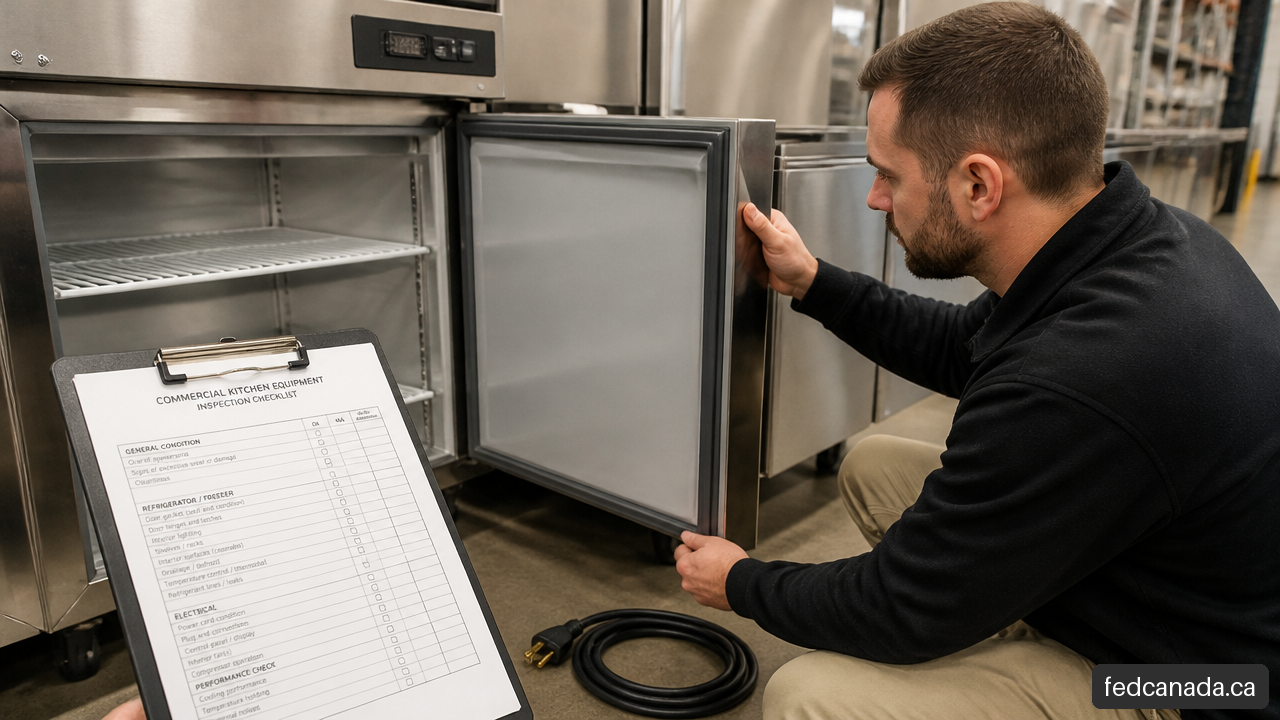
Use a Structured Inspection Before Paying
I would never inspect used food equipment as though it were only furniture. Ask to see it powered on and operating. If testing is unavailable, treat the uncertainty as part of the price decision.
A used-equipment inspection should cover:
- Identity and documentation: Confirm the model number, serial number, age if available, manuals, and any service records.
- Physical condition: Check for corrosion, cracked welds, warped doors, missing guards, sharp edges, damaged cords, and unstable legs or casters.
- Food-contact areas: Look for pits, peeling surfaces, hard-to-clean seams, damaged gaskets, and places where food debris could collect.
- Operating test: Run the motor, heating elements, refrigeration, controls, switches, timers, and lights. Listen for unusual noise and watch for erratic performance.
- Temperature or output check: For refrigeration, verify it can pull down and hold the intended temperature. For cooking equipment, check whether it heats consistently. For mixers, test more than an empty spin.
- Parts and serviceability: Confirm that common wear parts, manuals, and service options can be found before purchasing.
- Transport and installation: Measure the route from pickup point to final location. Include the cost of safe moving and any required utility work.
A used refrigerator that starts cold for five minutes is not necessarily proven reliable. A more meaningful check would involve operating it long enough to observe whether it stabilizes, whether the door seals, and whether the compressor behaves normally. If that cannot be checked, lower the amount you are willing to risk or choose a unit with clearer protection.
Compare Financing With Cash Using Total Repayment
Financing can preserve working capital for inventory, payroll, permits, or opening expenses. It does not automatically make an item cheaper. Compare the total amount repaid, payment schedule, fees, early repayment terms, and what happens if the equipment arrives late or needs service.
Use a simple break-even calculation before committing:
Estimated monthly benefit = additional monthly gross profit + labor savings + avoided outsourcing cost − added operating cost
Then compare the result with the monthly payment and the purchase’s full installed cost. Suppose a CAD 2,400 processor saves 12 labor hours per month and helps produce a menu item that earns additional gross profit. If the combined monthly benefit is only slightly above the payment, the purchase may be vulnerable to slow months or repair costs. If it replaces a reliable outsourced process at a clear, recurring cost, the payback case may be stronger.
The key is to use conservative assumptions. Count only savings or sales you can reasonably support, not the best-case scenario.
Key Takeaways
Buy for the peak hour
Budget Food Equipment should handle the busiest practical period, not merely an average day. Capacity, recovery time, and cleaning time often matter more than the lowest listed price.
Include installation in the decision
Confirm electrical, gas, ventilation, plumbing, delivery access, and required accessories before placing an order. An inexpensive unit that cannot be installed affordably is not a bargain.
Use used equipment selectively
Simple stainless steel work surfaces and storage can be lower-risk used purchases when condition is clear. Refrigeration, powered equipment, and heating equipment deserve a much more thorough operating test.
Protect your repair options
Before buying, check whether manuals, wear parts, and qualified service support are realistically available. A low-priced machine with no practical repair path can become disposable equipment.
Frequently Asked Questions
What counts as budget food equipment?
Budget food equipment is equipment that meets the operation’s real output, sanitation, utility, and reliability needs at a manageable total cost. It can be new, used, open-box, clearance, or financed. The lowest price alone does not define value.
Is used restaurant equipment worth buying?
It can be, particularly for shelving, racks, worktables, and other simpler items that can be inspected closely. Used refrigeration and powered appliances can also work, but only when operation, condition, parts availability, and installation requirements are clear enough to justify the risk.
What food equipment should a new café buy first?
Start with equipment required to store food safely, prepare the core menu, and serve customers consistently. For many cafés, that means refrigeration, shelving, prep surfaces, basic smallwares, and the main beverage or food-production equipment before specialty upgrades.
How do I compare a cheap commercial mixer with a more expensive one?
Compare bowl capacity, attachment compatibility, motor performance under your actual product load, controls, warranty terms, replacement parts, footprint, and duty cycle. A lower-cost mixer may be the better choice for light batters and limited batches, while dense dough or repeated use may justify more capacity or stronger construction.
Is household equipment acceptable for selling food commercially?
This depends on the product, workload, facility, warranty, and local requirements. Household equipment may be acceptable in limited circumstances, but it can be unsuitable for repeated production, difficult to service, or inconsistent with facility requirements. Confirm suitability before building a business process around it.
How can I inspect used food equipment before buying it?
Confirm the model, inspect food-contact surfaces and structural condition, run the unit under normal conditions, check temperatures or output, review service history when available, and confirm replacement parts can be obtained. If a seller cannot demonstrate key functions, price the unit as unverified or walk away.
How do I know whether equipment will work with my electrical service?
Compare the appliance’s voltage, wattage, amperage, plug type, and circuit requirements with the building’s available service. For gas, ventilation, plumbing, and electrical modifications, obtain guidance from qualified local professionals before buying. Do not assume a standard outlet or existing circuit is sufficient.
Recent Posts

Leave a Comment
Your email address will not be published. Required fields are marked *