



Commercial Vacuum Sealers: Chamber vs External Buying Guide
Commercial Vacuum Sealers: Chamber vs External is a purchasing decision best made around your food, production schedule, and cost per finished package. I recommend a chamber machine for frequent liquid-rich packaging and repeated batch work; an external-suction machine can remain the better choice for intermittent dry-product packaging. Neither design automatically guarantees longer shelf life or safer food.

Table of Contents
- Commercial Vacuum Sealers: Chamber vs External Mechanics
- Match the Machine to the Product
- Size for Real Production, Not Advertised Speed
- Calculate Ownership Cost and Installation Needs
- Key Takeaways
- Frequently Asked Questions
Commercial Vacuum Sealers: Chamber vs External Mechanics
How air removal changes the workflow
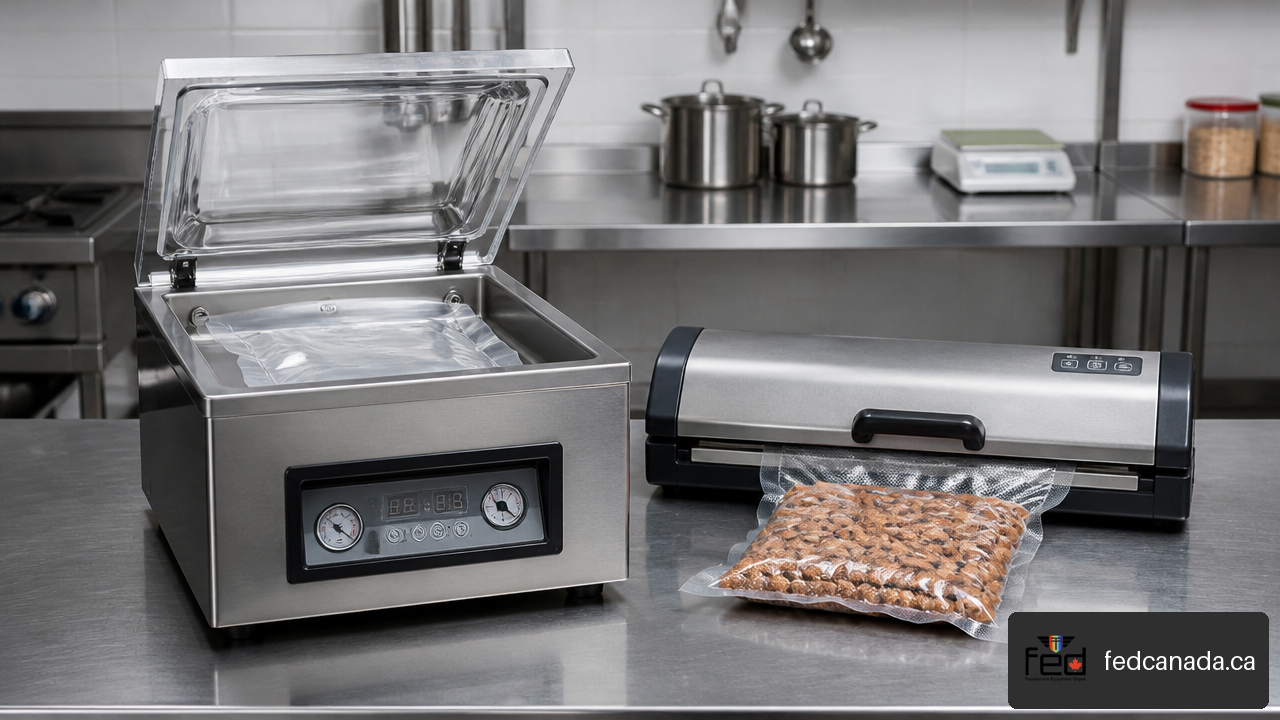
A chamber vacuum sealer holds the filled pouch inside a closed enclosure. An external-suction sealer leaves the pouch outside, with its open end positioned in the machine. As The Vacuum Sealer Expert explains, chamber machines evacuate the surrounding chamber, while external machines draw air from inside the pouch through its opening.
That difference matters with liquids. Inside a chamber, pressure falls both around the pouch and inside it, reducing the pressure difference that would otherwise pull liquid toward the opening. The machine heat-seals the pouch before restoring atmospheric pressure.
External suction draws air along the bag toward the machine. Free liquid can follow, contaminating the seal area or entering components. A moisture setting may change sealing behaviour, but it does not turn an external machine into a chamber machine.
What each design actually buys you
| Decision factor | Chamber vacuum sealer | External-suction vacuum sealer |
|---|---|---|
| Typical application | Wet foods and repeated batches | Dry foods and intermittent packaging |
| Common bag format | Smooth chamber pouches | Embossed or channelled bags |
| Package limitation | Usable chamber dimensions and seal-bar length | Bag-opening width, plus external support space |
| Installation trade-off | Generally heavier and more space-intensive | Generally easier to move and store |
| Purchase decision | Justify through product capability and operating cost | Justify through adequate performance with lower commitment |
These are category tendencies, not guarantees. Commercial external machines can outperform light-duty models substantially. Likewise, a small chamber machine is not automatically suitable for uninterrupted production.
I would compare exact models rather than treating “commercial” or “heavy duty” as a measurable specification.
Match the Machine to the Product
Use product state as the first filter
“Wet food” covers very different packaging problems. A drained steak and a pouch of thin stock should not receive the same recommendation.
| Product state | Practical starting choice | Operating condition or limitation |
|---|---|---|
| Free liquids: soup, stock, sauce | Chamber | Chill appropriately, leave headspace, and follow liquid-cycle instructions |
| High-moisture solids: fish or marinated meat | Usually chamber for repeated work | Keep liquid and food residue away from the seal zone |
| Dry solids: nuts or firm dried ingredients | Either | Check crushing risk, bag compatibility, and workload |
| Fine powders: flour or seasoning | Model-specific assessment | Air movement may carry powder into the seal area or machine |
| Hot products | Cool under an approved food-safety procedure first | Reduced pressure can cause vigorous boiling |
| Partially frozen products | Either, subject to compatibility | Ice and sharp edges may puncture film; freezing is not a safety substitute |
For a butcher packaging marinated meat throughout the day, I would generally favour a chamber machine. The relevant benefit is repeatable handling of liquid-rich portions, not simply a claim of stronger suction power.
For a business sealing occasional batches of dry ingredients, an external machine may meet the requirement without occupying permanent bench space. Confirm that the film and process suit the intended storage conditions.
Fine powders deserve a supplier demonstration. A machine that handles coarse spice blends acceptably may behave differently with flour. Ask about manufacturer-approved controls rather than improvising filters or inserts.
Understand temperature and food-safety limits
Chamber machines handle liquids better, but they cannot ignore temperature. Water boils at lower temperatures as pressure falls. Warm sauce may foam or boil during evacuation, rise toward the pouch opening, and contaminate the seal.
I recommend cooling through the operation’s approved process before packaging, then selecting settings allowed by the manufacturer. Where available, liquid-sensitive controls may help, but they do not replace temperature control.
Vacuum sealing is packaging, not sterilization. Removing air does not destroy pathogens or make perishable food shelf-stable.
Reduced-oxygen packaging can create conditions that require specific food-safety controls. Canadian operators should confirm applicable requirements with their local public-health authority, particularly when changing refrigerated shelf life or introducing cook-chill or sous-vide processes.
Do not assign a longer use-by period simply because a pouch looks tight. Storage temperature, ingredients, handling, and a validated process still determine acceptable storage life.
Size for Real Production, Not Advertised Speed
Fit the largest loaded pouch
Seal-bar length alone cannot establish chamber capacity. The product must fit inside the usable enclosure while its pouch opening lies correctly across the sealing area.
I would size a chamber with actual product samples:
- Fill the intended pouch with the largest normal portion, leaving the manufacturer’s required clean sealing margin.
- Measure the loaded pouch’s width, length, and maximum thickness.
- Check usable chamber dimensions, lid shape, seal-bar position, and any insert plates.
- Confirm whether several pouches can lie flat without overlapping seals or obstructing the lid.
- Request a packaging demonstration before committing to an expensive or difficult-to-return machine.
A deep roast may fit the chamber’s floor dimensions but interfere with a sloping lid. Conversely, a long fillet may suit an external machine because the bag remains outside—provided the opening fits the seal bar and the product has adequate support.
Check bag dimensions carefully. Suppliers may describe overall pouch size differently from usable internal capacity.
Measure sustainable packages per hour
Published output figures are useful only as starting points. KBT Packing’s comparison lists approximately 100–600 packs per hour for chamber systems and 20–120 for external systems; these are vendor-reported category ranges, not a universal performance standard.
A practical calculation is:
Packages per hour = 3,600 ÷ complete cycle seconds × packages per cycle
For example, an assumed 60-second cycle with two pouches produces a theoretical 120 packages per hour. That figure falls if the operator must also weigh portions, wipe openings, label packages, or stop for cooling.
Ask the supplier to separate:
Evacuation, sealing, cooling, and chamber-venting time.
Loading and unloading time under your proposed staffing arrangement.
Maximum continuous operating period and mandatory recovery breaks.
Output using your product, pouch size, and target vacuum settings.
Duty cycle and vacuum depth are different specifications. A machine may reach a low pressure but be unable to repeat that performance continuously. If a single chamber cannot meet peak demand, investigate larger or multiple-chamber equipment rather than assuming faster settings will solve the bottleneck.
Compare vacuum specifications on the same basis
“99% vacuum” and “powerful suction” are incomplete purchasing specifications. Ask whether pressure is expressed as absolute pressure or as a gauge reading relative to the surrounding atmosphere.
Absolute pressure is measured relative to a perfect vacuum; lower values indicate lower remaining pressure. Gauge readings use ambient pressure as their reference, so the basis matters—especially when comparing specifications for installations at different elevations.
For a useful demonstration, request the same:
Product temperature and portion size.
Pouch material and dimensions.
Target pressure and measurement location.
Cycle endpoint and permitted operating time.
A pump’s ultimate vacuum specification is not necessarily the pressure reached in a loaded production cycle. For fragile products, deeper evacuation may also cause crushing. Adjustable vacuum or pulse control can matter more than the lowest advertised pressure.

Calculate Ownership Cost and Installation Needs
Calculate cost per acceptable package
Machine price is only the entry cost. I recommend comparing cost per acceptable package, excluding rejected or leaking packs from the finished count:
Cost per package = (allocated equipment cost + bags + labour + maintenance + energy + packaging-related losses) ÷ acceptable packages
Use the same analysis period and expected production volume for both machines. Keep estimates conservative; do not credit speculative shelf-life extensions as guaranteed savings.
Consider this illustrative calculation in Canadian dollars, not a supplier quotation:
| Assumption | External machine | Chamber machine |
|---|---|---|
| Comparable pouch cost | C$0.18 | C$0.08 |
| Additional chamber purchase cost | — | C$3,000 |
| Pouch savings per package | — | C$0.10 |
| Packages needed to recover premium from bags alone | — | 30,000 |
At an assumed 1,000 packages monthly, bag savings alone would recover that premium in 30 months. At 5,000 monthly, the calculation becomes six months. Neither estimate includes labour, financing, repairs, or differences in packaging failures.
Smooth chamber pouches are often less expensive than embossed bags, but compare equivalent dimensions and film performance. A cheaper pouch is not a saving if it punctures around bones or fails under the intended heating conditions.
Treat pouch film and seal quality separately
Machine architecture does not determine the entire package’s durability. Ask the pouch supplier to confirm:
Compatibility with the exact sealing system.
Food-contact suitability and intended temperature range.
Puncture resistance for bones, corners, or frozen products.
Oxygen and water-vapour barrier performance for the storage application.
Film thickness alone does not describe barrier performance. For freezer storage, moisture transfer and puncture resistance matter alongside air removal. For sous-vide use, obtain explicit confirmation that the pouch suits the proposed cooking conditions.
Seal failures also need diagnosis, not an automatic increase in vacuum:
- Inspect the sealing margin for wrinkles, grease, liquid, or powder.
- Confirm the pouch lies flat and is not overfilled.
- Check the seal bar, protective cover, gasket, and permitted settings.
- Adjust sealing time or temperature only within manufacturer guidance.
- Inspect cooled seals and isolate suspect packages under the operation’s food-safety procedure.
Insufficient sealing energy may leave weak bonds; excessive energy can distort or damage film. Follow model-specific settings rather than copying another machine’s cycle.
Check power, upkeep, and service before ordering
Some tabletop machines use 120 V service; larger equipment may need 208–240 V or three-phase power. The nameplate and installation manual control the decision, not the product category. Have a qualified electrician verify compatibility where necessary.
Before purchase, confirm:
Voltage, phase, frequency, amperage, plug, and circuit requirements.
Machine weight, bench capacity, lid-opening clearance, and ventilation space.
Cleaning access and separation between raw and ready-to-eat workflows.
Noise expectations, delivery access, and any model-specific drainage needs.
Warranty coverage, local service options, and replacement-part availability in Canada.
Maintenance depends on pump design. Oil-lubricated chamber pumps generally require oil checks and changes according to their manuals. Oil-free pumps avoid that task, but not all maintenance. Both designs can require replacement gaskets, sealing elements, and protective seal-bar covers.
For used, open-box, or scratch-and-dent equipment, establish whether the condition is cosmetic or functional. Request a sealing demonstration and available service records. A lower purchase price may be reasonable; an unknown pump condition needs a repair allowance.
Key Takeaways
Make the choice around the limiting requirement
My recommendation for Commercial Vacuum Sealers: Chamber vs External starts with the requirement that cannot be compromised:
Choose chamber when free liquids, frequent marinated products, or repeated batches define the workload. Avoid buying an undersized chamber merely to meet a budget.
Choose external when products are predominantly dry, packaging is intermittent, and compact storage matters. Avoid relying on moisture settings to manage free liquid.
Validate capacity with loaded pouches and a realistic production trial. Do not buy on pump size or advertised vacuum percentage alone.
Compare ownership costs using equivalent film, realistic labour, and acceptable packages. Keep food-safety and shelf-life assumptions separate from the sales calculation.
If two machines both meet the product requirement, the better purchase is usually the one with the lower supported operating cost and service burden—not necessarily the larger machine.
Sources/References
Frequently Asked Questions
Food and bag compatibility
Can an external vacuum sealer package soup or sauce?
I would not use a standard external-suction machine for unfrozen free liquid unless its manufacturer explicitly permits that application. Liquid can enter the sealing area or machine. Freezing portions first may be an approved workaround for some models, but it adds handling time and does not establish food safety.
Can smooth bags be used in an external vacuum sealer?
Usually not in a conventional edge-suction model that requires embossed channels. Those channels keep an air path open during evacuation. Some specialized external systems use different arrangements, so follow the exact machine’s compatibility instructions rather than assuming all external sealers accept the same bags.
Can embossed bags be used in a chamber sealer?
Some chamber machines can seal compatible embossed bags, but manufacturer approval and correct sealing settings still matter. There may be little financial reason to use them when suitable smooth pouches cost less. Confirm the bag’s material, temperature rating, and sealing requirements before purchasing a large quantity.
Buying and troubleshooting
Is a chamber vacuum sealer worth it for a small restaurant?
It can be, particularly if sauces, stocks, or marinated portions are routine. I would compare monthly package volume, labour, pouch savings, and available space. A restaurant producing only occasional dry packs may receive little benefit from the extra investment, even if the chamber machine has greater theoretical capacity.
Why are vacuum pouches leaking after sealing?
Possible causes include contaminated or wrinkled openings, incompatible film, incorrect sealing settings, worn components, or punctures during handling. Check whether failure occurs along the seal or elsewhere in the pouch. That distinction helps separate a sealing problem from inadequate film protection around bones or sharp product edges.
What products should never be vacuum sealed?
There is no reliable universal list independent of temperature, storage time, and processing conditions. I would not vacuum-package any food for an intended storage method lacking appropriate safety controls. Be especially cautious about extending refrigerated life or holding perishable food at room temperature; sealing does not make either practice safe.
Recent Posts

Leave a Comment
Your email address will not be published. Required fields are marked *