





Probe Thermometers: Calibration and Use Made Reliable
Reliable food temperature checks start with a simple principle: a temperature reading is only useful when the instrument, the probe placement, and the measurement method are all reliable. Whether we are checking a roast, cooling soup, monitoring a refrigerator, or verifying a hot holding pan, the displayed number can be misleading if the thermometer is out of calibration or the sensing area is in the wrong place.
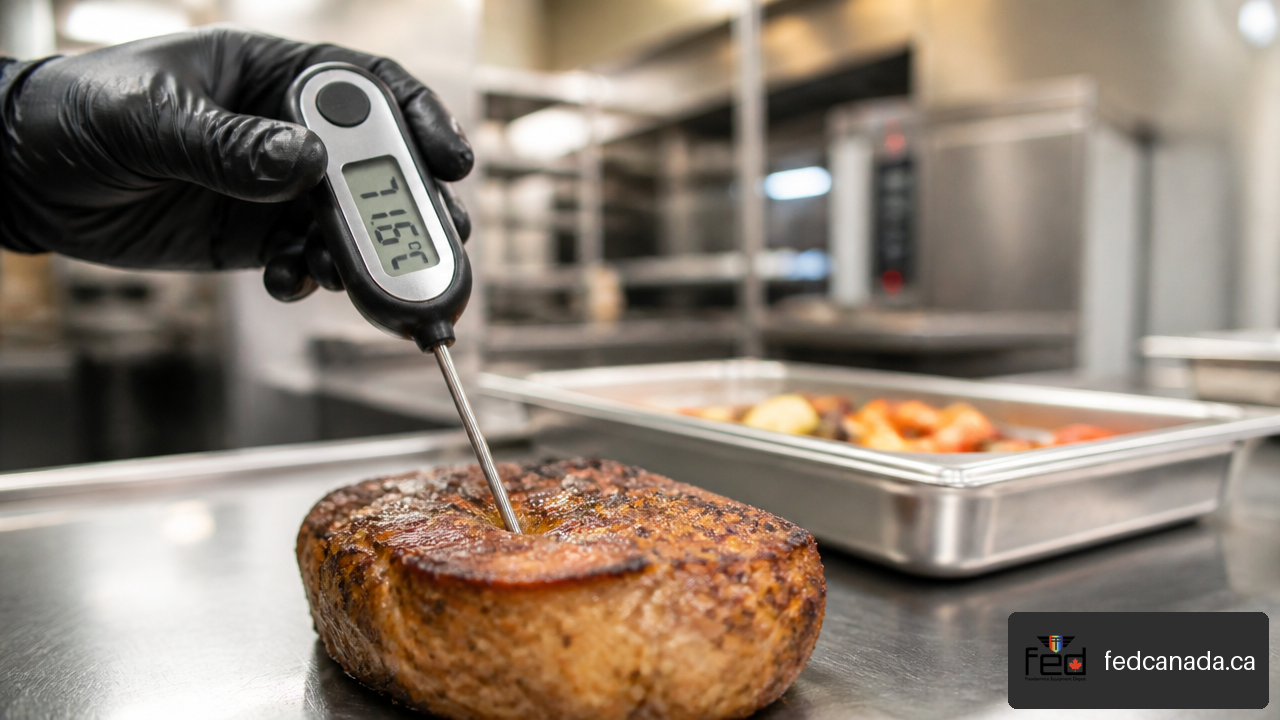
Table of Contents
- Key Takeaways
- How Probe Thermometers Work
- How to Calibrate a Probe Thermometer
- Using a Probe Thermometer Correctly
- Troubleshooting Unreliable Readings
- Frequently Asked Questions
Key Takeaways
Calibration verifies the instrument, not the food
Calibration compares a probe thermometer against a known reference temperature. It tells us whether the thermometer has a calibration offset: the difference between the displayed temperature and the reference temperature.
That distinction matters. A thermometer that reads accurately does not automatically mean food is safe, cooked, chilled, or held at the required temperature. Food-temperature compliance still depends on where and when the probe is inserted, the required temperature for the food or process, and whether the reading has stabilized.
Reliable readings depend on three conditions
For day-to-day foodservice use, reliable measurement depends on the following:
An accurate thermometer that has passed a calibration check or has been adjusted correctly.
Correct probe placement in the food’s coldest, thickest, or otherwise relevant area.
Enough time for stabilization, so the sensing area can approach the actual temperature of the product.
A probe thermometer can be correctly calibrated and still give the wrong answer if the sensing area is too shallow, pressed against a hot pan, or removed before the display stabilizes.
How Probe Thermometers Work
What a probe thermometer measures
A probe thermometer measures the temperature at its sensing area, not the entire food item or container. In many commercial food thermometers, the sensing area is close to the tip, but its exact location and required immersion depth depend on the instrument design.
Digital probe thermometers commonly use a thermistor or thermocouple sensor. A thermistor changes electrical resistance as temperature changes. A thermocouple produces a small electrical signal when two different metals experience a temperature difference. The thermometer converts that signal into a temperature on the digital display.
This process is fast, but it is not instantaneous. The metal probe must exchange heat with the food, liquid, or reference bath before it reaches thermal equilibrium. If the probe enters hot soup for only a second, the display may still reflect the probe’s previous temperature rather than the soup’s actual temperature.
Common thermometer types and their best uses
Different thermometer designs suit different tasks. The right choice depends on the temperature range, product thickness, response time, and whether direct food contact is needed.
| Thermometer type | Best use | Main limitation |
|---|---|---|
| Digital instant-read probe | Spot checks in cooked foods, sauces, chilled products, and receiving | May not be suitable for continuous monitoring or very thin foods |
| Dial stem thermometer | General food checks where a rugged mechanical instrument is preferred | Often needs deeper immersion and may respond more slowly |
| Thermocouple thermometer | Fast checks across a broad temperature range, often with interchangeable probes | Requires compatible probes and careful handling of connections |
| Leave-in probe thermometer | Roasting, baking, smoking, and continuous cook monitoring | Not ideal for rapid checks across many separate foods |
| Infrared thermometer | Surface temperature screening of pans, equipment, and packaged products | Cannot measure the internal temperature of food |
An infrared thermometer and a probe thermometer are not interchangeable. Infrared units measure surface temperature only. A roast can have a hot exterior while its centre remains undercooked. For internal food temperatures, a clean probe thermometer is the appropriate tool.
Choosing the best reference point for calibration
The ice-point method is usually the most practical check for routine food thermometers because it tests the lower part of the temperature range relevant to refrigeration, cold holding, receiving, and cooled food. It is also safer and easier to prepare than boiling water.
Boiling-point calibration is useful when a thermometer will regularly measure high-temperature food or cooking processes. For example, a probe used to verify fryer oil, stock, or hot holding equipment may benefit from a high-temperature verification in addition to an ice-point check.
The key is to match the reference bath to the decision we need to make. A thermometer used mainly for refrigerated food should not be judged only at boiling temperature. Likewise, an instrument used near high cooking temperatures should not be assumed accurate across its full range because it passed one low-temperature test.
How to Calibrate a Probe Thermometer
Start with a repeatability check
Before adjusting a thermometer, repeat the calibration check three times under the same conditions. This separates a consistent calibration offset from random variation caused by poor placement, incomplete immersion, a weak battery, or a changing reference bath.
Food safety guidance commonly recommends performing the verification three times and comparing the recorded readings. If the thermometer reads 1°C (about 2°F) high on each check, that suggests a repeatable offset. If it reads 0°C, then 3°C, then 1°C in the same reference bath, adjustment may not solve the real problem.
Record each result before changing anything. Once a dial or digital setting is adjusted, the original pattern is lost.
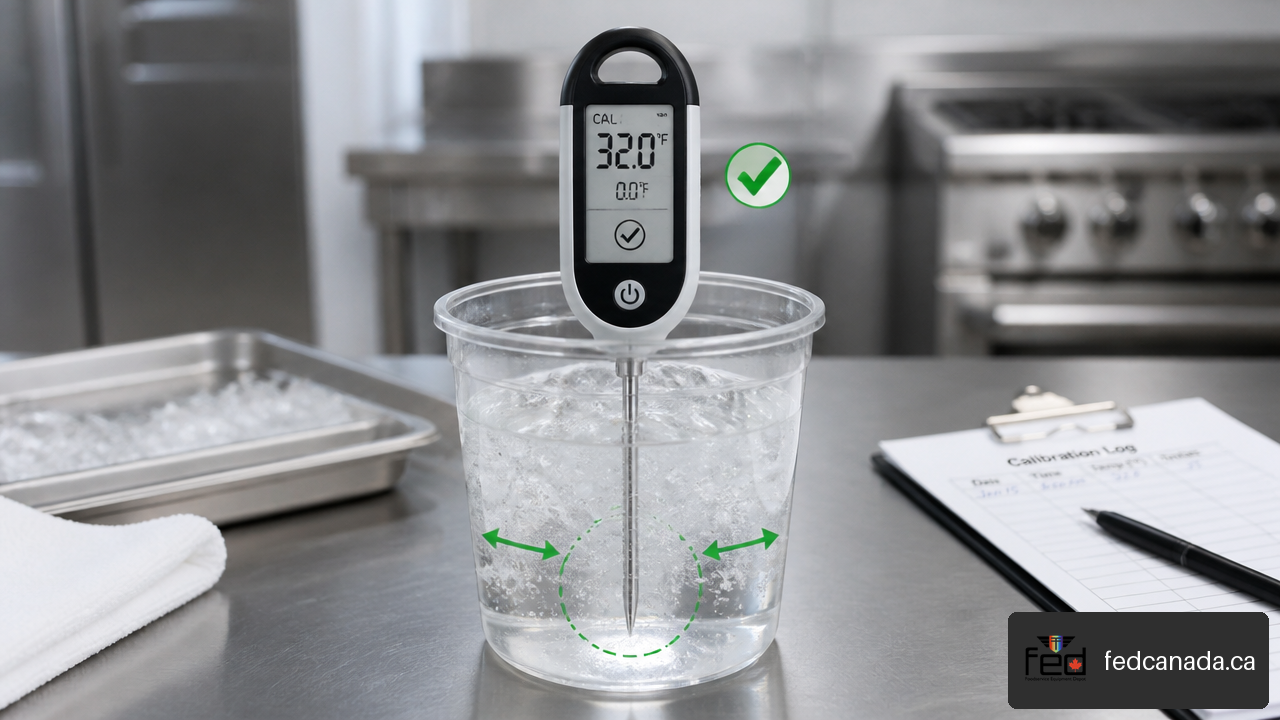
Calibrate with an ice-water slurry
An ice-water slurry should be close to 0°C or 32°F when prepared properly. It is more reliable than a glass containing only cold water and a few floating ice cubes because the mixture must contain both ice and water around the sensing area.
Use this procedure:
Fill a clean insulated cup or container with crushed ice.
Add clean water until the spaces between the ice are filled. The mixture should be slushy, not mostly water.
Stir gently to make the temperature more uniform through the reference bath.
Insert the probe into the centre of the slurry, keeping the sensing area away from the sides and bottom.
Keep the probe immersed while waiting for the display to stabilize.
Record the observed temperature, then repeat the check twice more.
The USDA Food Safety and Inspection Service thermometer instructions describe using an ice-water mixture, immersing the probe at least 2 inches (about 5 cm) without touching the container, and allowing at least 30 seconds before checking the reading.
Placement is not a minor detail. The sides and bottom of a container can be warmer or colder than the slurry itself. A probe pressed against the container may measure the container rather than the reference bath.
Use boiling water only with the correct target
At sea level, pure water boils at approximately 100°C or 212°F. But that is not a universal target. Water boils at lower temperatures at higher elevations because atmospheric pressure is lower.
For that reason, do not force a high-altitude boiling-water result to 100°C simply because that is the familiar reference point. Determine the expected local boiling temperature, then compare the thermometer with that local target. A restaurant in a mountain community may see a correct boiling point that is several degrees below 100°C.
Use boiling water carefully:
Bring clean water to a rolling boil.
Keep hands, cables, and the thermometer body away from steam and hot metal.
Insert the sensing area sufficiently into the water without touching the pot.
Wait for a stable reading while the probe remains immersed.
Compare the display with the locally expected boiling temperature.
Adjust or replace the thermometer
Many dial thermometers have a calibration nut behind the dial. If the instrument is designed for adjustment, hold the probe in the reference bath and carefully turn the nut until the display matches the reference temperature.
Some digital thermometers have a reset, calibration, or offset function. Others are sealed and cannot be adjusted by the user. In those cases, the practical choices may be to apply a documented correction factor, return the unit for service where available, or replace it.
Avoid forcing an adjustment on a device that is not designed for it. A loose stem, cracked display, bent probe, damaged cable, corrosion, or moisture inside the unit can indicate physical failure rather than a simple calibration offset.
Improve reference-bath consistency
A reference bath should surround the sensing area with a stable, uniform temperature. That is why centred probe placement and gentle stirring of an ice bath matter: both improve temperature uniformity around the sensor.
For a practical example, consider two checks in the same cup. One probe rests against the glass near the surface, while the other is centred in a well-mixed ice slurry. The two readings may differ even when both thermometers are accurate. The difference is not necessarily an instrument problem. It may be a reference-bath and placement problem.
Using a Probe Thermometer Correctly
Insert the probe where the decision is made
A temperature reading should answer a specific question. Are we confirming that poultry reached its required internal temperature? Checking whether a soup cooled sufficiently? Verifying cold storage? The probe position should match that question.
For thick foods such as roasts, burgers, casseroles, and poultry pieces, insert the probe into the thickest portion. Avoid bone, large pockets of fat, the pan, and the surface. Bone and metal conduct heat differently from surrounding food and can create false high or low readings.
For thin foods such as patties, fillets, or folded eggs, insertion angle matters. Insert from the side so the sensing area sits in the centre of the food rather than passing through it. A probe tip that emerges from the opposite side may partly measure surrounding air.
For soups, sauces, gravies, and hot holding pans, stir first where practical. Then measure in several locations, especially if the product is deep, thick, or held in a large vessel. One reading near a heated wall does not represent the entire batch.
Wait for stabilization, then verify the result
A stable reading means the display has stopped changing materially. The required time varies by thermometer type, probe diameter, food density, and temperature difference between the probe and product.
Rather than relying on a fixed number of seconds for every food, watch the display. A thin thermocouple probe in hot liquid may stabilize quickly. A thicker probe inserted into a dense frozen product may take longer. Removing the probe early can create a reading that looks precise but has not reached thermal equilibrium.
When a reading is close to a critical limit, take a second measurement in a nearby location. This is especially useful for large batches, mixed foods, or products with uneven heating. The second check is not redundancy for its own sake. It helps distinguish a local hot or cold spot from the product’s overall condition.
Clean and sanitize between uses
Probe hygiene supports both food safety and measurement quality. Food residue can insulate the sensing area, slow response time, and transfer allergens or microorganisms between products.
A practical workflow is:
Wash visible residue from the probe with warm water and detergent, following the manufacturer’s cleaning instructions.
Rinse if required by the cleaning product.
Sanitize the probe using an approved food-contact sanitizing method.
Allow it to air dry or use a clean single-use towel.
Store the thermometer where the probe will not contact dirty surfaces or be bent.
Do not immerse the entire unit unless it is rated for that level of water exposure. The probe may be washable while the display housing, battery compartment, or cable connection is not.
Troubleshooting Unreliable Readings
Separate calibration error from use error
An inaccurate result can come from the instrument, but it can also come from the measurement method. Before assuming the thermometer is defective, review the conditions.
| Symptom | Likely cause | Practical response |
|---|---|---|
| Reading changes widely in the same reference bath | Poor immersion, probe contact with container, weak battery, unstable bath | Rebuild the bath, centre the probe, repeat three checks, inspect battery |
| Reading is consistently high or low | Calibration offset | Check whether the thermometer can be adjusted or document the offset if appropriate |
| Reading is slow to settle | Thick probe, dense food, residue on probe, cold probe entering hot food | Clean the probe and allow more time for stabilization |
| Reading is implausibly high near cookware | Probe touching pan, tray, bone, or heating surface | Reposition the sensing area into the food or liquid |
| Display flickers or resets | Battery, moisture, damaged electronics, loose connection | Replace battery if appropriate; remove from service if the fault continues |
A thermometer that reads 0°C in an ice slurry but reports 85°C (185°F) when touching a hot pan is not necessarily inaccurate. It may be measuring the pan correctly. The issue is that the pan temperature does not answer the food-temperature question.
Know when to remove a thermometer from service
Remove a probe thermometer from use when it cannot produce repeatable readings, has visible damage, has a cracked or loose probe, allows moisture into the display, or cannot be adjusted despite a consistent unacceptable offset.
There is no single universal tolerance or replacement rule that fits every foodservice, consumer, laboratory, and industrial thermometer. Follow the manufacturer’s specifications and any applicable local food-safety requirements. When those instructions are unavailable, a conservative decision is sensible: if the instrument cannot be verified against a reference bath and the reading affects a food-safety decision, use another verified thermometer.
Keep a short calibration record
A calibration record turns a one-time check into an operational control. It also makes recurring problems easier to spot.
Include these details:
Date and time of the check.
Thermometer identification, model, or asset number.
Reference method used, such as ice-point or boiling-point.
Expected reference temperature and observed readings.
Repeatability results from all three checks.
Adjustment made, correction factor used, or removal-from-service action.
Initials or name of the person completing the check.
For example, if one thermometer consistently reads 1°C high in an ice slurry for several weeks, the record shows a stable offset. If the next check suddenly varies by 4°C (about 7°F), that change points to a new issue such as damage, battery failure, or improper technique.
Canadian food safety context
In Canada, food premises rules are set provincially. In Alberta, for example, the Food Retail and Foodservices Code expects operators to monitor food temperatures with accurate thermometers, and inspectors often ask to see a working, verified probe thermometer during an inspection. Health Canada publishes safe internal cooking temperatures for common foods, and your local public health inspector can confirm which records your operation should keep. Thermometers used in a commercial kitchen should also be designed for food contact, with NSF-certified models a common choice.
Frequently Asked Questions
What is a probe thermometer used for?
A probe thermometer measures the internal temperature of food, liquids, equipment contents, or reference baths. It is used for cooking checks, cold holding, cooling, reheating, receiving, and equipment verification. Unlike an infrared thermometer, it can measure below the surface when the probe is inserted correctly.
How often should we calibrate a food probe thermometer?
There is no universal schedule that applies to every thermometer and operation. A sensible approach is to verify calibration on a routine schedule and whenever the thermometer is dropped, exposed to extreme temperatures, gives an implausible reading, has a battery change, or is used for a critical food-safety decision. Higher-use operations generally benefit from more frequent checks than occasional home use.
Should the probe touch the bottom or sides of the container?
No. During calibration, keep the sensing area away from the container bottom and sides. Contact with the container can distort the reading because the probe may measure the container material rather than the ice slurry or boiling water.
Can we calibrate a digital probe thermometer?
Some digital models include a reset or calibration function; others do not. First perform a repeatable calibration check. If the thermometer has an approved adjustment feature, follow its instructions. If it cannot be adjusted, document the offset only if that is permitted by your procedure and the offset is stable; otherwise, replace or service the instrument.
Is boiling-water calibration accurate at high altitude?
It can be accurate when the expected boiling point is adjusted for local altitude. Water does not always boil at 100°C. At higher elevations, the boiling point is lower, so a reading below 100°C may be correct rather than evidence of thermometer error.
Which calibration method is better: ice water or boiling water?
Ice-water calibration is usually the better routine choice for food probes used around refrigeration and cold food. Boiling water is useful for checking performance at higher temperatures. Where possible, choose the reference point closest to the temperature range that matters most for the thermometer’s intended use.
Why does my probe thermometer give different readings each time?
Different readings may result from insufficient immersion, contact with the container, a poorly mixed ice bath, premature reading, a weak battery, probe damage, or inconsistent placement in food. Repeat the check three times in a stable reference bath before deciding that the instrument itself is inaccurate.
Is a household kitchen thermometer good enough for a restaurant?
Usually not. Household thermometers are built for occasional use and may be slower, less durable and harder to sanitize. A commercial kitchen needs a thermometer that stands up to constant use, cleaning and sanitizing between products, gives fast and repeatable readings, and can be verified on a schedule. Commercial food thermometers are typically NSF certified, and many have a calibration or reset function, which makes daily checks and inspection records much easier.
Equip Your Kitchen with FED
Accurate temperatures start with equipment that holds them. Call or visit FED to talk through refrigeration, hot holding and cooking equipment for your kitchen. New equipment is listed in our online catalogue with pricing, and used and clearance units are available for pickup at our Calgary warehouse. See what is in stock on our clearance page.
Recent Posts

Leave a Comment
Your email address will not be published. Required fields are marked *