




Vulcan Commercial Ranges: Settings, Troubleshooting and Buying Guide
This guide to Vulcan commercial ranges starts with one practical rule: identify the exact model before adjusting settings, ordering parts, or diagnosing a fault. Vulcan range families, burner systems, oven controls, fuel types, and installation requirements can differ significantly. A setting that is correct for one gas range may be wrong for another configuration.
Table of Contents
- Key Takeaways
- Set Up and Operate a Vulcan Range Correctly
- Troubleshoot Vulcan Range Problems Safely
- Choose the Right Vulcan Commercial Range
- Frequently Asked Questions
Key Takeaways
What to remember before changing a setting or buying a range
Confirm the model and fuel type first. The data plate and model specific installation manual control the correct ignition procedure, thermostat range, electrical needs, gas requirements, and clearances.
Use burner output and simultaneous demand together. Burner count alone does not show the actual gas load a kitchen may place on its utility service during peak production.
Treat oven controls as model dependent. Vulcan documentation shows that some thermostat arrangements cover about 200°F (93°C) to 550°F (288°C), while others cover about 250°F (121°C) to 500°F (260°C).
Start troubleshooting with external checks. Verify fuel supply, control positions, pilot status, and visible burner condition before assuming an internal component has failed.
Match the top to the menu workflow. Open burners, griddles, French plates, charbroilers, and oven bases solve different production problems. A mixed top can reduce bottlenecks when the menu has competing tasks.
Fair warning: Do not bypass safety devices, alter regulators, disassemble gas controls, or attempt internal gas repairs unless the applicable Vulcan manual explicitly authorizes the work and qualified service is available.
Set Up and Operate a Vulcan Range Correctly
Start with model identification and installation checks
Before operating a range, We recommend locating the equipment data plate and recording the model number, serial number, fuel designation, and electrical information where applicable. This simple step prevents a common mistake: using a generic instruction sheet for a different Vulcan family or oven base.
Confirm these points before the first service and whenever a range is moved:
The range fuel matches the installed utility: natural gas, propane, or electric.
The appliance is level. A range that is not level can affect pan stability, grease movement, and the consistency of griddle cooking.
The hood captures the full cooking surface and is operating when required by the local installation plan.
The oven door closes correctly and racks fit the intended pan orientation.
The required utility shutoff and accessible service area remain available.
A representative Vulcan 36 inch Endurance six burner range is offered in natural gas or propane with a standard oven base. Its published specifications list six 30,000 BTU/hr burners and 215,000 BTU/hr total input. See the published specifications for Vulcan’s 36 inch six burner Endurance range for the exact dimensions, fuel options, oven base, burner input, and ignition arrangement for that model.
That example shows why total load matters. Six burners at 30,000 BTU/hr create 180,000 BTU/hr of top heat input before considering the oven. During a quiet prep period, only one or two burners may be active. During a rush, several burners and the oven can call for heat at once. The installation must support the range’s listed total input, not merely the average workload.
Light pilots and burners in the proper sequence
Gas ignition systems vary by model. Some configurations use pilots and manual rotary piezo ignition, while other models may use different arrangements. Follow the exact procedure in the manual supplied for the installed range.
For a documented Vulcan gas range procedure, the basic operating sequence is:
Open the gas supply only after confirming there is no gas odour.
Set the burner control fully to the ignition position or fully on position specified for the model.
Activate the applicable igniter and confirm the burner lights.
Reduce the control to the desired cooking setting after ignition.
Vulcan’s installation and operation manual for supported range configurations specifies turning the burner fully on for ignition, then reducing it to the desired setting after it lights. This matters because some burner valves and ignition arrangements require the full on position to establish the main flame correctly.
Do not repeatedly cycle a control if ignition does not occur. Turn the control off, follow the manual’s waiting instructions, ventilate as appropriate, and investigate the cause rather than allowing unburned gas to accumulate.
Set oven temperature by control type, not assumption
The thermostat dial controls the oven’s target temperature, but the scale and direction can vary. On some Vulcan equipment, increasing temperature may involve turning the control in one direction; on another configuration, the dial layout can differ. The control markings and the model specific manual are the authority.
Vulcan documentation includes thermostat examples with ranges of approximately 200°F (93°C) to 550°F (288°C) and approximately 250°F (121°C) to 500°F (260°C). That difference is not trivial. A baker expecting a 550°F (288°C) setting from a 500°F (260°C) control may keep turning a dial beyond its intended range or assume the oven has failed.
Use this operating method:
Preheat to the recipe temperature with the door closed.
Allow the oven to cycle normally rather than judging temperature only by the first burner ignition.
Load pans with space for air movement, especially in a convection oven base.
Check product results across several cycles before concluding that calibration is off.
If food consistently undercooks or overcooks, compare the oven’s actual performance with the method allowed in the model manual, then arrange qualified service if needed.
A convection base is generally better suited to operations that need more consistent airflow around multiple pans. A standard oven can be a sensible fit for roasting, holding, braising, or lower volume baking where forced air is not essential. The best choice depends on how the oven supports the line, not simply on which option sounds more advanced.
Troubleshoot Vulcan Range Problems Safely
When a burner will not ignite or stay lit
Start with the easiest external causes. A burner that does not light can be related to the gas supply, an incorrectly positioned control, a pilot issue, an ignition issue, or a blocked or improperly seated burner component. It is not safe to assume that a failed burner always means a failed valve.
Use this operator level sequence:
Turn the burner control off and confirm the main gas supply is on.
Check whether other burners are operating. If none work, the issue may be upstream of a single burner.
Confirm that the appropriate pilot is lit if the model uses pilots.
Make sure removable burner heads, grates, and caps are seated correctly after cleaning.
Follow the manual’s ignition sequence once more.
Stop if there is a gas odour, delayed ignition, repeated flame failure, or any uncertainty about the safety system.
A burner that lights briefly and then goes out may involve a flame safety function, pilot condition, or another control related condition. There is no universal Vulcan repair rule for this symptom because designs differ by model. Avoid improvised fixes. Record the model number, which burner is affected, whether the oven works, and exactly what happens after the control is turned. That information gives a service technician a much clearer starting point.
When the oven does not reach the set temperature
An oven that seems cold is not always failing to heat. The problem can be caused by a control setting, a door left ajar, a recently loaded cold product, blocked airflow, a thermostat issue, or an oven burner and ignition condition.
Work through the symptom in order:
| What you notice | Safe first check | What it may indicate |
|---|---|---|
| Oven does not appear to heat at all | Confirm gas or electrical supply and correct control setting | Utility, ignition, or control issue |
| Oven heats slowly after loading | Reduce excessive cold load and keep door closed | Normal recovery limitation or workflow issue |
| Food cooks unevenly | Check pan placement, rack position, and airflow | Loading pattern, convection airflow, or temperature concern |
| Oven cycles but product remains inconsistent | Verify recipe method and compare results over several cycles | Possible calibration or heat distribution issue |
For example, loading several cold sheet pans into a preheated oven can create a sharp temperature drop. The oven may be operating normally but require recovery time. By contrast, an oven that never reaches a moderate setpoint with an empty cavity and closed door deserves service attention after basic utility and control checks.
Do not use a generic thermostat adjustment procedure from another range. Internal calibration methods and allowable tolerances are model specific.
When flames look weak, uneven, or abnormal
A weak or uneven burner flame can result from a partially obstructed burner component, improper reassembly after cleaning, fuel supply conditions, or a model specific adjustment issue. It is tempting to diagnose flame condition by colour alone, but the available manufacturer material does not establish one universal flame colour rule for every Vulcan range.
Safe external checks include:
Make sure burner heads and removable components are clean, dry, and fully seated.
Remove food debris only after the equipment is cool and the fuel control is off.
Compare the affected burner with other burners of the same type.
Check whether the symptom began after cleaning, moving the unit, changing fuel supply, or servicing the hood.
Stop using the affected section if flames lift, go out unexpectedly, produce delayed ignition, or behave differently from normal operation.
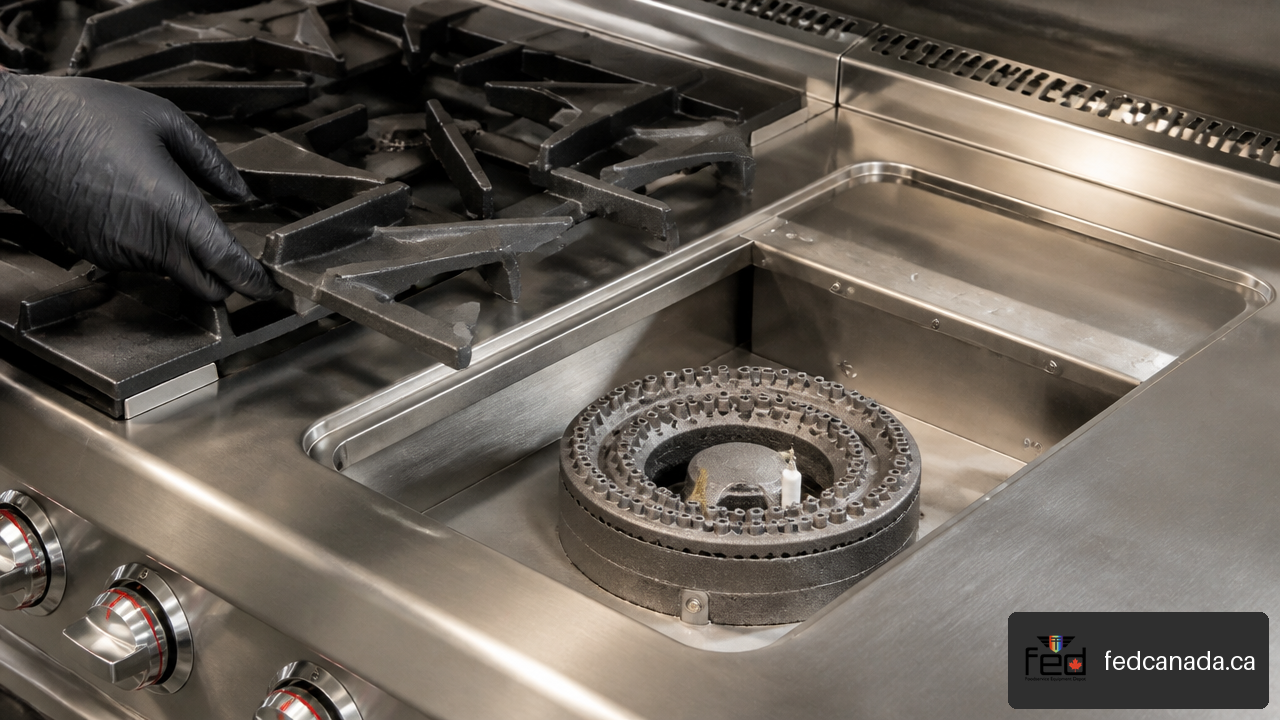
Maintenance helps prevent basic performance issues, but it is not a substitute for authorized service. Daily wiping, proper grate cleaning, and keeping burner areas free of spill buildup support ignition and heat transfer. Any adjustment involving gas pressure, regulators, pilots, valves, or internal controls should follow the applicable documentation and qualified service process.
Choose the Right Vulcan Commercial Range
Select the duty level using your real peak workload
The useful question is not only, “How many burners do We need?” Ask, “What must be cooking at the same time during the busiest 15 minutes of service?” A range selected for a quiet average can become a constraint when sauté, stock, finishing sauces, and oven work overlap.
Vulcan positions its range families differently. The Vulcan commercial range family comparison identifies V Series as the heavy duty option for continuous high volume work with 35,000 BTU/hr burners, Endurance as a busy kitchen and smaller operation option with 30,000 BTU/hr burners, and SX as the lightest duty, more economical family with 28,000 BTU/hr burners.
| Operating pattern | Likely fit | Why it fits | When to reconsider |
|---|---|---|---|
| Continuous high volume sauté, boiling, and finishing | V Series heavy duty | Higher burner output and continuous use positioning | Reconsider if utility capacity, hood coverage, or budget cannot support the specification |
| Regular restaurant service with varied line cooking | Endurance | Balanced burner output and restaurant oriented configuration | Reconsider if the line routinely runs every burner and oven at full demand for long periods |
| Infrequent or moderate production | SX | Lower duty and lower entry cost positioning | Reconsider if growth plans will quickly increase peak production |
We would avoid choosing solely on initial price. A lighter duty range may be appropriate for a small café with intermittent cooking, but it can create delays if the menu shifts toward high volume pan searing and sauce work. Conversely, a heavy duty model may be more capacity than a limited menu operation needs.
At FED, we stock both new and restored Vulcan ranges. On the lighter duty side, we regularly carry restored SX units such as the Vulcan SX36 6 burner range (natural gas), the SX36 6 burner propane range with standard oven and the SX60F 60 inch range with a 24 inch griddle. For heavier, mixed top production, the restored Vulcan VC0136-500 custom range combines burners, griddle, hot plate, charbroiler and a double oven. For electric kitchens, we carry the new Vulcan EV36S-6FP 36 inch electric range with French plates and the Vulcan EV12-2FP 12 inch electric hot plate range. Restored stock changes quickly, so check availability before planning around a specific unit.
Choose the top configuration around line workflow
Burners are flexible, but flexibility is not always the fastest workflow. A cook who must prepare eggs, pancakes, burgers, pasta, sauces, and grilled proteins on one generic open burner top will constantly exchange pans and wait for space.
Vulcan’s range selection guidance by menu and configuration identifies open burners, French plates, griddles, planchas, charbroilers, and worktops as configuration options, alongside fuel and oven decisions.
| Cooking task | Best starting configuration | Practical tradeoff |
|---|---|---|
| Sautéing, sauce work, boiling, simmering | Open burners | Flexible for many pan sizes but less efficient for repetitive flat top items |
| Eggs, pancakes, burgers, breakfast production | Griddle or plancha | Fast repeatable surface cooking but less adaptable for pots and pans |
| Gentle or broad heat for certain cookware | French plate | Broader heat zone but less direct burner control |
| Direct grilling and searing | Charbroiler | Adds a specific cooking function but requires hood planning and cleaning discipline |
| Assembly or plating space | Worktop section | Reduces cooking capacity but can improve line flow |
A mixed configuration can be the smarter purchase when the menu is split. Consider a breakfast and lunch operation: a griddle handles repetitive breakfast items while open burners handle soups, sauces, and pasta. That layout often removes more bottlenecks than simply adding extra open burners.
Verify utilities, footprint, oven capacity, and hood coverage
Range width can run from compact 12 inch cooking stations to larger 72 inch stations. Before buying, measure more than the open floor space. Measure doorways, corners, hood width, fire suppression coverage where applicable, available gas or electrical service, and clearance needed for cleaning and maintenance.
Vulcan’s commercial restaurant range buying guide emphasizes production level, width, BTU output, and hood planning when comparing restaurant and heavy duty ranges.
Canadian installation and certification checks
Commercial ranges sold for use in Canada should carry a CSA or cUL certification mark on the data plate, and many also carry NSF sanitation certification. Check for these marks before buying, especially on imported or second hand equipment, because inspectors and insurers may ask for them.
Gas ranges are installed under the CSA B149.1 Natural Gas and Propane Installation Code by a licensed gas fitter, and a range is built for a specific fuel. Converting between natural gas and propane should only be done by qualified service using the manufacturer’s conversion parts. Electric ranges are a different planning problem: commercial electric ranges typically need 208V or 240V service, single or three phase, rather than a standard 120V outlet, so confirm the voltage and phase on the data plate against the panel before delivery.
Use this pre purchase verification list:
Record the exact available width, depth, height, and route into the kitchen.
Confirm fuel type and have the listed total input reviewed against the building utility capacity.
Verify that the hood footprint covers the full cooking equipment footprint and aligns with the installation plan.
Decide whether the oven will bake, roast, hold, braise, or mainly support the cookline.
Check sheet pan orientation, oven depth, door swing, and rack access against actual production pans.
Keep the model specific installation documentation with the purchase file before installation begins.
This is where a purchase can fail despite selecting a good range. A 36 inch unit may fit the floor plan but not the hood capture area, delivery route, or available gas service. Solving those constraints before delivery is less disruptive than redesigning the line after the range arrives.
Frequently Asked Questions
Which Vulcan commercial range series is best for a high volume kitchen?
For continuous high volume cooking, the V Series is the most direct starting point because Vulcan positions it as a heavy duty family with 35,000 BTU/hr burners. The final decision should still account for total utility capacity, hood coverage, menu tasks, and whether the oven is part of peak production.
What is the difference between Vulcan V Series, Endurance, and SX ranges?
V Series is positioned for continuous high volume work, Endurance serves busy kitchens and smaller operations with 30,000 BTU/hr burners, and SX is the lighter duty, more economical family with 28,000 BTU/hr burners. The right option depends on sustained production demand, not just the number of seats.
How many burners does a restaurant need?
Count the pans, pots, and cooking tasks that must run simultaneously during peak service. Then add capacity only where it solves a real overlap. A six burner range may be ideal for one operation, while another kitchen benefits more from four burners plus a griddle or French plate.
What temperature range does my Vulcan oven thermostat provide?
It depends on the model and thermostat configuration. Documented Vulcan examples include approximately 200°F (93°C) to 550°F (288°C) and approximately 250°F (121°C) to 500°F (260°C). Read the installed range’s control markings and manual rather than relying on a universal temperature range.
Why will a Vulcan burner not ignite or stay lit?
Check the main gas supply, control position, pilot status where applicable, ignition sequence, and whether burner parts are correctly seated after cleaning. If there is a gas odour, repeated failure, delayed ignition, or unexpected shutdown, stop and arrange qualified service.
Why is my Vulcan oven not reaching the set temperature?
First rule out a wrong setting, a door that does not fully close, excessive cold product load, poor pan spacing, or a utility issue. If an empty oven with a closed door consistently fails to reach a reasonable setpoint, use the model manual and qualified service process rather than attempting generic thermostat adjustment.
Should We choose a standard or convection oven base?
Choose a convection base when the operation benefits from circulating air and more consistent multi pan baking or roasting. Choose a standard oven when conventional roasting, braising, holding, or lower volume oven work better matches the menu. Also confirm that pan orientation and oven depth work with your actual cookware.
What is the difference between a commercial range and a residential range?
A commercial range is built for long hours of continuous use, with much higher burner input, heavier grates and oven construction, and installation requirements such as ventilation hood coverage, fire suppression where required, and specific clearances. A residential range is built for intermittent home cooking. Commercial ranges are generally not intended for home kitchens, and installing one in a residence can create code, insurance and warranty problems, so check with your local authority and insurer first.
Are Vulcan ranges approved for use in Canada?
Check the data plate on the specific unit. A range intended for Canadian installation should show a CSA or cUL mark. The fuel type, gas input and electrical rating on that same plate determine what your installer needs to provide.
Find Your Next Range at FED
Call or visit FED to talk through the right range for your menu and space. New equipment is listed in our online catalogue with pricing, and used and clearance units, including restored Vulcan ranges, are available for pickup at our Calgary warehouse. See what is in stock on our clearance page.
Recent Posts

Leave a Comment
Your email address will not be published. Required fields are marked *