



Chest Freezer vs Reach-In Freezer for Restaurants
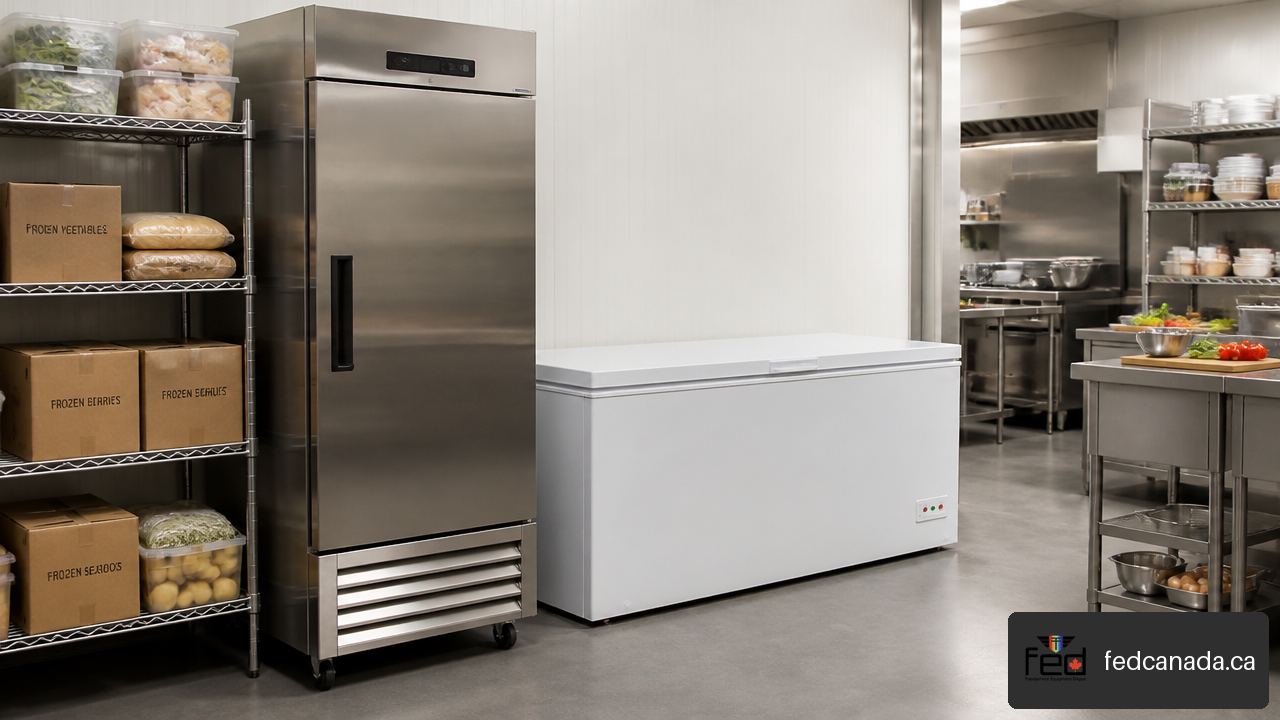
Choosing a Chest Freezer vs Reach-In Freezer for Restaurants is less about which unit is “better” and more about where product is used, how often staff retrieve it, and how much organized storage the kitchen actually needs. I recommend a reach-in for high-frequency service access and a chest freezer for bulk backup inventory. Many restaurants ultimately benefit from both.
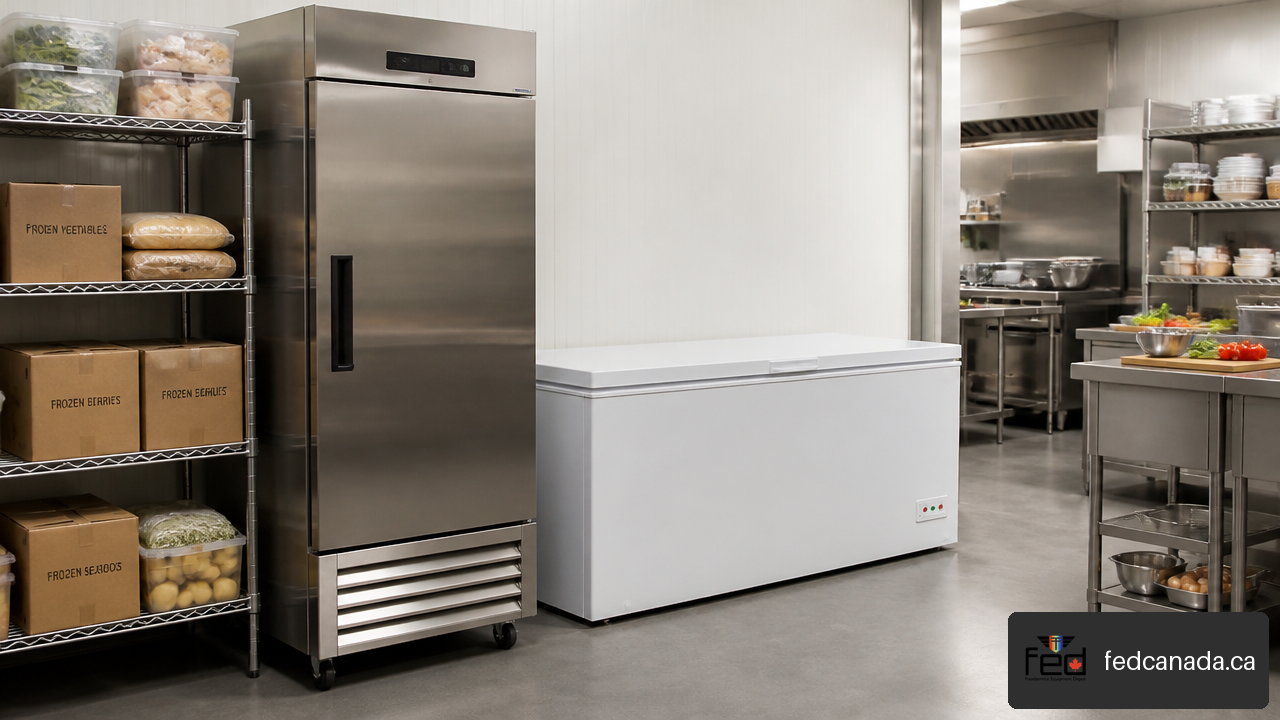
Table of Contents
- Key Takeaways
- Choose by Workflow, Access, and Kitchen Layout
- Calculate Usable Capacity and Operating Value
- Protect Food Safety While Managing Energy and Maintenance
- Frequently Asked Questions
- Sources and References
Key Takeaways
The practical answer for most restaurants
A reach-in freezer is usually the better primary freezer when employees need to retrieve frozen ingredients repeatedly during prep or service. Shelves, front doors, labels, and eye-level visibility reduce search time. A cook can identify a pan of portioned chicken, a box of frozen fries, or a container of prepared sauce without lifting other inventory first.
A chest freezer is generally the stronger value for backup stock, bulk deliveries, seasonal product, large protein cases, and oddly shaped packaging. Its open interior can hold products that are difficult to fit on reach-in shelves, and the top-opening design tends to retain cold air when opened briefly.
The most useful distinction is simple: store what staff need now in a reach-in, and store what the restaurant needs later in a chest freezer or walk-in.
Quick comparison
| Decision factor | Commercial chest freezer | Commercial reach-in freezer |
|---|---|---|
| Best use | Bulk and low-turnover inventory | Daily service and organized prep stock |
| Access style | Top opening, product may be stacked | Front opening, shelf-based retrieval |
| Floor shape | Wide and low | Tall and narrower |
| Organization | Requires baskets, dividers, and zones | Easier to label by shelf or section |
| Cold-air retention | Often favourable with a closed lid | More cold air can escape through open doors |
| Capacity value | Often more storage volume per purchase dollar | Usually less raw volume for the same budget |
| Best placement | Storage room, receiving area, backup zone | Prep area, dessert station, production kitchen |
When one freezer is not enough
I would avoid forcing one unit to perform two conflicting jobs. A chest freezer near a busy line creates digging, lid interference, and delayed retrieval. A reach-in used as the only bulk freezer can become crowded, disorganized, and expensive to operate if staff keep the doors open while searching.
For example, a casual restaurant might keep one or two days of frozen fries, portioned proteins, dessert items, and prep components in a reach-in. Cases from the weekly delivery remain in a chest freezer until needed. This allocation protects service speed while keeping reserve inventory separate and easier to count.
Choose by Workflow, Access, and Kitchen Layout
Measure retrieval frequency, not just cubic feet
The strongest selection question is not “How much product fits?” It is “How often will someone need to find a specific product?” Retrieval frequency changes the value of organization.
Use this simple classification before comparing models:
| Product category | Typical access pattern | Better starting point |
|---|---|---|
| Fries, burger patties, portioned proteins | Repeated access during service | Reach-in freezer |
| Frozen desserts, pastry trays, garnishes | Regular but controlled access | Reach-in freezer |
| Bulk meat cases, seafood cartons, large bags | Low-frequency replenishment | Chest freezer |
| Seasonal menu items and emergency stock | Occasional access | Chest freezer |
| High-value specialty products | Limited access but close inventory control | Reach-in or organized chest zone |
A practical rule: if an employee opens the freezer several times during a service period, the item usually belongs in a reach-in. If it is accessed once a day, once every few days, or only when replenishing line stock, a chest freezer is often more efficient.
This is also a labour question. Suppose a kitchen keeps six frozen product categories in a deep chest freezer. If staff must move bags or boxes to reach the item at the bottom, each retrieval may take longer than expected. The delay is not only a few seconds. It can interrupt prep, increase the chance of leaving the lid open, and make staff less likely to rotate inventory correctly. There is no universal published labour-time figure for this difference, but the workflow effect is easy to evaluate during menu planning.
Plan around doors, lids, aisles, and body movement
A reach-in uses vertical space well, but its doors project into the aisle. A chest freezer may sit lower and fit under some visual sightlines, yet its lid requires clear overhead space and room for an employee to lean over the cabinet safely.
Before purchase, measure more than the equipment footprint:
Measure the wall length and floor depth where the unit will sit.
Mark the full door swing or lid-opening path with tape.
Confirm that staff can pass while another employee is loading or retrieving product.
Check clearance around the condenser area as required by the manufacturer.
Verify the route from receiving to the final location, including doors, hallways, stairs, and turns.
Very wide chest freezers can become awkward because product in the centre and bottom is harder to reach. A deep-freezer planning guide from BeThere Trading notes that wide chest models may require baskets and a deliberate loading plan to keep product accessible.
Fair warning: the footprint that looks efficient on a floor plan can still fail in real use. A chest freezer placed beneath shelving may technically fit, but the lid may not open fully. A reach-in placed opposite a prep table may block the aisle every time a door opens. Test the open position, not just the closed dimensions.
Match the freezer to packaging and SKU count
SKU count matters because every distinct frozen product needs a predictable home. A restaurant with eight frozen items may manage well with baskets and colour-coded labels in a chest freezer. A restaurant with 30 items, including prepared sauces, vegan proteins, seafood, desserts, and multiple portion sizes, usually benefits from reach-in shelving.
The package shape matters too. Reach-ins work best when products are stable, stackable, and easy to group on shelves. Chest freezers are often more forgiving of bulky cartons, long boxes, irregular vacuum packs, and large bags. WebstaurantStore’s commercial freezer configuration guide similarly distinguishes shelf-based reach-in configurations from chest freezers that can accommodate bulky packages.
A simple chest-freezer zoning method
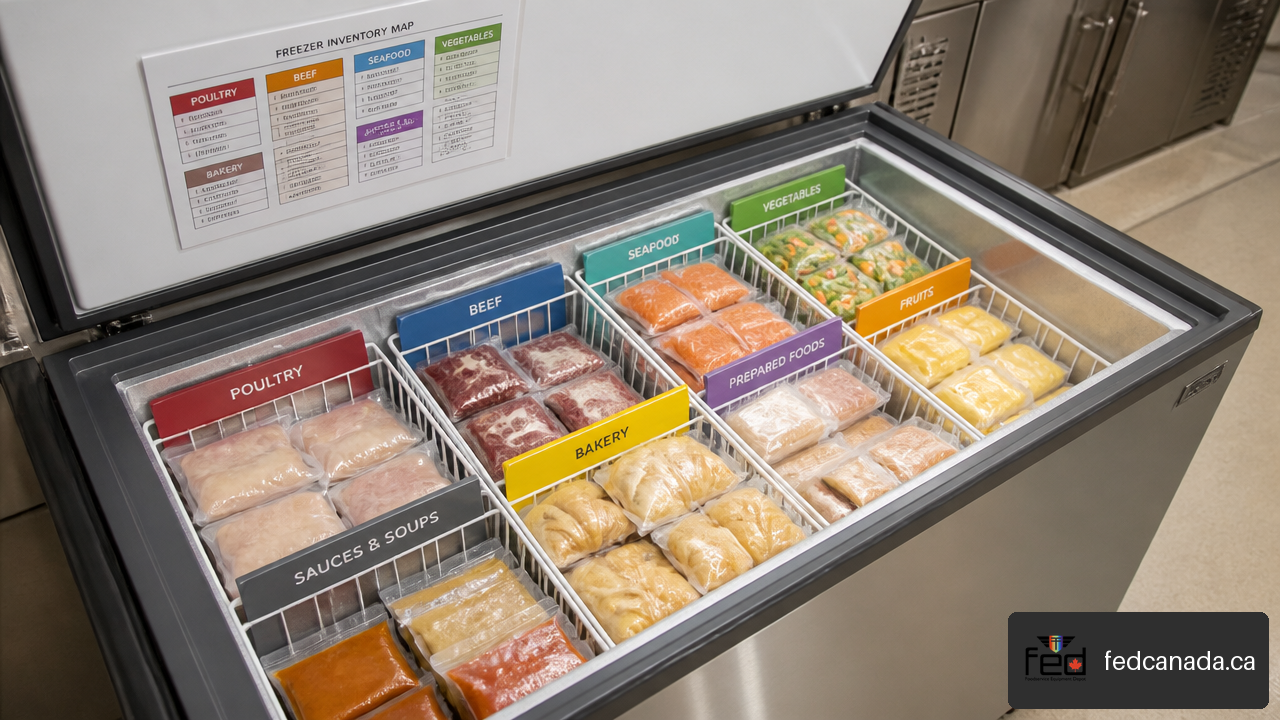
If a chest freezer is the right fit, avoid treating it as one large pile. Divide it into defined zones:
Front zone: Products used most often for replenishment.
Basket zone: Small packages, opened cases, and high-value items.
Centre zone: Full cases of medium-turnover products.
Bottom zone: Sealed reserve stock and low-turnover inventory.
Attach a freezer-safe inventory map to the lid or nearby wall. Each zone should have a product family, delivery date, and earliest expiry date. This supports first-expire, first-out rotation and reduces unnecessary digging.
Calculate Usable Capacity and Operating Value
Nominal capacity is not usable capacity
Manufacturer capacity is useful for comparing models, but it should not be treated as the amount of product a restaurant can use comfortably. Usable capacity is the storage space available after allowing for baskets, shelves, product separation, airflow, package shape, safe stacking, and employee access.
Commercial chest freezer examples can range approximately from 200 to 700 litres, while reach-in models can span roughly 550 to 2,000 litres, depending on the configuration. As BeThere Trading’s commercial freezer buying guide notes, internal layout affects how much of that stated volume can be used in practice.
A 500-litre chest freezer packed with mixed cartons may hold a great deal of inventory but still perform poorly if employees cannot locate items without unloading the top layer. Conversely, a smaller reach-in may hold less total product while supporting faster, more accurate retrieval. That is why I recommend estimating both volume and access value.
Use a demand-based capacity estimate
Start with frozen inventory demand rather than appliance size. Review delivery frequency, average weekly frozen usage, menu volatility, and emergency reserve requirements.
A practical planning sequence looks like this:
List every frozen SKU and the average quantity kept on site.
Separate daily service stock from backup cases.
Identify products that cannot safely be stacked or mixed.
Add capacity for the longest expected delivery gap.
Reserve space for new menu items, promotions, and seasonal demand.
Choose a freezer that can be organized without filling every open area.
Consider a restaurant that uses 12 cases of fries, eight cases of proteins, four dessert cartons, and several prepared-food containers each week. If deliveries arrive once weekly, storing everything in a single reach-in can create a dense, hard-to-rotate cabinet. A reach-in for active stock plus a chest freezer for unopened cases usually makes more operational sense than simply buying a larger reach-in.
Compare energy use by operating pattern
Chest freezers are often considered more energy-efficient because cold air tends to remain in the cabinet when the lid opens. Cold air is denser than warm room air, so it does not spill out of a top-opening freezer as readily as it can through an open front door. The commercial chest freezer overview from The Restaurant Warehouse identifies this cold-retention advantage alongside chest freezers’ role in bulk storage.
That advantage is real in principle, but it should not become a blanket buying rule. Energy consumption depends on several model-specific variables:
Ambient kitchen temperature.
Door or lid opening frequency.
Gasket condition.
Defrost system design.
Cabinet insulation.
Compressor performance.
Product load and temperature when loaded.
A chest freezer opened once or twice daily for case replenishment may retain temperature well. A chest freezer opened repeatedly during service can lose much of that practical advantage because staff spend time searching with the lid raised. Likewise, a reach-in used efficiently, with assigned shelves and quick retrieval, may have a more controlled opening pattern than an unorganized chest.
When comparing specific units, review the manufacturer’s electrical requirements, energy information where available, refrigeration system details, warranty, and clearance instructions. Avoid estimating operating cost from freezer type alone.
Protect Food Safety While Managing Energy and Maintenance
Temperature control and compliance come first
For restaurant use, a freezer must maintain the temperature required by applicable local food-safety rules and the operator’s food-safety program. Many operations target 0°F or lower, equivalent to about -18°C or lower, for frozen storage. Local health requirements and product instructions should guide the final standard.
The equipment itself should be appropriate for commercial foodservice use. Before buying, confirm the unit’s listing or certification, sanitation suitability where applicable, electrical specifications, temperature range, warranty coverage, and whether local inspectors or lease requirements impose additional conditions. A domestic freezer may look economical initially, but it may not be suitable for the workload, warranty expectations, or compliance needs of a commercial kitchen.
Prevent temperature problems during daily use
Food-safety performance depends on operations, not only cabinet design. The common failure points are overloading, poor air circulation, damaged gaskets, warm product loading, and doors or lids left open while staff search for stock.
A basic control routine should include:
Check and log freezer temperature at the frequency required by the restaurant’s food-safety procedures.
Keep products labelled with receiving date, preparation date where applicable, and expiry or discard information.
Cool products appropriately before freezing when required by your food-safety process.
Keep vents and airflow paths clear.
Inspect door gaskets and lid seals for tears, gaps, debris, and poor closure.
Investigate temperature alarms, excess frost, unusual compressor cycling, and water accumulation promptly.
A stocked chest freezer may retain cold longer during an outage if the lid stays closed, but exact holding time varies substantially by model, insulation, load, ambient conditions, and prior temperature. It is safer to use a documented outage plan than to rely on generic hour estimates. Keep the unit closed, monitor temperatures when possible, follow local public-health direction, and discard food when safety cannot be verified.
Cleaning, defrosting, and inventory discipline
Reach-ins are generally easier to inspect visually, clean shelf by shelf, and reorganize without removing all inventory. Their maintenance burden often centres on shelf cleaning, door gaskets, drain areas, and condenser care according to the manufacturer’s instructions.
Chest freezers can require more planning. Spills migrate downward, ice can accumulate, and cleaning the bottom may require moving significant inventory. Schedule defrosting and deep cleaning for a low-stock period. Move product to another monitored freezer, keep it protected from thawing, clean and dry the cabinet completely, then reload by zone rather than returning items as one mixed stack.
For daily service products, The Restaurant Warehouse’s reach-in freezer guidance emphasizes eye-level, shelf-based access. That layout supports quicker identification of products used repeatedly during active production.
Frequently Asked Questions
Is a chest freezer or reach-in freezer better for a restaurant?
A reach-in is usually better for daily production and service access. A chest freezer is usually better for bulk, reserve, and low-turnover inventory. Restaurants with steady volume often benefit from assigning each unit a separate role rather than choosing one universal freezer.
Which freezer is best for products used repeatedly during service?
Choose a reach-in freezer. Shelves make it easier to separate proteins, vegetables, desserts, and prepared items by category. Employees can locate product quickly and are less likely to leave the door open while moving cases or bags.
Is a chest freezer more energy-efficient than a commercial reach-in freezer?
It can be, particularly when used as a mostly closed bulk-storage unit. Top-opening cabinets tend to retain cold air better during brief openings. Actual operating cost still depends on the specific model, kitchen heat, maintenance, loading habits, and opening frequency.
How much usable storage does a chest freezer provide?
Usable storage is lower than nominal volume when baskets, dividers, inaccessible bottom areas, packaging gaps, and safe access are considered. The exact reduction varies by product mix. Assess it by laying out actual case sizes and deciding whether staff can retrieve any required product without unloading unrelated stock.
Does a reach-in freezer take less floor space than a chest freezer?
A reach-in often uses less wall width because it stores vertically, but it needs clearance in front for the doors and employee movement. A chest freezer may require more horizontal floor area and overhead space for the lid. Measure the open door or lid position before deciding.
How should a restaurant organize a chest freezer?
Use baskets for small items, dividers for product families, durable labels, and a fixed zone map. Put the most frequently replenished products near the top or front. Keep unopened reserve cases at the bottom and use first-expire, first-out rotation so older inventory does not disappear beneath newer deliveries.
When is a walk-in freezer a better choice?
A walk-in becomes more appropriate when freezer demand exceeds the capacity of individual cabinets, when the restaurant receives large shipments, or when multiple departments need substantial frozen inventory. It can also simplify bulk access, though it requires more space, installation planning, and capital investment.
Sources and References
Verified external sources
The Restaurant Warehouse — Commercial Chest Freezer: https://therestaurantwarehouse.com/collections/chest-freezers
The Restaurant Warehouse — Commercial Upright Reach-In Freezers: https://therestaurantwarehouse.com/collections/reach-in
WebstaurantStore — Guide to Commercial Freezers: https://www.webstaurantstore.com/guide/1342/guide-to-commercial-freezers.html
BeThere Trading — Deep Freezer Guide: Chest Freezer Sizes, Temperatures and Power Use: https://www.betheretrading.com/blog/deep-freezer-guide
betheretrading.com: https://www.betheretrading.com/blog/commercial-freezer-buying-guide
Recent Posts
Leave a Comment
Your email address will not be published. Required fields are marked *