


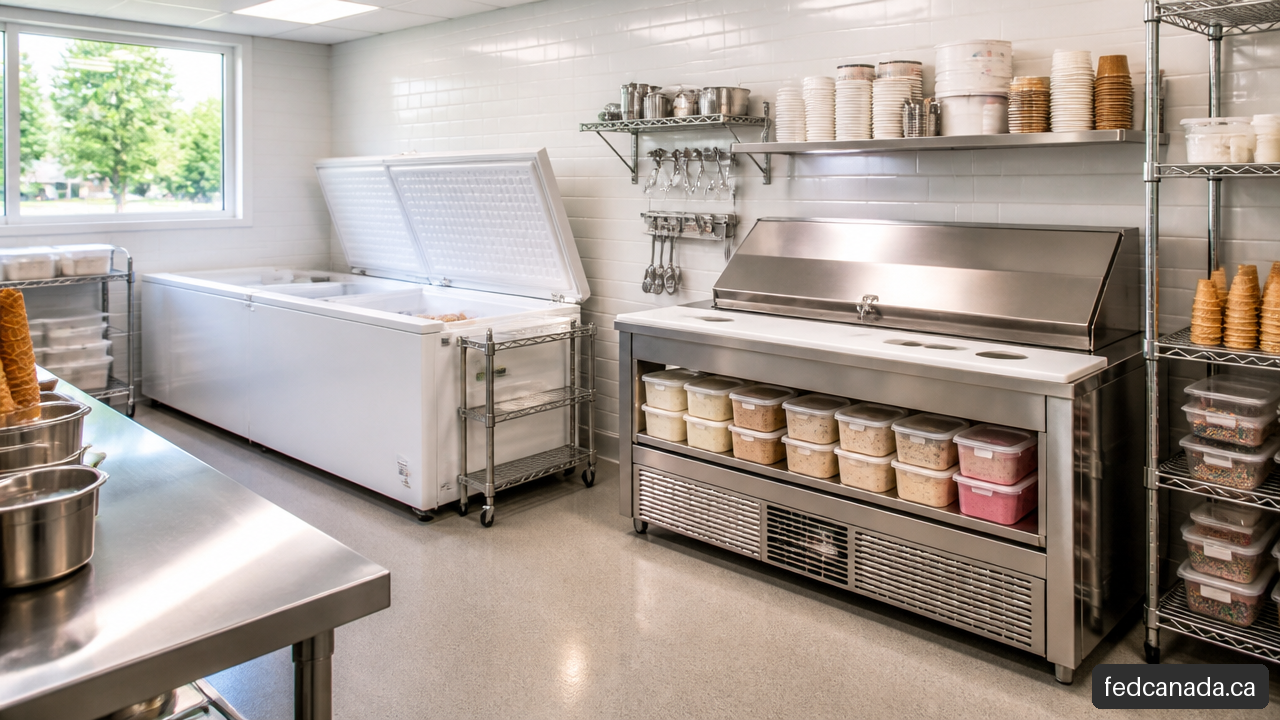
Commercial refrigeration equipment for ice cream storage typically uses low-temperature freezer systems, insulated cabinets, temperature controls, and compressor configurations designed to keep frozen desserts stable.
The right unit is not simply the coldest freezer available. It must match how the product moves through your operation: reserve storage, customer display, scoop service, or rapid hardening after production.
A freezer that holds bulk tubs overnight may not be the best choice for a busy counter where lids open every few minutes. Likewise, a glass-top novelty freezer can sell packaged treats effectively but may be a poor substitute for deep reserve storage.
We recommend choosing equipment around the product’s required condition at each stage, not around one universal freezer temperature.
Match the Freezer to the Service Model
The most useful way to choose ice cream refrigeration is to start with the workflow. Ask one question first: Will this equipment store product, serve it, sell it visually, or harden it?
Each task creates a different refrigeration load and calls for a different cabinet design.
Storage freezers protect reserve inventory
A commercial storage freezer is intended for sealed tubs, cartons, novelties, and backup inventory that does not need to be visible to customers.
Chest freezers are common because cold air naturally settles inside the cabinet when the lid opens. That reduces the immediate loss of cold air compared with a full-height upright door opening.
Storage freezers are usually the practical choice when your priority is maximum product volume in a compact footprint.
A small scoop shop, for example, may keep its active flavors in a dipping cabinet and hold unopened replacement tubs in a back-of-house chest freezer. This separation reduces service interruptions and helps the dipping cabinet recover faster after repeated opening.
Choose a storage freezer when:
- You need reserve space for tubs, cartons, or seasonal inventory.
- Product is accessed periodically rather than every few minutes.
- You have enough floor space for a horizontal cabinet.
- Product presentation is less important than capacity and stable storage.
Avoid relying on an upright reach-in freezer as the only bulk storage unit if the operation opens it frequently during rush periods.
Uprights can be convenient for organization, but every door opening allows denser cold air to spill downward and pulls warmer room air into the cabinet.
Dipping cabinets balance firmness and service speed
A dipping cabinet is a top-loading commercial freezer built for scooping. It holds ice cream firm enough to retain its shape while allowing staff to serve it without excessive force.
The cabinet may use canisters or baskets to position tubs near the working surface, making flavor changes and service faster.
The key difference is operational. Reserve storage aims to keep product deeply frozen and stable. A dipping cabinet aims to maintain a usable serving condition through a long service interval.
That means it must recover after frequent lid openings, handle heat from the service area, and avoid softening the top layer of product.
GoFoodservice’s ice cream freezer guide distinguishes storage freezers, dipping cabinets, and display units by their role in reserve holding, serving, and equipment selection.
That distinction matters because trying to use one cabinet for all three jobs often creates either hard-to-scoop product or unstable reserve storage.
Display freezers sell packaged frozen treats
Glass-lid chest freezers and display freezers are designed to make packaged bars, sandwiches, cones, pops, and novelty items easy to see.
Their merchandising value is clear: customers can view options without staff opening a back-room freezer.
Yet visibility creates tradeoffs. Glass surfaces can gain condensation in humid spaces, and frequent customer access raises the refrigeration load.
Customer-facing dipping and glass-top freezer formats are generally better suited to novelty sales and product presentation than to hidden bulk reserve storage.
For a convenience store or café, this may be exactly the right tradeoff. For a high-volume ice cream shop, it is often better to pair a display cabinet with dedicated backup storage.
Hardening equipment serves a separate production task
A hardening cabinet is not simply an extra-cold freezer. It is used after freshly churned ice cream is packed, helping the product firm quickly enough to preserve its fine structure before long-term storage.
This is most relevant to producers and shops making ice cream on site.
If you buy finished packaged products, a hardening cabinet may add cost and consume floor space without solving a real need.
If you make product in-house, however, ordinary storage freezers may cool new batches too slowly, especially when warm containers are loaded alongside already frozen inventory. That can warm nearby product and create quality inconsistencies.
Control Temperature for Texture and Scoopability
Ice cream quality depends heavily on temperature stability, not just the displayed setpoint. When the product warms slightly and refreezes repeatedly, some water can migrate and form larger ice crystals.
The result may be a coarse, icy, or grainy texture rather than a smooth scoop.
Separate storage targets from serving targets
There is no single temperature that is ideal for every frozen dessert, cabinet, and service model. General operator guidance commonly places ice cream storage between about minus 5°F and minus 20°F, while service temperatures may be closer to 0°F to 6°F.
The detailed ranges, loading advice, and dessert-specific differences are summarized in WebstaurantStore’s guidance on ice cream freezer temperatures.
The practical implication is simple: store reserve stock colder than the product you expect to scoop immediately.
Moving a limited number of tubs from deep storage into a dipping cabinet can support faster service without exposing the entire inventory to frequent access.
| Operating stage | Primary goal | Typical equipment approach | Main risk if poorly managed |
|---|---|---|---|
| Reserve storage | Preserve inventory and texture | Chest or upright storage freezer | Product becomes too hard or experiences temperature swings |
| Scoop service | Maintain workable firmness | Dipping cabinet | Surface softening during heavy service |
| Packaged product display | Visibility and self-service | Glass-lid or display freezer | Warm-air infiltration and overloading |
| Fresh product hardening | Rapidly firm newly produced product | Hardening cabinet | Slow freezing and larger ice crystals |
Treat frozen desserts as different products
Ice cream, gelato, sorbet, and frozen yogurt should not automatically receive the same setpoint. Their formulation affects how firm they feel at a given temperature.
Sugar, fat, air content, and solids all influence freezing behavior. A higher-sugar product may remain softer at temperatures that make a lower-sugar ice cream very hard.
This depends on the formulation and manufacturer instructions. A gelato counter may intentionally operate warmer than deep storage because the product is served at a softer texture.
Sorbet can also behave differently because it lacks dairy fat and may have a higher sugar concentration.
The safe operational approach is to start with the product maker’s guidance, then verify that the cabinet maintains a consistent product condition during actual service.
A freezer display reading is useful, but the real test is what happens inside the tub: stable texture, clean scoops, and no recurring surface frost.
Loading practices influence product temperature
Open-top and display cabinets rely on cold-air circulation. Loading product above the marked freezer line can interfere with that air movement and expose the upper packages or tubs to warmer conditions.
In display applications, keeping product below the freezer line also supports a cleaner presentation and reduces the tendency for the top layer to soften.
Fair warning: a cabinet can look fully stocked and still be poorly loaded. Consider a novelty freezer packed with boxed treats stacked above the internal line.
The compressor may run longer, the front row may look fine, and yet products near the top can cycle through marginal temperatures each time the lid opens.
Leave clearance where the manufacturer indicates, and do not block internal vents, evaporator covers, or fan paths.
Frozen does not always mean a mandated number
Food rules can require foods to be maintained frozen without prescribing one ice-cream-specific holding number.
In the United States, the FDA Food Code is commonly understood to require frozen food to remain frozen rather than establishing a universal numeric setpoint for every frozen product.
This distinction is explained in the linked freezer selection and temperature guidance.
For Canadian operators, local food-premises requirements, public-health direction, equipment-sanitation expectations, and product-supplier instructions may all matter.
Because directly applicable ice-cream-specific legal setpoints can vary by context, do not assume a general frozen-food requirement is the same as the best quality target for a particular dessert.
Understand the Refrigeration System Under the Cabinet
Commercial refrigeration equipment for ice cream storage typically uses a vapor-compression refrigeration cycle.
The compressor raises refrigerant pressure and temperature, the condenser releases heat to the surrounding area, the expansion device reduces pressure, and the evaporator absorbs heat from inside the cabinet.
The cycle repeats to remove heat entering through cabinet walls, lid openings, product loading, and ambient air.
Why ice cream needs a low-temperature system
Ice cream cabinets often operate at lower temperatures than standard refrigerated food-holding equipment.
At these conditions, the evaporator must run cold enough to pull heat from the cabinet while the compressor operates with lower suction pressure. This is often described as low-backpressure refrigeration.
Secop’s commercial refrigeration application overview notes that low-temperature ice cream applications can involve low-backpressure systems and operating conditions around minus 35°C to minus 25°C in some soft-scoop and retail uses.
Not every cabinet must operate at those exact conditions, but the engineering point is important: ice cream duty is different from ordinary refrigerated storage.
A standard freezer may be able to reach a cold number during a quiet overnight test. The harder question is whether it can maintain product quality after repeated openings, a room-temperature product load, or a warm condenser environment.
Commercial ice cream equipment is selected for the latter conditions.
Compressor capacity must match the access pattern
Frequent access changes the load profile. Each lid or door opening introduces warmer air and moisture.
The refrigeration system must remove that heat while controlling frost accumulation and recovering cabinet temperature quickly enough to protect the remaining product.
Consider two otherwise similar businesses:
- A seasonal campground store opens a novelty freezer intermittently throughout the day.
- An ice cream counter opens a dipping cabinet repeatedly during a ten-minute rush.
The second operation needs faster recovery and a cabinet layout that supports repeated service.
A larger storage freezer does not automatically solve that problem because its purpose is capacity, not necessarily high-frequency scoop access.
Insulation, seals, and condensers affect operating cost
The compressor receives most of the attention, but cabinet construction has a major effect on energy use.
Quality insulation slows heat gain through walls and lids. Tight door gaskets limit warm-air infiltration. A clean condenser allows heat to leave the system efficiently.
When the condenser coil is blocked with grease, lint, dust, or debris, heat cannot transfer effectively. The compressor runs longer and may struggle to hold temperature during demand peaks.
In a foodservice environment, this is not a cosmetic maintenance issue. It can contribute to warmer product, higher electrical use, and avoidable wear on the refrigeration system.
Select Capacity, Cabinet Features, and Energy Performance
The best unit is the one that holds enough product for peak demand without becoming oversized, underloaded, or operationally awkward.
Capacity should be based on the busiest period, delivery schedule, product package size, and the amount of backup stock you need during supply interruptions.
Size for inventory movement, not just cubic volume
Start by estimating how many tubs, cartons, or novelty cases you sell during your busiest delivery cycle. Then add a reasonable reserve quantity.
Measure the actual packaging dimensions because nominal cubic feet does not reveal whether a cabinet accommodates your container shape or basket system efficiently.
Use this sequence:
- Count peak weekly or delivery-cycle inventory by product format.
- Separate reserve stock from front-of-house serving stock.
- Measure tubs, boxes, and any canisters or baskets.
- Allow airflow clearance and avoid planning to fill every available inch.
- Check delivery paths, electrical requirements, ventilation clearance, and floor space before ordering.
A unit that technically fits the inventory but leaves no space for air circulation is undersized in practice.
Conversely, a very large cabinet can increase purchase cost, floor-space use, and energy consumption if it remains mostly empty for long periods.
Prioritize features that solve actual operating problems
Useful features depend on the cabinet’s role. A digital thermostat can make it easier to monitor and adjust a setpoint.
Audible alarms may help flag temperature excursions. Locking lids can protect inventory in self-service environments.
Interior baskets improve product organization and reduce prolonged lid opening while staff search for a flavor.
| Feature | Best use case | Benefit | Watch for |
|---|---|---|---|
| Digital temperature control | Storage and dipping cabinets | Easier setpoint monitoring | Display reading should be checked against product performance |
| Solid insulated lid | Reserve storage | Lower heat gain and strong insulation | Less product visibility |
| Glass sliding lid | Novelty display | Customer visibility and merchandising | Condensation and frequent-opening loads |
| Interior baskets or dividers | Packaged products and tubs | Faster stock rotation and organization | Reduced usable volume if layout is poorly planned |
| Temperature alarm | High-value inventory | Earlier warning of a temperature issue | Alarm placement and response procedures still matter |
Manage energy efficiency as a total system issue
Energy efficiency is not only about an equipment label or compressor rating. It is the combined result of cabinet insulation, lid style, thermostat settings, ambient conditions, loading habits, condenser cleanliness, and how often the freezer is opened.
A glass-lid cabinet may use more energy in a high-traffic setting than a solid-lid storage chest because customer access and radiant heat create additional load.
Still, its sales value may justify the cost. The better question is not “Which freezer uses the least energy?” It is “Which freezer uses energy efficiently for its intended job?”
For example, using a glass-top display freezer for all backup inventory may appear efficient because it consolidates equipment.
In practice, staff and customers may open it so often that reserve stock experiences unnecessary swings.
A two-unit setup, with a display freezer plus a well-insulated storage freezer, can sometimes protect product better and reduce the workload placed on each cabinet.
Key Takeaways
- Commercial refrigeration equipment for ice cream storage typically uses low-temperature compressor systems, insulated cabinets, evaporators, condensers, and controls designed for stable frozen holding.
- Storage freezers, dipping cabinets, glass-top display freezers, and hardening cabinets serve different jobs. Select equipment based on product workflow rather than appearance alone.
- Deep reserve storage and scoop service usually need different temperature targets. Keep backup inventory colder and move smaller quantities into service equipment as needed.
- Temperature swings, overloading, blocked airflow, dirty condensers, and frequent lid opening can damage texture and increase energy use.
- For display cases, keep products below the marked freezer line and preserve clearance around vents and internal airflow paths.
- Energy performance depends on insulation, seals, cabinet access, ambient conditions, maintenance, and correct sizing, not only on the compressor.
Frequently Asked Questions
What type of commercial freezer is best for ice cream storage?
For bulk reserve inventory, a commercial chest storage freezer is often the strongest choice because it offers stable cold holding and good capacity.
For active scoop service, choose a dipping cabinet. For packaged novelty sales, choose a glass-lid display freezer.
The best setup for a busy shop commonly combines at least one storage unit with one service or display unit.
What temperature should ice cream be stored at in a commercial freezer?
Many operators use a storage range of about minus 5°F to minus 20°F, but the appropriate target depends on the product, cabinet design, and supplier guidance.
The goal is stable product temperature, not simply choosing the lowest possible setpoint. Always follow the ice cream manufacturer’s handling instructions where available.
What temperature should ice cream be served at?
Ice cream is often easier to scoop at temperatures closer to 0°F to 6°F than at deep reserve storage conditions.
This varies by recipe. Products with different sugar, fat, and air content can feel dramatically different at the same display temperature.
What is the difference between an ice cream storage freezer and a dipping cabinet?
A storage freezer holds reserve product, usually out of sight and with limited daily access. A dipping cabinet is designed for continuous scoop service.
It positions tubs for staff access and is built to handle frequent opening while keeping product firm enough to serve.
Should ice cream be stored in a chest freezer or an upright freezer?
Chest freezers are often preferred for bulk storage because opening the lid usually releases less cold air than opening a tall upright door.
Uprights can work well when organization, shelving, and quick access to many product types matter more.
The right choice depends on your available floor space, inventory format, and access frequency.
How full should an open ice cream display freezer be loaded?
Do not load products above the cabinet’s freezer line. Keep clearance for circulation and avoid covering vents or evaporator components.
A visibly full case is not helpful if the upper products warm or if airflow is restricted.
Why does ice cream get icy or grainy in a commercial freezer?
Icy texture often results from temperature fluctuation and partial melting followed by refreezing.
Common causes include frequent access, warm product loading, poor lid seals, blocked airflow, frost buildup, or a refrigeration system that cannot recover quickly enough during busy periods.
Can gelato and sorbet use the same freezer as ice cream?
They can be stored in the same general equipment category, but they may need different holding conditions to achieve the desired serving texture.
Gelato and sorbet formulations often behave differently from traditional ice cream. If you serve several dessert types, use separate zones or equipment where practical and follow product-specific guidance.
Sources and References
- WebstaurantStore — Ice Cream Storage: Freezer Types, Temperatures, & More: https://www.webstaurantstore.com/guide/701/types-of-commercial-ice-cream-freezers.html