




Manitowoc Ice Machines: Settings, Troubleshooting and Buying Guide
Manitowoc Ice Machines: Settings, Troubleshooting and Buying Guide starts with one practical rule: identify the exact machine before changing settings, ordering parts, or interpreting an error. Manitowoc Q Series, QD Series, Indigo units, undercounter models, and older control designs can use different probes, valves, menus, and diagnostic logic. A correct repair on one series can be the wrong procedure on another.
If your machine is running but making thin ice, entering harvest too soon, showing a long fill condition, or stopping after several batches, begin with the machine’s data plate, control panel layout, and model specific manual. That small amount of documentation prevents expensive guesswork.
Table of Contents
- Settings and operating modes
- Troubleshooting Manitowoc ice machines
- Cleaning, filtration, and maintenance
- Buying the right Manitowoc ice machine
- Key takeaways
- Frequently asked questions
Settings and operating modes
Identify the model and control generation first
I recommend treating the data plate as the starting point for every Manitowoc service decision. Record the complete model number, serial number, voltage, refrigerant type, and production configuration. Then photograph the control panel, water trough, probe arrangement, and any displayed fault codes.
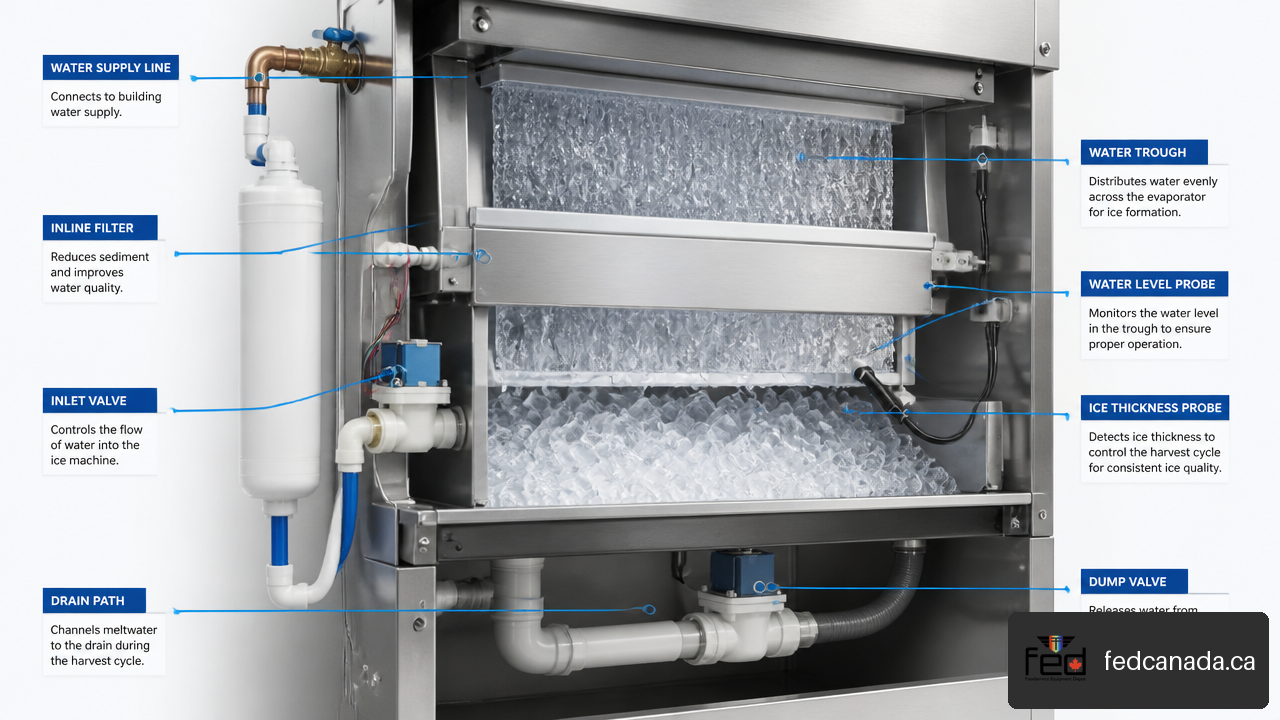
This matters because a Q Series cube machine may use an ice thickness probe and a curtain switch differently than an Indigo model with a digital interface. Some units use a conventional dump valve to drain water from the trough during selected stages. Others may use a siphon cap arrangement. An undercounter machine can also have different bin sensing and airflow constraints than a modular head mounted on a separate storage bin.
Use this quick identification guide before acting:
| What to document | Why it changes the diagnosis |
|---|---|
| Full model and serial number | Determines the correct manual, parts, electrical data, and control logic |
| Control display or switch layout | Confirms whether menu based diagnostics are available |
| Ice style and machine type | Helps match production needs, bin options, and expected cycle behavior |
| Water system layout | Distinguishes filters, dump valves, siphon components, and drain routing |
| Refrigerant label | Keeps refrigeration service work model specific and technician only |
What Freeze, Harvest, Clean, and Off mean
Most Manitowoc ice machines operate through a sequence rather than a simple on and off cycle. The names may vary by series, but the underlying functions are broadly similar.
| Mode | What the machine is doing | What you should observe |
|---|---|---|
| Freeze | Water circulates across the evaporator while refrigeration removes heat and forms ice | Water movement, a growing ice sheet or cubes, and normal condenser airflow |
| Harvest | The machine releases formed ice from the evaporator into the bin | Ice drops, the curtain or bin sensing system responds, and the cycle resets |
| Clean | The machine runs a cleaning sequence designed for approved ice machine cleaner and rinsing | Water system activity without normal ice production |
| Off | Production is disabled | The machine should not begin a new ice cycle |
Freeze is where ice thickness is established. Harvest is where the machine must release that ice cleanly. A machine can appear to be “working” while failing in either stage. For example, an ice thickness sensing problem can trigger harvest too early, producing a thin slab. A failed harvest condition can leave a fully formed sheet attached to the evaporator.
Fair warning: do not force a machine through modes by bypassing probes, switches, or safety controls. Those tests can be useful for trained technicians using a model specific procedure, but they can also create overflow, freeze up, electrical hazards, or equipment damage.
Settings that affect real world output
The most useful owner level settings are often operational rather than electronic. Ice production depends on the installed environment and incoming utilities as much as the control board.
Review these conditions before assuming a setting is wrong:
The ice thickness target or probe condition
The cleanliness of the evaporator, trough, probes, and water distribution system
Incoming water flow through the filter and inlet valve
Drain routing that allows water to leave without backing up
Airflow around the condenser and room temperature at installation
Bin level sensing, curtain movement, lid position, or other harvest completion inputs
A restaurant may need more ice during lunch and dinner rushes but still have poor daily production because the machine sits beside hot cooking equipment or a blocked condenser. In that situation, changing a thickness setting will not correct the root cause. The machine needs adequate ventilation and model appropriate installation clearances.
Troubleshooting Manitowoc ice machines
Start with an evidence preserving error workflow
When a Manitowoc unit displays a fault, record it before resetting anything. Error history can contain old events that no longer matter, but clearing codes immediately also removes useful clues.
Use this low risk sequence:
Photograph the control display, status lights, and any error history.
Record the time, room conditions, recent cleaning, filter replacement date, and visible symptoms.
Check for simple causes such as a closed water valve, full bin condition, displaced curtain, blocked airflow, or obvious water leak.
Follow the model specific instructions to clear or acknowledge faults only after preserving the original information.
Run the machine through a supervised cycle and document the first fault or symptom that returns.
This separates a historical warning from the active stopping condition. If a long fill fault returns shortly after reset, focus on the water system. If the machine produces several normal batches and then stops, the problem may require deeper control or refrigeration diagnosis.
Use symptoms to narrow the likely component
The table below is a practical way to avoid replacing parts at random. It does not replace the service manual, but it helps determine where an owner level inspection ends and technician testing begins.
| Symptom | Likely areas to inspect first | Owner safe checks | Technician level work |
|---|---|---|---|
| Runs but makes no ice | Water supply, filter, bin sensing, condenser airflow | Confirm water valve is open, inspect filter age, clear airflow | Electrical outputs, refrigeration pressures, compressor diagnosis |
| Thin ice or early harvest | Ice thickness probe, probe contamination, harness | Clean and rinse probes as directed, inspect connectors | Probe calibration, continuity checks, board input testing |
| Ice forms but will not release | Harvest controls, curtain switch, refrigeration system | Check for visible curtain obstruction and record cycle behavior | Hot gas, TXV, refrigerant, and electrical diagnosis |
| Long fill or slow trough fill | Filter restriction, supply valve, inlet valve, water level sensing | Verify supply valve, inspect leaks, replace overdue filter | Measure flow, inlet valve electrical testing, diagnose probe inputs |
| Water drains from trough | Dump valve or siphon system, drain arrangement | Look for continuous visible draining and note cycle stage | Valve disassembly, component testing, model specific water system repair |
| Stops with sensor or safe mode fault | Water level probe, thickness probe, harness, connectors | Clean, rinse, dry, and inspect visible wiring | Harness continuity, grounding, board input, firmware or control analysis |
Premature harvest versus failed harvest
These faults can look similar because both involve the ice thickness system, but they have opposite outcomes.
Premature harvest means the machine leaves freeze mode before a normal ice sheet forms. The ice may be thin, incomplete, or irregular. Scale, mineral film, cleaner residue, moisture at a connector, probe position, or a damaged harness can make a sensor appear to detect the required thickness too soon.
Failed harvest means ice has formed but the machine does not transition or does not successfully release it. The cause may still involve a thickness input, but it can also involve a curtain switch, harvest control, hot gas function, TXV performance, or another refrigeration issue.
Consider two scenarios. In the first, a bar receives undersized cubes and the machine enters harvest quickly. Probe contamination is a sensible early suspect. In the second, a full ice sheet remains attached to the evaporator after an extended cycle. Cleaning the probe may help only if sensing caused the missed transition; otherwise, a qualified technician should assess the harvest and refrigeration system.
When to stop and call a technician
I would keep owner troubleshooting to observation, sanitation, filter replacement, basic airflow checks, and manual guided operating steps. Escalate the work when it involves any of the following:
Live voltage measurement or electrical component replacement
Refrigerant pressure, compressor, TXV, or hot gas system diagnosis
Jumping sensors, switches, or safety devices
Control board replacement without verified sensor and harness testing
Repeated safe mode, recurring error codes, or water overflow
Leaks, burned wiring, breaker trips, unusual noise, or overheating
A control board is rarely the best first guess. Check probes, connector condition, harness damage, water flow, valves, and grounding first. A damaged probe harness can imitate a failed sensor, while a restricted filter can imitate a more serious machine fault.
Cleaning, filtration, and maintenance
Clean probes carefully, then rinse and dry
Scale and residue can interfere with water level and ice thickness sensing. The fix is not simply “clean it harder.” Use only the cleaner, sanitizer, concentration, contact time, and rinse process specified for the exact machine.
After cleaning, inspect the probes and their connectors. A probe can remain unreliable if cleaner residue, mineral film, or moisture is left behind. Community troubleshooting reports have described water level probes continuing to indicate water after the trough emptied because residue remained after cleaning. That does not prove every false reading has the same cause, but it is a good reason to rinse thoroughly and allow accessible components to dry before assuming the probe or board has failed.
Verify the water system in the right order
A long fill condition is often approached backward. Do not start with refrigeration components when the trough is not receiving water quickly enough.
Use this order instead:
Confirm the building water valve is fully open and the supply has not been shut off during maintenance.
Check the filter service date and replace a filter that is overdue or suspected of restriction.
Inspect the supply line for kinks, leaks, crushed tubing, or shared demand that reduces flow during busy periods.
Observe whether the trough fills normally, slowly, or drains away while filling.
Check visible drain routing and note whether water appears to leave through a dump valve or siphon system at the wrong time.
If flow remains poor, arrange for qualified testing of inlet valve operation, actual supply pressure, probe inputs, and plumbing suitability.
There is no universal water pressure or line size figure that should be applied to every Manitowoc machine. One practitioner discussion referenced a three eighths inch line and roughly 40 psi on a particular shared supply arrangement, but that is not a universal specification. Always use the requirements in the manual for your exact unit. For example, a machine may fill normally when the restaurant is closed but fault during service because another fixture is drawing from the same branch line.
Create a maintenance record that supports decisions
A simple maintenance log turns intermittent problems into useful evidence. Record cleaning dates, sanitizing dates, filter changes, error codes, production complaints, room temperature concerns, and replacement parts.
| Maintenance item | What to record | Why it helps |
|---|---|---|
| Water filter | Installation date and replacement date | Connects slow fill symptoms with possible restriction |
| Cleaning cycle | Cleaner used and rinse completion | Helps investigate scale or residue related sensor faults |
| Condenser area | Dust, grease, blocked airflow, or service date | Explains heat related production decline |
| Error history | Photo and date before clearing | Separates recurring active faults from older events |
| Repairs | Part number, labour date, and result | Supports repair versus replacement decisions |
Buying the right Manitowoc ice machine
Size the machine for the peak, not the average
The right Manitowoc ice machine is not necessarily the unit with the largest stated daily output. Start with your busiest service window: bar rush, banquet setup, hotel breakfast, patio season, catering load, or healthcare meal service. Then account for the ice style customers actually need.
A high volume quick service restaurant may prioritize cube production and recovery after repeated bin draws. A cocktail bar may prioritize ice format and a bin that keeps service staff supplied through a concentrated evening rush. A café with limited floor space may need an undercounter configuration, accepting that storage and peak capacity are more constrained.
Avoid buying strictly by price if the machine cannot recover between busy periods. At the same time, avoid oversizing without checking electrical capacity, water supply, drain requirements, ventilation, and bin compatibility.
Compare total cost, not just production rating
Production ratings are measured under stated conditions. Actual output changes with incoming water temperature, ambient air temperature, maintenance condition, condenser cleanliness, and installation layout. Treat published capacity as a comparison point, then verify the conditions attached to it.
| Buying factor | Choose more capacity or capability when | Be cautious when |
|---|---|---|
| Daily production | Demand remains high across long service periods | Demand is seasonal or a large bin would hold ice too long |
| Bin storage | Staff need a large reserve before predictable peaks | Floor space, access, or sanitation practices limit storage |
| Air cooled configuration | The site has reliable room ventilation and service access | The machine will sit near heat sources or in a tight enclosed area |
| Water filtration | Water quality or scale risk could affect performance | Filter maintenance will be ignored or hard to schedule |
| Energy efficiency | The machine will operate heavily year round | Efficiency claims are compared without matching machine size and conditions |
| Serviceability | Local support can obtain parts and understands the platform | The model is uncommon or access for repairs is poor |
Confirm installation and serviceability before ordering
Before purchasing, confirm the machine head, bin, electrical supply, water line, drain type, clearance requirements, and delivery path. A modular ice maker only performs as intended when paired with a compatible bin and installed on a suitable surface.
I also recommend asking practical service questions before committing:
Is the selected bin compatible with the exact ice machine model?
Can the site provide the required electrical connection without adapters or overloaded circuits?
Is there a suitable water supply, filter plan, and drain route?
Can panels be removed for cleaning and service after installation?
Are replacement filters and common service parts readily available?
Does the operator have a plan for cleaning records and warranty requirements?
For an older machine with recurring faults, compare the repair estimate with the value of improved capacity, energy use, warranty coverage, downtime reduction, and available parts. Replacement is not automatically the better answer. A repair can be sensible when the issue is isolated, the unit suits the operation, and support remains available. Repeated refrigeration, control, and water system faults together are a different financial picture.
Key takeaways
The best troubleshooting order
The most reliable order is identify, document, inspect, clean, test, then escalate. Start with the model and visible symptoms. Preserve error information before resetting it. Verify water flow and sensor cleanliness before blaming a control board.
The best buying order
Choose a Manitowoc ice machine by peak demand, ice type, storage needs, installation constraints, water conditions, and service access. Daily production is only one part of the decision. A correctly sized machine with a maintainable filter plan and compatible bin usually creates fewer operational surprises than a larger unit installed without enough airflow or drainage capacity.
Frequently asked questions
How do I identify my exact Manitowoc ice machine model?
Find the data plate and record the full model and serial number, electrical information, and refrigerant label. Photograph the control panel and water system before seeking a manual or part. Do not rely on the machine’s general appearance because similar cabinets can use different controls and components.
Why is my Manitowoc ice machine running but not making ice?
Begin with water supply, filter restriction, bin full sensing, condenser airflow, and the displayed fault history. If water is not reaching the trough correctly, ice production cannot begin normally. If water flow and basic conditions are normal, refrigeration and electrical diagnosis should be handled by a qualified technician.
Why does my machine enter harvest too early?
Premature harvest often points to ice thickness sensing. Scale, residue, moisture, probe position, connector damage, or a harness issue can cause the machine to interpret the ice as thick enough before it is. Clean and rinse according to the correct manual, inspect visible connections, and arrange professional testing if the symptom continues.
Why will my Manitowoc machine not enter harvest after ice forms?
A failed harvest can involve the thickness sensing circuit, curtain switch, harvest controls, or refrigeration system. Document whether a full ice sheet is present, whether the curtain moves, and whether any fault appears. Do not bypass the curtain or probe to force a harvest cycle.
Can a clogged water filter stop ice production?
Yes. A restricted filter can slow trough filling enough to trigger a long fill condition or prevent stable water circulation. Replace filters on schedule, but do not assume the filter is the only cause. A partially closed valve, damaged supply line, failed inlet valve, drain issue, or false water level reading can create similar symptoms.
What causes water to drain from the trough instead of flowing over the evaporator?
A dump valve that does not close properly can allow water to leave the trough when it should remain available for the freeze cycle. Some Manitowoc designs use a siphon based arrangement instead, so the correct diagnosis depends on the model. Note when the draining occurs and provide that observation to a technician.
Should I replace the control board if the machine shows a sensor error?
Not first. Clean and inspect the relevant probe, connectors, and visible harness condition. Verify water flow and check for contamination or moisture. A damaged harness or faulty input device can look like a board failure. Board replacement is best considered after model specific diagnostic testing confirms the supporting components are sound.
When is it better to replace an older Manitowoc ice machine?
Consider replacement when repairs are recurring across several systems, parts are difficult to obtain, production no longer meets demand, or downtime has become costly. Keep repairing when the fault is isolated, the machine fits the operation, and service support remains practical. Compare the complete cost of ownership rather than focusing only on the next repair bill.
Recent Posts



Leave a Comment
Your email address will not be published. Required fields are marked *