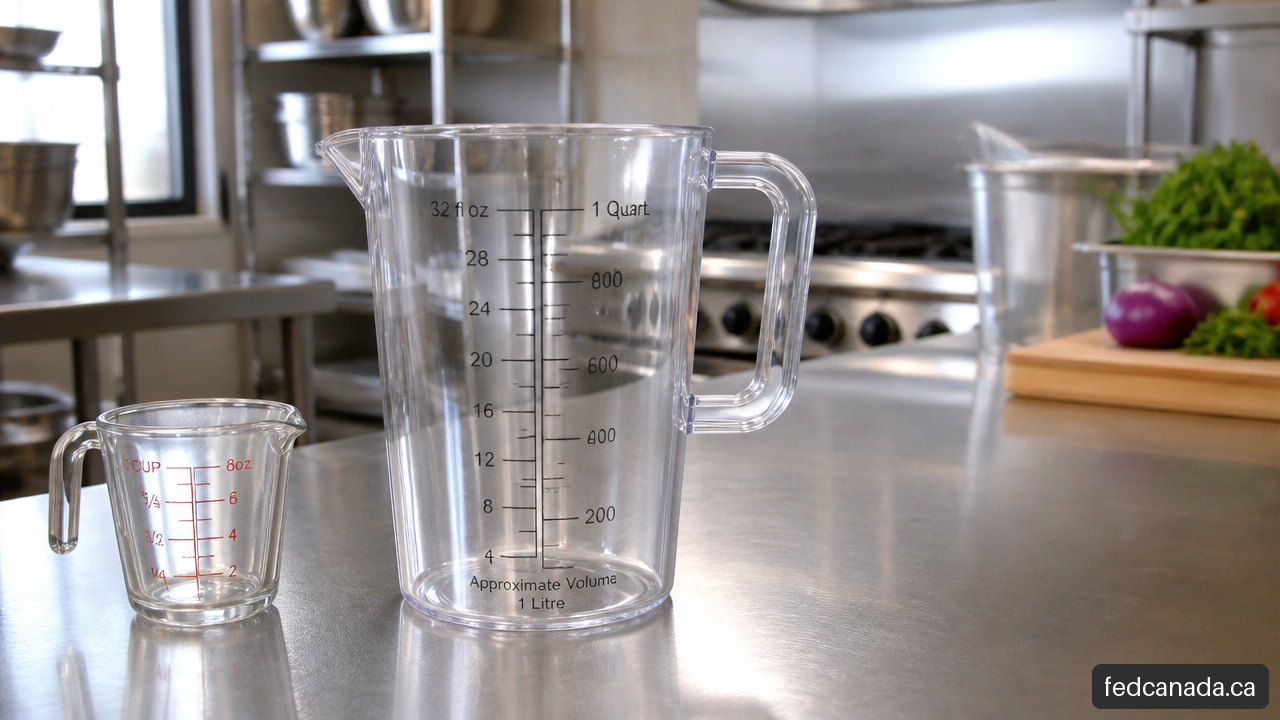
A 1 qt cup usually means a container with a one-quart liquid capacity. The quick answer is simple: 1 US quart equals 4 US cups. But for Canadian kitchens, recipe conversions, product labels, and foodservice prep, the measurement system matters just as much as the math.
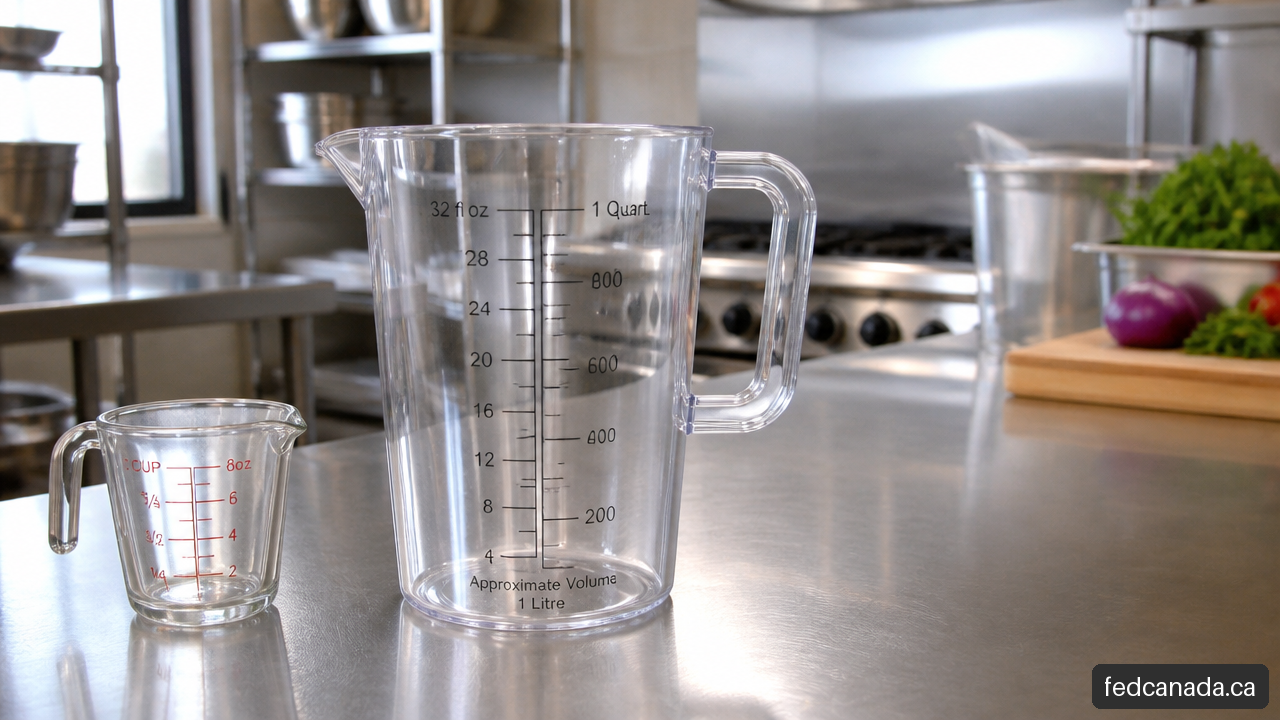
A quart can refer to a US customary quart or an Imperial quart, while a “cup” may mean a US cup or a 250 mL Canadian metric cup. Those units are close enough to look interchangeable on paper, yet different enough to affect a soup batch, sauce ratio, baking formula, or storage-container fill level.
Table of Contents
- What a 1 qt cup means
- US, metric, and Imperial quart differences
- How to measure one quart accurately
- Using quart measurements in cooking and foodservice
- Key Takeaways
- FAQ: 1 qt cup questions
- Sources
What a 1 qt cup means
The phrase 1 qt cup can mean two different things. It may describe a one-quart measuring container, prep container, deli container, or liquid vessel. It may also be shorthand for the question, “How many cups are in 1 quart?” The surrounding wording usually reveals the intended meaning.
For example, “Fill a 1 qt cup with stock” refers to a container capacity. “Convert 1 qt to cups” is a measurement question. In either case, identifying the volume system is the first useful step.
The standard US answer
In the US customary system:
| Measurement | Equivalent volume |
|---|---|
| 1 US quart | 4 US cups |
| 1 US quart | 2 US pints |
| 1 US quart | 32 US fluid ounces |
| 1 US quart | 1 quarter of a US gallon |
| 1 US quart | about 946.35 mL |
The familiar four-cup answer works when both the quart and cups are US customary units. A US cup is approximately 236.59 mL, so four US cups total approximately 946.35 mL.
This is often the intended interpretation in US recipes, equipment specifications from US manufacturers, and containers marked with US fluid ounce graduations. A 32 fl oz fill line is a practical confirmation that a vessel is designed around one US quart.
Why “cup” creates confusion
A cup sounds like a universal unit, but it is not. A US measuring cup, an Imperial cup, and a Canadian metric cup do not necessarily hold the same amount.
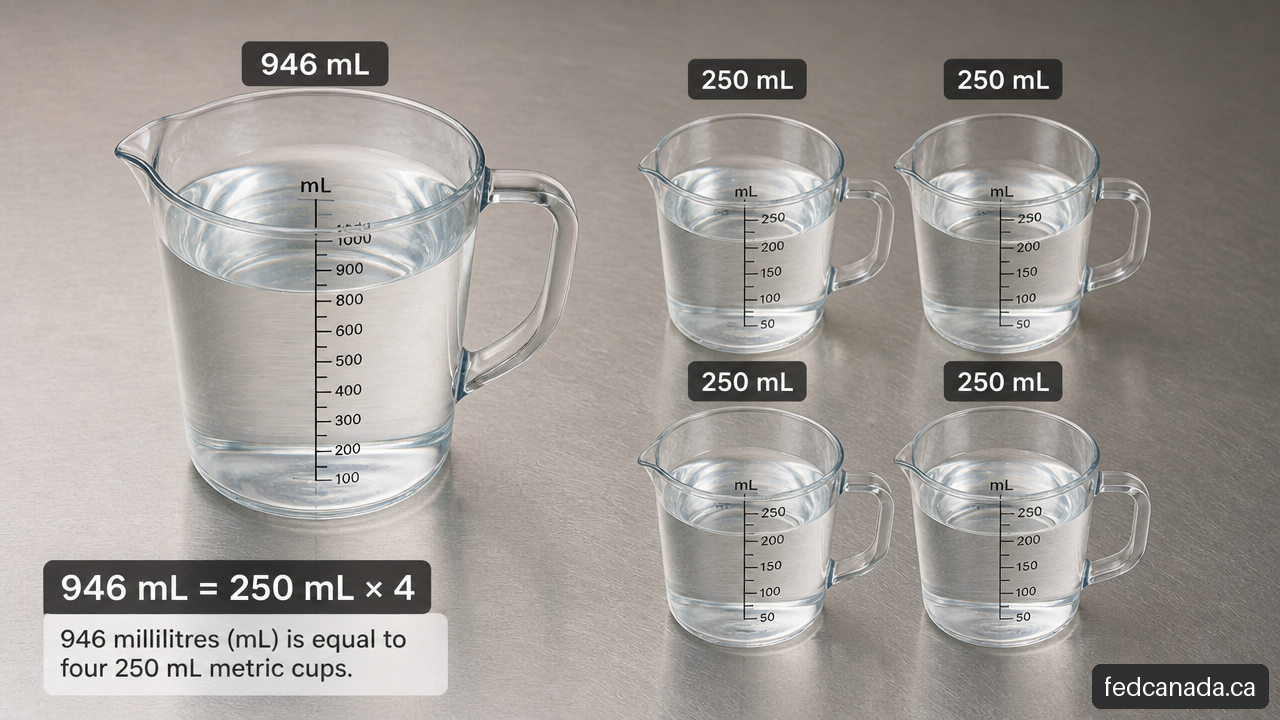
The issue becomes noticeable when a recipe says “1 quart” but the available measuring cup is marked only in 250 mL increments. Four 250 mL cups equal 1,000 mL. That is 53.65 mL more than a US quart, which is approximately 5.7% extra volume.
For a pot of broth, that difference may be manageable. For a reduced sauce, custard, brine, or a small baking recipe where moisture balance matters, it can change the result. I recommend treating an unlabeled “cup” as a question to resolve rather than assuming it equals the cup used in the original recipe.
A useful interpretation rule
Use the units printed on the recipe, package, measuring tool, or equipment specification as the controlling context.
- If a recipe uses fluid ounces, US pints, US gallons, or US cups, interpret the quart as a US quart unless it says otherwise.
- If a Canadian recipe uses millilitres and litres alongside “cups,” the cup may be a 250 mL metric cup.
- If a document expressly says Imperial, use Imperial volumes throughout rather than mixing them with US measures.
- If the system is unclear, convert the target volume to millilitres and measure with a marked graduated container.
That last option removes most of the ambiguity. Instead of debating what “four cups” means, measure the stated target volume directly.
US, metric, and Imperial quart differences
The phrase “1 quart equals 4 cups” is true only when quart and cup belong to the same measurement system. It does not mean every group of four cups equals every quart.
Side by side volume comparison
| Measurement system | Quart volume | Cup volume used in that system | Cups needed for that quart |
|---|---|---|---|
| US customary | 946.352946 mL | about 236.59 mL | 4 US cups |
| Canadian metric cup comparison | 946.352946 mL | 250 mL | about 3.785 metric cups |
| Imperial | 1,136.5225 mL | system dependent | 4 corresponding Imperial cups |
A review of cooking weights and measures shows the key distinction: a Canadian metric cup is 250 mL, while a US quart is approximately 946.353 mL and an Imperial quart is 1,136.5225 mL.
That difference is not merely technical. An Imperial quart holds about 190 mL more than a US quart. In practical terms, that is more than three quarters of a 250 mL metric cup.
Converting a US quart into Canadian metric cups
A Canadian metric cup is commonly 250 mL. Since one US quart is 946.352946 mL, it equals about 3.785 metric cups, not four metric cups. The exact numerical conversion is shown by this US quart to metric cup conversion.
This is where a familiar shortcut can become misleading:
Four cups equal one quart only when the cups and quart come from the same system.
If a recipe calls for one US quart and only a 250 mL metric cup is available, the accurate approach is to measure 946 mL, or use three full 250 mL cups plus roughly 196 mL. Filling four 250 mL cups produces a full litre, which is larger than the requested US quart.
Canadian and Imperial terminology
Canadian kitchens commonly use metric volume markings, particularly millilitres and litres. However, older equipment references, imported recipes, and some product descriptions may use Imperial terminology. That makes “quart” potentially unclear without nearby units or clear labelling.
For an alternative Canadian system conversion, ConvertUnits’ Canadian quart and cup comparison shows a different relationship than the standard US four-cup conversion. This is precisely why it is safer to identify the system before scaling a recipe.
A simple recovery method helps when you discover a mismatch late in prep. Stop using cups as the bridge unit, convert the intended quantity to millilitres, and continue from that volume. For a US quart, use approximately 946 mL. For an Imperial quart, use 1,136.5 mL. The numbers may be less memorable, but they are much harder to misinterpret.
How to measure one quart accurately
The best tool depends on what you are measuring and how much precision the task needs. A clear graduated container is usually more reliable than repeated fills from an unlabeled cup.
Choose the measuring tool before you start
Use this practical guide:
| Situation | Best choice | Why |
|---|---|---|
| US recipe calling for 1 quart | 1 qt or 32 fl oz marked container | Matches the recipe’s likely system |
| Canadian recipe with metric units | 1 L graduated container | Easy to read in mL and L |
| Need exactly 1 US quart with metric tools | Graduated container filled to 946 mL | Avoids the four 250 mL cup error |
| Large volume soup or stock prep | Larger graduated pitcher or scale with a validated recipe | Faster and less spill prone |
| Thick sauces or viscous liquids | Wide graduated container and scraper | Reduces product left behind in the cup |
A one-litre container is especially useful in Canada, but it should not be mistaken for a one-US-quart container. It is about 53.65 mL larger. For general liquid holding, the difference may not matter. For formula-based recipes, use the line that matches the recipe’s system.
Measure liquids at eye level
Accurate volume measurement is mainly about reading the liquid level correctly. Place the container on a stable, level surface. Let the liquid settle, then lower your line of sight until it is level with the mark.
For water, stock, juice, milk, oil, and other thin liquids, read the lowest point of the curved liquid surface, known as the meniscus. You do not need lab-level precision for every kitchen task, but a tilted measuring vessel can add more error than the last few millilitres of the conversion.
Follow this sequence:
- Confirm whether the recipe uses US customary, metric, or Imperial units.
- Select a container marked in the needed unit whenever possible.
- Set the container on a level counter before reading the measurement.
- Pour slowly as you near the target line.
- Recheck after bubbles settle, especially with foamy liquids such as milk, cream, or blended mixtures.
- Transfer promptly if the ingredient is hot or if the container is not designed for storage.
Account for different liquid behaviours
Not every liquid pours or settles the same way. Water and broth form a clear meniscus quickly. Oil clings to the side of the measuring cup. Honey, syrup, melted chocolate, and thick sauces can leave a substantial coating behind.
For viscous ingredients, measure in a vessel with a wide opening and scrape the sides with a flexible spatula. If the recipe is sensitive to ratios, such as a glaze or syrup, use the same measurement system for every ingredient. Switching from a US quart of liquid to four 250 mL cups partway through creates a mismatch even if each individual measurement looks reasonable.
Do not fill a storage container to the rim
A one-quart container describes its total capacity, not necessarily its recommended working fill level. Hot soup needs room for safe handling. Liquids that freeze need headspace for expansion. Sauces being transported need room to reduce splashing when the lid is applied.
For storage or transport, leave enough empty space to fit the lid securely and prevent overflow. The right amount depends on temperature, movement, and whether the food will expand. A quart container filled to the very top may technically hold one quart, but it is not automatically the best way to portion or carry a full quart of liquid.
Using quart measurements in cooking and foodservice
Quart measurements appear frequently in recipes because they are large enough for sauces, soups, dairy, stocks, batters, and beverage bases without requiring repeated cup measurements. In restaurant prep, one quart also aligns with common container sizes, making it useful for portioning and batch organization.
When a one quart container is the practical choice
A one-quart container is a sensible choice when the recipe or prep list calls for a quantity close to 946 mL, or when a standardized quart portion simplifies station setup.
Examples include:
- Portioning cooled soup base for a small batch
- Holding measured stock before adding it to a sauce
- Organizing premeasured dry or wet ingredients for production
- Storing a beverage concentrate in a labeled, lidded container
- Separating a one-quart batch for cooling, reheating, or transport
The container’s markings should match the work. A clear container with readable mL, ounce, or quart graduations is useful when the measured amount matters. A plain container of roughly one-quart capacity is suitable for storage, but it should not be treated as a precision measuring device unless it has reliable marks.
Scaling recipes without multiplying errors
Suppose a soup recipe calls for 1 US quart of stock. Doubling the recipe means 2 US quarts, or approximately 1.893 L. If you instead use two full litre measures, you add about 107 mL beyond the intended amount.
That may sound small, but scaling magnifies the issue. A ten-quart batch interpreted as ten litres adds more than half a litre compared with ten US quarts. In a stock-heavy soup that could be acceptable; in a reduced sauce, it may require more time and energy to reach the intended consistency.
The practical decision is not “always use millilitres” or “always use quarts.” It is to choose one system, stay within it, and convert only once. For Canadian commercial kitchens working from mixed recipe sources, recording both the original unit and a verified metric equivalent on the prep sheet can reduce repeat errors.
Dry ingredients need a different approach
A quart is a measure of volume, not weight. It can measure flour, sugar, chopped vegetables, or other dry ingredients, but a quart of one ingredient does not weigh the same as a quart of another.
For baking and formula-driven production, weight is often the more repeatable option for dry ingredients. Flour can compact during scooping, shredded cheese can settle, and chopped vegetables can vary widely in particle size. Use a quart or cup measure for liquids and broad-volume prep where appropriate, but follow recipe weights when they are provided.
When to pause before converting
Pause and verify the source measurement when any of these signs appear:
- A recipe uses both litres and quarts without explaining the system
- A measuring vessel has only 250 mL cup marks, while a recipe was written in US cups
- The recipe came from an older Imperial source or imported equipment manual
- A portioned product must meet a defined fill volume
- A recipe is being multiplied several times for production
The fix is straightforward: identify the original unit, calculate the metric target, write it down, and use that same target throughout the batch. This is more dependable than relying on memory of conversion shortcuts during a busy prep period.
Key Takeaways
The answer depends on the measurement system
- 1 US quart equals 4 US cups, 32 US fluid ounces, and approximately 946.35 mL.
- A Canadian metric cup is 250 mL, so a US quart equals about 3.785 metric cups, not four 250 mL cups.
- An Imperial quart is 1,136.5225 mL, making it larger than a US quart.
The safest measuring decision
- Use a 32 fl oz or US quart marked vessel for a US recipe.
- Use a graduated metric container when the recipe is in millilitres or litres.
- Measure 946 mL when you need one US quart but only metric tools are available.
- Avoid treating a one-litre container as automatically equal to one US quart.
The practical rule for containers
A 1 qt cup may be a capacity label rather than a precision instruction. Check graduations, leave headspace for hot or moving liquids, and use the recipe’s original system for accurate results.
FAQ: 1 qt cup questions
How many cups are in 1 quart?
One US quart equals 4 US cups. This is the standard answer used in US customary cooking measurements. It is accurate only when the cups are US cups, each measuring approximately 236.59 mL.
Is 1 quart always equal to 4 cups?
No. It equals four cups when the quart and cup are defined within the same system. Four US cups equal one US quart. Four corresponding Imperial cups equal one Imperial quart. Four Canadian metric cups equal 1,000 mL, which is larger than a US quart.
How many millilitres are in 1 US quart?
One US quart equals 946.352946 mL, commonly rounded to 946 mL or 0.946 L for kitchen use. If a recipe requires exact conversion and the available tools are metric, fill to 946 mL rather than one full litre.
How many millilitres are in 1 Imperial quart?
One Imperial quart equals 1,136.5225 mL, or about 1.137 L. That is substantially larger than a US quart, so the two should not be swapped in recipes without conversion.
How many 250 mL cups make 1 US quart?
A US quart is about 3.785 cups of 250 mL each. In a practical kitchen measurement, use three full 250 mL cups plus about 196 mL to reach one US quart. Using four full metric cups makes one litre, not one US quart.
Is 1 quart the same as 1 litre?
No. One US quart is approximately 0.946 L, while one litre is 1,000 mL. The difference is 53.65 mL. A litre is closer to 1.057 US quarts.
How can I measure 1 quart without a quart container?
For a US quart, use one of these methods:
- Measure 4 US cups.
- Measure 32 US fluid ounces.
- Measure approximately 946 mL in a graduated metric container.
The 946 mL method is usually the clearest option when using Canadian metric measuring tools.
Does a 1 qt cup mean a one quart container or four cups?
It can mean either. On a product listing or container label, it usually means a vessel with a one-quart capacity. In a conversion question, it usually refers to the relationship between quarts and cups. Look for nearby terms such as “capacity,” “container,” “32 oz,” “recipe,” or “convert” to determine the intended meaning.
Sources
- Wikipedia — Cooking weights and measures: https://en.wikipedia.org/wiki/Cooking_weights_and_measures
- UnitConverters.net — Convert Quart (US) to Cup (metric): https://www.unitconverters.net/volume/quart-us-to-cup-metric.htm
- ConvertUnits — Convert quart to cup [Canada]: https://www.convertunits.com/from/quart/to/cup+%5BCanada%5D