




Funnel: From Physical Tool to Marketing System
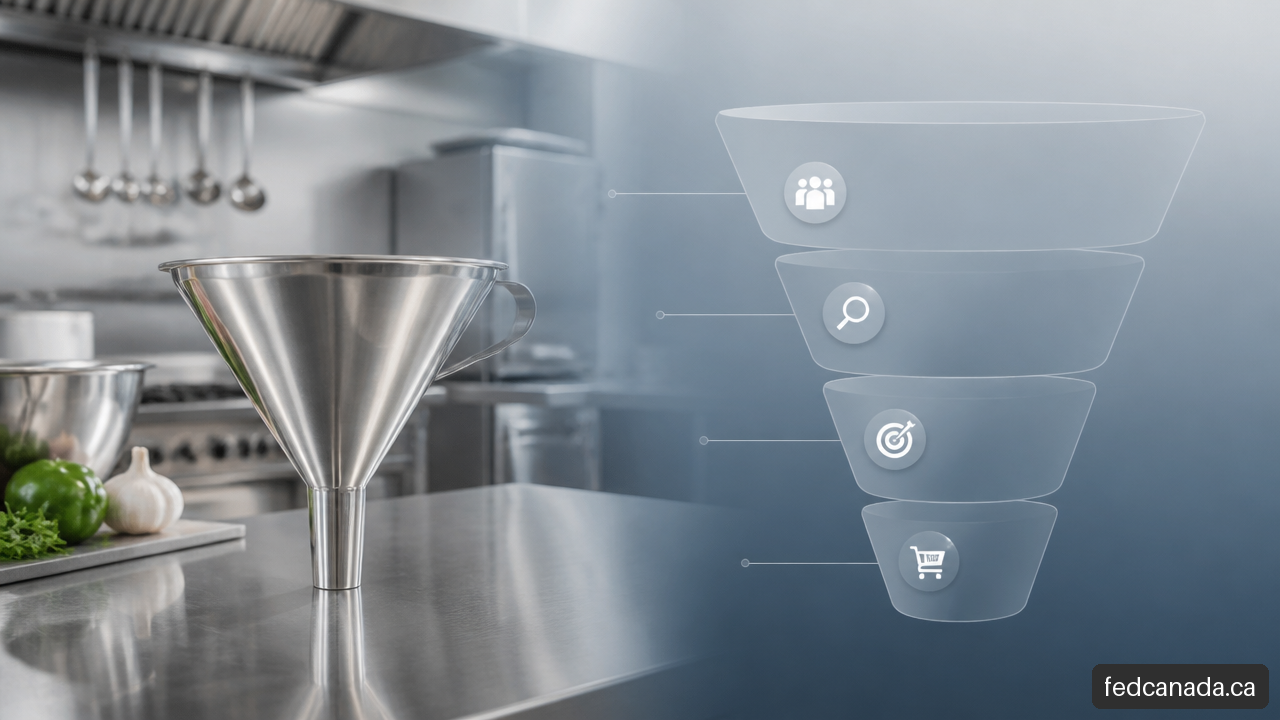
Funnel can mean a simple pouring tool, a model for guiding buyers toward a decision, or a marketing-data platform called Funnel. The right meaning depends on the problem you are trying to solve. A kitchen operator may need a physical funnel for transferring sauces or dry ingredients, while a business owner may need a clearer view of how prospects become customers.
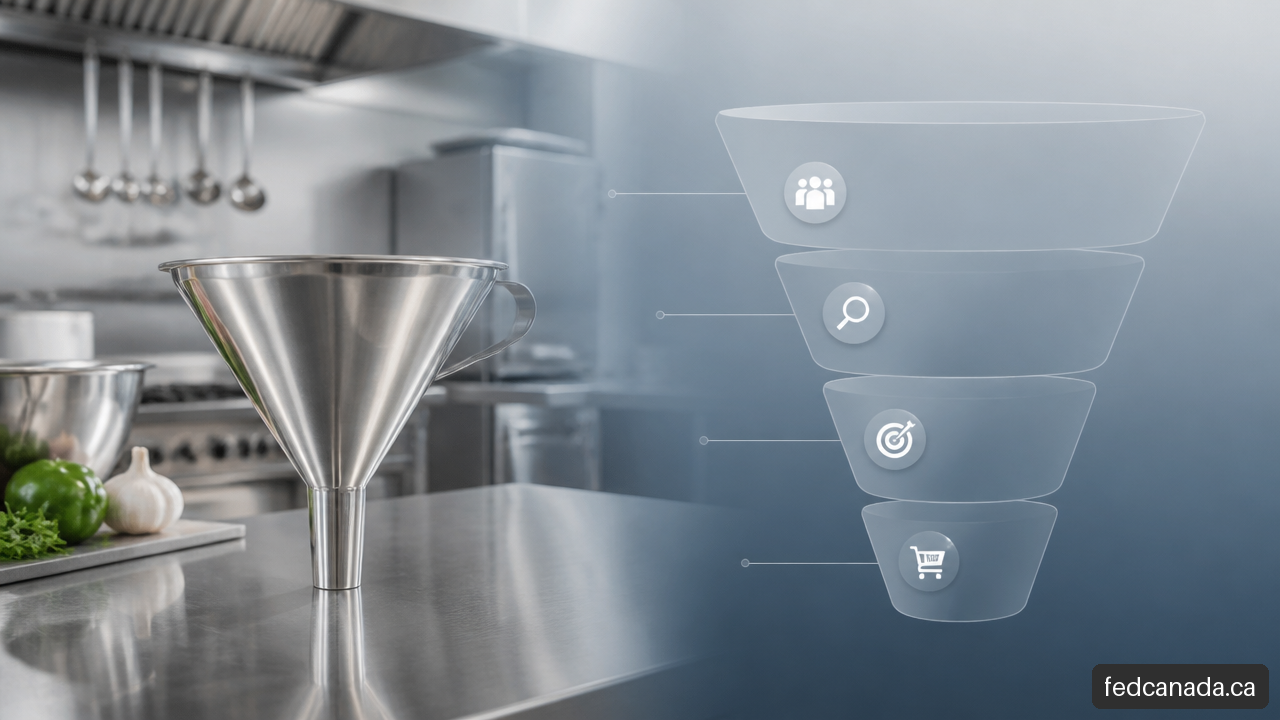
For this article, I will distinguish these meanings first, then focus on the marketing and data concepts that help organizations measure customer journeys, improve conversion rates, and make better decisions.
Table of Contents
- Key Takeaways
- What Does Funnel Mean?
- How a Marketing Funnel Works
- Funnel Software and Marketing Data
- How to Improve a Conversion Funnel
- Frequently Asked Questions
Key Takeaways
Funnel has three common meanings
A physical funnel directs liquids, powders, or small ingredients into a narrow opening. A marketing funnel describes the path people take from first awareness to a desired action. Funnel, with a capital F, is also the name of a marketing-intelligence platform for collecting, preparing, and sharing marketing data.
The shape represents drop-off, not failure
A funnel is wider at the top because more people may see an offer than ultimately purchase it. That narrowing is normal. The useful question is not whether prospects leave, but whether avoidable friction is causing the right prospects to leave too soon.
Better decisions require stage-level measurement
A single revenue number cannot explain where performance changed. Measuring movement between awareness, consideration, intent, and conversion helps identify whether the issue is reach, message fit, offer clarity, sales follow-up, checkout friction, or data quality.
A funnel is most useful when it turns a vague concern such as “sales are down” into a specific operational question: “Which customer action declined, when did it change, and what may have caused it?”
What Does Funnel Mean?
A physical funnel directs materials accurately
The literal funnel is a hollow, tapered tool that helps transfer a material from a wider opening to a smaller one. In foodservice settings, this may mean moving oil into a container, portioning sauces into bottles, or filling spice jars without unnecessary waste.
Its design solves a practical control problem. The wide mouth catches material, the narrow tube directs it, and the user can control flow more precisely than by pouring directly. Material viscosity, opening size, cleanliness requirements, and spill risk all affect which physical funnel is appropriate.
For example, a wide-mouth stainless steel funnel can suit thicker ingredients or repeated commercial use, while a small plastic funnel may be sufficient for occasional dry goods. A narrow tube may be too slow for thick sauces, and a funnel that is difficult to sanitize can create avoidable food-safety concerns.
Funnel can also describe directed movement
The term is used as a verb when people, materials, money, or information are directed toward one place. Merriam-Webster’s definition of “to funnel” includes moving something toward a focal point or through a conduit.
That idea carries directly into business. A company may funnel website traffic to a product page, inquiries to a sales team, or marketing data into a reporting system. The word does not automatically imply manipulation. It simply describes a designed path.
A marketing funnel models customer progress
A marketing funnel is a simplified model of how people move from discovering an offer to taking a desired action. That action could be buying a product, requesting a quote, booking a consultation, downloading a menu, subscribing to updates, or starting a financing application.
The model is useful because buyers do not all arrive ready to purchase. A restaurant owner searching for a replacement refrigeration unit after equipment failure has a different need from an entrepreneur researching what equipment is required to open a café. Both may eventually buy commercial equipment, but they need different information and different CTAs.
| Meaning of funnel | Main purpose | Typical example | Key decision factor |
|---|---|---|---|
| Physical funnel | Transfer materials cleanly and accurately | Filling a bottle with sauce | Material, flow rate, sanitation |
| Marketing funnel | Guide potential customers toward action | Visitor becomes a quote request | Relevance, trust, friction |
| Sales funnel | Manage opportunities through sales stages | Qualified lead becomes closed sale | Follow-up, fit, timing |
| Funnel software | Organize marketing data for reporting and analysis | Ad and CRM data flow into reports | Data quality, access, governance |
How a Marketing Funnel Works
The usual stages: awareness through conversion
Marketing teams may use different labels, but most funnels include a progression from awareness to consideration, decision, and conversion. Sales teams may add stages such as qualification, proposal, negotiation, and closed won.
The important point is that stages should reflect observable behavior, not vague assumptions. “Interested” is hard to measure. “Viewed a product category twice in seven days” or “requested a quote” is easier to define and audit.
- Awareness: A person first encounters the business, product, or problem it solves.
- Consideration: They compare options, read specifications, review prices, or evaluate alternatives.
- Intent: They show stronger purchase signals, such as adding an item to a cart, requesting a quote, or checking delivery availability.
- Conversion: They complete the target action, such as purchasing, submitting a form, or booking a call.
- Retention and advocacy: Existing customers reorder, renew, refer others, or leave reviews.
Marketing, sales, and conversion funnels are related but different
These models overlap, but they answer different questions. A marketing funnel asks how attention becomes interest. A sales funnel asks how opportunities are managed toward revenue. A conversion funnel focuses on measurable digital or operational actions.
For a commercial equipment supplier, an awareness-stage visitor may read about choosing a commercial range. A consideration-stage visitor may compare electrical requirements, dimensions, lead times, and financing options. An intent-stage visitor may request a quote or place an item in a cart. The conversion may be an online order, a completed purchase order, or a confirmed financed transaction.
Measure the transitions, not just the totals
Funnel metrics work best when calculated between stages. The basic formula is straightforward:
Stage conversion rate = people who completed the next action ÷ people who entered the current stage × 100
Suppose 1,000 visitors reach a refrigeration category page, 120 view a product page, 30 add a unit to a cart, and 12 complete an order. Each step provides a different diagnostic signal.
| Funnel transition | Example calculation | What a weak result may indicate |
|---|---|---|
| Category view to product view | 120 ÷ 1,000 = 12% | Poor filtering, weak product relevance, unclear category structure |
| Product view to cart | 30 ÷ 120 = 25% | Pricing concerns, missing specifications, delivery uncertainty |
| Cart to purchase | 12 ÷ 30 = 40% | Checkout friction, freight surprises, payment barriers, delayed approvals |
No benchmark is universally “good.” A high-value custom equipment purchase will behave differently from a low-cost accessory order. Compare similar products, traffic sources, time periods, and customer types before treating a change as meaningful.
Why prospects leave at each stage
Drop-off often comes from a mismatch between buyer questions and available information. At the top of funnel, the message may reach people who are not a fit. In the middle, product details may not answer practical questions. At the bottom, uncertainty about cost, shipping, installation, warranty, or payment can delay action.
This is why more traffic is not always the answer. If many visitors reach product pages but few request quotes, sending more paid traffic may simply increase wasted spend. The better next step may be clearer specifications, transparent delivery guidance, stronger CTAs, or an easier way to speak with a knowledgeable representative.
Funnel Software and Marketing Data
What Funnel software is designed to do
Funnel is not the same thing as a marketing funnel. Funnel is a software platform. Funnel’s official introduction describes it as a marketing-intelligence platform that collects, stores, and prepares marketing data.
That distinction matters. A marketing funnel is the customer-behavior model. A marketing-data platform helps bring together the information needed to evaluate that model. One is a framework for understanding buyer progress; the other is a system that can support measurement and reporting.
Data Hub and Measure serve different jobs
Funnel’s documentation distinguishes between Funnel Data Hub, its core environment for working with marketing data, and Funnel Measure, an add-on focused on marketing measurement. The practical difference is task-based rather than purely technical.
| Product area | Primary job | Best fit | Watch for |
|---|---|---|---|
| Funnel Data Hub | Connect, organize, store, visualize, and share marketing data | Teams needing consistent reporting inputs across sources | Definitions and naming rules still need ownership |
| Funnel Measure | Support marketing measurement and analysis | Teams evaluating marketing performance and attribution questions | Measurement design must match business decisions |
| Funnel AI | Help explore data and product documentation | Users needing guidance within the platform | Outputs still require human review and context |
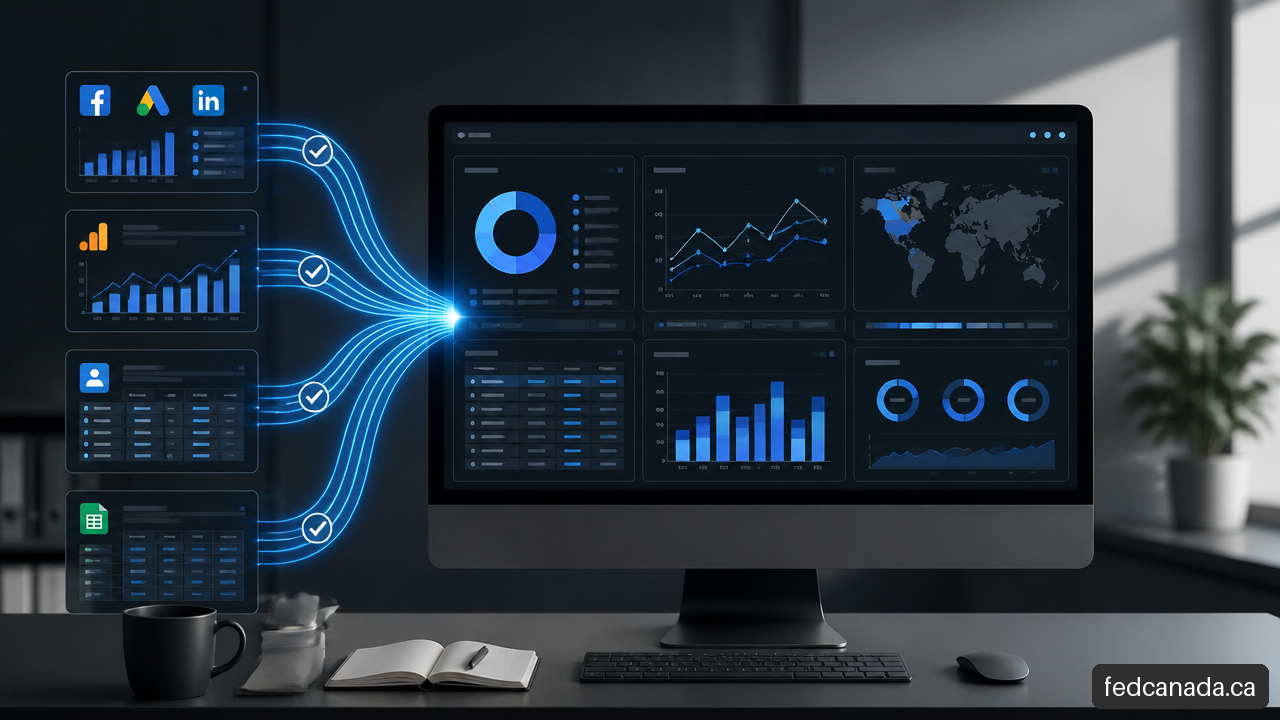
Choose a data hub when the immediate problem is fragmented reporting: advertising platforms, analytics systems, CRM records, spreadsheets, and other sources show different figures or require repetitive exports. Choose a measurement layer when the organization has reasonably organized data but needs stronger methods for understanding performance and assigning marketing credit.
Connectors simplify collection, but do not remove responsibility
Connector-based tools can retrieve data from advertising, analytics, and CRM systems and send it to reporting destinations. This can reduce manual export work, but it does not make every source automatically comparable.
Fair warning: different platforms define metrics differently. “Clicks,” “conversions,” “revenue,” and “new customer” may each use different attribution windows, time zones, deduplication rules, or reporting delays. A dashboard can look precise while combining figures that are not directly comparable.
A useful governance process assigns responsibility for:
- Defining shared metrics, including revenue, leads, qualified leads, and conversions.
- Documenting source systems, refresh schedules, permissions, and known limitations.
- Naming fields consistently so “Paid Social Spend” is not split across several nearly identical labels.
- Reconciling unexpected changes before executives use the data for budget decisions.
Questions to ask before adopting a marketing-data platform
No platform should be selected based only on connector count or dashboard screenshots. Product capabilities, supported destinations, and integrations can change over time. Verify current requirements directly with the vendor before committing.
Ask these questions early:
- Which sources are essential, and which fields must be available from each source?
- How frequently does data refresh, and what happens if a source connection fails?
- Can the platform preserve required historical data, or are there source-specific limits?
- Who owns metric definitions and approves changes to transformations?
- What permissions, privacy obligations, contractual terms, and data-location requirements apply to your organization?
- Can nontechnical users understand the reporting logic well enough to challenge unusual results?
For a Canadian organization, privacy and data-handling requirements should be reviewed with the appropriate internal or professional resources. The answer depends on the data involved, contractual commitments, provinces where customers operate, and how data is collected and used. For example, aggregated ad-spend data presents a different risk profile than a dataset containing identifiable customer records from a CRM.
How to Improve a Conversion Funnel
Start with one decision and one conversion event
A common failure is building an elaborate funnel before agreeing on its purpose. Start smaller. Define one business decision, one audience, and one conversion event.
For example, an operator may want to know why quote requests for commercial refrigeration have declined. The conversion event is the completed quote request. The funnel can then track traffic to relevant categories, product detail views, quote-form starts, and quote-form submissions. This is more actionable than reporting every website event at once.
Diagnose friction with evidence, not guesses
When a stage underperforms, inspect the experience surrounding that action. A category page may need clearer filters for width, voltage, capacity, condition, or price range. A product page may need better dimensions, documentation, availability signals, or shipping information. A form may ask for too much information before a buyer sees a reason to complete it.
Use a controlled process:
- Confirm that tracking is working and that the comparison period is valid.
- Segment results by device, channel, product category, customer type, and geography where appropriate.
- Identify the largest meaningful drop-off, not merely the lowest percentage.
- Form one explanation that can be tested.
- Change one or a small number of related elements.
- Review conversion quality, not just conversion volume.
A larger number of form completions is not automatically better if the new form attracts low-fit inquiries that sales teams cannot serve efficiently.
Match the CTA to the buyer’s level of readiness
A CTA should feel like a logical next step. Asking a first-time visitor to “Buy Now” may be premature for a complex, high-cost purchase. Asking only for an email may be too weak for someone urgently replacing failed equipment.
| Buyer situation | Better CTA | Why it fits |
|---|---|---|
| Researching an opening or renovation | View equipment checklist or compare categories | Supports early planning without forcing a commitment |
| Comparing specific models | Check specifications or request a quote | Addresses technical and budget questions |
| Replacing failed equipment urgently | Confirm availability or contact support | Reduces delay and operational uncertainty |
| Ready to order a standard item | Add to cart or begin checkout | Keeps the purchase path direct |
Avoid the most common funnel-management mistakes
The first mistake is treating every visitor as equally valuable. A broad audience may improve top-of-funnel volume while lowering downstream efficiency. The second is optimizing one stage in isolation. A more aggressive CTA can increase clicks but reduce qualified leads if it creates unclear expectations.
The third is relying on inconsistent data. If paid advertising reports one conversion total, web analytics reports another, and the CRM reports a third, do not average them and move on. Determine what each system measures, when it records the event, and whether the same person or order may be counted more than once.
The fourth is assuming a funnel is linear. Real buyers often return through several channels. Someone may first see an ad, later search for a product, request a quote after speaking to a colleague, and purchase days later through a different device. Funnels remain useful models, but they should not be mistaken for a complete record of every decision influence.
Frequently Asked Questions
Is a funnel only a physical tool?
No. A funnel can be a physical tool for directing materials, a verb describing directed movement, a business model of customer progression, or the name of a marketing-data platform. Context usually makes the intended meaning clear.
What is the difference between a marketing funnel and a sales funnel?
A marketing funnel focuses on building awareness and interest before a prospect is ready to engage deeply. A sales funnel focuses on managing qualified opportunities through steps such as discovery, proposal, negotiation, and purchase. In many organizations, the two connect at the point where a marketing-qualified lead becomes a sales opportunity.
What are the usual stages of a conversion funnel?
Most conversion funnels move through awareness, consideration, intent, and conversion. Some organizations add retention and advocacy after purchase. The right stages are the ones tied to real actions that can be reliably measured.
Why does a funnel get narrower at each stage?
People leave because not everyone who sees an offer needs it, can afford it, trusts it, or is ready to act. Some drop-off is expected. The goal is to reduce unnecessary friction for qualified prospects rather than attempting to retain every visitor.
How do I calculate funnel conversion rate?
Divide the number of people who completed the next action by the number who entered the prior stage, then multiply by 100. For example, if 20 of 100 product-page visitors submit a quote request, the product-page-to-quote conversion rate is 20%.
What is Funnel software?
Funnel is a marketing-intelligence platform that helps organizations collect, store, and prepare marketing data. It can support reporting workflows by bringing data from multiple marketing sources into a more manageable structure.
What causes inaccurate funnel reporting?
Common causes include broken tracking, inconsistent event definitions, differing attribution rules, duplicate records, time-zone differences, missing CRM data, connector failures, and changes to source-platform reporting. Before acting on an apparent trend, confirm that the underlying data and definitions are stable.
Sources/References
- merriam-webster.com: https://www.merriam-webster.com/dictionary/funnel
- help.funnel.io: https://help.funnel.io/en/articles/8020917-introduction-to-funnel
Recent Posts


Leave a Comment
Your email address will not be published. Required fields are marked *