





Commercial Equipment Warranties and Service Plans: What to Check
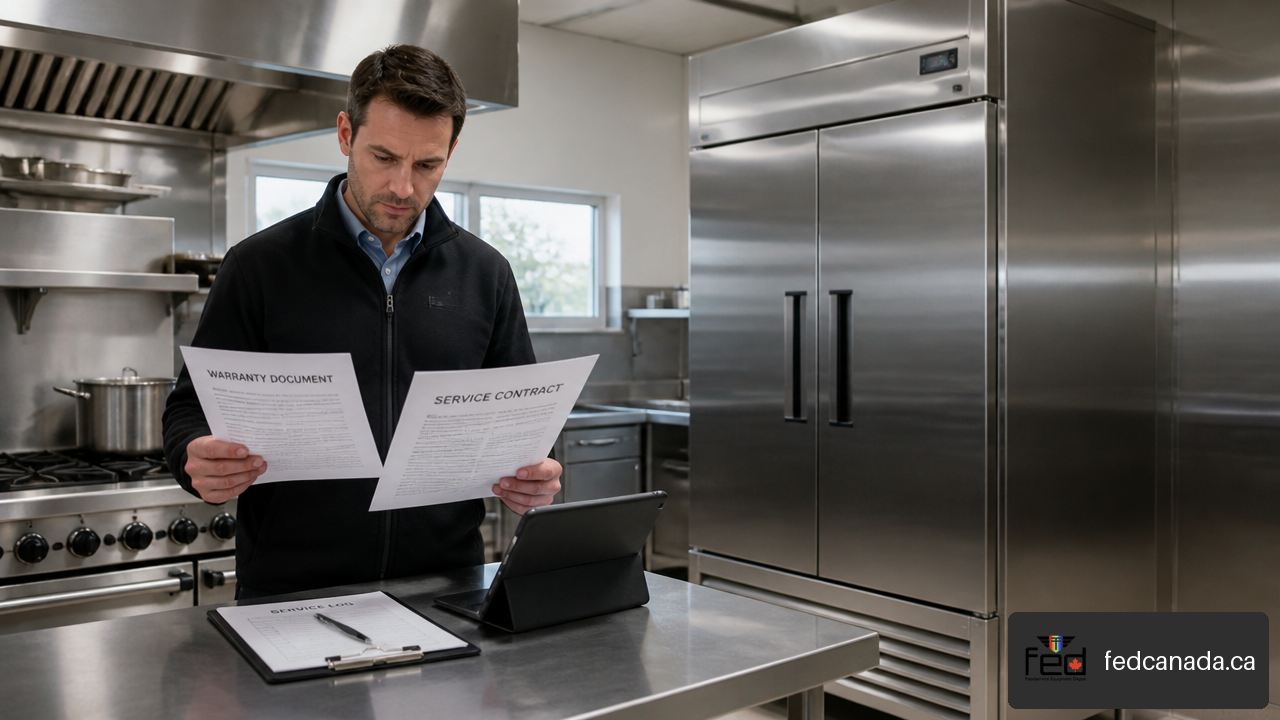
Choosing a commercial equipment warranty or service plan comes down to one practical question: what happens when critical equipment stops working? A warranty may cover a failed part but not the technician’s trip charge. A service plan may promise priority response but exclude preventive maintenance, expedited freight, or business interruption. Those gaps matter when a refrigerator, combi oven, dishwasher, HVAC unit, laundry machine, or other revenue-critical asset is out of service.
We recommend treating warranty and service terms as part of the equipment purchase, not paperwork to review after delivery. The right agreement can reduce unexpected repair costs and shorten disruption. The wrong one can leave a business paying for labour, travel, diagnostics, rental equipment, and lost operating time despite having “coverage.”
Table of Contents
- Key Takeaways
- Start With the Difference Between a Warranty and a Service Plan
- Check Coverage, Exclusions, and Operating Conditions
- Measure the Plan Against Downtime Risk
- Build a Claim Process Before a Failure
- Frequently Asked Questions
Key Takeaways
An OEM warranty is usually the manufacturer’s baseline promise for defined defects or component failures. An extended service contract is a separate paid agreement that may add repair support, labour, travel, maintenance, or post-warranty coverage.
Do not assume “parts and labour” includes diagnosis, technician travel, after-hours work, shipping, rental equipment, or expedited freight. Each cost should be named in writing.
Match the contract’s commercial use definition to real operating conditions, including hours of operation, throughput, temperature, humidity, washdown exposure, and multi-shift use.
Ask what starts the service clock. “Response within one business day” can mean a ticket acknowledgement, technician dispatch, site arrival, or completed repair. These are not the same outcome.
Review backorder wording closely. A repair promise can become less useful if parts shortages suspend the provider’s obligations without an escalation, replacement, or loaner option.
Keep a claim file with purchase, installation, maintenance, fault, and service records. Documentation does not guarantee approval, but it can reduce avoidable disputes.
Start With the Difference Between a Warranty and a Service Plan
A warranty is not automatically a full repair program
A commercial equipment warranty generally protects against specified manufacturing defects or failures during a defined period. It may cover a compressor for several years, for example, while labour coverage lasts for a much shorter period. Electronics, controls, structural components, and accessories can have separate terms.
That distinction is easy to miss because sellers often describe a product using one headline warranty period. The headline is only a starting point. The actual terms may divide coverage by component, remedy, labour allowance, and permitted use.
A useful way to review the document is to separate these questions:
| Contract question | Why it matters | What to request |
|---|---|---|
| Which components are covered? | Compressors, motors, electronics, frames, controls, and accessories may have different terms. | A component-by-component coverage schedule. |
| What remedy applies? | Repair, replacement part, credit, or replacement unit create very different business outcomes. | Written remedy hierarchy and approval process. |
| Who performs the work? | Some manufacturers require authorized technicians. | A list of approved service providers for your location. |
| Which costs are included? | A covered part can still leave labour or travel charges. | A list of included and excluded charges. |
A service plan is different. It is a contract for defined support services, usually purchased separately from the equipment. Depending on the plan, it may start after the manufacturer warranty expires, overlap with it, or provide benefits the warranty does not. It may include corrective repair after a failure, scheduled inspection, cleaning, calibration, priority dispatch, or discounted replacement parts.
The key word is may. Do not assume preventive maintenance is included just because the plan is called “comprehensive.” Preventive maintenance and corrective repair are separate activities. Preventive maintenance is scheduled work intended to reduce failure risk. Corrective maintenance happens after a fault occurs.
Read the manufacturer and installer agreements together
The manufacturer, equipment seller, installer, and service contractor may each have different responsibilities. For example, a manufacturer warranty might cover a defective component, while the installer is responsible for workmanship or utility connections. The service contractor may be responsible only for the labour explicitly included in its plan.
We recommend reviewing the manufacturer’s warranty and the installing contractor’s agreement together, because their responsibilities can differ.
This matters most when an early failure could be attributed to installation. Consider an ice machine that does not perform as expected after commissioning. The cause could be the machine, water quality, drainage, electrical supply, ventilation, or installation workmanship. A warranty claim and an installation claim may follow different paths.
Decide whether the service plan fills a real gap
A paid plan is not automatically the better choice. It should address a risk your business cannot comfortably absorb.
We suggest comparing three options:
| Option | Best fit | Main trade-off |
|---|---|---|
| Rely on OEM warranty | New equipment with manageable downtime and strong local service access. | Coverage may be narrow, especially for labour, travel, and wear items. |
| Buy a service plan | Critical equipment, remote sites, limited internal maintenance capacity, or unpredictable repair budgets. | Upfront cost may exceed actual repairs if failures are limited. |
| Self-insure repairs | Lower-cost assets, redundant equipment, or businesses with cash reserves and reliable local technicians. | A single major failure can create an unplanned cost and downtime exposure. |
The decision should not rest only on plan price. It should rest on the consequences of being without the equipment.
If budget is what pushes a business toward older or less protected equipment, equipment financing can spread the purchase cost over time and leave more cash available for maintenance and unexpected repairs.
Check Coverage, Exclusions, and Operating Conditions
Test the coverage line by line
Before approving a purchase, ask for a clear answer on parts, labour, service calls, diagnostics, travel, shipping, and emergency service. These categories are often bundled loosely in sales language but billed separately in service practice.
For commercial equipment, the most useful review is a cost responsibility table:
| Cost or service item | Questions to ask |
|---|---|
| Parts | Are original manufacturer parts required? Are freight and expedited shipping included? |
| Labour | Are standard labour hours covered? Is there a cap per visit or per repair? |
| Diagnostics | Is diagnosis covered when the failure is not covered or no fault is found? |
| Travel | Is there a trip charge, travel radius, mileage cost, or remote site surcharge? |
| After-hours work | Are evening, weekend, holiday, and emergency rates excluded? |
| Preventive maintenance | Does it include inspection, cleaning, adjustment, calibration, or consumables? |
| Replacement equipment | Is there a loaner, rental allowance, replacement unit, or only repair? |
Coverage should also be reviewed by component category. Structural frames may have longer protection than electronics. Refrigeration systems may have different terms for compressors, controls, fans, and refrigerant-related work. Wear items commonly receive less protection or none at all.
Identify exclusions that can defeat a claim
Exclusions are not minor details. They define the boundary between a covered repair and a billable service call.
Common areas to examine include:
Wear items such as belts, filters, gaskets, seals, hoses, batteries, bulbs, cables, pads, and similar components expected to degrade through use.
Consumables, cleaning materials, water filters, lubricants, and routine replacement items.
Damage related to misuse, abuse, impact, pests, corrosion, environmental exposure, or inadequate cleaning.
Failures associated with poor ventilation, restricted airflow, water quality, drainage, gas pressure, electrical supply, or other site infrastructure.
Unauthorized modifications, repairs, or replacement parts.
Failures occurring outside the stated commercial use classification or operating environment.
Installation and utility requirements deserve special attention. Incorrect electrical service, inadequate water supply, improper gas pressure, or installation by an unapproved provider can create coverage risk. FER Magazine’s overview of product warranties specifically identifies incorrect installation, improper utility connections, and unauthorized service as common risks for commercial foodservice warranty coverage.
Fair warning: a denied claim is not always about obvious misuse. A commercial unit used in a hot, poorly ventilated room may experience conditions outside its stated operating specifications even when staff used it normally. Check the installation manual, utility requirements, clearance requirements, and duty cycle before purchase and again before commissioning.
Confirm Canadian Electrical and Certification Requirements
In Canada, two details deserve a check before any purchase. First, confirm that the unit’s voltage and phase match your building’s supply. Larger commercial equipment often runs on 208V or 240V, while many countertop units run on 120V, and connecting equipment to the wrong supply is a common reason for a denied claim. Second, confirm that the equipment carries a recognized Canadian electrical certification such as cUL or CSA, along with NSF certification for food equipment where your health inspector expects it. Uncertified units can create problems with inspections, insurance, and warranty support.
Location matters as well. Operations outside major centres should ask whether the provider’s travel radius covers their site and how long parts typically take to arrive, since longer shipping distances can stretch repair timelines. If you are planning a new kitchen or a major equipment change, our kitchen consulting service can help you review utility and installation requirements before you buy.
Match coverage to the actual work environment
“Commercial” is not a universal operating standard. Equipment may be marketed for commercial use while still carrying limits on daily operating hours, traffic volume, ambient temperature, or installation conditions.
Ask whether the written terms account for:
Hours of operation per day and days per week.
Peak demand, batch size, and expected throughput.
Single-shift, double-shift, or near-continuous operation.
Heat, humidity, grease, dust, washdown, outdoor exposure, or cold storage conditions.
Staff practices, including cleaning routines and operator training.
Equipment location, including access for technicians and availability of local parts.
For instance, a refrigeration unit in a seasonal resort may face long operating periods, power interruptions, remote service access, and high ambient temperatures. A standard plan may still be appropriate, but only if its travel terms, response expectations, and operating limits reflect that reality.
Measure the Plan Against Downtime Risk

Ask what starts the service clock
A service-level promise is only useful when the contract defines the starting event. “Response within 24 hours” may mean the provider acknowledges a ticket, dispatches a technician, arrives onsite, diagnoses the fault, orders a part, or restores equipment. Each interpretation offers a different level of protection.
A well-written repair service-level agreement defines the timing event, addresses exceptions for parts availability, and reports measures such as first-time fix, repeat return, backlog, and no-fault-found rates.
Use this sequence to translate a promise into operations:
Report: How can the issue be logged, and is support available after hours?
Acknowledge: When must the provider confirm it received the request?
Dispatch: When must a technician be assigned or sent?
Diagnose: Is there a target for onsite assessment and fault identification?
Repair: Is there a target for restoring operation once the cause is confirmed?
Escalate: What happens if the repair requires a backordered part, repeat visit, or specialist?
The most meaningful measurement is often mean time to restore: the elapsed time from the defined failure event until equipment is working again. A rapid dispatch does not help much if the required part arrives days later and no temporary remedy exists.
Stress-test the backorder exception
Parts availability is one of the most important, and least understood, limitations in service agreements. Many contracts excuse repair delays when a part is unavailable. That can be reasonable. A provider cannot always control manufacturer inventory or shipping disruption.
The problem is broad wording. If any parts delay pauses all obligations, a repair time commitment may become largely symbolic during a major failure.
Ask these questions before signing:
Does the provider have local or regional parts inventory for common failures?
Who determines whether a part is officially backordered?
Does a backorder pause response targets, restoration targets, or both?
Is expedited shipping available, and who pays for it?
Is a loaner, temporary unit, rental allowance, replacement authorization, or alternative operating solution available?
Is there an escalation point when a repair remains unresolved after repeated visits?
There is no universal standard for replacement or loaner equipment across commercial categories. This depends on the manufacturer, product type, provider, location, and contract. For example, a service plan for a small countertop appliance may reasonably focus on repair. A plan for a refrigeration asset holding valuable inventory may need a clearer contingency arrangement.
Compare plan cost with the cost of interruption
A practical decision model does not require invented failure rates or universal repair estimates. It uses your own business exposure.
Annual plan value = repair costs avoided + downtime costs reduced + administrative predictability gained.
Estimate downtime cost using the categories that apply to your operation:
| Downtime cost category | Example of exposure |
|---|---|
| Lost sales | Menu items cannot be produced or stored safely. |
| Spoilage or product loss | Refrigerated inventory cannot be protected. |
| Emergency labour | Staff are retained, redirected, or called in after hours. |
| Substitute equipment | Rental, loaner, temporary storage, or outsourcing costs arise. |
| Customer impact | Delays, reduced capacity, refunds, or cancelled service affect demand. |
Suppose a dishwasher failure does not stop service because the operation can use disposable ware temporarily. A full premium service plan may not be necessary if a local technician can respond quickly and the business can absorb a short disruption. By contrast, a single walk-in cooler with no backup creates a more concentrated risk. Faster access to diagnosis, parts, and escalation may justify higher service protection.
Also review recurring failure treatment. Ask whether repeat labour is covered, whether a third repair triggers engineering review, and whether the provider can authorize replacement when repair becomes uneconomic. Without such terms, a business can face repeated disruptions even though each individual repair is technically covered.
Build a Claim Process Before a Failure
Create a claim file at installation
The best time to prepare for a claim is when the equipment is installed and working properly. A claim file helps establish what was purchased, how it was installed, how it was maintained, and what occurred when it failed.
Keep the following records in one accessible location:
Invoice, purchase date, seller details, model number, serial number, and warranty registration confirmation.
Full warranty, service plan, maintenance agreement, and any amendments or renewal notices.
Installation records, commissioning reports, utility verification, permits where applicable, and installer contact details.
Maintenance logs, cleaning schedules, filter changes, calibration records, and service invoices.
Fault codes, photographs, videos, temperature records where relevant, and notes showing when the issue began.
Technician diagnosis, itemized estimates, part numbers, repair findings, and written correspondence.
This recordkeeping is especially valuable when a claim may involve installation, maintenance, or infrastructure questions. It also helps when equipment moves locations, changes ownership, or enters a renewal review.
Follow the required claim path
A claim can be weakened by an otherwise well-intentioned repair decision. If the agreement requires authorization before work begins, calling an independent technician first may create a dispute over reimbursement or eligibility.
Use a simple response protocol:
Make the equipment safe and protect food, inventory, staff, and customers.
Record the fault condition before resetting controls, moving the unit, or replacing parts when practical and safe.
Notify the warranty administrator or service plan provider using the required channel.
Obtain a claim or service ticket number and record the timestamp.
Confirm whether the provider requires an authorized technician and prior repair approval.
Ask which costs require separate approval, including travel, after-hours labour, diagnostics, freight, and rental equipment.
Keep written records of every update, delay, part order, and promised next action.
Review service quality at renewal time
A plan should be evaluated by outcomes, not only by whether a technician arrived. If your provider offers reporting, review first-time fix, repeat visits, ticket backlog, unresolved repair age, and no-fault-found calls. These measures can reveal whether recurring problems are equipment-related, operational, diagnostic, or related to the service network.
A high no-fault-found rate, for example, may point to intermittent issues, operator training needs, or a diagnostic process that does not capture the problem when a technician arrives. It does not automatically mean staff caused the issue. It is a reason to improve fault records and ask what evidence would help diagnose the next event.
At renewal, compare actual service history with the contract promise. If repeated failures caused long disruption, request clearer escalation terms, improved parts access, or a different service arrangement rather than simply renewing the same wording.
Frequently Asked Questions
What is the difference between a commercial warranty and a service plan?
A warranty is usually the manufacturer’s limited promise covering specified defects or component failures for a stated term. A service plan is a separate agreement that may add labour, travel, maintenance, priority service, or post-warranty repairs. Review both because they can overlap, leave gaps, or assign responsibility to different parties.
Does a warranty cover parts, labour, travel, and diagnostics?
Not necessarily. A warranty may cover a replacement part but exclude labour, trip charges, diagnostics, shipping, expedited freight, or after-hours work. Ask for written confirmation of each charge category before relying on coverage.
Can incorrect installation void commercial equipment coverage?
It can create a coverage dispute or exclusion, particularly when electrical, gas, water, drainage, ventilation, or structural requirements were not met. Use qualified installation support, retain commissioning records, and confirm any authorized installer requirement before work begins.
Are filters, gaskets, belts, and similar items usually covered?
Often they are not. These are commonly treated as wear items or consumables because they degrade through ordinary use. Check the exclusions list and budget separately for routine replacement parts and maintenance supplies.
What does response time mean in a service plan?
It depends on the contract definition. Response time may mean ticket acknowledgement, technician dispatch, arrival onsite, or diagnosis. Ask for separate targets for acknowledgement, dispatch, onsite arrival, and restoration so the promised service level is clear.
What happens if a covered part is backordered?
The answer depends on the contract. Some agreements extend repair timelines when parts are unavailable. Ask whether the delay pauses all obligations, whether expedited freight is available, and whether a loaner, replacement, rental allowance, or escalation path applies.
Should a business buy an extended service plan or self-insure repairs?
Choose a service plan when equipment is mission-critical, downtime is expensive, repair budgets are tight, or local service access is uncertain. Self-insuring may suit lower-cost equipment, units with built-in redundancy, or operations that can absorb repair costs and short outages. Compare the plan cost with realistic interruption exposure, not just the price of one repair.
What documents should be kept for a warranty claim?
Keep purchase records, model and serial numbers, warranty terms, installation and commissioning records, maintenance logs, photographs, fault codes, technician findings, invoices, and correspondence. Store them centrally so the information is available even when staff roles change.
Does a residential appliance warranty cover commercial use?
Usually not. Most residential appliance warranties exclude or void coverage when the unit is used in a restaurant, café, catering operation, or other commercial setting. Commercial equipment is built for longer duty cycles, heavier loads, and sanitation requirements, and its warranty terms are written for that use. If equipment will be used to serve customers, choose a commercial-rated unit with NSF certification and a cUL or CSA electrical listing.
Have questions about warranty terms or which equipment fits your kitchen? Call or visit our team. New equipment is available through our catalogue with pricing online, and used and clearance items are available for pickup at our Calgary warehouse.
Recent Posts


Leave a Comment
Your email address will not be published. Required fields are marked *