





Commercial Ice and Water Dispensers: Settings, Troubleshooting and Buying Guide
Choosing and running a commercial ice and water dispenser comes down to two things: making practical decisions before the purchase, and responding safely when the unit stops performing as expected. The central rule is simple: identify the exact model first. Controls, fault signals, production capacity, water requirements and reset procedures vary between manufacturers, and even between model families from the same brand.
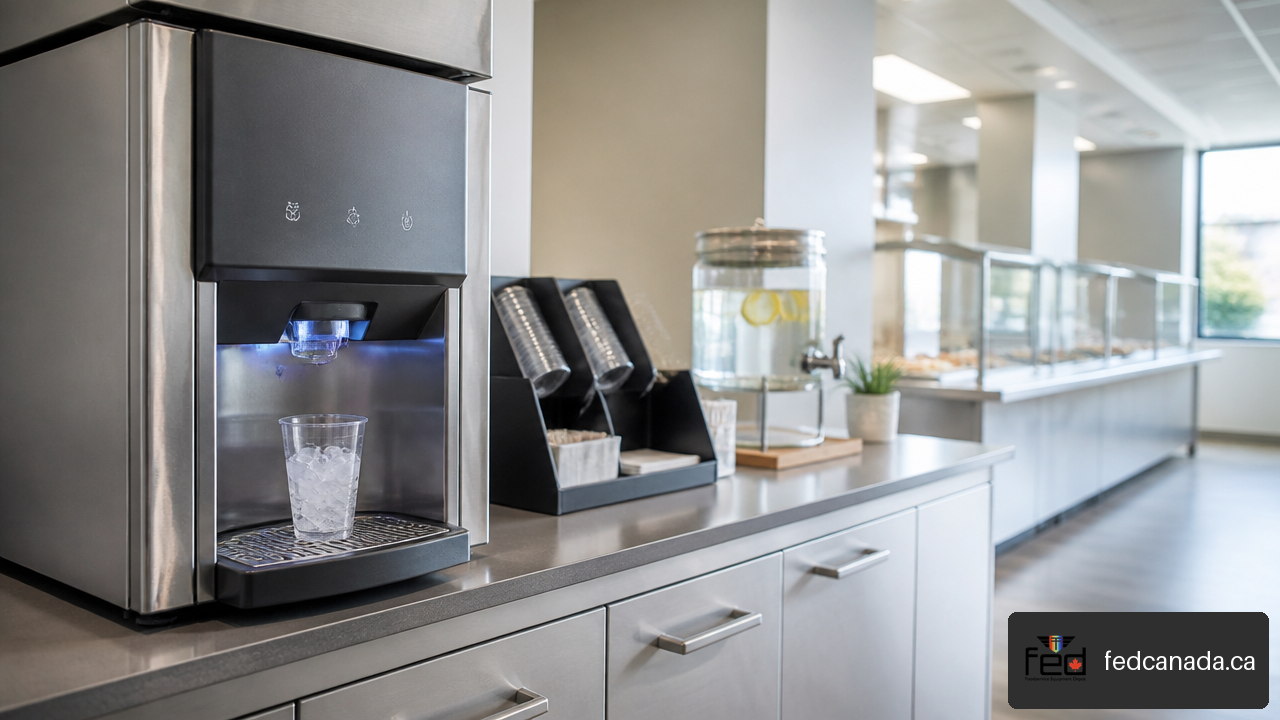
Table of Contents
- Settings and model identification
- Troubleshooting by symptom
- How to choose an ice and water dispenser
- Key Takeaways
- Frequently Asked Questions
Settings and Model Identification
The safest way to work with an ice and water dispenser is to treat its model number as the instruction set. A setting that is routine on one family may not exist on another. Before changing a mode, resetting a control or removing an access panel, locate the data plate and record the full model number, serial number and electrical rating.
Start with the exact model family
Look for the identification label on the cabinet or service area, then match the complete model number to the correct manufacturer manual. Do not rely only on the machine's general appearance. Two dispensers can share a cabinet style while using different control boards, displays, ice makers or water configurations.
Use this quick distinction before beginning any diagnosis:
| What you see | What it usually tells you | Best next step |
|---|---|---|
| ICE, OFF and WASH controls | A model family with operating and sanitation modes | Find the manual for that exact model before resetting it |
| UP, DOWN and MODE/SET controls | A unit with adjustable timed functions or display settings | Record current values before making a change |
| Sequentially blinking mode lights | A fault indication on applicable models | Identify the error procedure for that control family |
| Ice dispenses but water does not | The ice system and water circuit need separate checks | Inspect supply, valve and dispense control paths |
| Water dispenses but ice does not | The fault may be in ice production, storage or ice delivery | Confirm whether ice is being made and stored |
This model-first approach prevents a common mistake: applying a reset or DIP switch instruction intended for another model or brand. Where a control board has DIP switches, the manufacturer typically presets them, so they are not ordinary day-to-day operating controls. We recommend leaving them unchanged unless the exact service documentation calls for an adjustment.
What operating mode settings do
Many dispensers have a set of mode controls, often labelled along the lines of ICE, OFF and WASH or CLEAN. Typically, the ice setting places the unit in normal ice-making operation, OFF stops ice making, and the wash or clean setting is a service and cleaning mode used as directed by the manual. These controls are not universal across every dispenser, and their precise behaviour can differ by brand and model.
A useful operating rule is to change only the setting required for the immediate task. For example, use OFF or WASH only when the model's documented cleaning or reset procedure requires it. Do not use WASH as a general remedy for a dispenser that will not produce ice. If the underlying cause is a water restriction, sensor issue, mechanical jam or refrigeration fault, changing modes alone will not resolve it.
Timed functions, agitation and factory resets
Certain dispensers use timed functions, including agitation cycles that move stored ice to help reduce bridging or clumping. These settings affect how the dispenser manages ice in its hopper or bin, so changing them without a reason can create a new problem. An overly aggressive schedule may add unnecessary mechanical operation; too little movement may not suit the ice condition or usage pattern the equipment was configured for.
Some models with a front display allow timed settings to be restored to factory defaults through a button combination, and the same display may show error information. Check the exact procedure in your model’s manual before using it.
Fair warning: a factory reset is not a neutral restart. It can erase customized timed values. Write down displayed values and current programmed intervals first. If a dispenser was intentionally set for a particular traffic pattern, such as heavy beverage service at lunch followed by low overnight use, restoring defaults may change how the unit behaves after the fault is cleared.
Troubleshooting by Symptom
Troubleshooting works best when you separate the dispenser into four systems: incoming utility service, ice production, ice delivery and drainage. A symptom tells you where to begin, not which part to replace.
Use a symptom-to-subsystem map
| Symptom | Likely subsystem | Operator checks | Technician-level checks |
|---|---|---|---|
| No lights or no response | Electrical supply or controls | Confirm power source, switch position and breaker status | Wiring, transformer, PCB and electrical measurements |
| Power is on but there is no ice | Ice maker or bin control | Confirm water supply and whether ice is present in the bin | Door switch, chute movement, sensors and ice maker diagnosis |
| Ice is present but will not dispense | Ice delivery path | Check for congealed ice or an obstructed chute | Dispense switch, wheel motor, capacitor and control circuit |
| Water will not dispense | Water circuit | Confirm supply valve is open and check visible restrictions | Water valve, switch, wiring and internal controls |
| Water around cabinet or drain pan | Drainage system | Check drain routing and visible hose connections | Internal leaks, clamps, fittings and drain system faults |
This distinction matters. A full hopper with no ice at the cup point is not an ice maker production problem. It is usually an ice delivery problem. By contrast, a dispenser with an empty bin may have a water supply, refrigeration, sensor or ice maker issue even if the dispense switch still operates normally.
When power is present but ice will not dispense
If the unit has power and ice is visible in the storage area, start with the least invasive cause: congealed ice. Ice can freeze together into a solid mass, preventing movement through the chute or wheel. Turn the unit off using the model-approved procedure and disconnect power before reaching into the storage area or attempting internal service.
Once it is safe to inspect, look for a bridge of ice near the outlet or a compacted mass that does not move with normal dispensing. Do not force the mechanism with tools. A jam caused by congealed ice is different from a failed motor. If ice breaks apart easily and the dispenser still will not move it, the fault may involve the dispense switch, wheel motor, capacitor or related controls.
Typical service documentation lists power, ice maker, door switch, chute, motor, control board and drain checks among the possible fault paths. That is why it is better to diagnose by symptom than to assume every no-dispense issue is a motor failure.
How to respond to lights and error codes
Blinking lights are not a universal code system across dispensers. On some models, a particular blinking pattern of the mode lights indicates a machine error that stays active until the underlying condition is corrected and the unit is reset through its mode control. Use the error light guidance for your exact model only.
Follow this order when lights flash:
Record the light pattern, displayed code and time the fault occurred.
Confirm the full model number before interpreting the code.
Correct only the documented external cause, such as a closed water valve or drain restriction.
Perform the specified reset procedure for that model.
Stop and arrange qualified service if the fault returns after a correct reset.
Repeated resets can hide a recurring condition without fixing it. A display that clears briefly and then faults again is useful evidence for a technician, especially when the unit's water supply, drainage and operating environment have already been checked.
Drainage and leak checks that operators can make
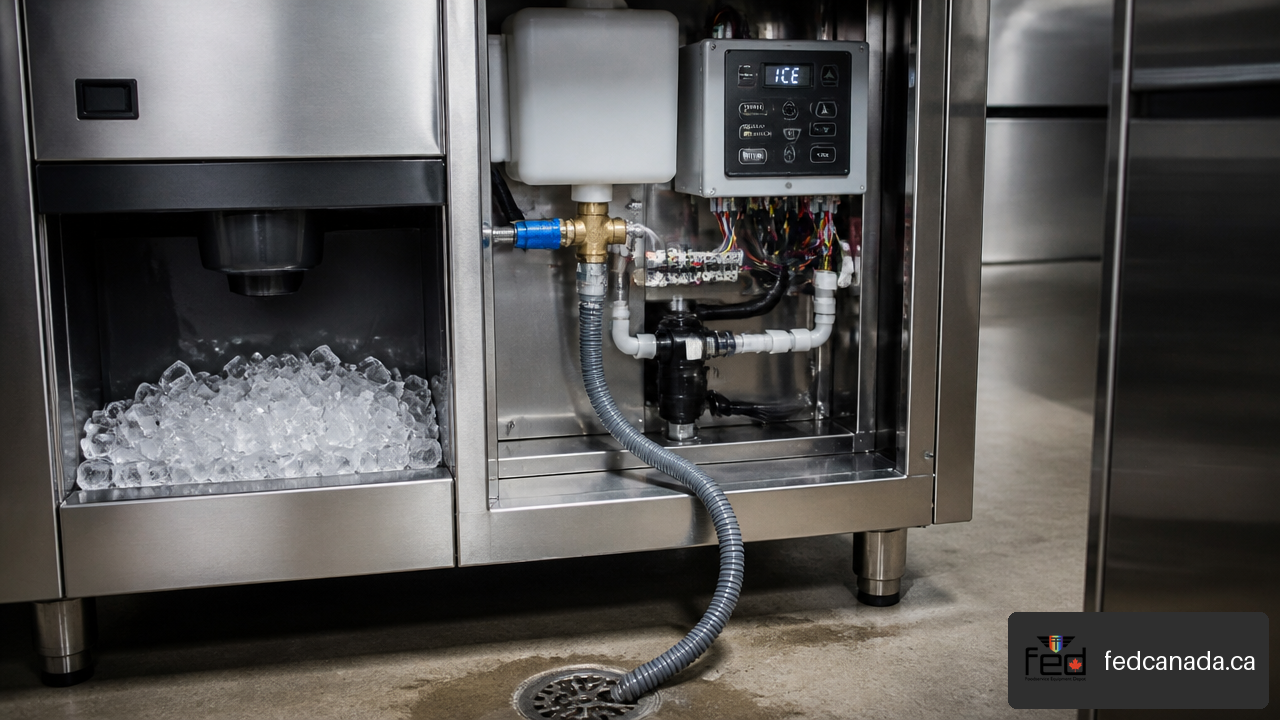
A drain problem often looks like a leak, but the water source may be normal meltwater that cannot leave the cabinet fast enough. Check that the drain line is not kinked, crushed, disconnected or routed uphill. Inspect accessible hose connections and the drain pan area for visible overflow.
Do not assume a dripping cabinet means a failed water valve. If the drain restriction is downstream, water can back up into a pan or overflow point. Conversely, water appearing only when the water dispense function is used may point to a different part of the circuit.
Stop troubleshooting and call for service when you find damaged wiring, a burning smell, repeated breaker trips, refrigerant concerns, water inside electrical compartments, a failed motor or control board, or a fault that returns after documented operator checks. Internal repairs require qualified personnel and the correct model-specific procedures.
How to Choose an Ice and Water Dispenser
A good purchase begins with demand and site readiness, not cabinet size alone. Ice capacity, production rate and dispenser style must fit the water, electrical and drainage conditions available at the installation point.
Match ice demand to production and storage
Separate production capacity from storage capacity. Production is how much ice a machine can make over a stated period under stated test conditions. Storage is how much ice can be available for immediate dispensing. A dispenser can have strong daily production but still run short during a concentrated rush if its available reserve and recovery rate do not fit the service pattern.
Consider a healthcare floor with steady all-day use versus a cafeteria with a 90-minute lunch rush. The same total daily demand can produce very different equipment needs. The healthcare application may value consistent recovery and hands-free service flow. The cafeteria may need enough stored ice to serve a short, intense peak without queues or empty cups.
Published production figures are measured under standard test conditions. The countertop ice and water dispensers we carry, for example, are rated from about 100 lb (45 kg) to 500 lb (227 kg) of ice per day, with built-in storage from roughly 12 lb (5 kg) to 40 lb (18 kg). Actual output depends on the configuration and site conditions, so check the specification sheet for the model you are considering.
Translate site specifications into real consequences
Every manufacturer specifies a range for incoming water pressure, incoming water temperature and room temperature. As a rough guide, many commercial ice machines are rated for incoming water of about 45°F to 90°F (7°C to 32°C) and room temperatures of about 50°F to 100°F (10°C to 38°C), with the best performance toward the cooler end of each range. Pressure limits vary more between models, so confirm them on the specification sheet.
Those numbers are not paperwork. They determine whether a capacity claim is achievable at your site.
| Site condition | Practical effect | Buying or installation response |
|---|---|---|
| Warm mechanical room | Higher heat load can reduce ice-making performance | Choose a suitable location with airflow and verify ambient conditions |
| Warm incoming water | Ice maker must remove more heat from each batch | Review production assumptions rather than sizing from the headline maximum |
| Low or inconsistent water pressure | Water filling and dispense performance may be affected | Measure supply pressure and address plumbing limits before installation |
| Shared circuit with other equipment | Voltage drop or nuisance trips can interrupt operation | Provide the required dedicated electrical service where specified |
| Poorly routed drain | Meltwater cannot leave the machine reliably | Plan gravity drainage, routing and service access before delivery |
Use a site readiness checklist before ordering
We recommend confirming these items before selecting a model or arranging delivery:
The full electrical requirement, including voltage, phase, amperage and dedicated-circuit needs.
Available water pressure at the installation point, not only elsewhere in the building.
Incoming water temperature during the warmest operating period.
Expected room temperature, ventilation and cabinet clearance.
Drain route, drain capacity and whether the line can maintain proper fall.
Width, depth, height and access path through doors, elevators or service corridors.
Ice type and usage pattern, including whether users need ice only or both ice and water.
Service access for cleaning, water shutoff and future maintenance.
A small site mismatch can create a disproportionate operating problem. For instance, a dispenser installed beside heat-producing equipment may remain within its maximum ambient limit but still make less ice than the buyer expects during the busiest period. Capacity should be treated as a planning figure tied to conditions, not an unconditional daily guarantee.
Choose features based on the user and the setting
Select the dispensing format around the people using it. Ice and water dispensing may suit break rooms, cafeterias, patient areas and self-service beverage stations. Ice-only dispensing may be appropriate where potable water is supplied separately or where the application needs a focused ice service point.
Also consider the ice format required by the application. Nugget ice and cube ice configurations are not interchangeable simply because both are ice dispensers. Verify that the dispenser, ice maker and delivery system are designed to work together.
For buyers balancing budget constraints, the lowest initial price is not necessarily the best fit if installation modifications are substantial. A model that matches existing voltage, water service and drainage may reduce avoidable setup work. If requirements are uncertain, pause before ordering and verify the model documentation against the site.
Confirm Canadian electrical, certification and water requirements
Most countertop ice and water dispensers run on a standard 115V or 120V circuit, while larger dispensers and modular ice machines may need 208V or 230V service. Confirm the voltage, plug type and any dedicated-circuit requirement before ordering. In Canada, look for a cUL or CSA electrical listing, which inspectors and insurers expect, and NSF certification for equipment that makes and dispenses ice for consumption. Hard water is common in many parts of the country, so ask whether a water filter or scale treatment is recommended for your unit. Scale build-up shortens cleaning intervals and can lead to service problems that a warranty may not cover.
Ice and water dispensers we carry
We stock several countertop dispensers that suit cafeterias, offices, healthcare settings and self-service beverage stations:
Scotsman HID312 countertop nugget ice and water dispenser: about 260 lb (118 kg) of soft nugget ice per day with 12 lb (5 kg) of storage, on a 115V supply.
Scotsman HID540 countertop nugget ice and water dispenser: about 500 lb (227 kg) of nugget ice per day with 40 lb (18 kg) of storage, for higher-traffic locations.
American Chef ACIM-220-WN countertop nugget ice and water dispenser: about 220 lb (100 kg) of nugget ice per day.
Champion 7CI112A countertop ice and water dispenser: about 100 lb (45 kg) of ice per day for lighter-demand settings.
Ice-O-Matic IOD250 countertop ice dispenser: 250 lb (113 kg) of bin storage with simple push-bar dispensing, for sites that need ice only.
See our full range of ice and water dispensers, or browse all ice equipment.
Key Takeaways
The practical decision rule
Identify the exact model before changing settings, reading lights or following a reset procedure.
Treat mode controls such as ICE, OFF and WASH as model-specific operating controls, not universal troubleshooting buttons.
Record timed settings before a factory reset because applicable resets can restore default values.
Diagnose no ice, no dispense, no water and leaks as separate system problems.
Check accessible power, water, ice, chute and drain conditions before escalating to internal parts diagnosis.
Size equipment around peak demand and actual site conditions, not a single production number.
Stop work when troubleshooting involves energized components, internal controls, motors, capacitors or repeated faults.
Frequently Asked Questions
How do I identify my exact ice and water dispenser model?
Find the manufacturer data plate and record the complete model number, serial number and electrical rating. Use the entire model designation when locating documentation. Cabinet style, control layout and ice type alone are not reliable identifiers because similar-looking dispensers can have different controls and service procedures.
Why does my dispenser have power but no ice?
First determine whether the unit is making ice and whether ice is present in the hopper or bin. If the bin is empty, investigate water supply, ice maker operation, door switch status or sensors using the correct manual. If ice is present but not reaching the cup, focus on congealed ice, chute movement and the dispensing system instead.
How do I safely clear a congealed ice jam?
Turn the unit off following the applicable procedure and disconnect power before placing hands near the storage area or dispensing mechanism. Inspect for ice frozen into a bridge or compacted mass near the outlet. Remove only ice that can be safely cleared without forcing mechanical parts. If the jam recurs, the cause may require service rather than repeated manual clearing.
Why does water not dispense when ice still works?
Ice and water use different delivery paths. Confirm that the water supply valve is open and that there is no visible restriction in accessible supply or drain routing. If the supply is confirmed and water still does not dispense, a valve, dispense switch, wiring or control issue may be involved and should be diagnosed by qualified service personnel.
What do flashing mode lights on an ice dispenser mean?
On certain models, sequentially flashing mode button lights indicate a machine error. The exact meaning depends on the model family. Record the pattern, consult the correct manual, correct the documented cause and complete the required reset. Do not apply an error code chart from a different model.
What water pressure and temperature does an ice and water dispenser need?
Requirements depend on the model. Many commercial ice machines are rated for incoming water of roughly 45°F to 90°F (7°C to 32°C) and perform best with cooler water. Pressure limits vary by model, so verify the requirements for your exact unit before installation.
When should I call a technician instead of continuing to troubleshoot?
Call for qualified service when the issue involves internal electrical parts, motors, capacitors, control boards, damaged wiring, recurring error codes, repeated breaker trips or water near electrical components. Also escalate when normal operator checks have confirmed adequate power, water supply, drainage and ice availability but the fault remains.
Can I use a residential ice maker or water dispenser in a commercial setting?
We do not recommend it. Residential units are not built for continuous commercial demand, they usually lack NSF certification for foodservice use, and their warranties typically exclude commercial use. For a café, office, clinic or restaurant, choose a commercial dispenser with NSF certification and a cUL or CSA electrical listing.
Need help choosing the right ice and water dispenser? Call or visit our team. New equipment is available through our catalogue with pricing online, and used and clearance items are available for pickup at our Calgary warehouse.
Recent Posts


Leave a Comment
Your email address will not be published. Required fields are marked *