



Commercial Food Processor Buying Guide for Busy Kitchens
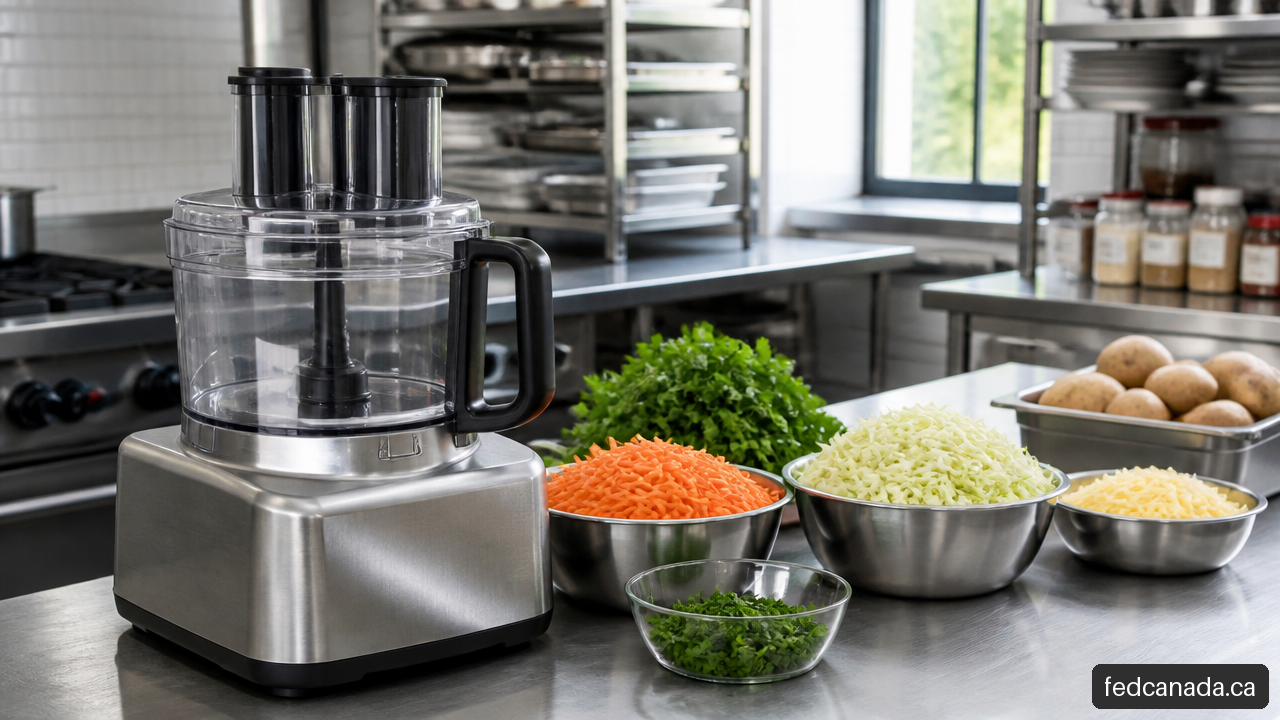
A commercial food processor buying guide should begin with your prep list, not a product catalog. The right machine can reduce repetitive knife work and keep cuts consistent. The wrong one can create a new bottleneck: a processor that overheats, occupies too much counter space, or makes every small batch feel like a cleaning project.
Table of Contents
- Key Takeaways
- Choose the Processor Type and Size
- Compare Power, Workflow, and Long Term Ownership
- Frequently Asked Questions
Key Takeaways
- Buy for the three prep tasks that consume the most labour, rather than for the widest possible attachment list.
- Use a batch bowl processor for sauces, dips, purées, and emulsions; use continuous feed for repeated slicing and shredding; choose a combination unit only when both workflows are genuinely frequent.
- Size bowl capacity around the largest realistic batch, plus room for ingredients to circulate. A packed bowl often produces uneven results.
- Horsepower matters, but duty cycle, blade design, feed opening, and operator workflow often matter just as much.
- Before ordering, confirm electrical supply, plug type, available circuit capacity, counter footprint, clearance for loading, and space for safe cleaning.
- Compare the cost and availability of discs, blades, seals, bowls, and service support. A low purchase price can become expensive if one worn component sidelines the unit.
Choose the Processor Type and Size
Start with the work that repeats every day
I recommend listing your three highest volume prep tasks before comparing models. This simple step prevents a common purchasing mistake: selecting a machine based on an occasional job instead of the task that happens every service day.
For example, a café may occasionally make soup, but if its daily prep involves shredding carrots, slicing cucumbers, and processing cabbage for salads, a feed chute and disc system should drive the decision. A restaurant producing hummus, pesto, dressings, and puréed soups may benefit more from a bowl processor with strong blade performance and an easy to scrape bowl.
Equippers’ task first sizing guidance recommends identifying high volume prep work and sizing the bowl by taking the largest recipe batch in quarts, adding 30% headroom, and rounding up to the next standard bowl size. That headroom is practical, not excessive. Ingredients need space to circulate around the blade; a bowl filled to the brim can leave coarse pieces at the top and overprocessed food at the bottom.
| Dominant prep task | Best processor type | Why it fits | When to avoid it |
|---|---|---|---|
| Sauces, dips, purées, pesto, emulsions | Batch bowl | The blade works repeatedly through a contained batch | Avoid as the only unit if slicing and shredding dominate prep |
| Cabbage, cheese, vegetables, potatoes | Continuous feed | Product moves through a chute for rapid, repeatable cutting | Avoid for very small sauce batches or fine emulsions |
| Frequent slicing plus regular purées | Combination unit | Supports both bowl work and feed chute production | Avoid if one workflow is rare and adds unnecessary cost and cleaning |
| Small garnishes and occasional sauces | Compact batch bowl | Lower footprint and quicker setup | Avoid when peak volume exceeds its realistic duty cycle |
A useful question is: Where does prep currently slow down? If the answer is “someone spends an hour slicing onions and shredding cheese,” continuous feed capacity is likely more valuable than a larger bowl. If the answer is “we keep making dressings in small batches all day,” a machine that is awkward to assemble and clean may be a poor fit even if it has impressive power.
Use a task based decision tree
The processor category should follow how food enters and exits the machine.
- Choose a batch bowl processor if ingredients are added together, transformed into a uniform mixture, and removed as one batch. This is the usual fit for salsa, hummus, aioli, pie filling, pastry ingredients, and puréed vegetables.
- Choose a continuous feed processor if product needs to pass through a feed opening in a steady stream. This setup is well suited to cabbage for slaw, vegetables for salads, potatoes for gratins, and cheese for pizza or casseroles.
- Choose a combination model if both workflows occur often enough to justify the added equipment cost, storage needs, and changeover time. A hotel kitchen that processes breakfast vegetables in the morning and banquet sauces later may have a strong case. A small sandwich shop that only makes sauce once weekly probably does not.
Fair warning: combination models are not automatically the best value. They can be a smart answer to mixed production, but they may add parts, attachments, and cleaning steps. If slicing represents 80% of use, I would prioritize a continuous feed machine and consider a separate smaller batch processor only if sauces become a real production need.
Turn recipe volume into bowl capacity
Bowl capacity is not the same as usable output. A 12 quart bowl does not mean every recipe should be made at a 12 quart fill level. Dense mixtures, sticky foods, and recipes requiring staged additions may need more open space than loose chopped vegetables. Use this practical sizing sequence:
- Identify the largest batch you expect to process during a normal busy period.
- Add 30% capacity for movement, staged additions, and uneven ingredient shapes.
- Check whether that batch must be completed in one run or can be divided without harming quality.
- Compare the resulting size with the machine’s footprint, cleaning workload, and staff handling needs.
Consider a kitchen making an 8 quart batch of salsa. Adding 30% produces a target of about 10.4 quarts, so a 12 quart bowl may be appropriate. But if the same kitchen mostly produces 2 quart batches of dressing, that 12 quart unit may be cumbersome for routine use. The better answer could be two machines with distinct roles, or a smaller primary processor supported by a larger prep unit used only on production days.
Alibaba’s 2026 equipment selection guide also frames capacity around peak production volume, available space, and batch requirements, while noting that larger central kitchen equipment may require substantially higher power and, in some cases, three phase electrical supply.
Compare Power, Workflow, and Long Term Ownership
Interpret horsepower with duty cycle in mind
Horsepower describes motor strength, but it is not a complete performance score. A processor’s results depend on the motor, blade geometry, RPM, bowl design, feed system, and the food being processed. Dense root vegetables, hard cheese, and thick nut based mixtures create more resistance than soft herbs or cooked tomatoes.
As a general selection range, Peggy Omara’s commercial processor comparison identifies roughly 1/2 to 3/4 HP as a possible range for light to moderate commercial use, while high volume operations may need 1 HP or more. Treat those figures as a starting point, not a universal rule. A 1 HP machine can still be the wrong choice if its bowl is too small, its feed chute is impractical, or its rated use does not match a long prep shift.
| Kitchen demand | Typical power priority | Better buying focus |
|---|---|---|
| Light café prep, dressings, herbs, small vegetable batches | Moderate power | Compact footprint, easy cleaning, small batch control |
| Restaurant prep with daily sauces and vegetables | Moderate to high power | Reliable bowl capacity, durable blades, useful discs |
| Catering, commissary, central production | High power and sustained output | Duty cycle, feed speed, service access, electrical compatibility |
| Heavy dough or thick paste production | High torque and product specific suitability | Confirm the manufacturer allows the task before buying |
A processor can be powerful enough for occasional dense ingredients yet unsuitable for repeated heavy loads over a full shift. Heat buildup affects both the motor and the food. Warm emulsions may split more easily, herbs can darken, and a unit that repeatedly trips protection systems interrupts prep when staff need it most.
For this reason, ask each supplier four direct questions:
- How many hours per day is the model intended to operate?
- Is there a stated maximum run time or required cool down period?
- Which ingredients or tasks are restricted?
- Which components are expected to wear first under high use?
Dito Sama’s professional processor selection advice specifically emphasizes daily operating hours, workflow fit, warranty, customer support, and original replacement parts. Those details are especially useful for kitchens where the processor is used across multiple prep periods rather than only once each morning.
Check attachments, food contact materials, and sanitation
Attachments should solve defined prep jobs. They should not become a drawer full of seldom used accessories.
| Attachment or component | Best use | Buying question |
|---|---|---|
| S blade | Chopping, mixing, puréeing, emulsifying | Is it included, removable, and available as a replacement part? |
| Slicing disc | Uniform vegetables, fruit, potatoes | Which slice thicknesses are included and which require extra discs? |
| Shredding disc | Cheese, cabbage, carrots | Can staff safely change and clean the disc quickly? |
| Dicing kit | Repeated diced vegetables or fruit | Is the product size consistent enough to justify the kit? |
| Dough blade or accessory | Limited dough tasks on approved models | Does the manufacturer explicitly rate the unit for dough? |
Food contact surfaces deserve more scrutiny than a broad “stainless steel” claim. Look for smooth, accessible surfaces that can be cleaned fully, not merely metal panels on the outside of the motor base. Bowls, lids, feed chutes, blades, discs, seals, and gaskets should be designed for repeated cleaning without cracks, rough seams, or difficult to reach residue traps. A hygienic design generally minimizes dead zones where food can accumulate.
For example, a feed chute with removable components may take longer to disassemble than a fixed chute, but it can be the safer choice if it lets staff clean underneath gaskets and around cutting areas. The practical test is simple: can the team see, access, wash, rinse, sanitize, and reassemble every food contact component without improvising?
Sanitation and electrical markings are related to compliance, but they are not identical. NSF certification generally concerns sanitation standards and cleanability expectations for food equipment. UL and ETL marks are commonly used to indicate electrical safety evaluation. Requirements vary by local health authority, insurer, facility policy, and the equipment’s intended installation, so I would verify what your jurisdiction and landlord require before purchase rather than assuming one mark covers every obligation. Peggy Omara’s guide also identifies UL or ETL sanitation related certification checks as relevant considerations when selecting commercial processors. Confirm the exact marks on the specific model, since listings, configurations, and regional versions can differ.
Plan for electrical fit, ergonomics, and service access
A processor that cannot be safely connected, loaded, or cleaned is not operationally useful. Before purchase, document the installation location and verify the following with the equipment specifications and a qualified electrician where needed:
- Voltage and frequency required by the exact model
- Plug configuration and whether the outlet matches it
- Circuit capacity and whether other equipment shares that circuit
- Whether the model needs single phase or three phase power
- Counter depth, height, ventilation clearance, and safe cord routing
- Vertical clearance needed to remove the lid, use the pusher, or load a hopper
In Canadian kitchens, electrical compatibility should be checked before an order is placed. Do not rely on a product photo or a generic listing. A unit may look suitable online but arrive with a plug or voltage requirement that does not match the planned location. Larger production equipment may introduce more complex electrical requirements, including three phase supply, which can affect installation timing and cost.
Ergonomics also affect throughput. A tall continuous feed machine placed beneath a low shelf can be frustrating to load. A heavy bowl that must be lifted and emptied repeatedly can create strain. Place the processor close to ingredient staging, a handwashing or warewashing path, and the containers where finished food will be stored. Every extra turn, reach, and trip becomes more noticeable during a busy prep period.
Finally, price the ownership system, not only the processor. Compare warranty duration, exclusions, labor coverage, shipping responsibilities, and local service options. Ask whether blades, discs, seals, lids, bowls, and switches are stocked or can be ordered promptly. Worn blades reduce cut quality and can make operators push harder, which slows output and increases wear elsewhere.
A processor should fit the prep flow from receiving to storage. The best specification sheet cannot compensate for a machine that is too hard to load, clean, or repair.
Frequently Asked Questions
What is the main difference between a commercial and home food processor?
Commercial food processors are intended for repetitive foodservice preparation, with larger capacities, more durable components, stronger motors, and commercial focused safety or sanitation options. The key difference is not simply size. It is whether the machine can support your actual volume, task mix, cleaning routine, and expected daily operating time.
Which is better: a batch bowl or continuous feed food processor?
Choose a batch bowl processor for purées, sauces, dips, mixing, and emulsions. Choose continuous feed for repeated slicing and shredding. Neither is universally better. The better choice is the one that handles the task consuming the most prep time with the fewest changeovers.
How much horsepower do I need in a commercial food processor?
For lighter prep, 1/2 to 3/4 HP may be adequate. High volume kitchens often need 1 HP or more. However, check permitted tasks and duty cycle before relying on horsepower alone. Dense dough, nut pastes, and repeated hard vegetable processing may require a machine specifically rated for that work.
How do I choose the right bowl size?
Start with your largest realistic recipe batch, add about 30% headroom, and move to the next standard bowl size. Then consider whether the same machine will also be used for small daily batches. A larger bowl can reduce batch count, but it may be inefficient for a cup or two of dressing.
Is NSF certification required for commercial use?
Not always, but it is often relevant. Requirements can depend on local health authorities, the type of foodservice operation, and facility policies. Check local rules and ask for the exact certification information for the model you are considering. Do not assume that a general “commercial” label confirms sanitation acceptance everywhere.
Should I choose UL or ETL certification?
UL and ETL are electrical safety marks commonly used for powered equipment. One is not automatically better for every buying situation. What matters is that the exact model has the listing required by your local authority, insurer, building, or operational policy.
What should I inspect before installing a processor in a Canadian kitchen?
Confirm voltage, frequency, plug type, circuit load, available outlet, counter dimensions, and overhead clearance. If the model is large or industrial, verify whether it requires three phase service. Also plan a location that supports ingredient loading, safe unloading, and full disassembly for cleaning.
Recent Posts
Leave a Comment
Your email address will not be published. Required fields are marked *