



Ladle Guide: Kitchen Use, Materials, and Steelmaking Meaning
A ladle is a purpose-built utensil for moving and portioning liquids with more control than an ordinary spoon. In a kitchen, it can carry soup, sauce, gravy, stock, punch, or batter from pot to bowl. In industry, the same word describes a refractory-lined vessel that holds molten steel. The shared name can be confusing, so it helps to identify the setting first.
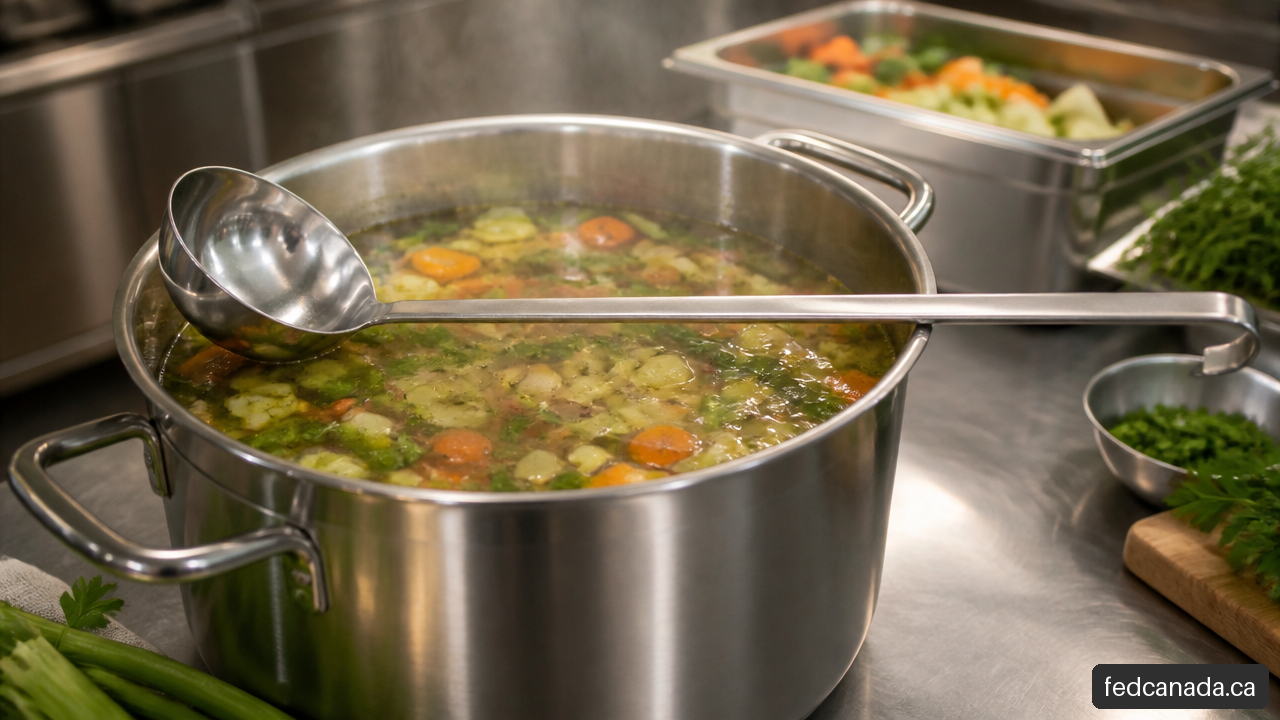
Table of Contents
- What Does Ladle Mean?
- Choosing a Kitchen Ladle
- Ladles in Steelmaking
- Key Takeaways
- Frequently Asked Questions
- Sources
What Does Ladle Mean?
The practical meaning of ladle depends on context. Most people mean the long-handled, deep-bowled serving utensil found beside a soup kettle or stockpot. In a steel plant, a ladle is a large vessel for transporting and treating liquid metal. There is also a separate company named Ladle that provides operational technology for foodservice and retail businesses.
The kitchen ladle
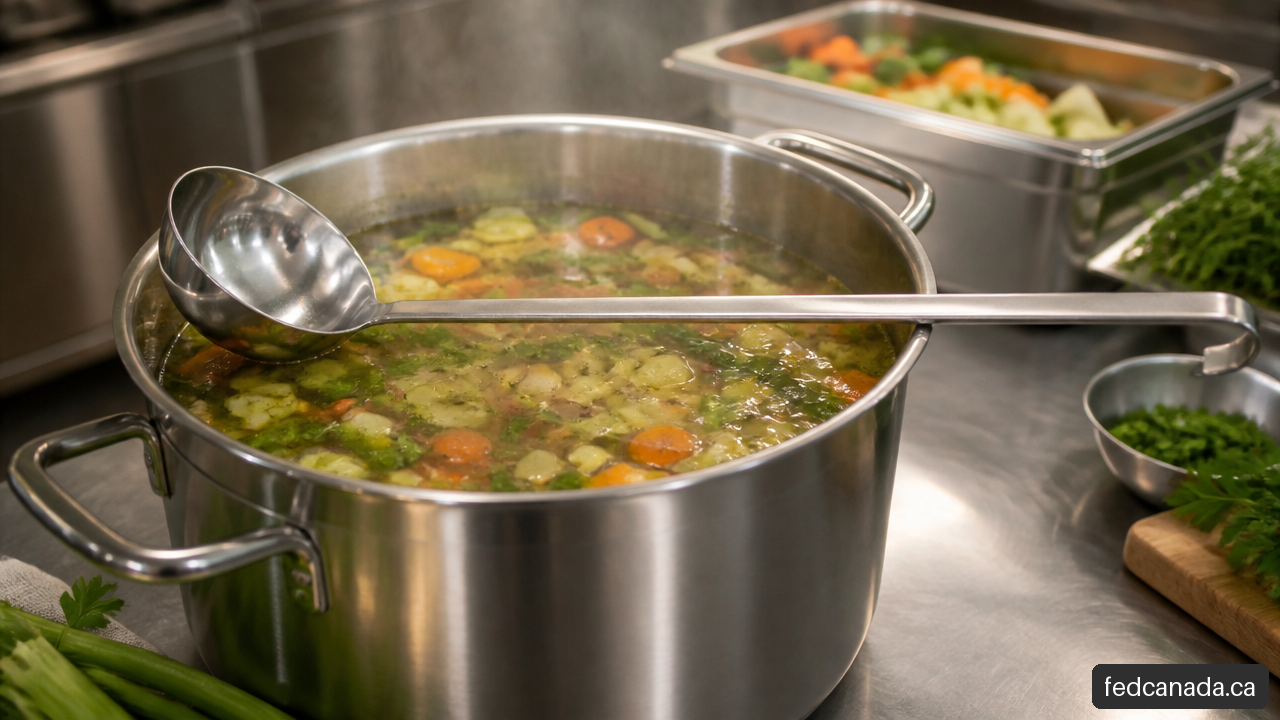
A kitchen ladle is designed for liquid transfer and portion control. Its bowl is deeper than a serving spoon, allowing it to hold a measured volume rather than merely lift solid food. The long handle also creates distance between the user’s hand and steam rising from a pot.
Cambridge Dictionary defines the utensil as a large spoon with a long handle and deep cup-shaped section, especially for serving soup. That basic design remains useful because it solves three everyday problems at once:
- It reaches into deep cookware without requiring a hand to hover over hot liquid.
- It carries liquid more securely than a flat or shallow spoon.
- It helps keep portions relatively consistent during service.
The verb matters, too. To ladle is to scoop and transfer a liquid using this type of utensil. In a restaurant or cafeteria line, that can mean portioning chili into bowls. At a beverage station, it may mean serving punch from a large bowl. In a bakery, it can mean moving a controlled amount of glaze or sauce.
How a ladle differs from a serving spoon
The distinction is less about appearance than function. A serving spoon is often broad and shallow, making it better suited to vegetables, rice, pasta, or side dishes. A ladle’s bowl is shaped to retain liquid while it travels from pot to plate.
| Utensil | Best suited to | Bowl shape | Portion control | Common limitation |
|---|---|---|---|---|
| Ladle | Soups, sauces, gravies, stocks, beverages | Deep and rounded | Strong for liquid portions | Less effective for dry foods |
| Serving spoon | Vegetables, grains, pasta, side dishes | Shallow or oval | Moderate | Liquid can spill easily |
| Slotted spoon | Foods lifted from liquid | Perforated | Limited | Intentionally drains liquid |
| Spatula | Turning, scraping, folding | Flat or flexible | Not intended for portions | Cannot carry liquids reliably |
A ladle is not necessarily the right choice just because a dish is wet. Consider a braise with large pieces of meat and vegetables: a slotted spoon may be better for the solids, while a ladle can portion the broth or sauce afterward. Using both tools avoids overfilling bowls with liquid while leaving the main ingredients behind.
The separate Ladle software meaning
When “Ladle” appears in discussions about audits, food safety records, retail pricing, or operational workflows, it may refer to a business rather than a utensil. The company’s Ladle company profile describes operational, compliance, and pricing solutions for foodservice and retail operators. Its main Ladle platform is therefore unrelated to cookware or steelmaking equipment.
Quick rule: If the surrounding words are “soup,” “gravy,” “pot,” or “portion,” the topic is probably the kitchen utensil. If they are “molten steel,” “refractory,” or “continuous casting,” it is industrial. If they are “audits,” “compliance,” or “pricing,” it may be the software company.
Choosing a Kitchen Ladle
For home cooks and foodservice operators, the best ladle is the one that matches the food, cookware surface, serving volume, and cleaning routine. Material alone is not enough. A durable stainless steel ladle can be an excellent choice for a stockpot, yet a poor match for delicate nonstick cookware if the edge repeatedly contacts the pan.
Start with food and capacity
Ladle capacity is usually more useful than total length when consistent service matters. A small sauce ladle allows a cook to finish plates neatly. A larger soup ladle reduces repetitive scooping during a busy meal period. Exact capacities vary by manufacturer, so it is worth checking the listed volume rather than assuming two similarly sized bowls hold the same amount.
| Food or task | Useful ladle profile | Why it works | When to avoid it |
|---|---|---|---|
| Thin soup or broth | Medium to large round bowl | Transfers liquid quickly with fewer passes | Avoid an oversized bowl for small cups or narrow bowls |
| Gravy or finishing sauce | Small bowl with a controlled pouring edge | Helps limit excess sauce on the plate | Avoid a very deep, wide bowl when precision is the priority |
| Thick chili or chowder | Sturdy medium bowl and rigid handle | Handles heavier contents and suspended ingredients | Avoid shallow bowls that leave solids behind |
| Punch or batch beverages | Large bowl with a long handle | Reaches into deep beverage containers | Avoid using it where ice or fruit pieces make pouring unpredictable |
| Batter or glaze | Smaller ladle with a defined lip | Allows repeatable transfers | Avoid if a measuring cup is needed for exact recipe quantities |
A useful decision point is whether the ladle is primarily a serving tool or a cooking tool. A serving ladle spends most of its time moving finished food from a vessel to a customer-facing bowl or plate. A cooking ladle may need to rest on cookware, reach to the bottom of a deep pot, and tolerate longer contact with heat. One tool can do both jobs, but a kitchen handling high-volume service may benefit from assigning ladles to specific stations.
Compare materials before buying
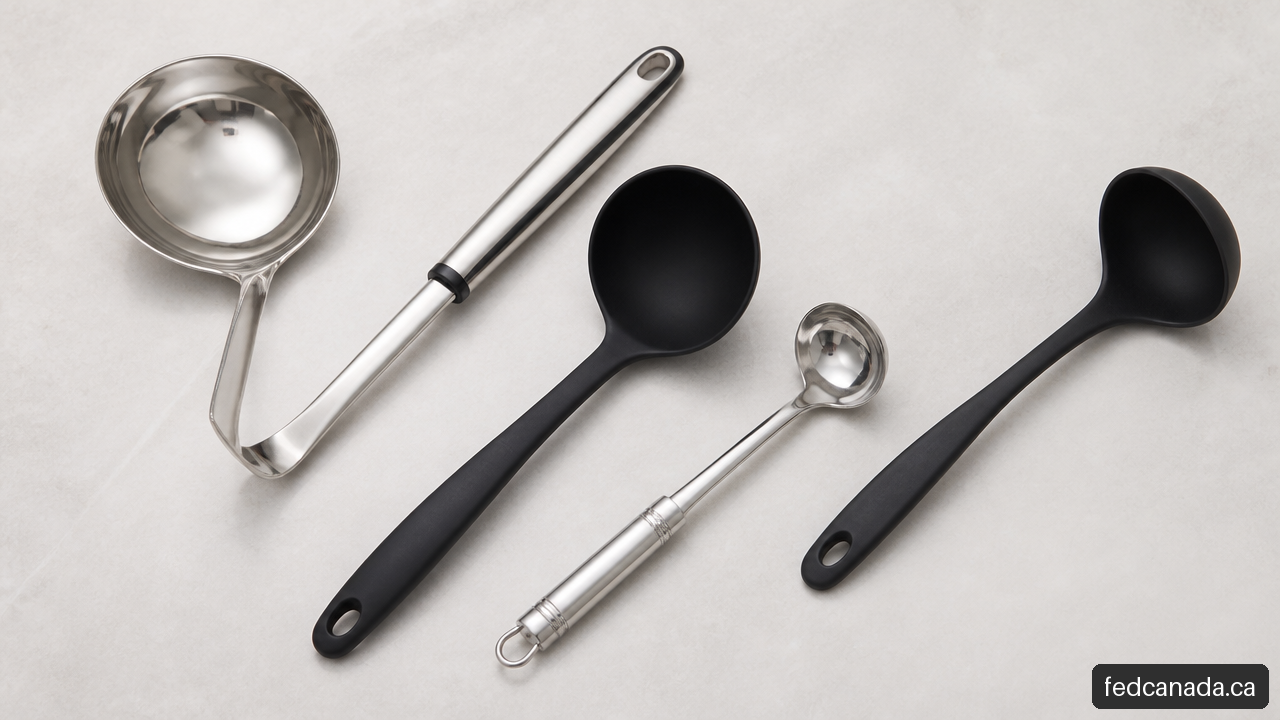
Kitchen ladles are commonly made from stainless steel, silicone, nylon, wood, or combinations of these materials. Each has a trade-off.
| Material | Strengths | Watch for | Best fit |
|---|---|---|---|
| Stainless steel | Durable, rigid, easy to sanitize, suitable for many hot-liquid tasks | Can scratch some coated cookware; handle design affects heat transfer | Stockpots, steam tables, sauce stations, general service |
| Silicone | Gentle on nonstick surfaces, flexible, often comfortable to grip | Flexibility can make heavy foods harder to control; heat limits vary by product | Nonstick cookware, light sauces, home use |
| Nylon | Lightweight and generally cookware-friendly | Product-specific heat tolerance matters; may be less rigid for heavy portions | Moderate-temperature tasks and coated pans |
| Wood | Comfortable grip and traditional appearance | Requires careful drying and may be less suitable for some commercial sanitation routines | Dryer serving applications or decorative service use |
| Hybrid construction | Can combine a steel core with a soft grip or silicone edge | Seams and joints need inspection and cleaning | Operators seeking grip comfort with greater structure |
For nonstick cookware, we recommend prioritizing a utensil with a silicone, nylon, or other manufacturer-approved nonmetal contact surface. Stainless steel is often a practical, long-life option for uncoated stockpots, hotel pans, and serving vessels, but it should not be treated as universally safe for every coated surface.
Fair warning: “heat resistant” is not a complete purchasing specification. It does not automatically mean the utensil can remain in a pot during extended cooking, rest against a hot sidewall, or sit over an open flame. Check the manufacturer’s stated temperature limit and intended use. If the documentation is unclear, use the ladle for serving rather than leaving it in actively cooking food.
Handle design is a safety feature
The bowl gets attention, but the handle determines much of the day-to-day control. A handle should be long enough to reach into the intended pot while allowing the user to keep a comfortable distance from steam. It should also be stiff enough that a bowl full of thick soup does not twist unexpectedly when lifted.
Look for these practical features:
- A hook, notch, or shaped end that can rest securely on a pot rim.
- A smooth transition between bowl and handle that does not trap food residue.
- A grip size that remains manageable when hands are wet or gloved.
- A length appropriate to the pot depth and serving vessel height.
- A bowl edge that pours cleanly instead of releasing sauce down the outside of the utensil.
For example, a long ladle may seem safer for a deep stockpot, but it can become awkward at a low soup warmer if the handle hits a sneeze guard or adjacent equipment. The correct length is the one that fits the station, not simply the longest option available.
Cleaning, storage, and replacement
Clean a ladle soon after use, especially after dairy-based soups, sticky syrups, or thick sauces dry along the bowl-to-handle joint. Wash according to the manufacturer’s instructions, inspect the utensil before reuse, and store it where the bowl does not contact unclean surfaces.
Replace a ladle when it develops cracks, loose handles, rough edges, deep corrosion, persistent warping, or damage that interferes with cleaning. A worn utensil is not only inconvenient. It can make portioning inconsistent and introduce avoidable sanitation concerns.
Ladles in Steelmaking
An industrial ladle is not an oversized kitchen tool. It is specialized equipment designed to contain molten steel at extremely high temperatures. It is lined with refractory materials, moved with dedicated equipment, and operated within tightly controlled industrial systems. Household cooking advice does not apply to molten-metal handling.
Ladle metallurgy versus a ladle furnace
Ladle metallurgy is the broader secondary steelmaking stage that occurs after primary melting and initial refining. The Cornell Legal Information Institute definition of ladle metallurgy describes it as a secondary process generally performed after initial refining in a basic oxygen process furnace.
A ladle furnace is one possible piece of equipment used within that broader stage. It can reheat steel and support chemistry and temperature control, but it is not synonymous with every ladle treatment. Some treatment sequences may involve alloy additions, stirring, slag practice, vacuum processing, or other steps depending on the target steel grade and plant configuration.
This distinction matters because the primary furnace and secondary treatment stage have different jobs. Primary melting and refining are optimized to convert raw inputs into liquid steel efficiently. Once the steel is tapped into a ladle, the process can focus more precisely on final chemistry, cleanliness, temperature, and uniformity before casting.
Why temperature control becomes difficult after tapping
Molten steel loses heat after it enters a ladle. Heat can escape from the exposed top surface, flow into the refractory lining, and move through the lining and vessel shell. Timing therefore matters: the steel must remain hot enough to cast correctly, but excessive temperature can create its own process challenges.
Encyclopaedia Britannica explains that ladle metallurgy and ladle-furnace treatment allow chemistry and temperature adjustments after primary melting, including electric-arc reheating in a ladle furnace. This setup lets the primary furnace focus on high-speed melting while later steps fine-tune the material.
The issue is not simply “keep steel hot.” The goal is a stable temperature margin above the liquidus temperature, often called superheat, that supports downstream continuous casting. If the temperature varies within the ladle, one part of the melt may behave differently from another at the caster. If the ladle waits too long, heat loss may narrow the process window. If it receives too much reheating, the operation may need to reassess timing and treatment decisions.
What individual ladle treatments are trying to achieve
Ladle treatments are selected for outcomes, not because every heat needs every step.
| Treatment or control | Intended outcome | Why it matters before casting |
|---|---|---|
| Deoxidation | Reduce dissolved oxygen | Supports chemistry control and steel cleanliness goals |
| Desulfurization | Reduce sulfur content where required | Helps meet grade-specific composition requirements |
| Alloy additions | Reach target composition | Determines properties associated with the intended steel grade |
| Argon stirring | Mix liquid steel | Helps make temperature and chemistry more uniform |
| Vacuum degassing | Reduce dissolved gases for appropriate grades | Can support cleanliness and quality requirements |
| Inclusion modification | Alter nonmetallic inclusions | Can improve how inclusions behave in later processing |
| Reheating in a ladle furnace | Restore or maintain target temperature | Helps prepare the melt for the next processing stage |
Stirring is a good example of the difference between a list of equipment and a process explanation. Argon bubbling, a permeable refractory bottom block, a refractory-lined lance, or electromagnetic stirring can promote mixing. The operational purpose is to reduce temperature and composition variation within the molten steel. Better uniformity helps the downstream caster receive material that is more consistent from the beginning to the end of a pour.
A firm safety boundary
Molten-metal ladle operations require specialized facilities, training, engineering controls, personal protective equipment, and site-specific procedures. They are not comparable to handling boiling soup. No general article can provide a safe operating method for molten-steel transport or treatment.
For general readers, the key point is simple: kitchen ladles are consumer or foodservice utensils; steelmaking ladles are industrial containment systems. Similar vocabulary does not mean similar risks, materials, or operating practices.
Key Takeaways
- A kitchen ladle is designed to scoop, carry, and portion liquids such as soups, sauces, gravies, stocks, and beverages.
- Bowl capacity, handle length, material, cookware compatibility, and cleaning method are more useful buying criteria than appearance alone.
- Stainless steel is often a durable general-purpose choice, while silicone or nylon may be more appropriate for nonstick cookware when used within the manufacturer’s stated heat limits.
- A ladle furnace is not the same thing as ladle metallurgy. The furnace is equipment used for controlled reheating, while ladle metallurgy is the wider secondary steelmaking process.
- Industrial ladle treatment helps steelmakers manage final temperature, composition, and uniformity before continuous casting.
- “Ladle” can also refer to a foodservice and retail operations software company, so the surrounding context determines the intended meaning.
Frequently Asked Questions
What is a ladle used for in cooking?
A ladle transfers and serves liquid or semi-liquid foods. It is especially useful when a dish needs to be moved from deep cookware into bowls, cups, plates, or serving containers with less spilling than a shallow spoon would allow.
What size ladle should I use for soup, sauce, gravy, or punch?
Use a larger capacity for soup, broth, punch, and other high-volume service. Choose a smaller ladle for gravy, sauces, dressings, or plate finishing where a heavy pour would overwhelm the food. Check the product’s stated capacity if portion consistency is important.
Which ladle material is safest for nonstick cookware?
A silicone or nylon ladle is often the safer starting point because it is less likely to scratch a coated surface. Still, verify the utensil’s heat limit and the cookware manufacturer’s guidance. Avoid assuming that all plastic-based utensils are suitable for every high-heat task.
Can a ladle go in boiling liquid or be used on a stovetop?
Many ladles can be used briefly in boiling food, but suitability depends on the material and the manufacturer’s instructions. A ladle should not be treated as cookware. Do not place it directly over a burner or leave it against a hot pan edge unless its instructions explicitly allow that use.
How do I clean and store a kitchen ladle?
Wash the ladle after use, paying close attention to joints, hooks, seams, and the underside of the bowl. Dry it thoroughly and store it in a clean utensil holder, drawer, or rack. Remove damaged utensils from service when cracks, looseness, corrosion, or rough surfaces prevent effective cleaning.
Why does a ladle have such a deep bowl?
The deep bowl holds liquid during the trip from cookware to serving vessel. That shape reduces splashing and makes it easier to serve a repeatable amount. A deeper bowl is especially useful for thin liquids that would run off a shallow serving spoon.
What does ladle metallurgy mean?
Ladle metallurgy means treating liquid steel after its initial primary refining. The purpose is to make controlled final adjustments to chemistry, temperature, and cleanliness before the steel moves into later production steps such as continuous casting.
What is the difference between ladle metallurgy and a ladle furnace?
Ladle metallurgy is the complete set of secondary treatments performed in or around the ladle. A ladle furnace is a specific system that uses electric-arc heating to adjust or maintain temperature. A heat may undergo ladle metallurgy without every possible treatment, depending on the required steel grade.
Sources and References
- Encyclopaedia Britannica — Steel: Ladle metallurgy, alloying, refining — https://www.britannica.com/technology/steel/Ladle-metallurgy
- Cornell Legal Information Institute — Ladle metallurgy — https://www.law.cornell.edu/definitions/index.php?width=840&height=800&iframe=true&def_id=8c574eae3d237a9c07067c79c50d80c6&term_occur=999&term_src=Title:40:Chapter:I:Subchapter:C:Part:63.7822
- Cambridge Dictionary — Ladle: English meaning — https://dictionary.cambridge.org/dictionary/english/ladle
- Ladle — About Us — https://ladle.com/company/about/
- ladle.com — https://ladle.com/
Recent Posts
Leave a Comment
Your email address will not be published. Required fields are marked *