




Kitchen Scale Guide: Accuracy, Capacity, and Better Results
A Kitchen Scale is one of the simplest tools for making recipes, portions, and prep work more consistent. For a home baker, it can mean dough that hydrates properly. For a café, bakery, caterer, or restaurant, it can help standardize portions, reduce ingredient waste, and make repeatable recipes easier to train across a team.
The useful question is not simply, “Does it show grams?” A dependable scale needs to suit the job: it should have enough capacity, provide practical accuracy at the amounts you use, hold steady under a bowl or container, and be easy to clean between tasks.
Table of Contents
- Key Takeaways
- What a Kitchen Scale Actually Measures
- How to Choose the Right Kitchen Scale
- How to Use and Verify a Kitchen Scale
- Care, Troubleshooting, and Foodservice Use
- Kitchen Scale FAQ
- Sources
Key Takeaways
What matters most before you buy
- Choose grams first for baking, recipe development, and consistent portion control.
- Do not confuse a scale that displays 1 gram increments with a scale that is accurate to exactly 1 gram.
- A 5 kilogram capacity suits many kitchens, but larger batch prep may call for a higher capacity platform scale.
- For yeast, spices, salt, coffee, hydrocolloids, or other very small additions, use a separate precision scale that reads tenths of a gram.
- Check repeatability, off center performance, and tare operation before relying on a scale for production recipes.
The practical buying rule
We suggest matching the scale to the smallest and largest quantities you need to measure. A general cooking scale can handle flour, vegetables, proteins, and most recipe ingredients. It may not reliably measure 0.3 grams of yeast or hold a large mixing bowl full of dough. One scale rarely does every job perfectly.
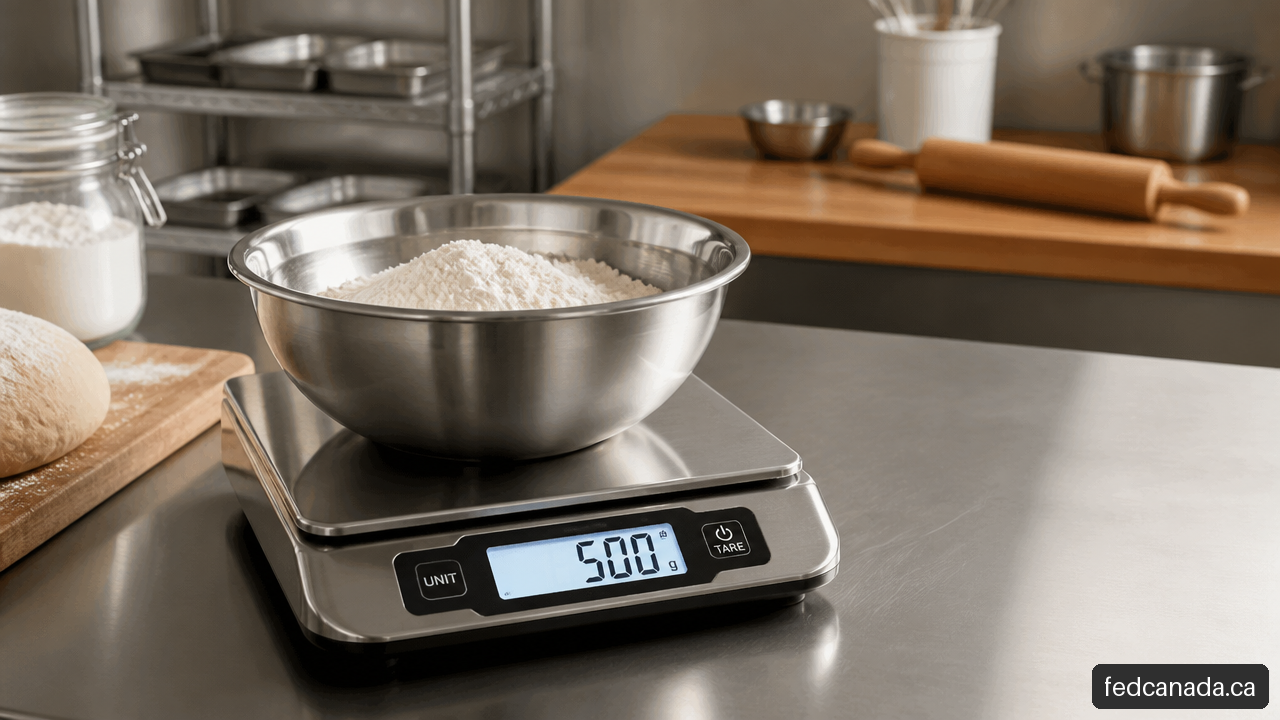
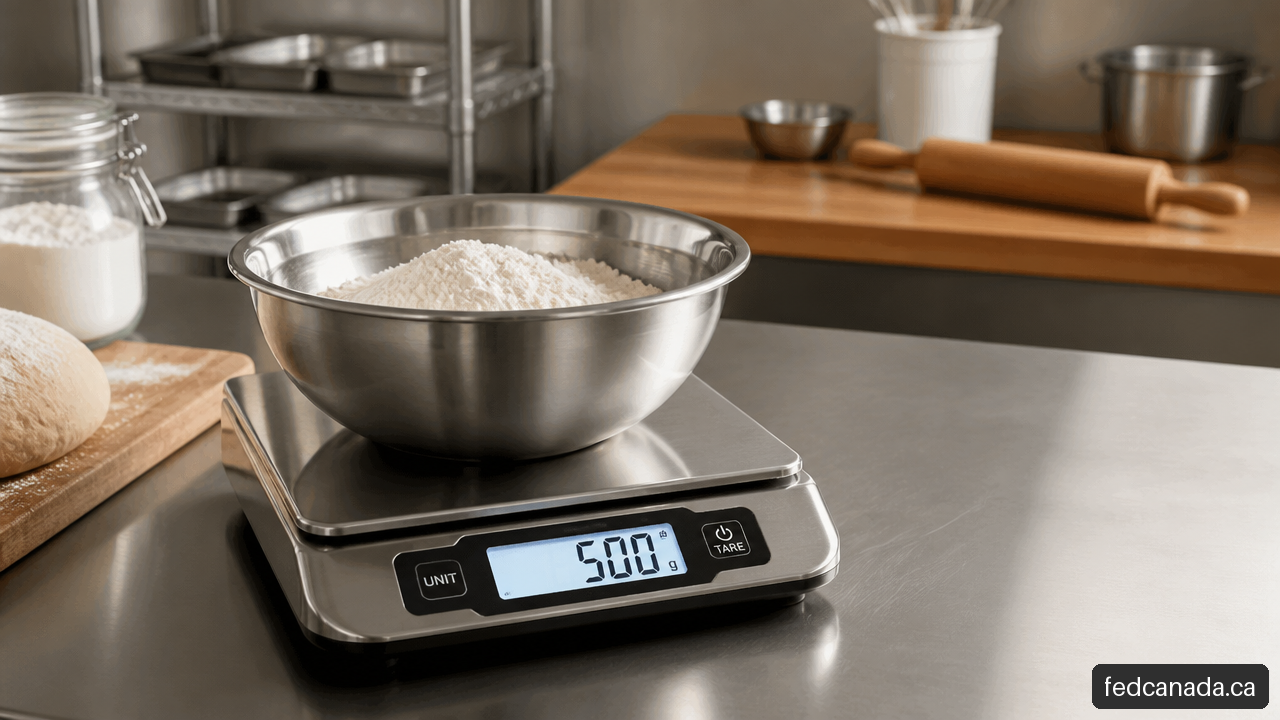
A kitchen scale is most valuable when it removes uncertainty. If a recipe calls for 500 grams of flour, the goal is not merely seeing “500” on the display. The goal is getting a stable, repeatable result every time the recipe is made.
What a Kitchen Scale Actually Measures
Mass, display resolution, and accuracy are different
Most digital kitchen scales use a load cell, a sensor that responds to force applied to the platform and converts it into a displayed weight measurement. The display might show whole grams, ounces, kilograms, pounds, or sometimes liquid related units.
The smallest change visible on the screen is called display resolution. If a scale changes from 100 g to 101 g, it has 1 gram resolution. That does not automatically mean the true mass is within 1 gram of the displayed number.
America’s Test Kitchen’s digital scale testing notes that consumer scales commonly show 1 gram increments even when measured deviations still occur. That distinction matters when accuracy is tight. A scale may consistently show 50 g for an object that is slightly above or below that mass, or it may fluctuate between nearby readings as ingredients are added.
For everyday cooking, a small difference may be harmless. A 2 gram variation in a pot of soup is unlikely to matter. In bread formulas, pastry, curing mixes, coffee, or small batch sauce production, the same variation can be more noticeable because the ingredient amount is small relative to the full recipe.
Why minimum usable load matters
A scale can have a high maximum capacity while being poor at detecting tiny additions. This is the minimum usable load issue. A typical 1 gram scale may not respond promptly when a few grains of salt or a pinch of spice are added. It may also round several small additions to the same displayed number before suddenly changing.
Consider a bakery formula that needs 1.5 grams of instant yeast. A general scale displaying whole grams may show 1 g, then 2 g, with no practical way to know where 1.5 g falls. The solution is not necessarily buying the most expensive large scale. It is usually using a dedicated precision scale for ingredients below roughly 10 grams.
Tare is net weight, not a measure of scale quality
The tare function tells the scale to treat the container currently on the platform as zero. It lets you measure the ingredient rather than the bowl, tray, deli container, or mixing tub.
A correct tare workflow is simple:
- Place the empty container fully on the scale platform.
- Wait for the reading to settle.
- Press tare or zero.
- Confirm the display returns to 0 g.
- Add the ingredient gradually until the target weight is reached.
- Tare again before adding the next ingredient if you are building a recipe in one bowl.
Best Buy Canada’s gram scale guidance recommends using a hard, level surface, avoiding vibration and drafts, and taring the container before ingredients are added. These basics matter because a load cell is sensitive to force, movement, and shifting pressure on the platform.
How to Choose the Right Kitchen Scale
Select a scale type by task
The best kitchen scale depends on what you weigh most often. The table below separates common needs without treating every scale as interchangeable.
| Kitchen task | Recommended scale type | Useful specification | When to avoid it |
|---|---|---|---|
| Everyday cooking and meal prep | Digital kitchen scale | 1 g resolution, 5 kg capacity, tare button | Avoid for tiny quantities below 2 g to 5 g |
| Bread, pizza, pastry, and batch baking | Large platform baking scale | 1 g resolution, 5 kg to 10 kg capacity, wide platform | Avoid if you need tenths of a gram |
| Coffee, spices, yeast, and additives | Precision scale | 0.1 g resolution, protected platform | Avoid for heavy bowls or large mixing batches |
| Butchery, bulk prep, and catering | High capacity bench scale | Larger platform, higher capacity, easy cleaning | Avoid for micro ingredients |
| Portion control and plated service | Compact digital scale | Fast settling, readable display, washable surface | Avoid if container size blocks the display |
For restaurants and foodservice businesses, it can be more efficient to use two scales: one general purpose scale at the prep station and one precision scale at the baking, beverage, or seasoning station. This reduces the temptation to use a small precision scale for a heavy container or a large prep scale for tiny amounts.
Capacity is about the full load, not only the ingredient
A scale’s maximum capacity includes everything sitting on it: the bowl, pan, container, ingredient, and sometimes a lid or scoop. A 5 kilogram scale can be overloaded faster than expected when a stainless steel bowl already weighs 1 kilogram and a dough batch weighs another 4.5 kilograms.
Before buying, estimate your largest realistic load:
- Empty container weight
- Largest ingredient batch
- Any liquid, ice, or garnish added in the same vessel
- A safety margin so normal use does not approach the limit
For example, a caterer weighing a 6 kilogram batch of potato salad should not choose a 6 kilogram scale. The container itself consumes part of that capacity. A 10 kilogram or higher capacity model would provide a more usable margin.
Platform size and corner loading deserve attention
A wide bowl can hide the display, but it can also create a more subtle issue: corner loading error. This is the change in reading that may occur when the same object is moved from the centre of the platform toward an edge.
Food & Wine’s kitchen scale testing found that platform position and repeat measurements can affect practical performance. This matters when a large container rests unevenly, hangs over the platform, or places most of its force near one side.
When comparing scales, choose a platform that supports your usual bowl base. Then test it. Place a known object in the centre, note the number, and move the same object to several positions near the platform edges. Small changes can occur, but large shifts suggest the scale may not be suitable for high consistency work.
Unit options and liquid modes need context
Grams are usually the clearest unit for recipes because they measure mass directly. Ounces can be useful when working from older or U.S. recipes. Millilitre and fluid ounce settings deserve more caution.
A scale cannot directly measure liquid volume. It measures mass, then may calculate an estimated volume based on an assumed density. Water is close to a simple one to one relationship: 100 grams of water is approximately 100 millilitres. Oil, milk, syrup, cream, honey, and sauces have different densities.
For example, 100 grams of oil is not automatically 100 millilitres of oil. If a production recipe needs exact liquid volume, use a graduated container or verify the ingredient by mass using a tested recipe standard. A millilitre mode can be convenient for water like liquids, but it should not be treated as universal laboratory measurement.
How to Use and Verify a Kitchen Scale
Set up the scale for stable readings
Before weighing, place the digital scale on a rigid, level countertop. Avoid flexible prep tables, unstable carts, vibrating refrigeration units, open windows, and areas where people repeatedly bump the surface.
Follow this reliable setup process:
- Wipe the platform dry and remove loose crumbs or debris.
- Turn on the scale and allow it to settle at zero.
- Select grams unless the recipe specifies another unit.
- Set the empty container on the platform.
- Press tare and wait for a stable 0 g reading.
- Add ingredients slowly, especially near the target amount.
- Stop touching the container while the display settles.
If the reading keeps climbing or dropping without ingredients being added, first check the counter. Airflow, vibration, a container touching a wall, a weak battery, or a warped platform can all create apparent drift.
Verification and calibration are not the same
These terms are often used as if they mean the same thing, but they describe different actions.
| Action | What it means | When to use it |
|---|---|---|
| Verification | Compare the displayed reading with a known mass | Before important prep, after a drop, or when readings seem suspicious |
| Calibration | Adjust the scale according to its manufacturer instructions using a specified mass | Only when the scale supports calibration and verification shows a meaningful issue |
| Repeatability check | Weigh the same item several times and compare results | When readings appear inconsistent or drift after taring |
Wirecutter’s kitchen scale evaluations note that accuracy can vary by model and load, and that some models permit calibration with external weights. Not every consumer scale offers this feature, and calibration weights can cost more than an entry level kitchen scale. Check the product manual before assuming a calibration button exists.
For a quick verification, use a known reference mass. Four Canadian or U.S. five cent coins are often treated as a nominal 20 gram check because each coin has a nominal mass of 5 grams. This is suitable for a basic check, not a substitute for certified calibration weights.
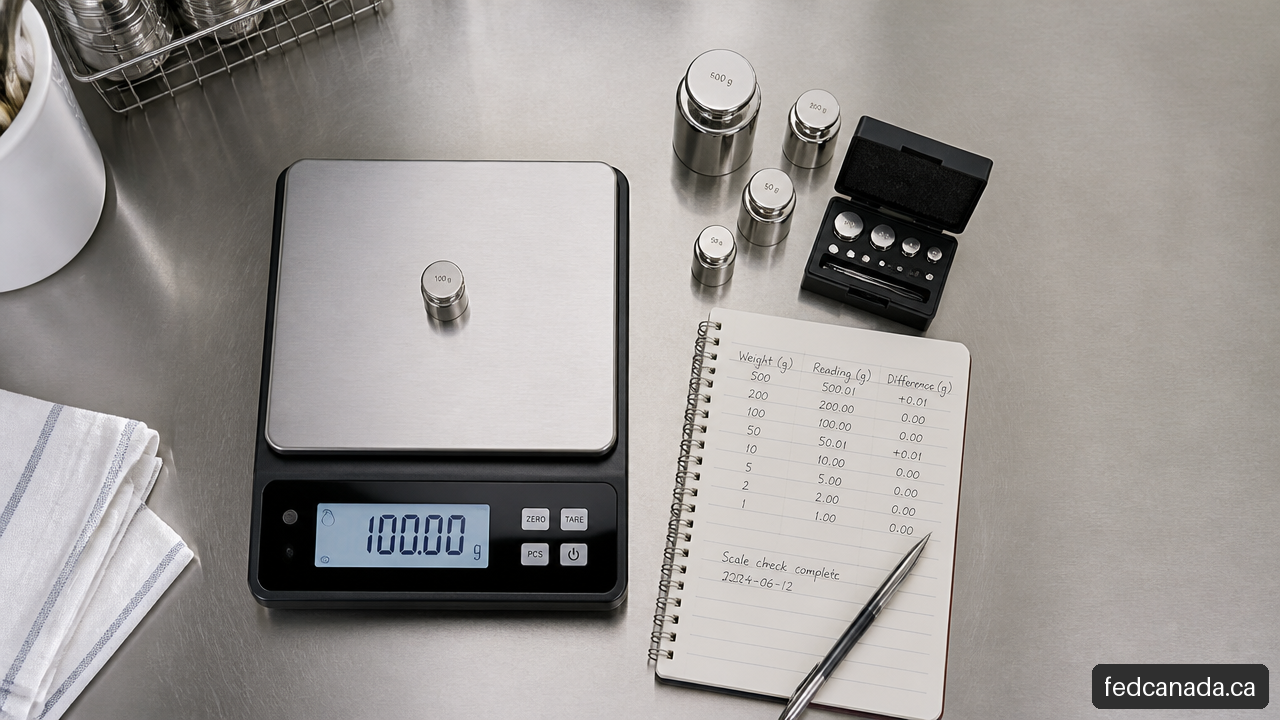
A repeatable home or workplace accuracy check
A single test at one weight can miss problems. A scale might perform well at 100 grams but behave differently near 1 kilogram or near its upper capacity.
Use this practical protocol:
- Choose at least three known masses, such as 20 g, 100 g, and 500 g or 1,000 g.
- Test each mass in the centre of the platform.
- Remove and replace each mass three times.
- Record each displayed result instead of relying on memory.
- Move one reference mass near several platform edges and compare readings.
- Place a bowl on the scale, tare it, and confirm the reference mass is still read correctly.
- Repeat the test if the scale has been moved, dropped, exposed to spills, or stored for a long period.
Good Housekeeping’s scale testing approach includes multiple reference masses and a bowl tare test. That method is useful because it checks the way a scale is actually used in a kitchen, not just how it performs with one item placed neatly in the middle.
Care, Troubleshooting, and Foodservice Use
Clean without forcing liquid into the scale
Most kitchen scales are not designed to be submerged. Even if the platform looks sealed, liquid can enter through buttons, seams, charging ports, or the underside.
For routine cleaning:
- Turn the scale off before wiping it.
- Use a lightly damp cloth with mild detergent when needed.
- Dry the platform, display, and seams promptly.
- Remove a detachable platform only if the manufacturer allows it.
- Never spray cleaner directly onto the display or buttons.
- Keep raw protein containers and wet prep tools from dripping onto the unit.
A removable platform can make cleanup easier, but it does not make the electronic base washable unless the product specifically states that it is.
Fix common reading problems before replacing the scale
| Symptom | Likely cause | Practical response |
|---|---|---|
| Reading changes while untouched | Vibration, draft, low battery, unstable counter | Move to a rigid surface, replace batteries, shield from airflow |
| Scale will not return to zero | Debris, container contact, sensor issue | Clear platform, ensure nothing touches the bowl, restart scale |
| Different result near the edge | Corner loading sensitivity or oversized container | Center the load, use a smaller bowl, consider a wider platform scale |
| Small additions do not register | Load is below practical sensitivity | Use a 0.1 g precision scale |
| Scale shuts off during prep | Short auto off setting or battery condition | Check settings, keep spare batteries, choose a model with longer timeout |
| Reading is far from reference mass | Overload, damage, or calibration issue | Verify at several masses, calibrate only if supported, replace if errors persist |
Fair warning: a scale that is consistently wrong by a small amount may be less disruptive than one that changes unpredictably. Repeatability is essential for recipes. If a scale reads 101 g for the same 100 g reference every time, it may be usable for some noncritical work after verification. If it reads 98 g, then 104 g, then 100 g under the same conditions, it is not dependable for controlled production.
Build a simple scale routine for foodservice
For a restaurant, café, bakery, or catering operation, a short routine can prevent small measurement errors from spreading across many batches.
- Assign each scale to a task, such as proteins, dry goods, baking, coffee, or small ingredients.
- Label the maximum capacity and preferred unit near the workstation.
- Keep a small known reference mass available for periodic checks.
- Verify scales before high value batches, recipe testing, or high volume production days.
- Record recurring problems, including drifting readings or cracked platforms.
- Replace batteries before they become an urgent service issue.
- Retire scales that fail repeatability checks or show major corner loading differences.
This routine does not need to become burdensome. It simply turns the scale from an assumed tool into a checked tool, much like confirming an oven temperature or refrigerator setting before relying on it.
Kitchen Scale FAQ
Is a digital kitchen scale better than an analog scale?
For most cooking, baking, and foodservice tasks, yes. A digital scale is generally easier to tare, switch units, and read in small increments. Analog scales can be durable and do not require batteries, but their dial markings are usually less practical for precise ingredient work.
How accurate does a kitchen scale need to be for baking?
For most baking, a scale that is repeatable and reasonably close across common recipe weights is sufficient. A general 1 gram scale works well for flour, water, sugar, butter, and similar ingredients. Use a 0.1 gram precision scale for small additions such as yeast, salt in tiny formulas, and specialty ingredients.
Does a 1 gram kitchen scale measure accurately to 1 gram?
Not necessarily. A 1 gram specification often describes what the display can show, not a guaranteed accuracy tolerance. Verify the scale with known masses at several weights if your recipe depends on close measurement.
Can I weigh liquids with a kitchen scale?
Yes. Measuring liquids by grams is often more reliable than measuring by volume when the recipe provides a mass. Water is straightforward because grams and millilitres are close. For oil, milk, syrup, cream, and sauces, use the recipe’s stated weight or a trusted conversion rather than assuming millilitres equal grams.
Why does my kitchen scale keep changing numbers?
The most common causes are an uneven surface, vibration, airflow, a container touching another object, battery issues, or delayed settling after an ingredient is added. Move the scale to a solid counter, clear the platform, replace batteries if needed, and test it with a known mass.
Why does my scale show different readings when I move the bowl?
The bowl may be placing pressure differently across the platform. This is corner loading sensitivity. Center the container whenever possible. If a large bowl causes meaningful changes from one position to another, choose a scale with a wider platform or use a smaller container.
How do I calibrate a kitchen scale?
First, verify it with a known reference mass. If the reading is off and the model supports calibration, follow the manufacturer’s exact procedure and use the specified calibration mass. Do not guess at the required weight. If the model does not support calibration and readings are inconsistent, replacement may be more practical.
What capacity should a restaurant or bakery kitchen scale have?
For general prep, 5 kilograms is a common starting point. Choose 10 kilograms or more when weighing large dough batches, proteins, bulk ingredients, or catering quantities. Include the container weight in your calculation and leave room below the maximum capacity.
Sources and References
Verified references
- Wirecutter / The New York Times — The 4 Best Kitchen Scales of 2026 — https://www.nytimes.com/wirecutter/reviews/best-kitchen-scale/
- America’s Test Kitchen — The Best Digital Scales of 2026 — https://www.americastestkitchen.com/equipment_reviews/1696-digital-kitchen-scales
- Food & Wine — The 6 Best Kitchen Scales, According to Our Tests — https://www.foodandwine.com/lifestyle/kitchen/best-kitchen-scales
- Good Housekeeping — 4 Best Kitchen Scales of 2024, According to Our Testing — https://www.goodhousekeeping.com/what-to-buy/kitchen-products/g39111517/best-kitchen-scales/
- Best Buy Canada — Gram Scales — https://www.bestbuy.ca/en-ca/shop/home-living/gram-scales
Recent Posts
Leave a Comment
Your email address will not be published. Required fields are marked *