




Commercial Refrigeration: Choosing Efficient, Reliable Systems
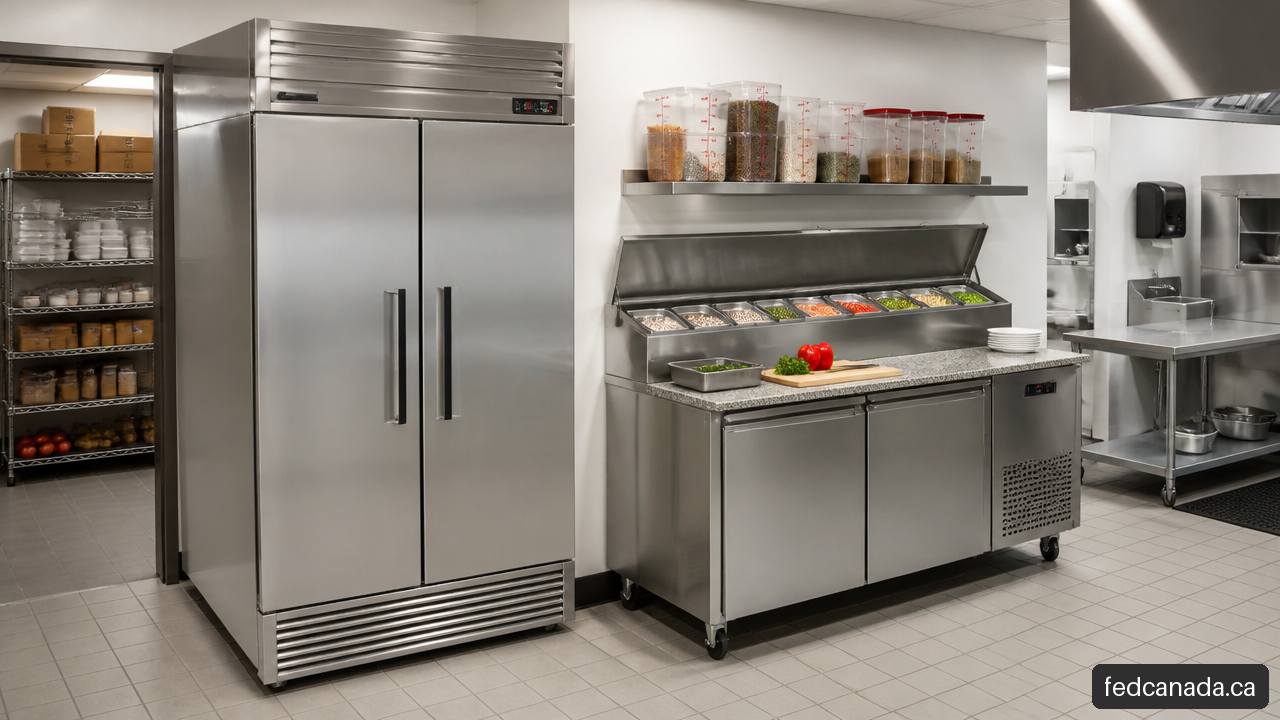
Commercial Kitchen With Stainless Steel Refrigeration Equipment and Organized Cold Food Storage
Commercial refrigeration is not simply a larger version of a household refrigerator. It is a food protection system, an energy load, and often a critical point of failure for a restaurant, grocery department, café, hotel, or food truck. I recommend evaluating it as part of the operation rather than as an isolated appliance: the right unit must protect product, fit the workflow, allow service access, and control operating costs over time.
Table of Contents
• Choosing the Right Commercial Refrigeration Format
• Canopy vs. Gravity Coil Refrigeration Systems
• Energy Efficiency, Refrigerants, and Compliance
• Maintenance, Failure Modes, and Service Planning
• Commercial Refrigeration FAQ
Key Takeaways
What I Would Prioritize First
The best commercial refrigeration setup is usually the one that matches product handling, kitchen layout, and local service capacity. A feature rich cabinet can still create avoidable downtime if its controls are difficult to access, replacement parts are slow to obtain, or the refrigeration system is poorly matched to the room.
For most buyers, the decision should begin with four questions:
• What food is being held, displayed, or frozen?
• How often will doors be opened or product loaded?
• Is the equipment located in a hot kitchen, a customer area, or a dedicated cold room?
• Can a qualified technician reasonably access parts, controls, condensate drainage, and the condenser?
The Practical Decision Lens
Refrigeration capacity is only useful when the system can maintain temperature under the actual heat, traffic, and loading conditions of the operation.
A reach in refrigerator used for pre chilled ingredients has a different job than a walk in cooler receiving frequent deliveries. Likewise, a display case selling prepared foods needs stable product temperatures without excessive dehydration, while a freezer needs dependable defrost performance and strong door seals. I would avoid choosing strictly by exterior dimensions or purchase price; both can conceal a poor fit.
Choosing the Right Commercial Refrigeration Format
What Counts as Commercial Refrigeration?
Commercial refrigeration equipment stores, holds, displays, or freezes perishable products in business settings. It can include reach in refrigerators, undercounter units, prep tables, refrigerated display cases, merchandisers, walk in coolers, walk in freezers, and remote refrigeration systems.
The U.S. Department of Energy uses a detailed functional definition rather than treating every cold cabinet alike. Its framework considers temperature range, display or storage purpose, door configuration, pull down versus holding use, and whether equipment connects to a self contained or remote condensing unit. The agency also excludes consumer products and equipment designed exclusively for medical, scientific, or research purposes. See the DOE’s commercial refrigeration equipment definition and rule timeline for the regulated product scope.
This distinction matters because a cabinet built to hold already chilled food is not necessarily designed to pull warm product down quickly. Loading warm stock into a holding cabinet can overwhelm the evaporator and compressor, creating temperature swings that look like equipment failure even when the unit is functioning as designed.
Selecting Equipment by Use, Not Just Capacity
I recommend matching the equipment format to the point where food is handled. The table below shows the practical differences.
Equipment type | Best use | Main advantage | Common limitation |
|---|---|---|---|
Reach in refrigerator or freezer | Back of house storage with frequent access | Compact footprint and direct access | Door openings can cause temperature recovery issues |
Undercounter refrigerator | Prep stations and tight kitchens | Keeps ingredients within reach | Limited capacity and possible heat exposure from nearby cooking equipment |
Refrigerated prep table | Sandwich, pizza, salad, and assembly lines | Combines ingredient pans with workspace | Requires disciplined pan loading and lid use |
Walk in cooler or freezer | Bulk storage and receiving | High volume and flexible shelving | Requires proper insulation, drainage, door hardware, and refrigeration design |
Refrigerated display case | Retail merchandising and grab and go food | Presents product to customers | Open access and lighting can increase energy demand |
Remote refrigeration system | Larger stores and multi case installations | Removes heat and noise from sales areas | More complex installation and service requirements |
Sizing a Unit Without Underestimating Heat Load
Cabinet volume is only one part of sizing. I would calculate storage needs first, then account for how product enters and leaves the equipment. A café that stores sealed beverages may need less recovery capacity than a busy prep kitchen where staff open doors every few minutes during service.
Consider these operating variables before specifying a unit:
• Product temperature at loading: Warm food creates a larger refrigeration load than pre chilled food.
• Door traffic: Each opening exchanges cold interior air for warmer, more humid room air.
• Ambient conditions: Equipment near fryers, ovens, dishwashers, sunlight, or HVAC supply problems works harder.
• Clearance and ventilation: Condensers need airflow. Tight enclosures can recirculate hot discharge air back into the system.
• Future menu changes: A new cold beverage program or expanded prepared food offering can outgrow storage quickly.
For example, a two door reach in may appear sufficient based on shelf space. If it sits beside a cooking line and is repeatedly opened during rush periods, its real world load can be far higher than its static capacity suggests. In that situation, relocating the cabinet, improving kitchen ventilation, or adding a dedicated prep refrigerator may be more effective than simply choosing a larger cabinet.
Canopy vs. Gravity Coil Refrigeration Systems
The Short Answer
A canopy style refrigeration system generally uses forced airflow, often arranged to create an air curtain or directed circulation pattern around the product area. A gravity coil system relies more heavily on natural convection: cold air falls from the evaporator coil while warmer air rises toward it.
Neither design is automatically superior. I would choose based on whether the priority is temperature uniformity and recovery, or gentler product holding with less air movement.
How Canopy Refrigeration Works
In many refrigerated display applications, a canopy system places the evaporator and fans in the upper section of the case. Fans move chilled air across or around products, sometimes creating an air curtain at the front opening. The moving air helps separate cold case air from warmer store air.
This arrangement can offer several operational benefits:
• Faster temperature recovery after customer access or stocking.
• More even temperatures across the display area when airflow is correctly balanced.
• Better suitability for open front merchandising where the system must counter warm ambient air.
• Potentially clearer product presentation because refrigeration components are integrated into the upper structure.
The tradeoff is that forced air can dry exposed products. Leafy greens, uncovered deli items, bakery products, and some prepared foods may lose moisture more quickly if airflow is excessive or incorrectly directed. Fan motors also add a small heat load and consume energy. If air paths are blocked by overfilled shelves, product packaging, or misplaced signage, the air curtain can collapse and temperatures can become uneven.
How Gravity Coil Refrigeration Works
A gravity coil evaporator cools air near the coil without relying as heavily on fan driven circulation. As air cools, it becomes denser and settles. Warmer air rises toward the coil, creating a slower natural circulation pattern.
This gentler approach is often useful where product dehydration is a concern. It can be suitable for applications where maintaining moisture and minimizing air movement is more valuable than rapid recovery. The slower airflow can also reduce the tendency for lightweight packaging, papers, or loose product to interfere with circulation.
Fair warning: gravity coil systems can have less uniform temperature distribution if loading practices are poor. Warm product placed high in the cabinet, blocked coil surfaces, or dense stock near airflow paths can create warm zones. Because recovery is typically slower, frequent door openings or heavy customer interaction may make a gravity coil design less suitable than a forced air alternative.
Side by Side Comparison
Decision factor | Canopy style system | Gravity coil system |
|---|---|---|
Air movement | Fan driven and directed | Natural convection with limited forced airflow |
Temperature recovery | Usually faster after access or loading | Usually slower, especially with frequent door opening |
Product moisture | Can dry exposed foods if airflow is strong | Often gentler for moisture sensitive products |
Best fit | Open displays, high traffic cases, products needing more uniform circulation | Covered storage or products where reduced airflow is preferred |
Main risk | Blocked air curtain, fan issues, excess dehydration | Uneven zones, slower pull down, restricted coil circulation |
Service focus | Fans, controls, air paths, evaporator cleanliness | Coil cleanliness, loading patterns, defrost and drainage |
When I Would Choose Each Approach
I would lean toward canopy or forced air refrigeration when the display is open, customers access product frequently, or the case needs quick recovery after restocking. A beverage merchandiser or high traffic prepared food display is a common example. The system needs to manage repeated contact with warm room air.
I would consider gravity coil refrigeration when the product is sensitive to drying and access is comparatively controlled. For instance, a covered holding application for certain fresh or unpackaged products may benefit from gentler circulation. But the case must be loaded thoughtfully, and staff should understand that natural convection depends on open space around the coil and product.
The manufacturer’s specific case design still matters. “canopy” and “gravity coil” are sometimes used differently across equipment categories, so I would confirm the evaporator location, fan arrangement, intended product load, and operating temperature range before treating the label as a complete performance description.
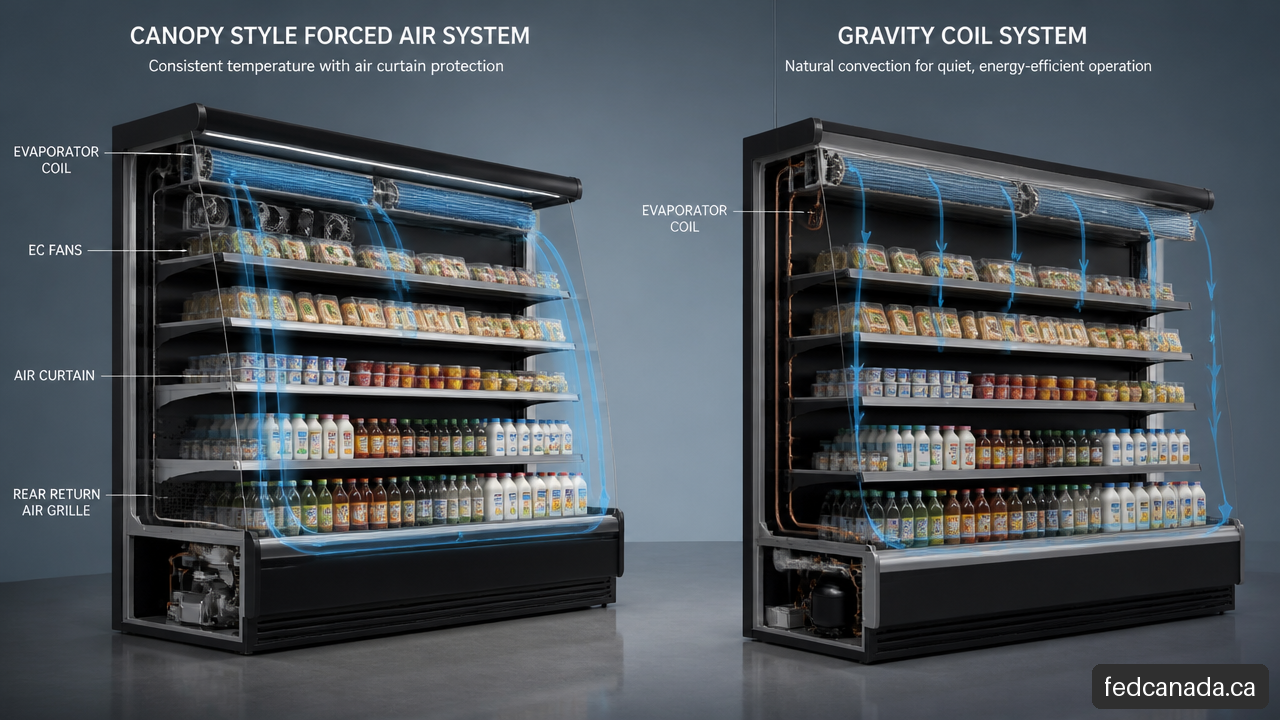
Comparison of canopy forced air refrigeration and gravity coil refrigeration airflow in display cases.
Energy Efficiency, Refrigerants, and Compliance
Where Refrigeration Energy is Actually Lost
Energy efficiency is not just a compressor specification. Commercial units consume more energy when heat enters through doors, poor insulation, damaged gaskets, open display fronts, warm product loading, dirty condensers, and inadequate ventilation.
The refrigeration cycle explains why. The evaporator absorbs heat from the cabinet. The compressor raises refrigerant pressure and temperature. The condenser releases that heat to the surrounding air. If the condenser is dirty or located in a hot, restricted space, heat rejection becomes harder. The compressor runs longer, energy use rises, and component wear increases.
I would start energy reduction with the conditions that make equipment work harder:
Keep condenser airflow clear and clean the coil on an appropriate service schedule.
Replace torn or compressed door gaskets before they create persistent warm air leakage.
Reduce unnecessary door openings by organizing inventory and labeling shelves.
Keep products away from evaporator air paths and do not overfill display cases.
Verify that the room HVAC system is not directing hot air at refrigeration equipment.
Understanding Standards and Test Methods
Energy claims should be compared using consistent test methods, not brochure language alone. In Canada, CSA Group’s commercial refrigeration energy performance standard describes methods for measuring volume, energy consumption, and total display area for electrically operated commercial refrigeration equipment. This is particularly relevant to cabinets and merchandisers, where display area and usable volume can influence comparisons.
In the United States, manufacturers use the DOE test procedures in 10 CFR 431.64 to determine compliance with commercial refrigeration standards. The current federal rule took effect March 24, 2025, and amended standards apply to covered equipment manufactured on or after January 22, 2029. That date matters for buyers planning major replacements or long term equipment standardization.
Sanitation is a separate concern from energy performance. NSF/ANSI 7 establishes minimum food protection and sanitation requirements for the materials, design, manufacture, construction, and performance of commercial refrigerators and freezers used to store or display cold food. In procurement, I would treat sanitation certification, energy performance, and electrical safety certification as related but distinct checks.
Refrigerants and Safety Transitions
Refrigerant selection affects service practices, environmental considerations, and equipment safety design. Refrigerants have different operating pressures, flammability classifications, and handling requirements. The right choice is not simply a matter of selecting the newest refrigerant; the equipment, installation environment, local rules, and technician capability must align.
North American commercial refrigeration safety requirements have been transitioning toward 60335 2 89 based standards. Intertek notes a September 29, 2024 transition date for 60335 2 89 based refrigeration safety standards. For purchasers, the practical point is to verify the product’s current certification markings and installation requirements rather than assuming older safety assumptions apply to newer equipment.
A California Rule That is Easy to Misread
California’s retail food store refrigeration rules are not a blanket requirement for every restaurant refrigerator. The California Energy Commission states that the relevant requirements apply to retail food or beverage stores with 8,000 square feet or more of conditioned floor area when refrigerated display cases, walk in coolers, or walk in freezers are connected to remote compressor or condensing units. The requirements are mandatory and cannot be traded away through the performance compliance method. Review the Commission’s retail food store refrigeration applicability guidance when a project falls within that scope.
That threshold and remote system condition are important. A small self contained case in a café is not the same regulatory scenario as a large grocery store rack system. I would involve the project’s code professional and refrigeration designer early when a retail renovation includes remote cases or walk ins.
Maintenance, Failure Modes, and Service Planning
The Warning Signs That Deserve Quick Action
A unit does not need to be completely warm before it needs service. Small performance changes often precede product loss or compressor damage.
• The cabinet runs almost continuously or cycles unusually often.
• Temperatures drift upward during busy periods and recover slowly.
• Frost or ice accumulates on evaporator surfaces, interior panels, or freezer products.
• Water appears under the cabinet or around the walk in doorway.
• Door gaskets no longer seal evenly, or doors fail to close on their own.
• Fans become noisy, airflow feels weak, or the condenser exhaust is unusually hot.
• The controller display does not agree with a verified product temperature measurement.
Connecting Symptoms to Likely Causes
A refrigerator that is not holding temperature may have a dirty condenser, blocked evaporator airflow, a failed fan, a damaged gasket, a defrost problem, incorrect control settings, or a refrigerant circuit fault. Those causes are not interchangeable. Cleaning a condenser will not correct a control sensor that is reading inaccurately, and adjusting a thermostat will not solve an iced evaporator caused by a failed defrost component.
Ice buildup inside a commercial freezer is especially revealing. It can result from humid air entering through a damaged gasket or frequent door opening. It can also point to a defrost issue, clogged drain, or poor door alignment. Ice insulates the evaporator and blocks airflow, so the system may run longer while cooling becomes less effective.
Building a Maintenance Routine That Supports Uptime
I would divide refrigeration care into routine checks and qualified service work. Staff can handle cleanliness, visual inspection, loading discipline, and temperature logging. Refrigerant diagnosis, electrical testing, control calibration, compressor work, and defrost troubleshooting should be handled by appropriately qualified service personnel.
Routine Task | Suggested Awner | Why it Matters |
|---|---|---|
Check and record operating temperatures | On site staff | Identifies drift before food quality is affected |
Inspect door gaskets and hinges | On site staff | Limits warm air infiltration and compressor run time |
Keep product clear of vents and coils | On site staff | Preserves evaporator airflow and temperature uniformity |
Clean accessible surfaces and drains | On site staff | Reduces sanitation and condensate problems |
Clean condenser and inspect electrical or refrigeration components | Qualified technician | Supports heat rejection and identifies developing component failures |
Verify controls, defrost operation, and refrigerant performance | Qualified technician | Addresses faults that cannot be confirmed by visual inspection alone |
Serviceability should be part of the purchasing decision. Warranty duration matters, but it does not guarantee rapid recovery when a unit fails. Parts distribution, technician familiarity, accessible components, and clear documentation can have a larger effect on downtime. If two units have similar efficiency ratings, I would give real weight to the one that local service providers can diagnose and repair without excessive delay.
Commercial Refrigeration FAQ
How is Commercial Refrigeration Different From Residential Refrigeration?
Commercial units are designed for business workloads, including frequent access, higher product turnover, food display, and larger storage demands. They commonly use more robust components, stronger insulation, commercial controls, and serviceable refrigeration systems. Residential equipment is generally not intended for the same door traffic, ambient heat, or continuous operational demands.
Which Type of Commercial Refrigerator do I Need?
Choose based on use location and food workflow. A reach in suits back of house storage, an undercounter unit supports prep stations, a prep table supports ingredient assembly, a display case supports merchandising, and a walk in supports bulk inventory. If food is accessed frequently by customers or staff, prioritize temperature recovery and airflow management.
Should I Choose Remote or Self Contained Refrigeration?
Choose self contained equipment for simpler installation, smaller footprints, and individual cabinets or cases. Choose remote refrigeration when a larger installation benefits from moving heat and noise away from the sales floor or kitchen. Remote systems can be more complex and may require more coordination for design, piping, controls, and service.
What is the Most Energy Efficient Commercial Refrigeration Setup?
The most efficient setup is the one correctly sized for its load, installed with adequate ventilation, maintained regularly, and operated with doors, gaskets, controls, and airflow paths in good condition. A highly rated cabinet can still waste energy if its condenser is dirty or it is placed beside a heat source.
How Do I Keep a Commercial Refrigerator at a Safe Temperature?
Use a verified thermometer or calibrated monitoring system, avoid overloading shelves, keep doors closed as much as possible, and load food at the appropriate starting temperature for the equipment’s intended use. If readings drift, investigate promptly rather than relying on a control display alone.
Why is My Commercial Refrigerator not Holding Temperature?
Start with simple checks: door seals, airflow clearance, product blocking vents, condenser cleanliness, and room temperature. If those do not explain the issue, a qualified technician should assess fans, defrost components, controls, sensors, refrigerant charge, and compressor performance.
How Often Should Commercial Refrigeration be Cleaned and Serviced?
Interior cleaning, gasket checks, drain inspection, and temperature review should occur routinely as part of normal operations. Condenser cleaning and technical inspection frequency depends on dust, grease, operating hours, and the equipment environment. A kitchen near frying equipment may need attention more often than a low traffic beverage display in a clean, conditioned area.
What Does NSF/ANSI 7 Require?
NSF/ANSI 7 addresses minimum food protection and sanitation requirements for commercial refrigerators, freezers, and related components used to hold or display cold food. It covers areas such as materials, design, construction, manufacturing, and performance. It is not a substitute for local health requirements, proper food handling, or routine cleaning.
Sources/References
• U.S. Department of Energy — Commercial Refrigeration Equipment: https://www.energy.gov/cmei/buildings/commercial-refrigeration-equipment
• California Energy Commission — Commercial Refrigeration: https://www.energy.ca.gov/sites/default/files/2023-09/2022_CEC-Commercial_Refrigeration_ADA.pdf
• CSA Group — Product page for commercial refrigeration energy performance standard: https://www.csagroup.org/store/product/2424111/
• Intertek — Commercial Refrigeration & Freezer Testing: https://www.intertek.com/appliances/commercial-refrigeration/
Recent Posts

Leave a Comment
Your email address will not be published. Required fields are marked *