



Electric Griddle Guide: Cook Better, Clean Easier
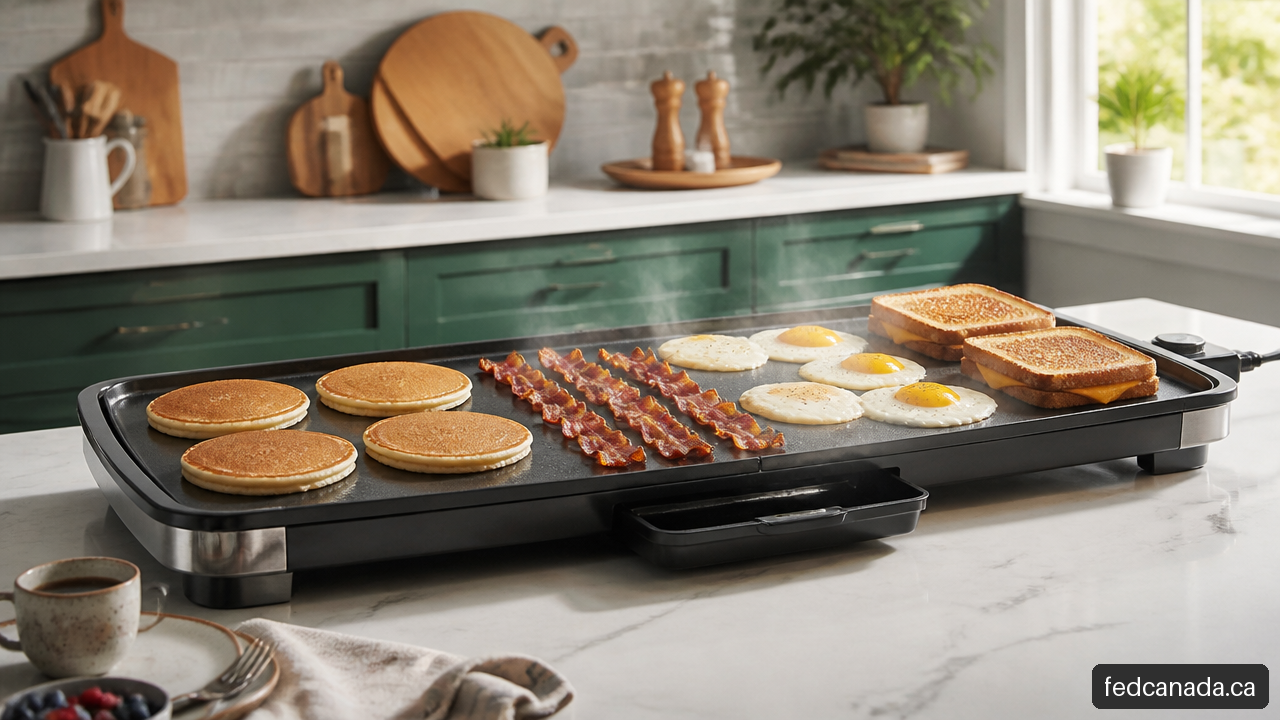
An Electric Griddle is one of the simplest ways to create more usable cooking space without adding another stovetop burner. Its broad, flat cooking area can handle breakfast, sandwiches, burgers, vegetables, and batch cooking while giving you direct temperature control at countertop height.
Table of Contents
- What an Electric Griddle Does Best
- How to Choose the Right Electric Griddle
- Temperature Control, Preheating, and Better Browning
- Cleaning and Maintaining an Electric Griddle
- Key Takeaways
- Electric Griddle FAQ
What an Electric Griddle Does Best
An electric griddle is a countertop appliance with an electrically heated flat cooking plate. Instead of placing a pan over one stovetop burner, you cook directly on a larger surface that is regulated by a thermostat or temperature control probe. The advantage is not simply that it makes pancakes. A griddle gives you a wide, continuous cooking area where several foods can cook at once. That matters when breakfast includes eggs, bacon, toast, and pancakes, or when lunch means cooking several grilled sandwiches without working in batches.
Electric Griddle vs. Frying Pan vs. Grill
A frying pan remains the better tool for sauces, deep sides, and small portions. An outdoor grill is better when open flame, smoke, and grill marks are the goal. An electric griddle sits between them: it offers an even, accessible flat surface for foods that benefit from direct contact with the plate.
| Appliance | Best for | Main limitation | When to choose it |
|---|---|---|---|
| Electric griddle | Batch breakfasts, sandwiches, burgers, flatbreads | Limited depth for sauces or braises | Choose it when surface area and temperature control matter most |
| Frying pan | Small meals, sauces, sautéing | One burner limits volume | Choose it for flexible everyday stovetop cooking |
| Stovetop griddle | Flat cooking on an existing range | Heat can depend on burner placement | Choose it when you want no extra appliance |
| Outdoor grill | High heat, smoke, grill marks | Weather, fuel, and outdoor setup | Choose it for charred or flame grilled foods |
For many households, an electric griddle is not a full replacement for either a stovetop or a barbecue. It is a practical second cooking zone. That distinction helps prevent disappointment: a flat plate can brown a burger well, but it will not create the same smoky flavor as charcoal or gas grilling.
Foods That Suit a Flat Cooking Surface
The most useful foods are those that benefit from steady surface contact and room to spread out. Consider the food’s shape, fat content, and moisture before deciding whether the griddle is the right tool.
- Pancakes, French toast, crepes, and breakfast sausage
- Fried eggs, scrambled eggs, bacon, and hash browns
- Burgers, sliders, quesadillas, and grilled sandwiches
- Chicken cutlets, fish fillets, and vegetables sliced into even pieces
- Tortillas, naan, flatbreads, and toasted wraps
A thick stew, a large pot of pasta, or a food that needs deep frying belongs elsewhere. The raised lip around many griddles is designed to contain food and grease, not replace the walls of a saucepan.
Why Cooking Area Changes the Experience
Cooking area is more than a capacity number. It affects whether food has room to brown. When pancakes touch each other, steam becomes trapped between them. When burgers are crowded together, released moisture cools the plate and slows browning.
A compact griddle can be enough for one or two people, especially if storage space is tight. A larger model makes more sense for family breakfasts, holiday cooking, or meal preparation. However, a very large plate can be awkward to carry, clean, and store. Choose the largest size you can comfortably handle when it is cool, greasy, and ready for cleanup—not just when it looks impressive in a product listing.
How to Choose the Right Electric Griddle
The best electric griddle depends on what you cook, how many portions you make, and how much cleanup effort you will realistically tolerate. Wattage, cooking area, plate design, and storage dimensions are all relevant, but no single specification tells the whole story.
Start With Your Cooking Pattern
Use this decision guide before comparing brands or finishes.
| Your priority | Look for | Consider avoiding |
|---|---|---|
| Small kitchen or apartment | Compact footprint, lighter body, vertical storage option | Oversized plates that are difficult to store |
| Family breakfast cooking | Broad cooking area, defined grease channel, stable temperature control | Small plates that force several batches |
| Easy cleanup | Removable plate and removable drip tray | Fixed plate designs if cleanup is your top priority |
| Burgers and sandwiches | Higher temperature range, sturdy plate, grease management | Shallow drip systems that may overflow with fatty foods |
| Delicate eggs and crepes | Smooth non-stick surface and responsive lower settings | Rough or damaged coatings |
A large plate is not automatically better. If you usually cook two eggs and two slices of toast, a massive griddle can take up counter space and add cleaning work without improving dinner. On the other hand, if you regularly prepare six pancakes at once, a small unit may make every breakfast feel slow.
Plate Construction and Non-Stick Surfaces
Most household electric griddles use a non-stick surface because it simplifies egg cooking and cleanup. The coating is helpful, but it is also the component most likely to be damaged by metal utensils, cutting, or harsh scrubbing.
I recommend treating the non-stick surface as a food-contact finish rather than a cutting board. Use silicone, nylon, wood, or carefully chosen plastic utensils. Avoid slicing directly on the plate. Once a coating is deeply scratched, food can cling in those damaged areas and cleaning becomes harder.
A smooth plate is especially useful for pancakes and eggs. A reversible plate with a ridged side may appeal to cooks who want grill-style marks, but those grooves are harder to clean and do not deliver the same result as an outdoor grill.
Electrical Setup in Canadian Homes
Check the manufacturer’s electrical instructions before use. For example, the Sunbeam Canada electric griddle owner’s guide specifies a 120-volt outlet and instructs users to turn the appliance off, unplug it, and let it cool before cleaning.
Use a stable, dry countertop close to an appropriate wall outlet. Keep the cord away from the hot plate edge and avoid placing the appliance where cabinet doors, towels, or loose paper can contact hot surfaces. If an extension cord is necessary, the appliance manual should guide that decision; extension cords can introduce capacity and placement issues that vary by model and household setup.
Fair warning: do not assume that “dishwasher-safe” means every part of the appliance can get wet. It commonly refers only to a removable cooking plate or drip tray.
Temperature Control, Preheating, and Better Browning
Good griddle cooking is mostly temperature management. The thermostat cycles power on and off to keep the cooking surface near its selected setting, but food temperature, batch size, and moisture can still change results.
Practical Temperature Guide in Fahrenheit and Celsius
The following settings are useful starting points, not universal rules. Thickness, sugar content, batter moisture, and the particular appliance can all shift the best setting.
| Food | Starting setting | Celsius equivalent | What to watch for |
|---|---|---|---|
| Crepes and thin batters | 300–325°F | 150–165°C | Browning too quickly or tearing |
| Eggs and delicate foods | 300–325°F | 150–165°C | Rubberiness or rapid browning |
| Bacon and breakfast sausage | 325–350°F | 165–175°C | Grease buildup and flare-like smoking |
| Pancakes and French toast | About 375°F | About 190°C | Dark edges before the center cooks |
| Grilled sandwiches | 350–375°F | 175–190°C | Bread scorching before cheese melts |
| Burgers and vegetables | 375–400°F | 190–205°C | Excess smoke or weak browning |
For pancakes, 375°F is approximately 190°C. The Consumers Guide temperature and cleanup guidance discusses about 375°F for pancakes, lower settings for thinner batters, and pushing residue toward a drip opening during cleanup. The goal is a cooked interior with controlled browning. If pancakes turn dark before bubbles form and the center sets, lower the setting. If they stay pale and spread excessively, give the plate more time to preheat or increase the setting slightly.
Preheating Is More Than Waiting for a Light
Preheating lets the whole cooking surface approach the chosen temperature before cold food arrives. Many models use an indicator light, but the precise meaning of that light differs by design. It may indicate active heating, temperature readiness, or a heating cycle.
Give the griddle time to stabilize after the indicator changes. This is especially useful on larger plates. A plate can be hot near the heating element while still recovering elsewhere. A simple home check can reveal obvious hot or cool zones:
- Preheat the empty, clean griddle at a moderate setting.
- Place equal small portions of the same batter or evenly cut bread pieces across the surface.
- Cook for the same amount of time without moving them.
- Compare colour and doneness, then note any repeatable pattern.
This is not a laboratory temperature test, but it can tell you whether one corner consistently cooks faster. If the difference is minor, rotate food during cooking. If it is dramatic or new, inspect the appliance for warping, poor contact, residue, or a control issue and consult the manufacturer’s instructions.
The Overcrowding Problem
A high thermostat setting does not guarantee a good sear. When a large amount of cold food hits the plate, it absorbs heat faster than the griddle can replace it. Surface temperature drops, moisture accumulates, and food steams instead of browns.
For instance, placing eight refrigerated burger patties tightly together may produce gray surfaces even at 400°F. Cooking four patties with space between them can create better browning at the same setting because steam has room to escape and the surface can recover heat.
If browning is weak, try these adjustments before turning the dial to maximum:
- Preheat longer before the first batch
- Pat wet foods dry before cooking
- Leave visible space between portions
- Cook in smaller batches
- Let the plate recover briefly between batches
Why Food Sticks Even on a Non-Stick Griddle
Sticking usually points to one of four issues: insufficient preheating, damaged coating, sugary residue, or food being moved too early. Proteins can initially cling to a surface, then release as they cook and firm up.
Use a small amount of oil only when it suits the food and the manufacturer’s care instructions. Too much oil can pool, smoke, or make pancakes fry around the edges. A light wipe of oil is often more useful than pouring oil directly onto the plate.
Cleaning and Maintaining an Electric Griddle
Cleaning method should follow the appliance’s architecture. The most common mistake is treating every griddle as fully washable. Some are designed for separate removable parts; others have an electrical heating base that must remain dry.
First, Separate Washable Parts From Electrical Parts
The safe rule is simple: consult the manual for your model before washing anything beyond the removable tray or plate. The Oster removable griddle instruction manual states that the heating base and cord must not be immersed, while the griddle plate and drip tray may be washed separately under its stated instructions.
Use this decision path:
- Turn the temperature control off and unplug the griddle.
- Allow it to cool before touching removable components.
- Check whether the plate, drip tray, or body is specifically identified as washable.
- Remove the temperature probe or control when the manual requires it.
- Wash only approved components, then dry every part completely before reassembly.
A fully immersible design can reduce cleanup work, but only under the manufacturer’s stated conditions. Even then, the temperature control is often a separate electrical boundary.
Cleaning Workflows by Design
| Griddle design | Best cleanup workflow | Important caution |
|---|---|---|
| Removable plate | Remove cooled plate and drip tray; wash as permitted | Keep the heating base and cord dry |
| Fixed plate with heating base | Wipe the cooled plate in place with a soft damp cloth | Do not submerge the appliance |
| Manufacturer-approved immersible body | Remove control probe first, then wash as directed | “Immersible” does not apply to every component |
For stuck-on residue, use warm water, mild dish soap, and a soft sponge or plastic scouring pad if your manual allows it. Avoid steel wool, abrasive powders, and sharp scraping tools. Those methods may remove residue quickly but can shorten the useful life of a non-stick cooking surface.
Cooling Time and Safe Cleanup
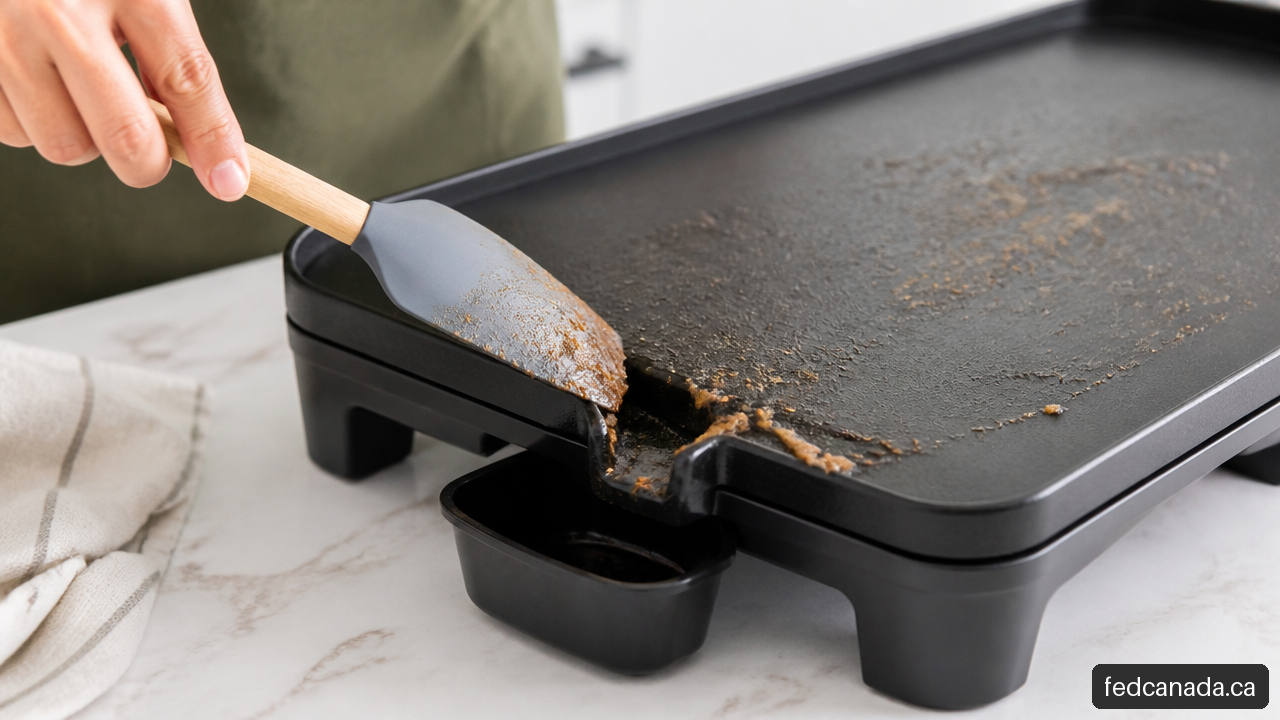
Do not rush cleanup while the griddle is extremely hot. The Cuisinart Canada Griddler instruction booklet directs users to let the appliance cool completely for at least 30 minutes before cleaning. Once the surface is warm but safely manageable, grease may be easier to guide toward the drip opening with a silicone spatula. Empty the drip tray before grease reaches its capacity. Overflow is messy, but it can also spread grease onto the countertop or appliance base.
Maintenance That Protects Performance
A clean griddle heats and releases food more predictably. Residue left on the plate can burn during the next use, creating smoke and uneven contact with food. After each use:
- Empty and wash the drip tray if your model includes one
- Remove grease and food particles from the cooking surface
- Dry washable parts thoroughly before storage
- Store the cord loosely rather than sharply bent around hot or rough edges
- Check the plate for peeling, deep scratches, warping, or damaged connectors
If the griddle begins heating unevenly, first rule out residue, overcrowding, an unstable countertop, or insufficient preheating. If those are not the cause, discontinue use if there are damaged electrical parts, a loose control connection, persistent burning smells, or visible coating failure.
Key Takeaways
- An electric griddle adds a large, flat cooking surface for batch meals without using a stovetop burner.
- Choose cooking area based on real portion size, storage space, and how often you cook batches.
- Temperature control and preheating matter because cold or crowded food can reduce surface heat and limit browning.
- Pancakes often start near 375°F, which is about 190°C; thinner batters generally need lower heat.
- A removable plate and drip tray can simplify cleaning, but the heating base, cord, and temperature control usually require separate care.
- Protect the non-stick surface with non-metal utensils, gentle cleaning, and no cutting directly on the plate.
Electric Griddle FAQ
What is an electric griddle?
An electric griddle is a countertop appliance with a flat, electrically heated cooking plate. It is designed for foods such as pancakes, eggs, bacon, sandwiches, burgers, and vegetables that cook well with direct surface contact.
Is an electric griddle better than a frying pan?
Neither is universally better. An electric griddle is better for cooking many flat foods at once, while a frying pan is more versatile for sauces, small portions, and stovetop recipes. Choose based on the meal rather than expecting one appliance to replace the other.
What temperature should I use for pancakes on an electric griddle?
Start around 375°F, or approximately 190°C. Lower the setting if pancakes brown before their centers set. Raise it slightly or preheat longer if they remain pale and spread too much.
How long should an electric griddle preheat?
Follow the model’s instructions and indicator light, then allow a little additional time for the full cooking surface to stabilize. Larger plates may need more time than compact models. The exact duration varies by wattage, plate construction, and selected temperature.
Why is my electric griddle heating unevenly?
Uneven cooking can come from natural hot zones, uneven placement, warped components, residue, or inadequate preheating. Test with equal pieces of bread or batter across the surface. Rotate food if the variation is minor; consult the manual or stop using the appliance if the imbalance is severe or accompanied by electrical problems.
Can I use metal utensils on an electric griddle?
Avoid metal utensils on a non-stick cooking surface unless the manufacturer explicitly says they are safe. Silicone, nylon, wood, and suitable plastic tools are less likely to scratch the coating. Never cut food directly on the plate.
Can an electric griddle go in the dishwasher?
Only specific removable parts may be dishwasher-safe. The plate or drip tray may be washable, while the heating base, cord, and temperature probe are not. Check the product manual rather than relying on a general dishwasher-safe label.
Can I submerge an electric griddle in water?
Usually, no. Never submerge the heating base, cord, or temperature-control probe unless the manufacturer specifically says the appliance body is immersible and explains which parts must be removed first.
Recent Posts


Leave a Comment
Your email address will not be published. Required fields are marked *