




ENERGY STAR Commercial Kitchen Equipment: Cut Utility Costs
ENERGY STAR Commercial Kitchen Equipment: Cut Utility Costs is not just a purchasing question. It is a decision about what your kitchen will cost to operate every day it is open. Certified equipment can reduce electricity, natural gas, and water consumption, but the best financial result comes from matching the right model to your production volume, utility rates, and operating schedule.
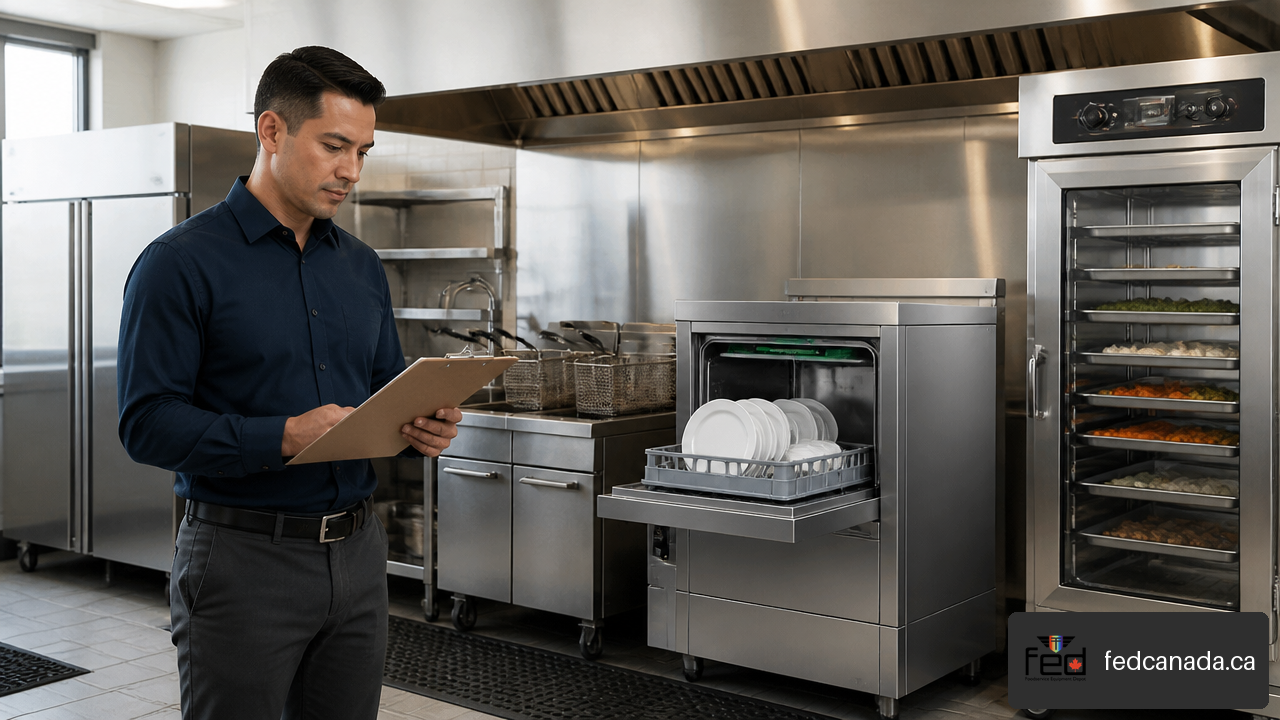
A lower utility bill is only part of the value. Better insulation, efficient burners, load sensors, heat recovery, and idle settings can reduce wasted energy while supporting more consistent kitchen operations. Still, certification alone does not guarantee a specific result. A lightly used appliance may take longer to pay back than an older unit that runs through every service period.
Table of Contents
- Key Takeaways
- What ENERGY STAR Certification Means in a Commercial Kitchen
- Build a Local Utility Cost and Payback Model
- Choose the Right Equipment Replacement First
- Protect Savings Through Installation and Daily Operation
- Frequently Asked Questions
- Sources
Key Takeaways
Focus on ownership cost, not just the equipment price
We recommend comparing the purchase price with expected energy, gas, water, maintenance, installation, and rebate costs. An efficient model with a higher upfront cost can be the less expensive option over its working life if it runs heavily enough.
Use local assumptions before forecasting savings
Published estimates are useful starting points, not guarantees. Electricity rates, gas tariffs, water and sewer charges, production volume, operating hours, and staff practices all affect the result.
Prioritize high use and high waste
The oldest appliance is not automatically the first one to replace. A fryer left hot for long idle periods, a steamer with constant production, or a dishwasher with high daily rack volume may offer a better return than equipment that is old but rarely used.
A practical rule: Buy capacity for your actual peak production, then compare efficient models with the same fuel type, throughput, and configuration. Comparing unlike equipment can make a savings claim look better than it really is.
What ENERGY STAR Certification Means in a Commercial Kitchen
Certification is a performance threshold, not a universal savings promise
ENERGY STAR identifies commercial foodservice products that meet category specific efficiency requirements. The label is relevant across equipment such as dishwashers, fryers, ovens, steam cookers, holding cabinets, ice machines, refrigerators, freezers, and coffee brewers.
For a broader baseline, ENERGY STAR’s commercial foodservice equipment overview states that a suite of certified equipment could save about 350 MMBTU and $4,000 annually. That is an illustrative whole kitchen figure, not a forecast for every restaurant, café, or institutional kitchen.
The label helps narrow a crowded equipment market. It does not replace specification review. Before comparing two models, verify their pan capacity, recovery rate, rack capacity, ice production, cabinet volume, voltage, gas connection, ventilation needs, and required clearances.
Where the utility savings come from
Efficient equipment usually cuts waste during heat generation, heat retention, standby periods, or water use. The mechanism matters because it affects whether your operation can capture the rated advantage.
| Equipment type | Efficiency mechanisms that may reduce consumption | Best fit for savings | Important caution |
|---|---|---|---|
| Dishwasher | Heat recovery, efficient rinse systems, dish load controls | High rack volume operations | Poor loading or leaks can reduce savings |
| Fryer | Better heat transfer, insulation, idle controls | Long operating hours and frequent frying | Oil management and calibration still matter |
| Steam cooker | Improved insulation, controls, water management | Repeated batch cooking | Oversized units can waste energy between loads |
| Holding cabinet | Insulated walls, door design, thermostat controls | Extended hot holding periods | Frequent door opening raises heat loss |
| Refrigerator or freezer | Efficient compressors, fan systems, gaskets, insulation | Constantly loaded cold storage | Hot kitchen placement increases refrigeration demand |
ENERGY STAR’s category savings comparison provides equipment specific annual energy, fuel, and utility bill estimates. Those comparisons show why a single answer to “Which appliance saves the most?” can be misleading. Steam cookers can have large published savings, while fryers, dishwashers, holding cabinets, and ovens may be stronger priorities in kitchens that use them for more hours.
Compare certified and noncertified models fairly
A meaningful comparison holds the job constant. An ENERGY STAR conveyor dishwasher should be compared with another dishwasher serving similar rack volume, not with a smaller door type machine. Likewise, a fryer comparison needs the same fuel type and production capacity.
| Comparison question | Fair comparison | Misleading comparison |
|---|---|---|
| Production capacity | Similar output per hour | Different capacities without adjusting for throughput |
| Fuel source | Electric to electric, gas to gas | Electricity cost versus gas cost without tariff conversion |
| Operating schedule | Same days and hours | A 14 hour operation versus a lunch only site |
| Equipment condition | New certified model versus current measured use | New model versus a theoretical “average” old model |
| Installed scope | Equipment, hookups, ventilation, commissioning | Sticker price alone |
This discipline is especially important for renovations. A larger appliance may improve workflow and still be the right purchase, but its utility case should be based on the production it enables, not solely on the certification label.
Build a Local Utility Cost and Payback Model
Separate electricity, gas, water, and maintenance savings
A combined savings number can hide the real source of the return. A gas fryer may offer fuel savings that matter most where natural gas is expensive. A dishwasher or steam cooker may produce a meaningful share of savings through reduced water and sewer charges. Refrigeration savings are usually electricity driven.
ENERGY STAR’s restaurant and foodservice checklist reports category level energy, water, and utility cost figures, reinforcing the need to separate each stream instead of treating every claim as an electricity only saving.
Use the following structure for every candidate replacement:
Record current annual electricity use, gas use, water use, repair spend, and operating hours where available.
Estimate the proposed model’s use under the same schedule and production level.
Multiply each utility difference by your local all in rate, including delivery, demand, water, and sewer charges where applicable.
Add reasonably expected maintenance differences, but do not assume maintenance savings without a credible basis.
Subtract applicable rebates from the installed cost.
Divide net installed cost by annual savings to estimate simple payback.
A simple payback calculation that reflects your site
Simple payback = (equipment price + installation + required upgrades − confirmed rebate) ÷ annual savings
Consider a dishwasher replacement with a net installed cost premium of $3,600 over a conventional alternative. If the local calculation shows $650 in annual electricity, water, and sewer savings, simple payback is about 5.5 years. If that same machine operates only three days a week, savings could be much lower and the premium may not be justified on utility cost alone.
The U.S. EPA’s Commercial Food Service Equipment Savings Calculator estimates energy consumption, operating costs, and savings. Use it as a starting model, then replace default inputs with your own utility rates, schedule, and equipment details.
| Input | Use your local value | Why it changes the result |
|---|---|---|
| Electricity rate | Blended cost per kWh | Determines the value of electric savings |
| Natural gas rate | Delivered cost per energy unit | Converts gas savings into dollars |
| Water and sewer rate | Combined volumetric charge | Captures dishwasher and steamer savings |
| Operating hours | Actual annual hours on | Changes idle and active energy use |
| Production volume | Racks, batches, pans, or meals | Reveals whether capacity matches demand |
| Rebate value | Confirmed eligible amount | Reduces the effective first cost |
Treat rebates as a cost reduction, not a bonus
A rebate can materially improve payback, but it should only enter the business case after eligibility is confirmed. Programs can have model requirements, preapproval rules, installation deadlines, documentation requirements, or funding limits. A unit that qualifies in one utility territory may not qualify in another.
A reliable process is straightforward:
Confirm the exact make and model before ordering.
Ask whether preapproval is required.
Save invoices, specification sheets, and installation records.
Use the rebate amount only after confirming the program terms.
If a rebate is uncertain, calculate two scenarios: one without it and one with it. This keeps an otherwise sound purchase from depending on money that may not arrive.
Choose the Right Equipment Replacement First
Rank opportunities by waste, use, risk, and capital needs
The appliance with the highest dollar savings estimate is not always the first replacement. A unit with large theoretical savings may be newer, lightly used, or expensive to replace. Meanwhile, a smaller fryer or holding cabinet that runs all day, drifts out of temperature control, and needs frequent repairs can be a more urgent operational investment.
| Priority factor | High priority signal | Lower priority signal |
|---|---|---|
| Run hours | Active or idling for long daily periods | Limited seasonal or occasional use |
| Utility waste | Poor insulation, long recovery, excessive water use | Consumption already close to expected performance |
| Reliability | Frequent service calls or failure risk | Stable operation with manageable repairs |
| Production impact | Downtime disrupts core menu production | Backup equipment is available |
| Replacement cost | Reasonable cost relative to annual savings | High capital cost with slow payback |
| Installation complexity | Straightforward replacement | Major electrical, gas, plumbing, or ventilation changes |
Use this matrix as a decision aid rather than a universal scorecard. A small restaurant with limited capital may reasonably replace one high use fryer first. A hospital kitchen may prioritize dishwashing reliability because downtime affects sanitation capacity, even if another appliance has a shorter utility payback.
Consider system effects beyond the appliance
Commercial kitchens are connected systems. Cooking equipment adds heat to the room, exhaust systems remove it, makeup air replaces it, and HVAC must manage the remaining load. Refrigeration works harder when it sits beside hot equipment or receives poor airflow.
The exact whole kitchen effect depends on layout, ventilation controls, weather, and operating practices, so it is difficult to assign one universal dollar value. Still, the interaction should shape the project scope.
For example, replacing a hot, inefficient fryer may reduce direct fuel or electricity use. If it also releases less heat during long idle periods, the kitchen may feel less burdened during service. That potential benefit should be treated as a secondary consideration unless site measurements support a specific HVAC savings estimate.
When not to replace equipment yet
Efficiency is not always the immediate answer. Delay replacement when the equipment is lightly used, safely repairable, appropriately sized, and performing near expected levels. Start with maintenance or operational corrections if the issue is a failed gasket, damaged door closer, scale buildup, poor calibration, or unnecessary all day operation.
On the other hand, avoid repeatedly repairing a unit that threatens food safety, creates service interruptions, or requires increasingly costly parts. Utility savings may then be only one part of the replacement case.
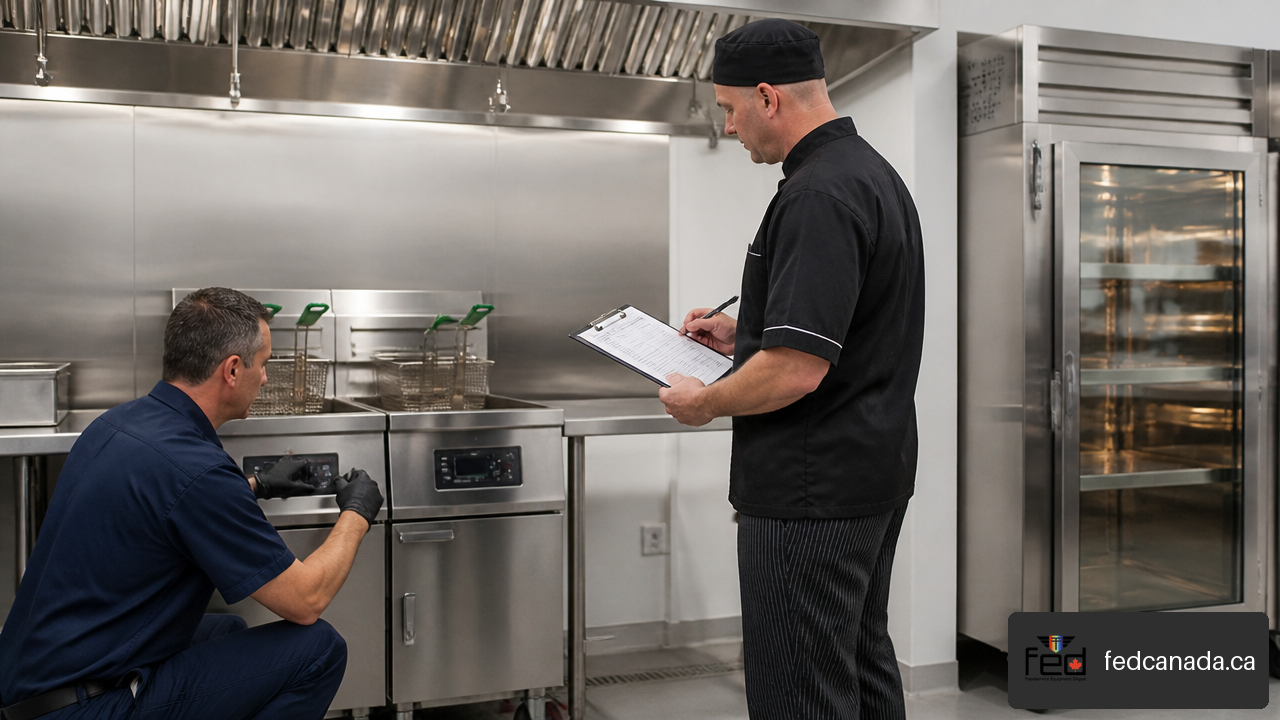
Protect Savings Through Installation and Daily Operation
Commission equipment before judging its performance
Commissioning means confirming that the equipment is installed, configured, and operating as intended. It is the bridge between rated performance and actual results. A highly efficient appliance can still consume too much energy if temperatures are miscalibrated, doors do not seal, water pressure is wrong, or staff bypass idle settings.
Before signoff, verify:
Correct electrical, gas, water, drainage, and ventilation connections.
Level placement, required clearances, and unobstructed airflow.
Thermostat settings and operating modes appropriate for the menu.
Door closure, gasket condition, and latch alignment.
Staff understanding of startup, shutdown, loading, cleaning, and idle procedures.
Avoid the habits that erase rated savings
Efficient equipment does not eliminate the cost of unnecessary operation. A holding cabinet left open, a fryer held at full temperature during a long slow period, or a dishwasher run with partial loads can consume resources without adding production value.
ENERGY STAR notes that restaurant energy costs commonly account for roughly 3% to 5% of sales and discusses servicing high efficiency fryers as part of maintaining expected performance in its commercial kitchen utility cost guidance. That makes routine checks financially relevant, not merely a maintenance task.
A practical operating standard is to assign responsibility. One person checks cold storage doors and gaskets. Another verifies fryer filtration and thermostat behavior. A closing procedure confirms equipment is placed into approved idle or shutdown modes. Small tasks are easier to sustain when they are explicit.
Measure savings after installation
Utility bills alone can be noisy because weather, menu changes, business volume, and utility prices move over time. A simple measurement process provides a better answer.
Collect at least several weeks of preinstallation utility and production data when possible.
Record daily operating hours, meal counts, racks washed, batches cooked, or another relevant production measure.
After installation, collect the same information over a comparable period.
Compare utility use per production unit, not only the total monthly bill.
Investigate large differences before declaring success or failure.
For instance, if electricity use rises after a new efficient refrigerator is installed, the cause may be a hotter kitchen, an open loading door, changed food volume, or a refrigeration issue elsewhere. Measurement should prompt diagnosis, not a quick assumption that the equipment failed to perform.
Frequently Asked Questions
What does ENERGY STAR certification mean for commercial kitchen equipment?
It means the product meets ENERGY STAR efficiency criteria for its category. It is a useful screening tool, but you should still compare capacity, fuel type, dimensions, installation requirements, and operating cost for your specific kitchen.
Which ENERGY STAR commercial kitchen appliances save the most money?
There is no universal winner. Steam cookers can show substantial published savings, while dishwashers, fryers, holding cabinets, ovens, and refrigeration can be better investments when they operate more hours or replace inefficient equipment. Rank opportunities using local rates, run time, replacement cost, and failure risk.
How much can an ENERGY STAR commercial dishwasher save each year?
ENERGY STAR publishes estimates that can include electricity, water, and utility bill savings under defined assumptions. Your result depends on rack volume, incoming water temperature, local water and sewer rates, machine type, loading practices, and the operating schedule.
Are ENERGY STAR fryers worth the higher purchase price?
They can be, particularly for operations with long frying periods or substantial idle time. Calculate the net installed premium after rebates, then divide by estimated annual gas or electricity savings. Also consider recovery performance, oil management, menu demand, and service access.
How do we calculate the payback period for commercial kitchen equipment?
Subtract confirmed rebates from the full installed cost, then divide by annual savings. Include electricity, natural gas, water, sewer, and supportable maintenance savings. Use a conservative estimate if your operating schedule is uncertain.
Should a restaurant replace its oldest equipment first?
Not necessarily. Replace equipment first when it combines heavy use, measurable waste, reliability problems, production importance, and a reasonable replacement cost. An old but lightly used appliance may be less urgent than a newer unit that runs inefficiently all day.
Do ENERGY STAR savings estimates apply to every kitchen schedule?
No. They are estimates based on stated assumptions. A breakfast only café, a high volume cafeteria, and a restaurant operating late into the evening will have different production patterns and idle periods. Adjust estimates using your actual hours and volume.
Sources
ENERGY STAR — Commercial Food Service Equipment: https://www.energystar.gov/products/commercial_food_service_equipment
ENERGY STAR — Why Commercial Food Service Equipment?: https://www.energystar.gov/partner-resources/products_partner_resources/retailer-resources/commercial-food-service-midstream/why-commercial-food-service-equipment
ENERGY STAR — How to Cut Utility Costs in Your Commercial Kitchen: https://www.energystar.gov/products/ask-the-experts/how-cut-utility-costs-your-commercial-kitchen
ENERGY STAR — Commercial Food Service Equipment Savings Calculator: https://www.energystar.gov/sites/default/files/2024-03/CFS%20Equipment%20Calculator.xlsx
ENERGY STAR — Energy and Water Efficiency Checklist for Restaurants and Food Service: https://www.energystar.gov/sites/default/files/tools/ES_Checklist_Restaurants_2023_0.pdf
Recent Posts


Leave a Comment
Your email address will not be published. Required fields are marked *