



Heated Holding Cabinets: Sizing, Humidity and Food Safety
Heated Holding Cabinets: Sizing, Humidity and Food Safety comes down to one practical question: can the cabinet keep enough prepared food at a verified safe temperature while preserving the texture guests expect? The best answer is rarely found in exterior dimensions or a single pan capacity number. It comes from matching production flow, food type, humidity needs, and monitoring procedures.
Table of Contents
- Key Takeaways
- Size the Cabinet Around Service Flow
- Choose Humidity for the Food, Not the Cabinet
- Build Food Safety Into Daily Holding
- FAQ: Heated Holding Cabinets
- Heated Holding Cabinets in Calgary
Key Takeaways
- Size by usable pan positions and peak demand. A cabinet that physically holds 15 pans may still be too small when deep pans, covers, mixed menu items, and recovery space are considered.
- Separate quality from safety. Humidity can reduce drying for many foods, but food safety depends on maintaining and verifying appropriate hot holding temperatures and time controls.
- Use moisture selectively. Moist holding may suit sliced meats, rice, vegetables, and sauces. Dry holding is often a better starting point for crisp fried foods and baked items that can soften.
- Measure food, not only air. A cabinet display indicates cabinet conditions. It does not automatically prove that every pan, especially the centre of a dense pan, is at the required holding temperature.
- Validate before a busy service. Temperature mapping, a loaded recovery test, and a written cleaning routine reveal problems that an empty cabinet test can miss.
Size the Cabinet Around Service Flow
A heated holding cabinet should be sized from the inside out. Start with the pan format used in your kitchen, then calculate how many pans need to be available at the busiest point in service. Exterior width matters for installation, but it does not tell you whether the cabinet can support the menu.
Calculate usable pan capacity
Begin with the food you need ready during the peak service window. Count full size 12 × 20 inch pans or GN 1/1 containers, then adjust for actual pan depth and replenishment frequency.
A simple planning method is:
Required pan positions = peak ready to serve pans + replenishment pans + operational reserve
For example, a lunch operation may need two pans of rice, two pans of vegetables, three pans of proteins, one pan of sauce, and two backup pans while the next batch finishes. That is 10 active positions before allowing for separation between foods or a reserve position for an unexpected rush.
| Sizing input | What to count | Why it changes cabinet size |
|---|---|---|
| Peak menu volume | Pans needed at the busiest service period | Sets the minimum working capacity |
| Batch frequency | How often fresh food replaces held food | Frequent small batches can reduce required capacity |
| Pan depth | Shallow, medium, or deep pans | Deep pans hold more product but can heat more slowly at the centre |
| Menu mix | Dry, moist, covered, and uncovered foods | Different foods may need separate zones or separate cabinets |
| Reserve capacity | Empty slots beyond the daily plan | Supports late orders, recovery, and temporary menu changes |
Manufacturer pan counts are useful starting points, not full production plans. For instance, the HotLogix HL2-18 heated humidified holding cabinet we carry is listed at 36 pans on a footprint of about 24.7 inches wide by 29.5 inches deep and 54.5 inches tall. That tells you what the cabinet can accept. It does not tell you whether a full load of deep pans of dense food can be loaded, recovered, accessed, and served at the speed your operation requires.
Account for pan depth, covers, and airflow
Two cabinets with the same stated pan count can perform differently once loaded. A shallow pan of gravy and a deep pan of mashed potatoes do not behave the same way. Dense food in a deep pan has more mass, and the centre may change temperature more slowly after loading or after the door is opened.
Covers also create a trade off. They can reduce moisture loss, limit exposure to airborne contamination, and help retain heat. But tightly covered pans can trap condensation. When a lid is lifted, droplets may fall back onto breaded food or roasted surfaces. Vented covers, partially opened lids where appropriate, or separate dry and moist holding zones can reduce this issue.
Do not pack shelves so tightly that air paths are blocked. Heated holding depends on warm air reaching around pans and containers. A cabinet that is full to its rated capacity may be acceptable for some foods, yet difficult to manage if every shelf is packed with deep, covered pans.
Choose cabinet style for the actual workflow
Cabinet type should follow where and how food is held.
| Workflow | Cabinet priority | Practical consideration |
|---|---|---|
| Restaurant line replenishment | Fast access and compact footprint | Smaller cabinets may work if batches are frequent |
| Banquet staging | High pan count and stable holding | Reserve space helps when service timing shifts |
| Catering transport | Mobility, secure doors, and recovery after travel | Test temperatures after loading and arrival |
| Space constrained kitchen | Under counter or narrow footprint | Confirm clearance, ventilation, and door swing before purchase |
| Mixed menu service | Independent heat and humidity adjustment | Separate food groups when texture needs conflict |
For counter service, a compact display unit is a different tool than a bulk back-of-house cabinet. The used Hatco FSDT-2 humidified holding and display cabinet at our Calgary warehouse measures about 22.4 × 25.4 × 27.5 inches, which suits pizzerias, convenience stores, and concession counters where guests see the product. It is built to present food, not to stage a full banquet.
Before purchasing, confirm the electrical connection, circuit capacity, plug type, overall dimensions, door clearance, and service access. Grounded connections are common, but electrical requirements vary by model. A cabinet that cannot be installed where it is needed will not improve service flow.
Choose Humidity for the Food, Not the Cabinet
Humidity control is a quality tool. It can slow moisture loss, but it cannot restore crispness, repair overcooked food, or replace safe temperature control. The right setting depends on the food surface, the pan cover, how long the item will be held, and whether guests expect crispness, tenderness, or a moist finish.
Dry, passive humidity, and active humidity
There are three practical approaches to cabinet moisture management.
| Holding approach | How it works | Best fit | Watch for |
|---|---|---|---|
| Dry holding | Heated air without deliberate added moisture | Fried foods, crusted baked goods, crisp roasted items | Surface drying during longer holds |
| Passive humidity | Water pan adds moisture through evaporation | Simple holding needs and transport | Less precise adjustment and potential scale buildup |
| Active humidity control | Moisture is adjusted separately from cabinet heat | Mixed menus and longer holding periods | More cleaning, water management, and operator setup |
An equipment range describes what a cabinet can be set to do. It is not a universal food safety target for every menu item. A humidified cabinet such as the HotLogix HL2-18 uses simple mechanical temperature controls, which keeps daily operation easy to teach, but you still need to set it from verified food temperatures rather than the dial.
A passive humidity pan is simpler. It adds moisture as water evaporates, without closed loop humidity control. Its output can vary with cabinet temperature, water level, loading, and door openings. An independently controlled system is generally more repeatable, but it still needs setup, cleaning, and a food specific operating procedure.
Match the holding environment to the menu
There is no single validated humidity setting that suits every food category. Use a starting approach, then assess texture and food temperature under real service conditions.
| Food category | Usually better starting condition | Why | Adjustment signal |
|---|---|---|---|
| Braised or sliced meats | Moderate moisture, covered pan | Limits surface drying | Add moisture if cut edges toughen |
| Rice and grains | Moderate moisture, covered or vented cover | Helps reduce drying and hardening | Reduce moisture if surface becomes wet |
| Vegetables | Low to moderate moisture | Helps retain tenderness | Reduce if colour dulls or water collects |
| Sauces and gravies | Covered pan, moisture level based on evaporation | Controls skin formation and thickening | Stir and check consistency regularly |
| Fried foods | Dry holding or very limited moisture | Protects coating texture | Reduce humidity if coating softens |
| Breads and pastries | Usually drier holding | Excess moisture can soften crusts | Use short holds and avoid condensation |
Consider fried chicken as an example. A moist cabinet may prevent the interior from drying, but moisture can migrate into the breading and make it soft. A dry cabinet may preserve the coating better, but long holding can dry the meat. The practical answer may be shorter batches, a dry cabinet, and a service plan that avoids holding the item longer than necessary.
Control condensation before it becomes a quality problem
Condensation forms when humid air meets a cooler lid, shelf, or cabinet surface. It is not automatically a safety failure, but it can cause soggy coatings, diluted sauces, drips between pans, and water around the cabinet.
Look for the pattern. If droplets collect mainly under pan lids, the pan may be too cool for the humidity level or too tightly covered. If water appears on multiple shelves, the cabinet may have excessive moisture for its load, frequent door openings, or inadequate warm up time.
Corrective actions can include:
- Reducing the moisture setting or water pan fill level.
- Using vented covers when food quality permits.
- Separating crisp foods from moist foods.
- Allowing the cabinet to preheat and stabilize before loading.
- Cleaning spills and checking drain or reservoir areas according to the manufacturer instructions.
Humidity capability can support quality during extended holding, but results still depend on loading, covers, food type, and the amount of time food remains in the cabinet.
Build Food Safety Into Daily Holding
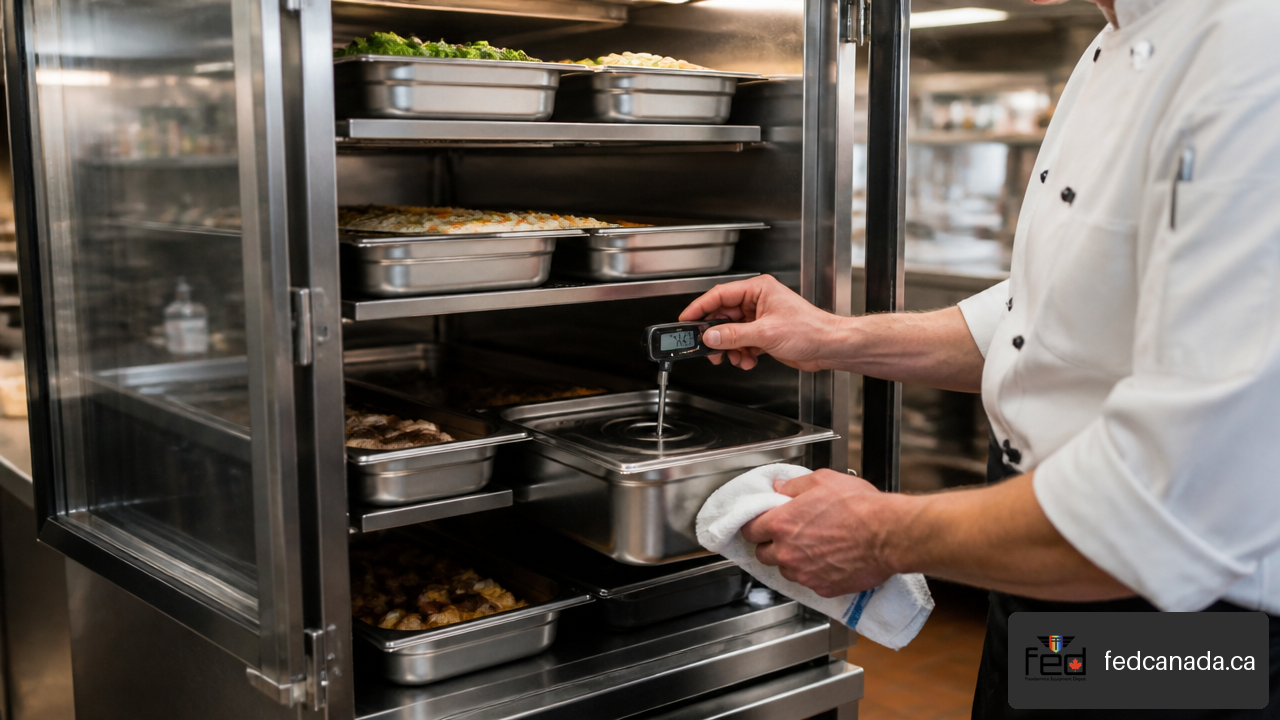
Heated holding is a control step, not simply a warm storage step. A cabinet can display the desired air temperature while a recently loaded, deep, or densely packed pan remains below the operation’s required hot holding threshold. The food must be checked directly.
Set the operating target from your food safety plan
Use the hot holding temperature and time requirements that apply to your jurisdiction and your HACCP based food safety plan. In Alberta, Alberta Health Services guidance says to keep hot food at 60°C (140°F) or above. Requirements can still vary by operation type, so confirm your own limits with your public health inspector, and never treat the cabinet dial as the rule by itself.
The practical operating target should include a margin that accounts for loading, door openings, thermometer uncertainty, and cooler spots. Set the cabinet based on verified food temperatures, not by copying a number from another kitchen or relying only on the manufacturer’s broad adjustment range.
Verify food temperatures and cold spots
A basic validation procedure is more valuable than assumptions about “even heat.” Perform it with the foods, pans, covers, and loading pattern used in service.
- Preheat the empty cabinet until its display is stable.
- Load representative pans at typical depths, including the densest product and the most frequently accessed shelf.
- Check food temperatures at several locations, especially centre portions of deep pans and pans near doors, corners, and lower shelves.
- Open the door as staff normally would during service, then record how long the cabinet and food take to return to the operating target.
- Adjust loading pattern, setpoint, batch size, or humidity level if any pan is slow to recover.
- Repeat the test after major menu, pan, or procedure changes.
This is temperature mapping in practical form. It identifies cold spots and recovery weaknesses before they affect a service period. A cabinet may recover quickly when empty yet respond differently after a busy team opens the door repeatedly and loads several pans at once.
Monitor, document, and respond
A workable HACCP routine gives staff clear actions rather than vague instructions such as “keep food hot.” Use calibrated thermometers, document checks at scheduled intervals, and define what happens when food falls outside the approved limit.
| Control point | What to verify | Example response if outside target |
|---|---|---|
| Start of service | Cabinet stabilized and food at approved hot holding temperature | Delay loading or service until conditions are restored |
| During service | Food temperature in representative pans | Increase replenishment frequency, adjust loading, or follow the site corrective action plan |
| Door activity | Excessive opening or long access periods | Organize pans by demand and assign a service sequence |
| Humidity system | Water level, residue, and condensation | Clean, descale, refill, or reduce moisture as appropriate |
| End of day | Spills, reservoir condition, shelves, and seals | Clean and inspect before the next service |
Low temperature alarms can help prompt action, but they are not a substitute for checking food. Some cabinets include a display or low temperature alarm. The alarm indicates a cabinet condition, while a probe thermometer confirms the temperature of the food itself.
Water handling deserves the same attention as temperature checks. Humidified units may develop mineral scale where water evaporates. Follow the manufacturer’s cleaning and descaling instructions, use the water treatment approach specified for the equipment where applicable, and do not let standing water or residue become routine. A clean humidity system is easier to operate consistently.
FAQ: Heated Holding Cabinets
How many pans should a heated holding cabinet hold?
Choose capacity from peak ready to serve pans, replenishment pans, and reserve space. Count the actual pan format and depth used in your kitchen. A cabinet rated for 15 pans may be appropriate for 15 shallow pans, but it may not offer enough practical capacity for 15 deep pans, covered pans, or mixed foods that need airflow and access.
Is a dry holding cabinet or humidified cabinet better?
Neither is universally better. Dry holding is often more suitable for crisp foods, while moisture assisted holding may better protect foods that dry at the surface. If your menu contains both fried foods and braised meats, separate cabinets or separate holding periods can produce more consistent results than one compromise setting.
What temperature should food be held at in a cabinet?
In Alberta, Alberta Health Services guidance says hot food should be kept at 60°C (140°F) or above. Confirm the limit that applies to your operation with your public health inspector and your site HACCP plan, then verify the actual food temperature with a calibrated probe. Do not assume a cabinet setting or display equals the temperature at the centre of every pan.
Does cabinet temperature equal food temperature?
No. Cabinet air responds faster than food, particularly dense products in deep pans. Food temperature can also vary by shelf position, door activity, covers, and loading density. Direct food checks are necessary.
Can humidity keep fried food crisp?
Usually, added humidity creates a risk of softer coatings. Fried food may hold better in a dry environment for a short period, with smaller and more frequent batches. If drying becomes a problem, first review batch timing and pan depth before adding significant moisture.
Why does food dry out in a humidified holding cabinet?
Humidity is only one factor. Food can still dry because it is held too long, left uncovered, exposed to strong airflow, or placed in shallow pans with a large exposed surface. The cabinet may also have insufficient water, an incorrect setting, or moisture that is escaping through frequent door opening.
How should a humidified holding cabinet be cleaned and descaled?
Turn the unit off and allow it to cool as directed by the manufacturer. Remove pans, shelves, and accessible water components; clean food residue; empty standing water; and follow the approved descaling procedure for the model. Avoid improvising chemicals, because they can damage components or leave residues. Record recurring scale buildup so water quality or maintenance frequency can be addressed.
Heated Holding Cabinets in Calgary
At Foodservice Equipment Depot in Calgary, we carry heated and humidified holding cabinets for restaurants, caterers, and concession operations, including the HotLogix HL2-18 for higher pan volume and the used Hatco FSDT-2 for counter display. You can browse our full range of commercial warmers and holding equipment online.
Not sure how many pan positions your menu really needs? Send us your peak service volume, pan sizes, and food types, and we will help you narrow it down. Call us at (403) 923.2270, email info@fedcanada.ca, or visit the warehouse at 6613 - 44th Street SE, Bay #5, Calgary, Monday to Friday, 9 AM to 5 PM.
Recent Posts


Leave a Comment
Your email address will not be published. Required fields are marked *