




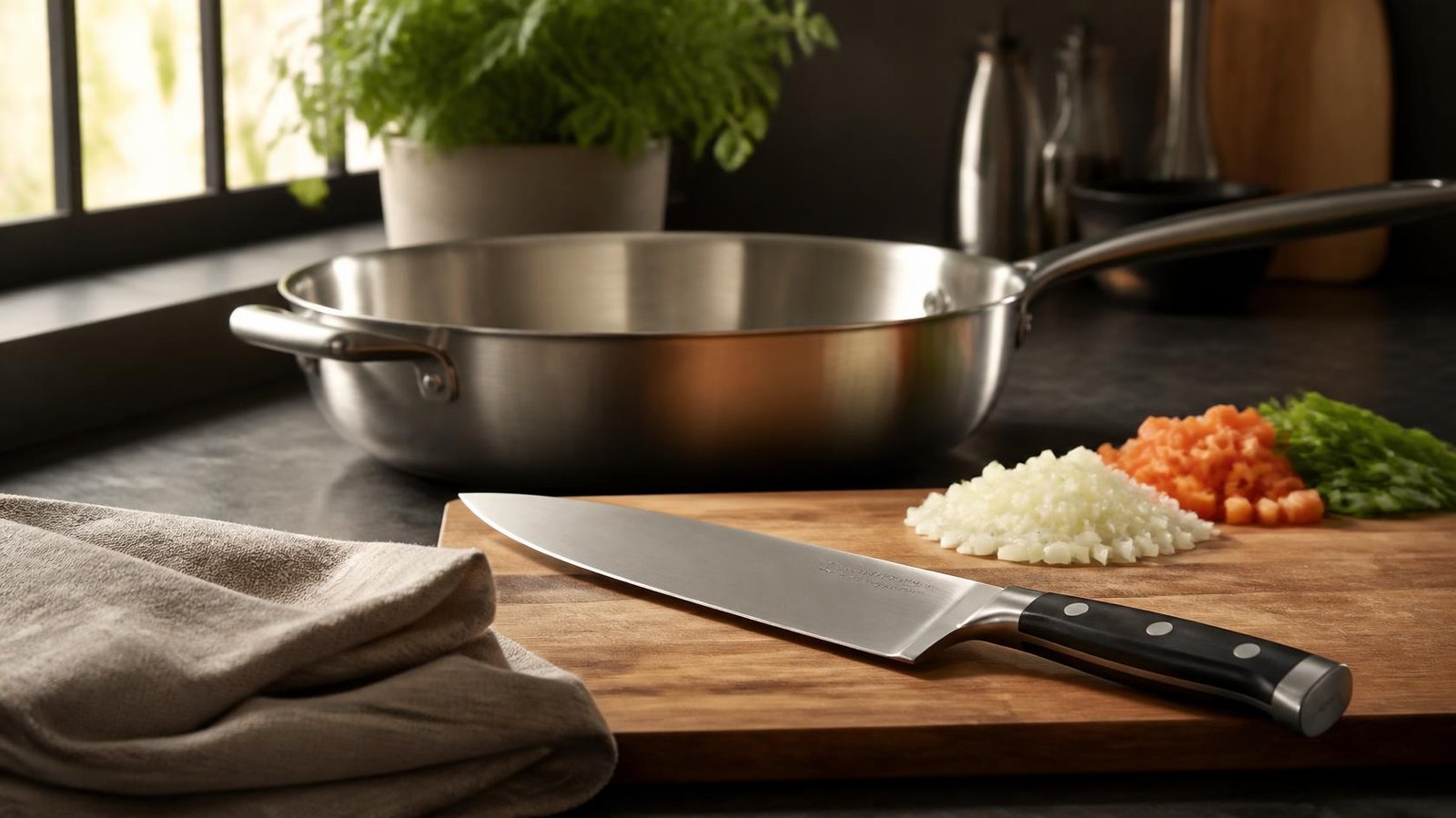
Zwilling: How to Choose Knives, Cookware, and Kitchen Tools
Zwilling is one of the most recognizable names in kitchen cutlery, but the name alone does not answer the questions that matter before buying: Where was this particular knife made? Is this pan built for everyday use or a premium upgrade? Does the warranty apply in a commercial kitchen? The useful answer is to evaluate each Zwilling product by its construction, intended use, care requirements, and service terms rather than assuming every item carries the same origin or performance profile.
Table of Contents
- Key Takeaways
- Understanding the Zwilling Brand Family
- Choosing Zwilling Knives and Cookware
- Care, Durability, and Canadian Warranty Decisions
- Frequently Asked Questions
Key Takeaways
- Zwilling is a German-origin culinary brand, not a single product specification. A Zwilling knife, pan, cutting board, and kitchen tool may differ substantially in materials, manufacturing origin, and ideal use.
- Verify country of origin at the product level. Some Zwilling knife collections are made in Germany, but the broader portfolio should not be treated as universally German-made.
- Knife selection starts with profile and steel construction. A forged chef’s knife can suit frequent prep work, while a smaller utility knife or paring knife may solve more daily tasks in a compact kitchen.
- Cookware value depends on construction. For stainless steel, compare bonded layers, heat-spreading material, pan thickness, handle design, lid fit, induction compatibility, and oven limits instead of relying on brand reputation.
- Warranty coverage is not a maintenance plan. In Canada, normal wear, accidental damage, misuse, some wooden-product damage, and possible commercial use may fall outside coverage.
- For restaurants and foodservice operators, document equipment condition early. Keep purchase records, model information, photographs, and a clear description of use if a potential defect needs inspection.
Understanding the Zwilling Brand Family
What Zwilling is, and why the name can be confusing
Zwilling is best understood as a culinary brand with deep roots in cutlery and a far broader current offering. Its name is closely associated with Zwilling J.A. Henckels, the twin-symbol trademark, knives, scissors, cookware, cutlery, storage, and kitchenware. The company traces its trademark history to Solingen, Germany, where Peter Henckels registered the twin symbol in 1731. The brand’s heritage and wider culinary portfolio are outlined in ZWILLING Canada’s company history.
That history matters because it explains why shoppers often use several names interchangeably. Still, product labels deserve close reading. ZWILLING, J.A. Henckels, and HENCKELS can appear in related brand and product contexts, but they should not be treated as identical indicators of construction, price tier, or country of manufacture.
For a buyer, the practical rule is simple: identify the exact collection and item number before comparing it. A brand name can signal a design tradition; it cannot replace the specifications on the product page, packaging, or product marking.
The wider group: similar ownership, different purposes
The Zwilling Group includes specialized brands that occupy different positions in the kitchen. This can make shopping easier when the cooking style is clear.
| Brand | Primary association | Best evaluated by |
|---|---|---|
| ZWILLING | Knives, cookware, cutlery, tools, kitchenware | Product line, materials, and intended task |
| MIYABI | Japanese-style kitchen knives | Blade geometry, steel, edge angle, and sharpening needs |
| STAUB | Enameled cast-iron cookware | Weight, heat retention, lid design, and cooking style |
| Demeyere | Premium stainless-steel cookware | Construction, responsiveness, induction performance, and budget |
| Ballarini | Nonstick-focused cookware | Coating care, heat limits, and expected service life |
The group relationship is useful context, not proof that products are interchangeable. A customer looking for a thin, nimble Japanese-style blade may compare MIYABI with other Japanese-inspired knife brands. A buyer who wants a heavy vessel for braising may consider STAUB. A restaurant replacing a worn sauté pan may care more about handle geometry, bottom construction, and serviceability than the group brand on the box.
Brand origin is not product origin
One of the most common mistakes is assuming that every Zwilling product is made in Germany because Zwilling is a German-origin brand. That is too broad. Zwilling does offer knife ranges tied to the Solingen manufacturing tradition, as shown in its Made in Germany knife collection, but that statement applies to those designated ranges rather than automatically to every item in the catalog.
This distinction affects buying decisions. If German manufacture is a priority, verify the individual knife collection and country-of-origin marking. If the priority is instead a manageable price, stainless-steel durability, or a particular blade profile, a different collection may still be appropriate.
Buying principle: Treat “Zwilling” as the start of research, not the final specification.
Choosing Zwilling Knives and Cookware
Choose a knife by task, not by block size
For most kitchens, the strongest starting point is not a large matching set. It is a small set of knives that match the work actually performed. A chef’s knife handles most chopping, slicing, and dicing. A paring knife manages in-hand work and small produce. A serrated knife is useful for bread, tomatoes, and delicate-crust items.
A forged knife is formed from a single piece of steel that is shaped during manufacturing. Depending on the collection, a forged construction can provide a substantial feel and a gradual transition from blade to handle. It does not automatically make one knife better for every user. Blade length, balance, grip, steel hardness, and edge geometry still determine whether it works comfortably for the task.
| Kitchen need | Useful Zwilling knife type | What to check before buying |
|---|---|---|
| Everyday vegetable and protein prep | Chef’s knife | Blade length, handle comfort, edge maintenance needs |
| Tight prep space or smaller ingredients | Utility knife | Blade height, flexibility, and storage space |
| Peeling and detailed work | Paring knife | Control, tip shape, and handle size |
| Bread, pastries, tomatoes | Serrated knife | Serration pattern and whether sharpening service is practical |
| Large roasts or dense produce | Larger chef’s knife or slicing knife | Blade length, board size, and user control |
For a café, bakery, or small restaurant, knife selection should account for who will use it and how it will be maintained. A highly refined edge can perform exceptionally well but still needs proper honing and sharpening. If several staff members use the same knives, standardized blade profiles and a clearly assigned sharpening routine can be more practical than mixing many premium styles.
Zwilling compared with MIYABI and WÜSTHOF
Zwilling, MIYABI, and WÜSTHOF are often compared because all are established cutlery names, yet their relevant differences are usually found at the collection level.
Zwilling’s German-style knife offerings may appeal to buyers seeking familiar Western blade shapes and a robust all-purpose prep knife. MIYABI is generally associated with Japanese-style knife design, which can mean a thinner blade profile and different edge characteristics depending on the line. WÜSTHOF is another German cutlery benchmark frequently considered by shoppers looking for classic Western forged knives.
I would avoid deciding between them based on country associations alone. Hold the decision to practical criteria: Does the handle fit the intended user? Is the blade shape appropriate for the food being prepared? Can the kitchen maintain the edge correctly? Will replacement or service be manageable in Canada?
A chef’s knife that feels stable during repetitive onion prep may be more useful than a technically impressive knife with an awkward handle. Likewise, a thinner blade may offer clean slicing but can be less forgiving if used to twist through hard squash, strike bone, or pry frozen food apart.
How to judge Zwilling stainless-steel cookware
Stainless-steel cookware should be compared by how it moves and retains heat. The phrase 3-ply generally refers to three bonded layers, often stainless steel surrounding an aluminum core. Aluminum spreads heat more readily than stainless steel, while stainless provides the cooking surface and exterior durability.
The important question is where the layers are located. A pan with layered construction extending up the sidewalls may heat differently from one with a layered base only. Neither design is automatically wrong; they suit different needs and price points. A base-focused construction can be perfectly suitable for many tasks, while full-clad construction may offer more responsive sidewall heating for sauces and sautéing.
| Cookware criterion | Why it matters | When it deserves priority |
|---|---|---|
| Bonded-layer construction | Influences heat distribution and responsiveness | Sauces, searing, and frequent stovetop use |
| Thickness and weight | Affects stability and heat retention | High-volume cooking and larger burners |
| Handle design | Changes comfort, control, and heat exposure | Repetitive service and heavy pans |
| Flatness of the base | Supports reliable burner contact | Induction and electric cooktops |
| Oven rating | Defines finishing and roasting options | Restaurant lines and home entertaining |
| Lid fit | Affects moisture retention and simmering | Braises, grains, soups, and reductions |
Community discussion can provide useful signals but should not be treated as laboratory testing. In Reddit conversations, some owners have praised Zwilling knives while describing cookware as more average. Another discussion included an individual who considered a roughly C$60 Zwilling stainless-steel pan with a 3-ply base to be good value. Those comments show why category-specific evaluation matters: satisfaction with a knife does not predict satisfaction with every pan, and one attractive price does not establish a universal value benchmark.
When nonstick is the better tool
Nonstick cookware can be the sensible choice for eggs, delicate fish, pancakes, and other foods that benefit from easy release. The trade-off is that a nonstick surface is a consumable performance layer, not a permanent feature. High heat, metal utensils, abrasive cleaning, and dishwasher cycles can accelerate wear.
Use stainless steel when browning, fond development, high-heat searing, and oven finishing are regular tasks. Choose nonstick when release and easy cleanup outweigh the need for aggressive heat. A well-equipped kitchen often needs both.
Care, Durability, and Canadian Warranty Decisions
Maintenance protects performance before a claim is needed
Knife care is mechanical. A sharp edge cuts efficiently because the apex remains thin and aligned. Honing realigns a slightly rolled edge; sharpening removes material to create a new edge. They are related, but they are not the same process.
For Zwilling knives, use a stable cutting board, wash and dry promptly, and store blades where they cannot strike other utensils. Avoid glass, stone, ceramic, and metal cutting surfaces. They can rapidly damage an edge. Never use a kitchen knife as a lever, screwdriver, can opener, or frozen-food splitter.
For stainless-steel pans, preheat gradually, add appropriate cooking fat when needed, and allow the pan to cool before washing. Sudden temperature changes can stress cookware and may contribute to warping. For stuck food, soak first rather than attacking the surface with harsh abrasives.
Wood deserves extra caution. Wooden handles, boards, and other components can absorb moisture, swell, crack, or lose their finish when repeatedly soaked or run through a dishwasher. Hand washing and prompt drying are the safer default. This is not merely cosmetic care; it can affect fit, hygiene, and long-term durability.
A practical Canadian warranty decision tree
Canadian warranty questions are easier when the issue is classified before a claim is submitted. Zwilling Canada states that its warranty addresses defects in materials and workmanship, while excluding normal wear and tear and identifying limitations involving misuse, accidental damage, wooden products, and potential commercial use. Review the exact language in ZWILLING Canada’s warranty terms and exclusions before starting a claim.
- Start with the product condition. Is there evidence of a manufacturing issue, such as a material or workmanship defect, rather than gradual deterioration?
- Review the use history. Consider heat level, dishwasher use, utensil choice, cutting surface, impacts, storage, and whether the product was used for its intended task.
- Identify exclusions that may apply. Normal edge wear, nonstick performance decline, accidental damage, misuse, and a chipped or broken tip from improper use may not qualify.
- Check for wood and commercial-use complications. Damage involving wooden components may face added limitations, and business use may be excluded under the Canadian terms.
- Prepare the claim clearly. Keep the receipt, model information, photographs, and a concise description of what happened and when it appeared.
The difference between a defect and wear can be frustratingly unclear. Consider two pans: one loses nonstick release after years of ordinary use, while another shows an early, unusual separation or defect. The first may be viewed as normal performance decline; the second may warrant inspection. The final determination depends on the product, condition, evidence, and warranty terms.
What foodservice businesses should plan for
Restaurants should not assume a consumer warranty functions as operational downtime protection. If commercial use is excluded or restricted, a replacement claim may not solve the immediate service problem. A line cook cannot pause dinner service for several weeks while a key pan or knife is inspected.
The practical response is redundancy. Keep backup knives for high-use stations, maintain a sharpening schedule, and have an alternative pan or tool for critical menu items. For capital purchases, confirm warranty applicability and service process before buying rather than after failure occurs.
Canadian warranty documentation indicates that an eligible defective product may be repaired or replaced at Zwilling’s discretion, with inspection and return delivery potentially taking about four to six weeks. Accepted replacement products are sent without charge. This makes a clear paper trail valuable, but it also reinforces the need for operational backup equipment.
Buying and service options in Canada
Canadians can purchase Zwilling products through a mix of brand retail, authorized retailers, and kitchen-equipment sellers. Retail presence can vary by region and over time. Zwilling’s Canadian retail footprint has included its first Canadian flagship store at CF Markville Shopping Centre in Markham, Ontario, described in a Canadian flagship-store announcement.
For warranty service, use Zwilling Canada’s current contact and claims instructions, and do not ship a product until the process calls for it. Photograph the issue before packaging. That small step can make it easier to explain whether the concern is a loose handle, coating problem, warped base, broken tip, or material defect.
Frequently Asked Questions
Is Zwilling the same company as HENCKELS or J.A. Henckels?
They are closely related names within the brand’s history and product ecosystem, but shoppers should not assume every item bearing a related name has the same origin, steel, construction, or price position. Confirm the specific brand mark, collection, and product details before comparing.
Are all Zwilling knives made in Germany?
No. Zwilling has German-made knife ranges associated with Solingen, but the full Zwilling portfolio should not be described as entirely German-made. Check the exact product page, package, or country-of-origin marking for the knife under consideration.
Which Zwilling knife is best for everyday home cooking?
For most home kitchens, a chef’s knife is the most versatile first purchase, supported by a paring knife and serrated knife as needed. Choose the chef’s knife length and handle based on the user’s grip, cutting-board space, and typical prep volume. A large knife is not automatically better if it feels difficult to control.
Is Zwilling cookware worth the price in Canada?
It depends on the construction and sale price of the individual piece. Compare layer construction, base thickness, induction compatibility, handle comfort, oven rating, and warranty limitations with similarly priced alternatives. A discounted stainless-steel saucepan can be strong value if its size and heat behavior match your cooking needs; an expensive set is poor value if several pieces will rarely be used.
What does 3-ply mean on a Zwilling stainless-steel pan?
It usually means three bonded layers, commonly stainless steel around an aluminum layer. The aluminum helps distribute heat, while the stainless steel provides a durable cooking surface and exterior. Check whether the layered construction is limited to the base or extends through the pan walls, because that can affect heating behavior.
Can Zwilling cookware go in the dishwasher?
Dishwasher suitability varies by product and material. Even where dishwasher use is permitted, hand washing can be gentler on finishes, wooden components, and nonstick surfaces. Do not put wooden products or parts in the dishwasher unless the exact product instructions explicitly allow it.
Does Zwilling cover broken knife tips or worn nonstick coating under warranty?
Not necessarily. Zwilling Canada identifies normal wear and tear as excluded, and chipped or broken knife tips caused by improper use may also be excluded. Nonstick performance decline can be difficult to classify because heat exposure, utensils, cleaning habits, and age all matter. Document the issue and review the terms before assuming it is a covered defect.
Does the Canadian Zwilling warranty apply to restaurant use?
Commercial use may be excluded under the Canadian warranty terms. Restaurants, caterers, and other foodservice businesses should confirm coverage for the exact product before purchase and maintain backup equipment for essential service tasks.
Sources and References
- ZWILLING Canada — Warranty: https://www.zwilling.com/ca/warranty.html
- ZWILLING Canada — Company History: https://www.zwilling.com/ca/magazine/culinary-world/article-about-us-zwilling-group.html
- ZWILLING Canada — Made in Germany Knives: https://www.zwilling.com/ca/knives/made-in-germany/
- Newswire — ZWILLING J.A. Henckels Opens Its Flagship Store in Canada: https://www.newswire.ca/news-releases/zwilling-j-a-henckels-opens-its-flagship-store-in-canada-with-an-experiential-shopping-experience-814922795.html
Recent Posts
Leave a Comment
Your email address will not be published. Required fields are marked *