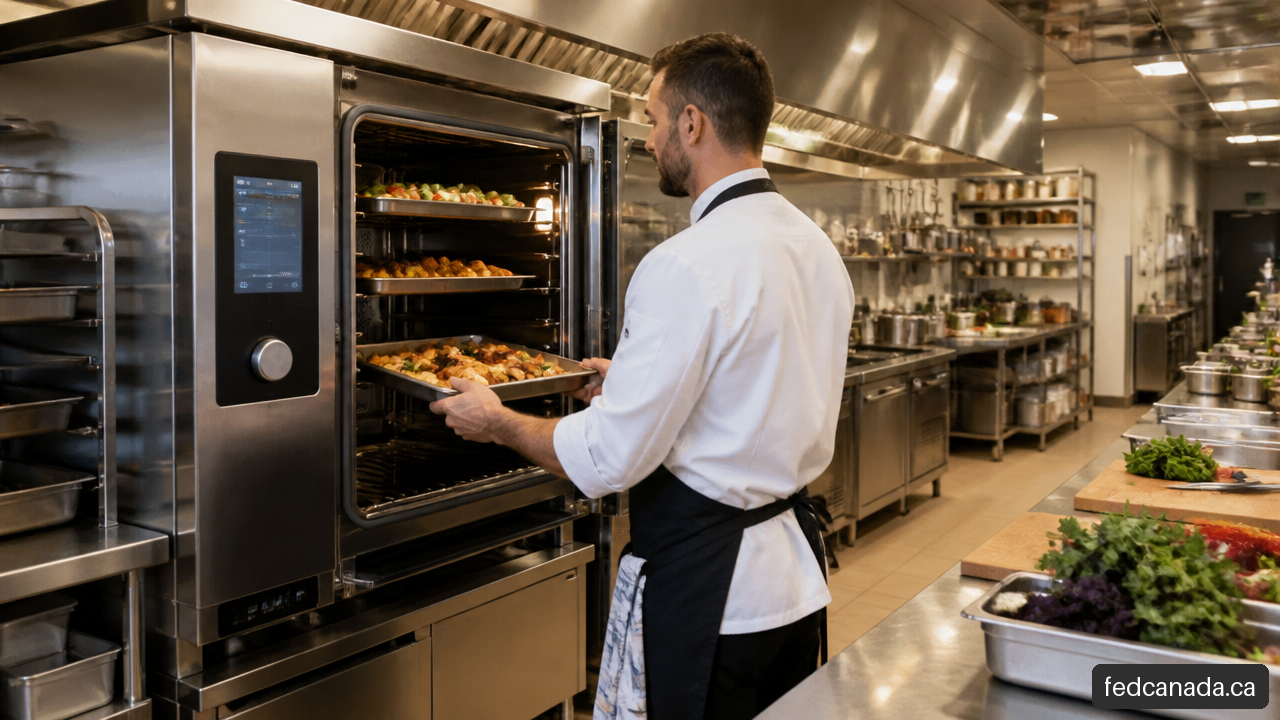

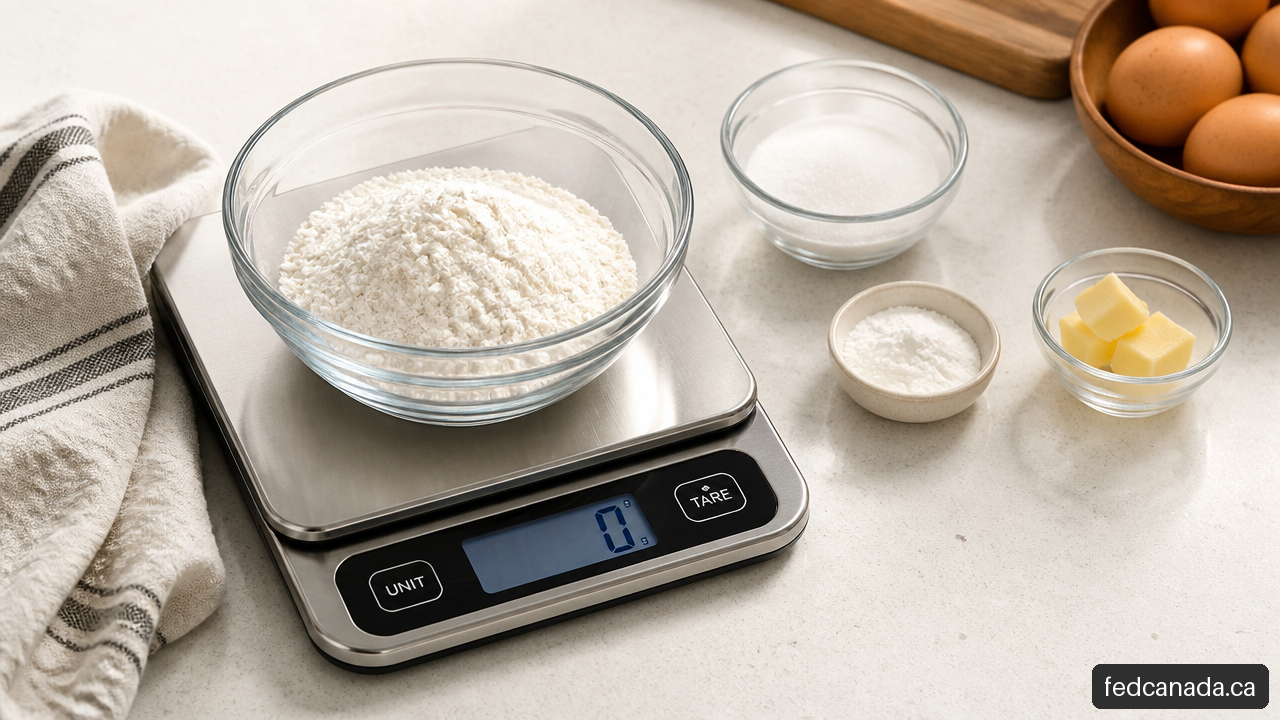
Food scales make cooking, baking, meal preparation, and portioning more repeatable because they measure mass instead of relying on cup sizes or visual estimates. I recommend choosing a scale based on what you weigh most often, not simply the smallest number shown on the display. A scale that handles bread dough, bowls, and batch cooking well may not be the best choice for tiny amounts of yeast or spices.
Key Takeaways
A good food scale is not necessarily the most expensive or the most precise-looking model. It is the one that gives stable, repeatable readings in the range and conditions where you need it.
- Choose a digital scale with 1 g resolution for most home cooking, meal prep, and everyday baking.
- Consider 0.1 g resolution when measuring small quantities of coffee, yeast, spices, salt, or supplements. A finer display does not automatically guarantee better accuracy.
- Look for enough capacity for your largest expected bowl, pot, dough batch, or container. Many household food scales are built around capacities near 11 lb, but a larger platform or higher-capacity bench scale may suit batch work better.
- Use the tare function to remove the container weight, but verify the tare whenever net weight matters. A wrong tare can create a wrong result even when the scale itself is functioning properly.
- Test suspicious readings with more than one known mass and at more than one point in the scale’s working range. A scale can appear correct with a small test item and still drift with a heavier bowl.
- For food sold by weight in Canada, ordinary kitchen accuracy is not the same as legal-for-trade approval.
A useful rule: buy for the smallest amount you need to measure reliably, the largest amount you need to weigh, and the conditions where the scale will live.
Types of Food Scales and Their Best Uses
Digital kitchen scales: the practical default
Digital food scales use an electronic sensing component, often called a load cell, to convert the force of an item on the platform into a displayed weight. They are usually the easiest option for daily use because readings are quick, unit changes are simple, and tare is built in.
For general cooking, a digital scale that displays grams and ounces is usually enough. Grams are particularly useful when following baking formulas, scaling recipes, or tracking portions because the same recipe can be repeated without interpreting a loosely packed or tightly packed measuring cup.
Choose a standard digital kitchen scale when you mainly need to weigh:
- Flour, sugar, butter, grains, produce, and proteins
- Meal-prep portions
- Coffee beans and loose tea in larger portions
- Everyday baking ingredients
- Sauces, dressings, and ingredients added directly to a mixing bowl
Avoid treating a basic household digital model as a precision laboratory instrument. Its display may show 1 g increments, but that does not prove every reading is exactly correct to within 1 g.
Precision scales for small amounts
A precision food scale commonly displays 0.1 g increments. Some models show even smaller increments. This can be helpful when a one-gram difference is meaningful relative to the ingredient amount.
Consider the difference between adding 1 g to a 500 g bread dough and adding 1 g to a 3 g dose of yeast. In the bread dough, the difference may be insignificant. In the yeast measurement, it can be a large percentage of the total.
Use a precision scale for:
- Small spice blends
- Fine salt and curing ingredients where an exact formula is required
- Yeast and baking additives
- Pour-over coffee or espresso dosing
- Supplements and small portion work, where appropriate
Fair warning: a 0.1 g display is not proof that the scale is dependable at every tiny load. Minimum-load performance varies, and some scales do not respond consistently when only a trace amount is added. If you need to measure 0.4 g repeatedly, test the scale with realistic amounts before relying on it.
Mechanical scales: simple but less flexible
Mechanical kitchen scales use springs or balance mechanisms rather than electronics. Their advantages are straightforward: no batteries, simple operation, and often robust construction. Their limitations are equally clear. They typically have coarser markings, less convenient tare adjustment, and less precise readability than a digital model.
A mechanical scale can work well for rough portioning or bulk ingredients, such as weighing several pounds of potatoes. It is less suitable for recipes that depend on small changes in flour, salt, or leavening.
High-capacity bench scales
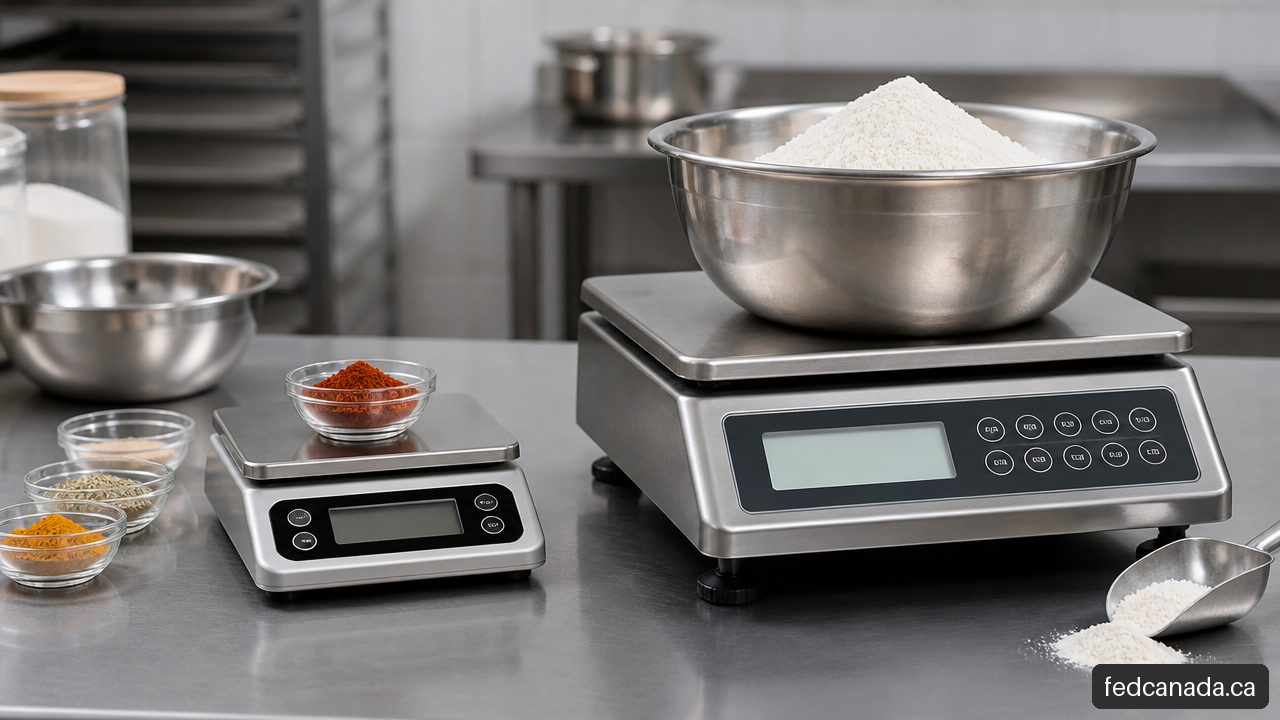
A high-capacity bench scale is designed for larger bowls, ingredient tubs, dough batches, and commercial prep work. These models often have a broader platform, a more durable housing, and capacities above those of a typical household scale.
The trade-off is that a high-capacity scale may be less useful for tiny quantities. One scale rarely handles both a 15 lb dough tub and a fraction of a gram of spice equally well. For frequent production work, using one bench scale for batch weights and one small precision scale for minor ingredients can be more dependable.
How to Compare Capacity, Resolution, and Accuracy
Start with capacity and platform size
Capacity is the greatest mass a scale is designed to measure. It includes the weight of the container, not just the food inside it. If a scale has an 11 lb capacity and you place a 2 lb stainless bowl on it, only about 9 lb of ingredient capacity remains.
Platform size matters almost as much. A large bowl can hide the display, forcing you to lean over or lift the bowl to check the reading. This is inconvenient, but it can also lead to accidental contact between the bowl and a wall, counter edge, or nearby appliance. Any contact can distort the measurement.
| Task | Useful Scale Characteristics | Potential Limitation |
|---|---|---|
| Daily cooking and meal prep | 1 g resolution, tare, 5 to 11 lb capacity | Small spice quantities may not register consistently |
| Home baking | Gram mode, readable display, broad platform | A shallow platform may not suit large dough bowls |
| Coffee and small ingredients | 0.1 g resolution, fast response | Lower capacity may limit bowl or carafe size |
| Bulk prep or catering | Higher capacity, durable housing, larger platform | Often less suitable for very small additions |
| Food sold by weight | Legal-for-trade suitability, service support, verification needs | Household scales may not meet transaction requirements |
Resolution is not accuracy
Resolution is the smallest increment shown on the display. A scale that changes from 20.0 g to 20.1 g has 0.1 g resolution. Accuracy describes how close the displayed measurement is to the actual mass. Repeatability describes whether the scale gives the same result again and again under the same conditions.
These terms are easy to blur together. A scale may display tenths of a gram while fluctuating between readings or reading slightly high or low. Conversely, a 1 g kitchen scale may be entirely practical for weighing 300 g of flour even though it is not suitable for measuring 0.3 g of spice.
I suggest evaluating food scales with three questions:
- Does the scale register the smallest amount I actually need to weigh?
- Does it return to the same reading when I remove and replace the same item?
- Does it remain sensible with the bowl, pot, or tray I plan to use?
For ordinary cooking, ReviewsXAI presents scales displaying in 1 g or 0.1 oz increments as generally suitable for meal preparation and standard kitchen tasks in its consumer guidance on kitchen-scale resolution. That is a useful starting point, not a universal accuracy certification.
Treat millilitre mode carefully
Some food scales offer a millilitre setting. This feature can be convenient for water or other liquids close to water in density, but it does not directly measure volume. The scale measures mass and applies an assumption about density.
That assumption can be misleading with oils, syrups, honey, milk, flour, or other ingredients whose density differs from water. If a recipe calls for 100 mL of oil, weighing 100 g is not necessarily the same thing. Use grams when the recipe provides a mass, and use a measuring vessel when a volume is essential and no reliable weight conversion is available.
Auto-off and display design affect real use
Features can change whether a scale is pleasant or frustrating during actual prep. Auto-off saves batteries, but a short timer can interrupt slow additions. A backlit display helps in dim kitchens. A removable platform may simplify cleaning. An angled display can remain visible under a large mixing bowl.
These details are not just convenience features. If you cannot see the display while pouring, you are more likely to overshoot the target and spend time correcting the recipe.
Using Food Scales Correctly and Solving Common Problems
A reliable tare workflow
Tare subtracts the mass of a container so the display shows the ingredient weight, also called net weight. The safest method is simple:
- Place the empty bowl, tray, or container fully on the platform.
- Wait for the reading to settle.
- Press tare and confirm that the display returns to zero.
- Add the ingredient without letting the container touch another surface.
- Recheck the display before adding the next ingredient or taring again.
The edge case is important: tare only works correctly if the container remains the same. If you switch bowls, add a liner, rest a spoon against the counter, or remove and replace a lid after taring, your displayed net weight may no longer be meaningful.
In retail settings, an incorrect packaging tare can produce an incorrect net weight even where the scale itself is accurate, as explained in this Canadian food-retail discussion of tare errors. The practical lesson applies at any scale: do not recalibrate first if the real issue is an incorrect stored or entered container weight.
Why readings jump, drift, or refuse to settle
Unstable readings usually come from the setup before they point to a failed scale. Check these conditions in order:
- Put the scale on a rigid, level countertop rather than a soft mat, uneven tile, or appliance lid.
- Make sure the platform, bowl, and cord are not touching a wall, backsplash, utensil, or adjacent object.
- Add ingredients gradually, especially liquids that slosh or powders poured quickly.
- Replace weak batteries and check that the battery compartment closes securely.
- Keep the scale away from vibration, strong airflow, and a moving appliance.
If the display changes while nothing is touching the scale, move it to another stable surface and restart it. If the problem continues after a fresh battery and clear platform check, it may need calibration or replacement.
Check performance across the range you use
One known-mass test is useful, but it is only a screening test. A scale that reads a small object consistently may perform differently with a large bowl or a near-capacity load.
A more useful home check is to test at three points:
- A low load that resembles your smallest normal ingredient amount.
- A middle load that resembles a typical bowl of ingredients.
- A larger load that approaches, but does not exceed, the maximum you expect to use.
Repeat each check two or three times, removing and replacing the item each time. You are looking for consistency as much as a single perfect number.
People often use coins as an informal check. In a Reddit discussion, users describe checking a food scale with coins and other known masses in this community conversation about suspected scale inaccuracy. That can be convenient, but verify the exact mass of the specific item used. Advice based on U.S. coins should not be transferred automatically to Canadian coins.
Water is another informal option. A Reddit discussion proposes about 250 mL of water as a 250 g check in a community water-reference suggestion. It is best treated as a rough check, not certified calibration. Vessel markings, temperature, meniscus reading, and the density assumption all affect the result.
Cleaning without damaging the scale
Turn the scale off before cleaning. Wipe the platform and exterior with a lightly damp cloth, then dry it promptly. Do not pour water directly over a typical household scale or submerge it unless the manufacturer specifically states that it is designed for that exposure.
For sticky ingredients, clean the surface before residue dries around seams or buttons. A removable stainless platform can be helpful, but the electronic base still needs protection from water.
Food Scales for Small Food Businesses and Canadian Sales
Household convenience versus commercial duty
A home scale may be suitable for recipe development, portion control, and kitchen prep in a small food business. It may not be suitable for wet, high-volume, or customer-facing production conditions. Commercial environments can require stronger housings, faster cleanup, larger platforms, washdown resistance, and records that support consistent processes.
For example, a scale used beside a sink or in a meat-prep area faces moisture and sanitation demands that a countertop baking scale was never designed to handle. A scale used all day for filling containers also needs durable keys, stable feet, and a platform that can tolerate repeated loading.
Selling food by weight in Canada
If the scale determines a price or declared weight in a commercial transaction, do not assume that a household kitchen scale is sufficient. Legal-for-trade status and verification requirements are separate from whether a scale appears accurate in daily use.
The product listing for the OHAUS Valor 4000 references Canada Weights and Measures Regulations, Class II, and a maximum number of verification intervals of nmax = 3000 in its Canadian food-processing scale specifications. That terminology signals a different category of requirement from a consumer display that simply shows 1 g increments.
Before selling packaged or portioned food by weight, confirm the applicable equipment and inspection requirements for the transaction and location. A practical example: using a household scale to portion cookie dough internally may be acceptable for production consistency, while using that same scale as the basis for a customer charge by weight may create a compliance issue.
Build a simple scale-control routine
For a small operation, consistency improves when scale care is part of the normal opening or prep routine:
- Inspect the platform, feet, display, and power source.
- Confirm the scale is on a stable surface with nothing touching it.
- Check a known reference item at a low and typical working load.
- Record unusual results, damage, or recurring drift.
- Clean and dry the scale after use, especially around seams and controls.
This routine does not replace required verification for regulated applications. It does make it easier to identify whether a problem started after a spill, impact, battery change, or move to a different workstation.
Food Scale FAQ
What is a food scale used for?
Food scales measure the mass of ingredients, portions, and finished food. They are useful for baking, meal prep, nutrition tracking, recipe scaling, coffee brewing, and commercial portion control. They reduce the variation that comes from estimating ingredient amounts by volume.
Is a digital food scale better than a mechanical one?
For most people, yes. Digital scales typically offer tare, multiple units, easier readability, and finer increments. A mechanical scale remains useful when battery-free operation and simple bulk weighing matter more than fine precision.
Is a 1-gram food scale accurate enough for baking?
Usually, yes for common baking tasks. A 1 g scale is generally practical for flour, sugar, butter, water, and most recipe quantities. Consider a 0.1 g scale if you regularly measure very small amounts of yeast, salt, or additives where a one-gram difference would materially change the formula.
How do I use tare correctly?
Place the empty container on the platform, wait for a stable reading, then press tare before adding ingredients. Repeat after each ingredient only if the bowl remains fully supported by the scale and nothing about the container setup changes.
Why does my food scale show different results on different surfaces?
An uneven, soft, vibrating, or unstable surface can interfere with the load cell and the scale’s feet. A countertop that flexes slightly under a heavy bowl may produce different results than a rigid, level worktable. Use the same stable surface when consistency matters.
Can I calibrate a food scale at home?
Some models include a calibration mode and specify a required calibration weight. Follow the manufacturer’s instructions exactly. Informal checks with coins or water can reveal obvious problems, but they do not provide the same assurance as the proper weight and procedure.
Should I weigh food before or after cooking?
Follow the form specified by your recipe, nutrition record, or production formula. Cooking can change water content dramatically. For example, 200 g of raw rice and 200 g of cooked rice are not equivalent portions because the cooked rice has absorbed water.
Can I use a household food scale to sell food by weight in Canada?
Not automatically. A household scale can support prep and internal portioning, but food sold by weight may require a legal-for-trade scale and other compliance steps. Check the requirements that apply to your product, transaction, and jurisdiction before using a consumer model for customer-facing weight claims.
Sources/References
- Fisher Scientific Canada + OHAUS, Valor 4000 Compact Food-Processing Bench Scales: https://www.fishersci.ca/shop/products/ohaus-valor-4000-compact-food-processing-bench-scales-model-v41pw-with-plastic-housing-4/02112274
- Reddit, “Is my food scale inaccurate?”: https://www.reddit.com/r/loseit/comments/5v7i1j/is_my_food_scale_inaccurate/
- Reddit, “Food Scale issues??”: https://www.reddit.com/r/1500isplenty/comments/1mo1wvz/food_scale_issues/
- Food Scale Issues in Canadian Food Retail — Three Regulators at the Meat Counter: https://food.gsjameson.com/the-feed/2026/5/1/three-regulators-at-the-meat-counter-who-governs-weight-accuracy-in-canadian-food-retail
- ReviewsXAI: https://reviewsxai.com/best-kitchen-scale-reddit/