




Best Commercial Espresso Machine: How to Choose the Right One
Choosing the Best Commercial Espresso Machine is less about finding one universal winner and more about matching capacity, workflow, staff skill, utilities, and service support to your operation. A two-group traditional machine can outperform a larger model in a compact specialty café with skilled baristas. A superautomatic may be the better purchase for a hotel breakfast room where speed and repeatability matter more than manual control.
Table of Contents
- Key Takeaways
- Size the Machine for Peak Demand
- Choose the Right Espresso Machine Architecture
- Plan Utilities, Water, and Canadian Compliance
- Evaluate Durability, Serviceability, and Total Cost
- Frequently Asked Questions
Key Takeaways
- The best machine is the one sized for peak drinks per hour, not average daily sales. A quiet afternoon does not compensate for a machine that creates a queue during a 20-minute morning rush.
- Traditional multi-group machines suit espresso-led menus, customization, and trained baristas. Superautomatic machines generally suit operations where staffing, training time, or drink consistency are the limiting factors.
- Group count is only part of capacity. Steam recovery, grinder output, staff movement, and milk-drink mix can become the real bottleneck.
- Treat electrical supply, water pressure, filtration, drainage, counter clearance, and service access as procurement requirements. They are not details to sort out after delivery.
- A lower purchase price can be expensive if parts are difficult to obtain, a technician cannot access the machine quickly, or hard water shortens component life.
Practical rule: Buy for the busiest predictable 15 to 30 minutes of service, then leave enough operational headroom that staff are not forced to compromise drink quality to keep up.
Size the Machine for Peak Demand
Start with peak drinks per hour, not business type
“Small café” and “busy restaurant” are vague labels. I would begin with a measurable question: How many espresso-based drinks must the bar produce during the busiest hour? Then break that demand into espresso shots, milk drinks, and drink customization.
For example, a café may sell 90 drinks in its busiest hour, but if 70% are lattes and cappuccinos, the steam system and barista workflow deserve as much attention as the brew groups. A restaurant with 40 drinks per hour might need fewer groups but stronger recovery if most orders arrive immediately after dessert service.
Use the following planning table as a starting point rather than a hard capacity promise. Menu complexity, barista skill, grinders, and cup sizes can move the result in either direction.
| Peak service pattern | Often suitable starting point | Why it may fit | When to size up |
|---|---|---|---|
| Up to about 30 espresso drinks per hour | One-group commercial machine | Compact footprint and lower utility demand can work for modest, focused service | Milk-heavy menu, long rushes, or one machine serving several revenue areas |
| About 30 to 80 drinks per hour | Two-group traditional machine or high-output superautomatic | Supports parallel brewing and better rush-period resilience | High share of large milk drinks, multiple baristas, or frequent custom orders |
| About 80 to 150 drinks per hour | Two-group high-capacity or three-group machine | More simultaneous brewing and stronger steam capacity can reduce queues | Airport, hotel, catering, or sustained high-volume service |
| More than 150 drinks per hour | Three-group setup, multiple stations, or specialized automated workflow | Capacity must be designed around labor, grinders, and station layout together | Any single point of failure would materially disrupt service |
Separate brew capacity from milk capacity
A common sizing mistake is assuming that more group heads automatically solve every speed problem. They do not. The brew group controls how many extractions can occur simultaneously, but a milk-heavy menu may slow down at the steam wand.
Consider two operations with identical sales volume. The first sells Americanos and straight espresso; its key constraint is shot production. The second sells mostly 16-ounce lattes. Even with the same number of group heads, the latte-focused operation can fall behind if the boiler cannot recover steam pressure quickly or if one barista must steam, pour, garnish, and hand off every drink.
A commercial-grade machine should maintain stable brew temperature while delivering enough steam for repeated milk texturing. Boiler architecture matters here. A heat exchanger machine can brew and steam at the same time, while dual boiler designs separate brew and steam duties for more independent temperature control. Neither is automatically superior; the right choice depends on volume, menu, and the level of control required.
Do not let the grinder become the hidden bottleneck
An espresso machine cannot make consistent coffee from inconsistent grounds. The grinder needs sufficient burr size, motor capacity, cooling, and dosing speed for the expected rush. One underpowered grinder paired with a capable two-group machine can leave a barista waiting for coffee between shots.
For a high-volume traditional bar, a sensible workflow usually includes at least one primary espresso grinder and a contingency plan. That may mean a second grinder for decaf, a second espresso offering, or operational backup if the primary grinder needs service. The purpose is not redundancy for its own sake. It is to prevent a small equipment failure from stopping the entire beverage station.
Choose the Right Espresso Machine Architecture
Traditional machines: best for control and flexible menus
Traditional espresso machines require staff to manage some combination of grinding, dosing, tamping, extraction, milk texturing, and drink finishing. Semi-automatic and volumetric models fall within this broad category, though their automation differs.
A volumetric machine doses a programmed water volume for each recipe. That removes one variable from the barista’s work while preserving hands-on control of grind setting, distribution, tamping, milk texture, and beverage presentation. For many cafés and restaurants, this balance makes sense: the machine improves repeatability without eliminating barista technique.
Choose a traditional machine when these conditions apply:
- Espresso quality and milk texture are central to the brand experience.
- The menu includes custom drinks, multiple coffee offerings, or regular recipe adjustments.
- Staff can be trained to dial in grinders and monitor extraction.
- The business benefits from visible barista craft and direct customer interaction.
Avoid assuming a traditional machine is the correct choice simply because it looks more professional. If staffing is frequently inexperienced or the counter is operated by employees with many other tasks, manual steps can create uneven drinks and slower service.
Superautomatic machines: best for repeatability with limited labor
A superautomatic machine typically automates grinding, dosing, tamping, brewing, and, depending on the model, milk preparation. It can be a strong fit for offices, convenience-focused foodservice, hotel breakfast rooms, healthcare settings, and restaurant operations where staff cannot dedicate attention to espresso preparation.
Canadian buyers commonly weigh traditional and superautomatic equipment based on service style and staffing needs, as outlined in TFI Canada’s restaurant coffee machine comparison. That is the right framing. The choice is not manual versus automatic in the abstract; it is whether the operation has the labor and training capacity to execute its intended menu consistently.
The trade-off is flexibility. Superautomatic systems can standardize recipes effectively, but they may offer less room for a barista to adjust extraction by feel, refine milk texture, or respond to unusual coffee behavior during the day. They also consolidate more moving parts into one machine, so cleaning routines and qualified service support matter greatly.
Match automation to the menu, not just the budget
| Machine type | Best fit | Main strength | Main trade-off |
|---|---|---|---|
| Manual or semi-automatic traditional | Specialty coffee bars and skilled teams | Maximum hands-on control | Quality varies more with training and workflow discipline |
| Volumetric traditional | Cafés and restaurants with repeatable espresso recipes | Consistent shot dosing with barista flexibility | Still requires grinder management and milk skills |
| Superautomatic | Hotels, offices, self-service areas, and limited-labor operations | Fast, repeatable drinks with fewer manual steps | Less customization and potentially more specialized servicing |
| Multi-group traditional | High-volume espresso bars | Parallel shot production and strong service presence | Requires space, utilities, capable grinders, and trained labor |
Features that matter during a rush
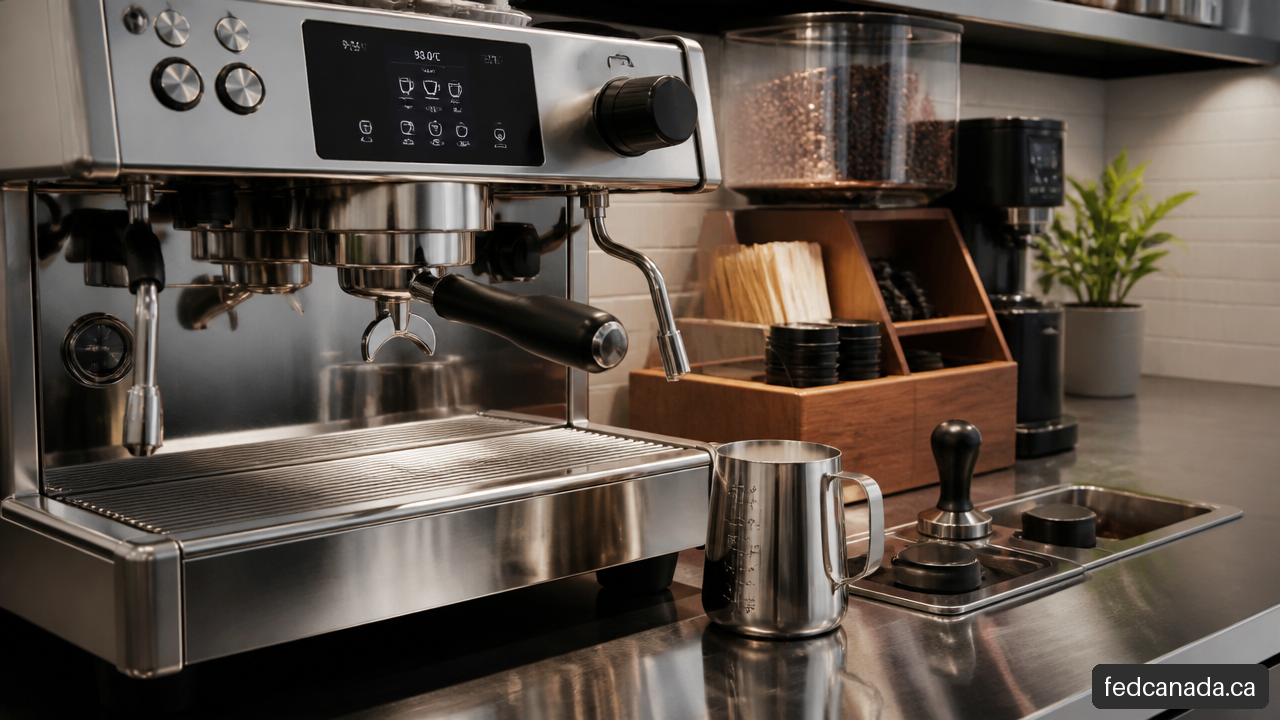
The best commercial espresso machines earn their value during the busiest service window. Look beyond decorative finishes and consider the systems that protect consistency.
- Thermal stability: Stable water temperature helps keep extraction predictable from one shot to the next. PID controllers can provide more precise boiler temperature management on applicable models.
- Volumetric dosing: Programmable doses reduce repeatable timing tasks and help staff produce a standardized recipe.
- Steam performance: Strong, sustained steam matters when cappuccinos and lattes dominate sales. Evaluate recovery, not just the number of steam wands.
- Ergonomics: Portafilter position, steam knob design, drip tray depth, cup clearance, and display visibility all affect speed and fatigue.
- Pressure consistency: Some commercial machines use gear-pump systems to maintain steady extraction pressure. Sanremo Canada identifies constant pressure delivery and extraction control as notable commercial machine considerations. Pressure profiling can be valuable in specialty applications, but it is rarely the first feature to prioritize for a new high-volume operation. First make sure the machine, grinder, water treatment, and staff workflow can deliver a reliable baseline espresso every day.
Plan Utilities, Water, and Canadian Compliance
Confirm electrical capacity before selecting a model
Electrical planning should happen before purchase, not while the machine is sitting at the loading dock. Many commercial espresso machines use 208V to 240V single-phase power and may require dedicated circuits in the 20A to 50A range, depending on the specific machine and heating system.
The commercial espresso installation guidance from 1st-line Equipment also notes that higher-capacity units commonly require sanitation certification and plumbed utility planning. The manufacturer’s data plate and installation manual are the controlling documents. A qualified electrician should verify voltage, amperage, conductor sizing, disconnect requirements, and local electrical code before installation.
A 110V compact unit may suit a catering cart or low-volume counter, but it should not be treated as a substitute for a higher-output machine that needs stronger electrical service.
Fair warning: a machine can power on and still be incorrectly installed. An undersized circuit may trip under heating load, while a mismatched supply can damage equipment or create an inspection issue.
Treat water treatment as equipment protection
Water filtration is not only about cup quality. Untreated hard water can leave mineral scale inside boilers, valves, solenoids, probes, and steam circuits. Water with unsuitable chemistry can also contribute to corrosion. Either problem can reduce thermal performance, create leaks, affect pressure control, and complicate warranty coverage.
The correct filtration setup depends on a local water test and the machine manufacturer’s water specifications. In some locations, hardness reduction is the priority. In others, filtration must balance scale control with avoiding overly aggressive water chemistry. A generic cartridge chosen without testing can be inadequate or unsuitable.
Create a replacement schedule tied to measured water use and filter capacity. Do not wait for poor-tasting coffee or a service call to discover that the treatment system is exhausted.
Plan water line, drain, and service clearance separately
A plumbed machine usually needs a dedicated cold-water connection and a gravity drain located below counter level. Drainage is not an optional convenience for many commercial installations; it affects how wastewater from the drip tray and internal systems is managed. Confirm whether local plumbing and health authorities require an air gap, open hub, or another approved arrangement.
Space is equally practical. The GoFoodService commercial espresso machine buying guide recommends considering group count, electrical needs, clearance, and utility constraints together. That approach avoids a familiar problem: a machine fits the counter width but cannot be pulled forward for service, cleaned properly, or connected to the required drain.
Before ordering, document these site conditions:
- Available voltage, dedicated circuit capacity, and breaker details.
- Cold-water supply location, pressure, shutoff access, and filtration space.
- Drain type, height, routing, and local plumbing requirements.
- Counter depth, machine width, overhead clearance, and rear access.
- Ventilation, heat exposure, and clearance from incompatible equipment.
- Local health inspection expectations, including whether NSF/ANSI 4 sanitation certification is required or preferred.
NSF/ANSI 4 is a sanitation standard for commercial food equipment. In practical terms, it signals that equipment design has been evaluated for cleanability and sanitation-related construction criteria. Electrical safety marks such as ETL or UL address a different question: whether the equipment meets applicable electrical safety requirements. Confirm what your jurisdiction, landlord, insurer, and health authority require before committing to a specific model.
Evaluate Durability, Serviceability, and Total Cost
Build quality matters because downtime costs more than repairs
Commercial espresso machines are built for repeated heating cycles, continuous pump operation, regular steaming, and frequent cleaning. Look for durable external panels, robust group assemblies, accessible valves, sensible drip tray design, and components that a technician can reach without dismantling half the counter.
A polished stainless exterior alone does not prove durability. What matters more is the underlying service design: Are wear parts available? Is there local technical support? Can common repairs be completed without extended shipping delays? Does the distributor provide installation guidance and parts support?
Compare total cost instead of purchase price
The purchase price is only one line in the decision. Total cost of ownership also includes water treatment, installation, routine cleaning, preventive maintenance, grinder support, replacement parts, labor, and lost sales during downtime.
| Cost factor | What to ask | Why it affects the decision |
|---|---|---|
| Installation | Does the site need electrical, plumbing, drain, or counter modifications? | A lower-priced machine can become costly if utility upgrades are substantial |
| Water treatment | What filtration does the manufacturer require for local water chemistry? | Correct treatment protects boilers and reduces scale-related failures |
| Preventive maintenance | Who performs it and how often? | Scheduled maintenance can reduce disruptive repairs during service |
| Parts access | Are common components stocked in Canada or available quickly? | Parts lead time directly affects downtime risk |
| Staff training | How many steps are required for a repeatable drink? | Training time affects quality consistency and labor efficiency |
| Energy and warm-up | Can the machine be scheduled or managed efficiently? | Heating demand matters over years of daily operation |
New versus used commercial machines
A used machine can make sense when the seller provides a documented service history, the model still has parts support, utilities match the site, and a qualified technician can inspect it before purchase. It may be less suitable when maintenance history is unclear or when the machine has been operated with untreated water.
For instance, a three-group machine at an attractive price may appear to solve a capacity problem. But if it requires an electrical upgrade, new filtration, drain work, replacement boilers, or hard-to-source electronics, the apparent savings can disappear quickly. I would compare the fully installed and supportable cost, not just the sticker price.
Frequently Asked Questions
What is the best commercial espresso machine for a small café?
For a small café, the best choice is often a one-group or two-group commercial machine sized for peak demand, paired with a capable grinder and proper water treatment. Choose one group only when rush volume, milk demand, and menu complexity are genuinely modest. A compact two-group machine may be the safer choice if two staff members need to work simultaneously or if the morning rush is concentrated.
What is the difference between a commercial espresso machine and a home machine?
Commercial machines are designed for sustained foodservice use, faster recovery, stronger steam output, more durable components, plumbed operation, and higher electrical demand. Home machines can make excellent espresso, but they are usually not designed for continuous back-to-back service, heavy milk production, or the sanitation and safety requirements that may apply in a commercial setting.
Should I buy a semi-automatic or superautomatic commercial espresso machine?
Choose a semi-automatic or volumetric traditional machine when beverage quality depends on barista control, milk texture, and customization. Choose a superautomatic when the operation needs repeatability with limited training time or limited labor. A hotel serving hundreds of breakfast guests may prioritize automation; a specialty café offering rotating coffees may prioritize manual control.
How many groups do I need for my expected drink volume?
Start with peak drinks per hour, then account for milk-drink share and number of baristas. One group can work for modest demand. Two groups often provide a practical balance for cafés and restaurants with regular rushes. Three groups or multiple stations become more appropriate when high demand is sustained and several drinks must be produced at once. If the menu is mostly large milk beverages, verify steam capacity separately.
What voltage and amperage does a commercial espresso machine need?
Requirements vary by model. Many larger commercial machines use 208V to 240V single-phase power and require a dedicated circuit, while some compact machines operate on 110V. Always use the manufacturer’s electrical specifications and have a qualified electrician confirm site compatibility before purchase or installation.
Do I need a plumbed water line and drain?
Most fixed commercial espresso installations benefit from a direct cold-water connection and proper drainage. A plumbed machine avoids manual filling and supports consistent operation. The drain arrangement must suit the machine, counter design, and local plumbing requirements. Mobile, catering, or temporary setups may use reservoir-equipped machines, but capacity and workflow limits should be expected.
What water filtration is needed for a commercial espresso machine?
The right filtration depends on local water testing and the manufacturer’s water specifications. The system should address hardness and contaminants while avoiding water chemistry that can cause corrosion. Use the machine maker’s requirements as the final reference, install the treatment system before commissioning, and replace cartridges based on measured use rather than guesswork.
How much maintenance does a commercial espresso machine need?
Daily work typically includes cleaning brew groups, wiping steam wands, flushing, emptying the drip tray, and following the manufacturer’s cleaning program. Regular preventive service may include inspecting gaskets, valves, pressure systems, pumps, filtration, and boilers. The exact schedule depends on machine design, water quality, sales volume, and manufacturer guidance. Consistent daily cleaning and timely filter changes are usually the least expensive maintenance tasks an operation can perform.
Recent Posts
Leave a Comment
Your email address will not be published. Required fields are marked *