



Butane Stoves: Portable Burners for Commercial Use
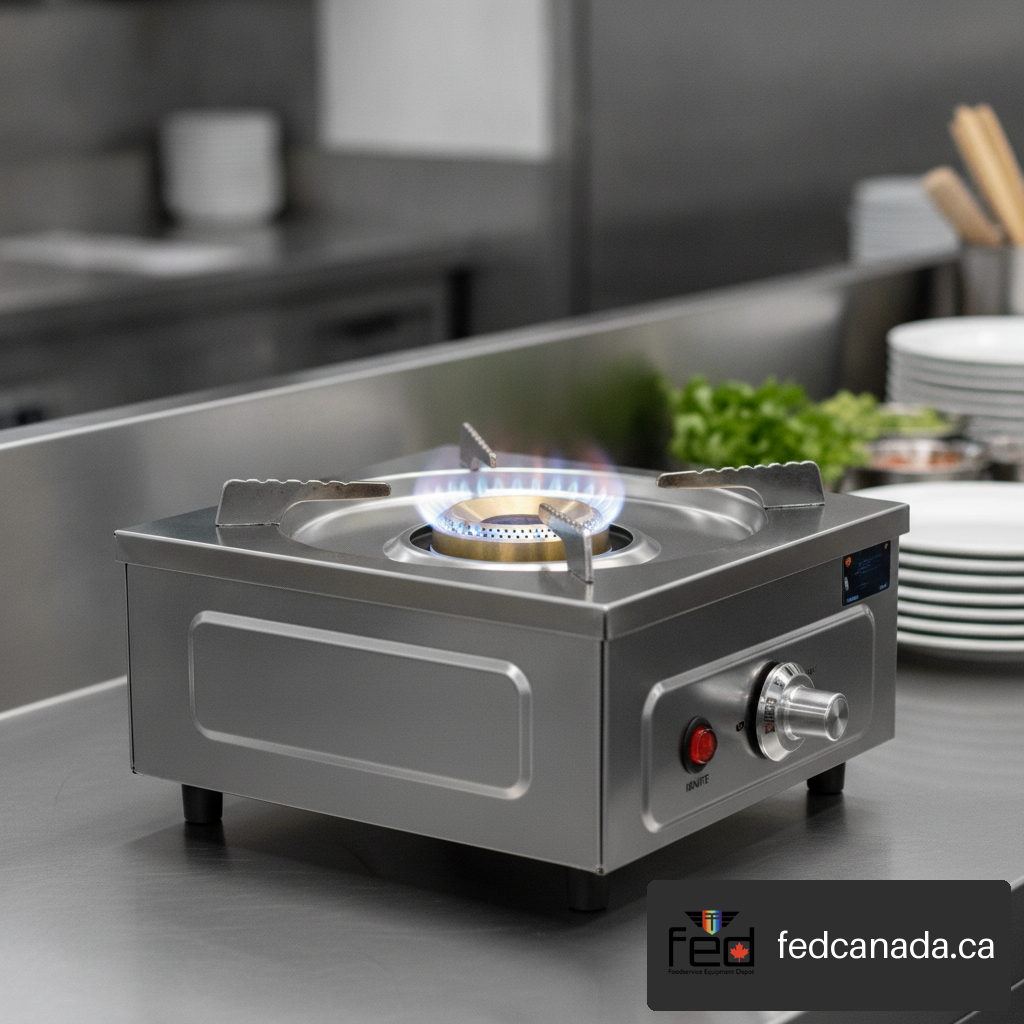
A portable butane stove provides compact, immediate heat for tabletop dining, off-site catering, emergency backup cooking, and outdoor food preparation. Unlike large stationary ranges or bulk liquid propane tanks, a butane burner relies on self-contained, aerosol-style cassette canisters that fit directly inside the stove body. This self-contained design delivers intense, localized heat with minimal setup time, making it a staple in commercial hot pot venues, chef action stations, catering setups, and mobile kitchens.
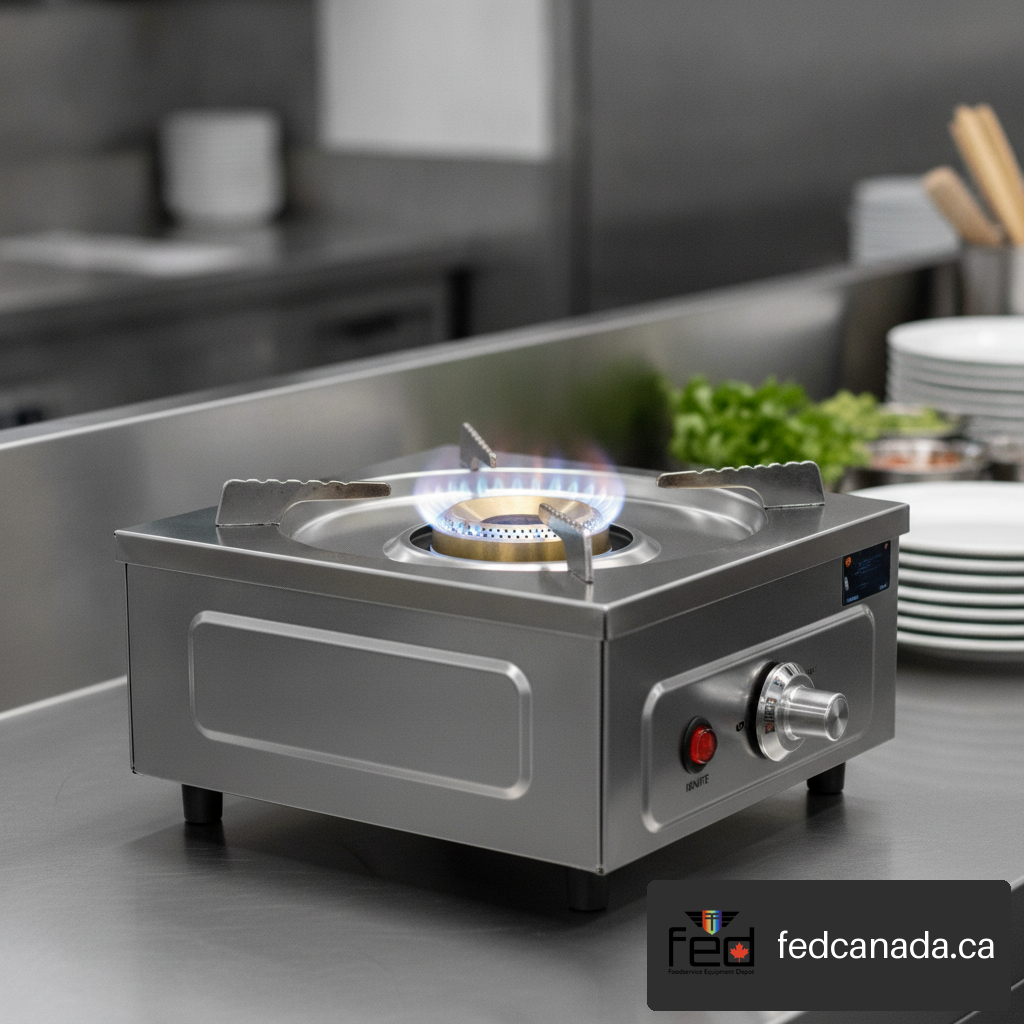
Understanding how a butane stove operates under varying conditions is critical for maintaining kitchen efficiency and operator safety. Heat output ratings, pressure regulation mechanisms, flame stability in wind, and low-temperature operating limits all directly dictate how well a burner performs during service. In this guide, we analyze the engineering, practical selection criteria, runtime formulas, and safety protocols necessary to choose and maintain the right portable cooking equipment for your business.
Table of Contents
- Key Takeaways
- How a Butane Stove Operates Under the Hood
- Comparing Butane, Propane, and Dual-Fuel Stoves
- Commercial and Portable Applications: Hot Pot, Catering, and Backup Power
- Safety, Indoor Use Guidelines, and Canister Seating Compliance
- Troubleshooting and Maintaining Your Portable Butane Stove
- Frequently Asked Questions
- Sources and References
Key Takeaways
High Heat in a Compact Footprint: Commercial butane burners produce between 7,000 and 15,000 BTU per hour, making them suitable for high-heat searing, boiling, and continuous tabletop service.
Vapor Pressure Dictates Cold Performance: Liquefied butane requires adequate internal canister pressure to vaporize. Standard butane canisters struggle near or below 32°F (0°C), where fuel pressure drops significantly.
Integrated Safety Mechanisms Are Essential: Modern commercial burners feature pressure-sensing shutoff devices that automatically disengage or stop gas flow if canister pressure exceeds safe limits (typically 60–90 psi).
Heat Panels Preserve Output: Premium stoves incorporate conductive heat panels that transfer ambient burner heat back to the canister, preventing pressure drops caused by evaporative cooling during continuous use.
Strict Indoor Ventilation Rules Apply: Only use butane stoves that explicitly meet commercial indoor safety standards, and always operate them in well-ventilated areas to prevent carbon monoxide buildup.
How a Butane Stove Operates Under the Hood
To evaluate portable cooking equipment, we must examine the physical components and mechanical principles that govern gas delivery and combustion. A butane stove transforms liquid fuel stored under low pressure into a controlled, steady gaseous flame.
Cassette Canisters and Internal Gas Delivery Mechanics
Portable butane stoves utilize thin-walled steel cartridges known as cassette canisters (commonly containing 227 grams or 8 ounces of fuel). Inside the canister, butane exists primarily as a liquid in equilibrium with a layer of gas vapor at the top. When the stove lever is engaged, an internal linkage presses the canister collar valve against the stove's fuel inlet receiver, forming an airtight seal.
Opening the burner control dial opens a metering valve. The pressurized gas vapor flows through the valve body, travels through a fine orifice tube, and enters the burner tube. As high-velocity gas shoots through the center of the venturi tube, it draws ambient air into the stream, creating a flammable air-fuel mixture that feeds into the burner head ports.
Piezoelectric Ignition and Flame Control Mechanisms
Modern commercial butane stoves eliminate the need for external matches or lighters by using piezoelectric ignition systems. When you rotate the control knob past the resistance point to the "ignition" position, a spring-loaded mechanical hammer strikes a small lead zirconate titanate crystal inside the stove body.
This physical impact generates a high-voltage electrical charge (typically several thousand volts at very low amperage). The charge travels along an insulated wire to a ceramic spark electrode positioned right next to the burner ports. The electrical current jumps across the small gap to the grounded brass or steel burner head, creating an electric spark that ignites the escaping gas-air mixture immediately.
Pressure-Sensing Shutoff and Heat Panel Engineering
Safety engineering in portable gas burners focuses heavily on managing internal canister pressure. Overheating a canister—whether through large cookware radiating heat downward, improper storage, or external heat sources—causes the liquid fuel inside to expand, rapidly increasing internal pressure.
Commercial stoves manage this risk through automated pressure-sensing shutoff systems. For instance, the Iwatani 35FW portable butane stove specifications show that its pressure-sensing mechanism interrupts fuel flow when internal canister pressure reaches approximately 60 to 90 psi (0.4 to 0.6 MPa). If an overpressure state occurs, an internal piston trips a latch, disengaging the canister lever and springing the fuel cartridge away from the inlet valve.
+-------------------------------------------------------------------------+ | BUTANE STOVE FUEL FLOW PATH | | | | [ Cassette Canister ] | | | (Liquid & Vapor Equilibrium) | | v | | [ Magnetic / Mechanical Receiver ] ---> (Pressure-Sensing Safety Shutoff) | | | | v | | [ Control Dial / Metering Valve ] | | | | | v | | [ Venturi Tube (Air-Fuel Mixing) ] <--- Ambient Air Inflow | | | | | v | | [ Brass / Steel Burner Head ] <--- Piezo Spark Electrode | | | | | v | | [ Controlled Flame Array ] | +-------------------------------------------------------------------------+
In addition to shutoff devices, high-end burners feature an integrated heat-panel system. As liquid butane vaporizes inside the canister, it absorbs heat from its surroundings, causing the canister temperature and internal pressure to drop steadily during prolonged operation (an effect known as evaporative cooling). A conductive metal plate bridges the burner housing to the fuel compartment, conducting residual combustion heat back to the canister. This maintains stable internal vapor pressure, allowing the stove to deliver consistent high-heat output until the cartridge is completely empty.
Comparing Butane, Propane, and Dual-Fuel Stoves
Choosing the right portable fuel system requires balancing thermal output, weight, temperature resilience, and operating expenses. Foodservice operators and outdoor caterers routinely compare butane with propane and dual-fuel configurations.
| Feature / Metric | Standard Butane Stove | Commercial Propane Stove | Dual-Fuel Portable Stove |
|---|---|---|---|
| Fuel Storage Type | Aerosol Cassette Cartridge (n-butane / isobutane) | Heavy Steel Cylinder / 1 lb Canister (propane) | Accepts Cassette Butane or Propane Hose |
| Average Thermal Output | 7,000 to 15,000 BTU/hr | 10,000 to 20,000+ BTU/hr | 8,000 to 12,000 BTU/hr (varies by fuel) |
| Cold-Weather Limit | Performance drops rapidly below 32°F (0°C) | Operates down to -40°F (-40°C) | Sub-freezing using Propane; Mild conditions on Butane |
| Physical Footprint | Low-profile, sleek tabletop design | Taller profile; external regulator hose | Medium profile; includes adapter hardware |
| Canister Pressure (at 70°F) | Low (~30 psi) | High (~110 to 120 psi) | Low on Butane / High on Propane |
| Primary Indoor Use Case | Tabletop hot pot, chef stations, catering | High-capacity back-of-house / outdoor focus | Versatile backup for emergency or mobile use |
Heat Output (BTU/hr) and Maximum-Power Runtime Analysis
Stove capacity is measured in British Thermal Units (BTU) per hour, which reflects the total heat energy delivered by the burner. Entry-level portable stoves deliver 7,000 to 10,000 BTU/hr, while heavy-duty commercial units deliver 12,000 to 15,000 BTU/hr.
To determine how long a stove will operate on a single canister, we use the mass-consumption calculation rather than relying on vague estimates. A standard butane cartridge contains roughly 227 grams of usable fuel. The energy density of liquefied butane is approximately 21,200 BTU per pound (or roughly 46.7 MJ/kg).
To estimate maximum-power burn time, apply this simple formula:
- Calculate total energy in one 227g (0.5 lb) cartridge:
0.5 lbs * 21,200 BTU/lb = 10,600 total available BTUs. - Divide total energy by the burner's max rating. For a 11,500 BTU/hr stove:
10,600 / 11,500 = 0.92 hours(approx. 55 minutes).
High-output models consuming fuel at full throttle empty standard cartridges within 45 to 55 minutes. Adjusting the control dial to a medium simmer (approx. 4,000 to 5,000 BTU/hr) extends operating time to 2.5 hours per cartridge.
Operating Temperature Thresholds and Vapor Pressure Physics
The chemical makeup of butane dictates its performance limits in cold climates. Pure n-butane has a boiling point of 31.1°F (-0.5°C). Below this temperature, liquid butane cannot boil into gas vapor inside an unheated cylinder, leaving the canister with zero effective gauge pressure to push fuel into the burner.
Isobutane blends lower the boiling threshold slightly to around 11°F (-11.7°C), but cold weather still severely impacts gas production. Field observations document that users encounter severe butane flame degradation near or below 32°F, often preferring propane or dual-fuel equipment for cold-weather catering or camping. Based on field observations regarding sub-freezing butane limitations, operators working in unheated winter environments should utilize propane, which maintains internal vapor pressure down to -40°F (-40°C).
Fuel Accessibility, Storage Requirements, and Operational Costs
While propane provides superior cold-weather output, butane offers operational advantages in space efficiency and weight. Butane cassette cartridges pack flat in compact carrying cases, requiring far less storage volume than bulky 1-lb propane cylinders or multi-gallon propane tanks. For front-of-house banquet service, butane burners sit lower on dining tables, improving visibility and safety for guests.
Cost considerations depend on local bulk purchasing options. Commercial kitchens buying cassette cartridges by the case (28 or 72 units) typically achieve an economical cost-per-hour rate, making butane highly cost-effective for indoor dining and catered events.
Commercial and Portable Applications: Hot Pot, Catering, and Backup Power
Portable butane stoves serve distinct operational needs across foodservice sectors. Their high energy density and immediate flame control make them versatile problem solvers in professional kitchens and mobile catering.
Tabletop and Front-of-House Foodservice Performance
In Asian hot pot establishments, table-side grill venues, and interactive buffet stations, low-profile butane burners are essential tools. Their compact dimensions permit guests to comfortably view and reach simmering pots without elevated center-of-gravity hazards.
Key features required for front-of-house commercial operation include:
Low-Profile Housing: Prevents high-sided pots from tipping over during guest interaction.
Brass Burner Heads: Offer corrosion resistance and withstand continuous multi-hour shift usage.
Easy-Clean Porcelain Enamel Drip Pans: Catch spills and overflows while resisting scorching.
Outdoor Catering, Food Trucks, and Remote Event Setup
For off-site caterers, food trucks, and pop-up events lacking direct utility hookups, butane burners supply localized cooking power for chef omelet stations, pasta bars, and live searing stations.
When working outdoors, wind management becomes critical. Cross-breezes can blow unshielded flames away from pot bases, dramatically slowing cooking times and wasting fuel. High-performance outdoor burners incorporate integrated windbreaks—such as double-layered outer flame guards—to block wind currents while maintaining airflow for clean combustion.
Emergency Readiness and Household Backup Cooking
When power outages disrupt electrical supply lines, commercial and residential kitchens lose induction cooktops and electric ranges. Butane stoves offer an immediate backup cooking method that requires no power grid connection, complex fuel lines, or lengthy preheating.
During power disruptions, a single portable butane stove can boil water, heat soup batches, or pasteurize liquids without delay, serving as a reliable line of defense against operational downtime.
Safety, Indoor Use Guidelines, and Canister Seating Compliance
Because butane combustion consumes oxygen and produces carbon monoxide (CO), safe operation requires strict adherence to safety standards and proper canister seating techniques.
+-------------------------------------------------------------------------+ | CANISTER INSTALLATION CHECKLIST | | | | 1. INSPECT GASKET -> Check receiver rubber O-ring for cracks/debris. | | 2. ALIGN NOTCH -> Align fuel canister rim notch directly upward. | | 3. ENGAGE LOCK -> Push lever to LOCK or snap magnetic collar. | | 4. AUDIBLE TEST -> Listen for gas hiss. If hissing, unlock immediately!| | 5. IGNITE & OBSERVE -> Rotate dial to ignite. Verify clear blue flame. | +-------------------------------------------------------------------------+
Distinguishing Indoor-Certified Models from General Outdoor Equipment
Not all portable gas burners are approved for indoor usage. Restaurant operators must carefully review equipment compliance standards:
Commercial Indoor Certification: Stoves intended for restaurant tables must carry appropriate commercial testing lab approvals (such as CSA, UL, or ETL safety marks) declaring them certified for commercial indoor use.
Outdoor-Only Burners: Lightweight backpacker burners, high-BTU camp stoves without safety shutoffs, and uncertified budget burners are restricted exclusively to open-air outdoor environments due to fire and toxic emission hazards.
Always verify local fire codes and municipal building regulations before deploying tabletop burners in enclosed commercial venues.
Canister Alignment, Magnetic Locking, and Seal Verification
Improper canister installation is a primary cause of gas leaks and ignition failure. Modern butane stoves utilize one of two locking mechanisms:
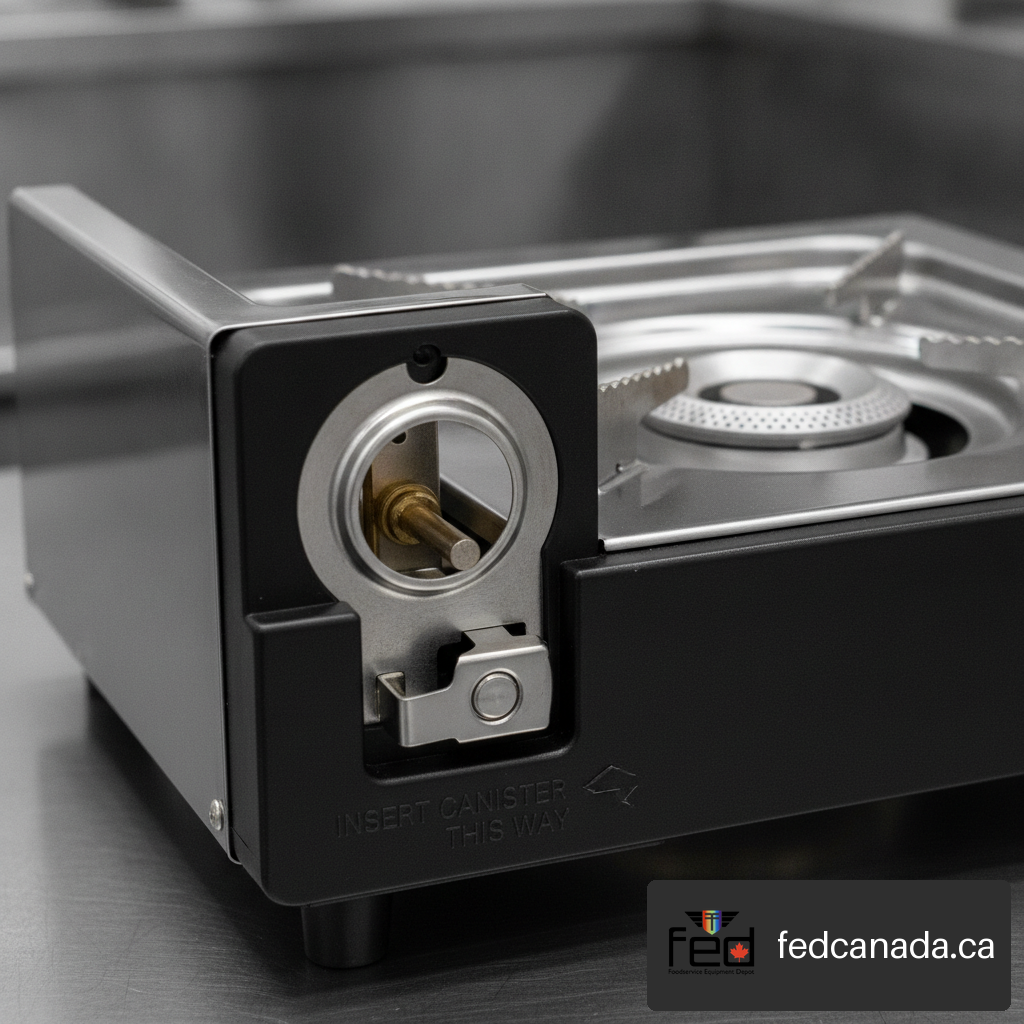
- Lever-Locking Systems: The user slides the cartridge into the compartment, aligns the index notch on the cartridge collar facing upward, and depresses a physical front-panel lever. This pushes the internal fuel block forward to seal against the canister valve stem.
- Magnetic Locking Systems: Found on premium models, this system uses permanent internal magnets to draw the canister collar into precise alignment against the valve receiver automatically. This reduces lever strain and lowers the risk of improper manual seating.
Critical Safety Check: The metal notch on the cassette cartridge rim MUST point straight up toward the top of the stove compartment. This orientation ensures that the internal fuel pickup tube draws gas vapor from the top of the cartridge rather than liquid fuel from the bottom.
Ventilation, Carbon Monoxide Safety, and Canister Storage Protocols
Combustion produces carbon monoxide—an odorless, colorless gas that can reach dangerous levels in unventilated spaces. We enforce strict facility rules for gas equipment safety:
Fresh Air Exchange: Never operate gas burners inside sealed rooms without active mechanical HVAC ventilation or open fresh-air intake pathways.
Distance Restrictions: Keep burners at least 12 inches away from combustible walls, curtains, or paper products.
Cookware Diameter Limits: Never use cookware that completely covers the fuel canister compartment lid. Oversized pans reflect radiant heat back downward into the fuel cartridge, triggering internal pressure spikes.
Safe Storage Practices: Store spare butane cartridges in a cool, dry area away from direct sunlight, heating ducts, or temperatures exceeding 120°F (49°C). Never leave fuel cartridges inside vehicle trunks during warm weather.
Troubleshooting and Maintaining Your Portable Butane Stove
Proper care and structured diagnostics keep portable burners running safely and extend their operational lifespan. Below is our systematic diagnostic matrix for resolving common equipment failures.
| Symptom / Fault | Primary Root Cause | Step-by-Step Diagnostic & Corrective Action |
|---|---|---|
| No Spark When Dial Rotates | Misaligned spark electrode; broken piezo lead; grease buildup | 1. Remove canister and inspect burner spark pin.2. Clean ceramic spark insulator with isopropyl alcohol.3. Adjust metal spark gap distance to approximately 3–4 mm from burner port. |
| Spark Present, But Fuel Will Not Ignite | Canister empty; safety shutoff tripped; clogged burner ports | 1. Check canister weight/fuel level.2. Reset internal pressure trip button (if equipped) or unlock/relock canister lever.3. Inspect burner ports for food spill obstruction. |
| Yellow, Lazy, or Smoking Flame | Incomplete combustion; dirty venturi tube; spider webs/dust in air mixer | 1. Turn off stove and let cool completely.2. Use compressed air to blow out venturi tube inlet.3. Scrub burner head ports with a stiff brass wire brush to restore oxygen mix. |
| Hissing Sound / Gas Smell Near Canister | Damaged O-ring seal; misaligned canister notch | 1. Instantly disengage lock lever and remove canister.2. Check internal rubber receiver seal for cracks, debris, or tears.3. Re-align canister notch straight UP and re-seat cartridge. |
| Flame Fluctuates / Fades out Gradually | Canister evaporative cooling; low ambient operating temperature | 1. Verify if stove model includes a heat-panel assembly.2. In sub-freezing weather, transition to propane or warm canister in ambient room before use. |
Resolving Ignition Failures and Contaminated Burner Ports
When stoves are stored between catering seasons or used outdoors, fine dust, cobwebs, or boiled-over grease can clog the igniter tip and burner ports. According to community discussions on outdoor stove maintenance, a user reported ignition trouble after outdoor storage, while commenters suggested contamination or incomplete cleaning as possible contributors.
To restore reliable ignition performance after storage:
- Confirm the gas supply is disengaged and the stove is fully cooled.
- Scrub the central ignition electrode using a fine wire brush or alcohol wipe to remove oxidation and carbon deposits.
- Clear individual gas ports on the burner head using a small needle or paperclip.
- Blow compressed air into the center venturi throat to dislodge cobwebs or dust settled in the mixing chamber.
Diagnosing Weak Flames, Pressure Trips, and Cold Canisters
If your stove ignites but produces a weak, sputtering flame, the safety shutoff system may have tripped partially due to an overpressure state, or the canister may be too cold. Disengage the canister lever, allow the canister to return to ambient room temperature (never heat cartridges over open flames or hot water), press the manual safety reset button if present on your regulator assembly, and re-engage the cartridge.
Cleaning, Port Care, and Long-Term Storage Maintenance
Maintain commercial performance by cleaning your stove after every catering shift:
Drip Pan Care: Wipe down porcelain enamel drip trays using warm soapy water and non-abrasive sponges. Avoid harsh steel wool that strips protective coatings.
Body Housing: Clean outer steel casings with food-safe degreaser spray.
Pre-Storage Protocol: Always remove butane canisters before packing the stove into its hard-shell plastic carrying case. Storing stoves with canisters engaged keeps internal springs under tension, wearing out rubber O-ring seals prematurely.
Frequently Asked Questions
What is a butane stove and how does it work?
A butane stove is a portable gas burner powered by a liquefied butane cassette canister. When locked into place, liquid butane turns into gas vapor, passes through a control valve and venturi tube where it mixes with air, and ignites at the burner head via a mechanical piezoelectric spark.
Can a butane stove be used indoors safely?
Yes, provided the specific stove model is certified for commercial indoor use and operated in a well-ventilated space. You must maintain clear fresh air exchange, avoid oversized cookware that reflects excessive heat onto the fuel compartment, and comply with all local commercial fire safety codes.
Why will my butane stove not ignite?
Ignition failures are usually caused by a dirty spark pin, an incorrectly seated canister, an empty fuel cartridge, or a tripped pressure safety shutoff. Clean the spark gap with a brush, ensure the canister notch points straight up, lock the cartridge firmly, and verify that gas is flowing through the valve.
How long does one butane canister last during cooking?
A standard 227-gram (8 oz) butane canister lasts approximately 45 to 55 minutes when burned continuously on maximum heat (11,000 to 15,000 BTU/hr). Lowering the control valve to a medium simmer extends runtime to approximately 2 to 2.5 hours.
Does a butane stove work effectively in cold weather?
Standard butane stoves experience severe performance drops near or below 32°F (0°C) because liquid butane cannot vaporize efficiently at freezing temperatures. For reliable operation in freezing conditions, choose propane or dual-fuel stoves.
What is the difference between a butane stove and a dual-fuel stove?
A standard butane stove burns cassette cartridges exclusively. A dual-fuel stove includes specialized adapter hoses and pressure regulators, allowing it to run on either low-profile butane cartridges or high-pressure propane cylinders depending on weather conditions and fuel availability.
What should be checked before buying a commercial butane stove?
Verify the BTU heat output rating, ensure the presence of an automated pressure-sensing safety shutoff mechanism, select models with conductive heat-panel systems to maintain continuous pressure, check for indoor safety certification marks, and choose durable brass burner heads and easy-to-clean drip pans.
Sources and References
Iwatani + 35FW Portable Butane Stove: https://www.iwatani.com/35-fw
Reddit r/camping + Butane stove: https://www.reddit.com/r/camping/comments/1xg9nlj/butane_stove/
Reddit r/preppers + Butane camp stoves?: https://www.reddit.com/r/preppers/comments/1h47nqt/butane_camp_stoves/
Recent Posts

Leave a Comment
Your email address will not be published. Required fields are marked *