



Restaurant BBQ Equipment: Choosing a Commercial Barbecue
Selecting the right **barbeque for restaurant** service requires balancing culinary authenticity, operational volume, and physical kitchen infrastructure. Commercial kitchen environments put extreme demands on cooking equipment. Unlike residential units, a commercial barbecue grill or smoker must withstand continuous high-heat operation, maintain rapid temperature recovery during rush periods, and integrate seamlessly with commercial extraction hoods and sanitation workflows.
Whether you are launching a dedicated wood-smoked pithouse or integrating flame-broiled items into an existing commercial kitchen line, choosing the right barbecue equipment directly dictates your production speed, food quality, labor cost, and utility expenditure. We created this comprehensive guide to walk you through equipment categories, sizing calculations, ventilation requirements, and total cost of ownership to help you make an informed decision for your foodservice operation.
## Key Takeaways
• **Separate Production from Finishing**: Dedicated smokers handle low-and-slow bulk cooking, whereas direct-heat equipment sears and holds items for rapid ticket fulfillment.
• **Calculate Usable Grate Area**: Never size equipment based on total square inches alone; account for thermal drop zones and a 20% spatial margin for food handling.
• **Design Ventilation Early**: Solid-fuel and high-fat cooking appliances demand specialized Type I hood systems, dedicated exhaust ducts, and engineered makeup air balance.
• **Factor in Total Cost of Ownership**: Operating expenses—fuel, daily sanitation labor, ash disposal, and preventative maintenance—frequently outpace initial equipment purchase prices.
• **Execute Pre-Opening Acceptance Testing**: Verify heat recovery, draft performance, and hot-spot distribution before launch to prevent service bottlenecks.
## Table of Contents
• [Categorizing Commercial Barbecue Equipment: Smokers, Charbroilers, and Grills](#categorizing-commercial-barbecue-equipment-smokers-charbroilers-and-grills)
• [Sizing and Capacity Planning: Calculating Usable Grate Area and Hourly Output](#sizing-and-capacity-planning-calculating-usable-grate-area-and-hourly-output)
• [Commercial Kitchen Infrastructure, Ventilation, and Safety Compliance](#commercial-kitchen-infrastructure-ventilation-and-safety-compliance)
• [Total Cost of Ownership: Analyzing Fuel Efficiency, Maintenance, and Labor](#total-cost-of-ownership-analyzing-fuel-efficiency-maintenance-and-labor)
• [Portable and Outdoor Barbecue Solutions for Catering and Mobile Service](#portable-and-outdoor-barbecue-solutions-for-catering-and-mobile-service)
• [Equipment Commissioning: Pre-Opening Performance and Acceptance Testing](#equipment-commissioning-pre-opening-performance-and-acceptance-testing)
• [Frequently Asked Questions](#frequently-asked-questions)
• [Sources and References](#sources-and-references)
## Categorizing Commercial Barbecue Equipment: Smokers, Charbroilers, and Grills
Commercial barbecue equipment falls into distinct operational categories. Choosing the right setup starts with defining the exact role each piece of equipment will play on your line.
### Smoker Systems vs. Direct-Heat Finishing Grills
A common mistake when outfitting a barbecue kitchen is assuming one machine can handle both low-and-slow smoking and high-heat ticket execution. In high-volume operations, these processes require separate appliances.
Commercial smokers rely on indirect heat and smoke, operating between 200°F and 275°F (93°C to 135°C) over extended periods of 4 to 16 hours. They excel at breaking down connective tissue in collagen-rich cuts like brisket, pork shoulder, and ribs. However, they lack the intense radiant thermal energy required to crisp chicken skin, sear steaks, or rapidly re-therm pre-cooked meats during a dinner rush.
Direct-heat equipment—such as open-pit grills or charbroilers—operates between 500°F and 800°F (260°C to 427°C). According to KaTom Restaurant Supply's guide on starting a barbecue restaurant, outdoor grills may be used for direct-heat barbecue styles, and smoker selection is part of starting a barbecue restaurant. For indoor kitchen lines that need intense direct heat, installing a [commercial radiant charbroiler](https://fedcanada.ca/product/southbend-48-natural-gas-radiant-charbroiler-sb-48-cl) provides consistent radiant heat transfer across heavy cast-iron or steel grates, allowing high-turnover protein searing.
+-----------------------------------------------------------------------------------------+
| BARBECUE KITCHEN FLOW |
| |
| +--------------------+ +-----------------------+ +------------------------+ |
| | Smoker System | ---> | Low-Temp Holding Unit | ---> | Direct-Heat Finishing | |
| | (Indirect Heat) | | (140°F - 160°F Hold) | | (Charbroiler/Grill) | |
| +--------------------+ +-----------------------+ +------------------------+ |
+-----------------------------------------------------------------------------------------+
### Comparing Fuel Sources: Charcoal, Gas, and Electric
Selecting your primary fuel source alters kitchen logistics, operating expense, flavor profile, and municipal code compliance.
1. **Charcoal and Solid Wood**: Delivers traditional smoky flavor profiles, deep smoke rings, and high surface radiant heat. However, solid-fuel equipment introduces operational challenges: manual fire tending, fuel storage requirements, ash removal protocols, fire protection considerations, and variable combustion rates.
2. **Natural Gas and Liquid Propane**: Provides instant ignition, precise knob-controlled temperature regulation, and uninterrupted thermal input. According to M KAYN's commercial charbroiler specifications, commercial charbroilers may be gas or electric, and countertop units can be placed on stands or refrigerated bases. Gas units use radiant plates or ceramic radiants to transfer heat, generating flavor when rendered fats drip onto hot surfaces.
3. **Electric Equipment**: Ideal for locations where open flames or solid fuels are restricted by building codes, landlords, or local zoning. Electric commercial grills deliver uniform heat distribution and minimal ambient heat loss, though they lack natural wood smoke notes without supplemental smoke generators.
### Flat-Bed vs. Hooded Configurations
The physical geometry of your equipment dictates heat retention, smoke penetration, and cook speed. As outlined in Cater-Kwik's catering barbecue overview, flat-bed units provide broad cooking surfaces, while hooded units retain heat and support more even cooking.
| Configuration Type | Primary Advantage | Heat Transfer Mode | Best Use Case | Operational Limitation |
| :--- | :--- | :--- | :--- | :--- |
| **Flat-Bed Open Grill** | High visibility, rapid flipping, max cook access | Direct radiant heat | High-speed grilling, burgers, skewers, quick searing | High heat loss, smoke disperses into room |
| **Hooded / Closed Grill** | Convection trap, faster thick-cut cooking | Radiant + Convective | Whole birds, thick roasts, indirect smoking | Limits line cook access, requires lid management |
| **Rotisserie Barbecue** | Continuous self-basting, visual customer merchandising | Indirect radiant / convection | Whole chickens, pork loins, large roasts | High mechanical moving parts, precise loading balance |
| **Cabinet Smoker** | Vertical footprint efficiency, high rack volume | Low-temp convective smoke | Bulk brisket, pork shoulders, ribs | Zero direct-searing capability |
## Sizing and Capacity Planning: Calculating Usable Grate Area and Hourly Output
Sizing your commercial barbecue equipment correctly prevents kitchen bottlenecks during peak hours. Relying on raw surface area measurements can cause operational issues if you fail to account for hot spots and loading margins.
### The Usable Surface Area Model
Manufacturer specifications state nominal cooking surface area (e.g., 48 inches wide by 24 inches deep = 1,152 sq in). However, practical kitchen capacity—known as *usable capacity*—is typically 75% to 80% of nominal area.
To calculate required surface area for direct-heat service, use this mathematical model:
Required Usable Area (sq in) = (Target Portions per Hour * Portion Surface Footprint (sq in) * Cook Time (min)) / (60 min * Loading Efficiency Factor)
Where:
• **Portion Surface Footprint**: Average square inches occupied by a raw protein cut (e.g., an 8 oz burger patty requires ~16 sq in; a half chicken requires ~48 sq in).
• **Loading Efficiency Factor**: Set to `0.80` to account for 20% open grate space required for spatula movement, tongs, turning clearance, and thermal boundary layers.
*Example Calculation*: A restaurant aims to serve 120 chicken halves per hour. Each half occupies 48 sq in and takes 25 minutes to cook on a direct-heat grill grid.
Required Usable Area = (120 portions * 48 sq in * 25 min) / (60 min * 0.80)
Required Usable Area = 144,000 / 48 = 3,000 sq in
Accounting for an 80% usable surface ratio, the nominal equipment grate size required is:
Nominal Area Required = 3,000 sq in / 0.80 = 3,750 sq in
This volume requires either two 48-inch commercial grills or a dedicated multi-rack rotisserie configuration.
### Dissecting Heat Recovery and Peak-Hour Bottlenecks
Heat recovery rate is the speed at which a cooking surface returns to target operating temperature after cold protein is loaded. When a cook loads 30 pounds of cold meat (38°F / 3.3°C) onto a hot grill grate, surface temperature drops immediately.
• **Low-BTU/Lightweight Grates**: Thermal energy drops rapidly and struggles to recover, causing meat to steam in its juices rather than sear.
• **High-BTU/Heavy Cast-Iron Grates**: Cast-iron and heavy-gauge steel act as thermal batteries. They store thermal energy, minimizing recovery time during back-to-back ticket cycles.
When evaluating gas or electric charbroilers, look for high BTU ratings per linear inch (typically 15,000 to 20,000 BTU per 6 inches of burner width) paired with thick, reversible cast-iron grates.
### Direct-Heat Capacity vs. Low-and-Slow Holding Volumes
For low-and-slow smoked barbecue (brisket, pulled pork, ribs), equipment capacity is measured by internal volume and rack count rather than linear cooktop width. A 30-square-foot vertical rack smoker can hold roughly 300 lbs of raw brisket.
Because smoked meats require extended cooking cycles (up to 14 hours), smokers must be sized based on **daily volume rather than hourly volume**. Smoked meats are cooked in overnight or early-morning batches and transferred to commercial holding cabinets operating at 140°F to 150°F (60°C to 65°C) to maintain food safety and meat moisture until service.
+-----------------------------------------------------------------------------------------+
| BATCH PRODUCTION VS. REAL-TIME SEARING |
| |
| BATCH METHOD (Smoker): |
| [14-Hour Smoke Cycle] ---> [Hot Holding Cabinet] ---> [Slice & Plate on Order] |
| |
| REAL-TIME METHOD (Direct-Heat Grill): |
| [Raw Prep Station] ---> [Direct Heat Grill] ---> [Immediate Plate & Serve] |
+-----------------------------------------------------------------------------------------+
## Commercial Kitchen Infrastructure, Ventilation, and Safety Compliance
Installing commercial barbecue equipment indoors requires adhering to mechanical codes, ventilation standards, and fire protection protocols. Failing to plan for proper extraction can derail project schedules and launch timelines.
### Exhaust Hood and Makeup Air Requirements for Indoor Barbecue
Barbecue appliances generate dense smoke, heavy grease-laden vapors, and extreme convective heat loads. According to Eurotec Australia's indoor commercial barbecue guide, indoor professional barbecue equipment is designed for extraction systems, commercial gas or electric services, and high-volume operation.
• **Type I Exhaust Hoods**: Required for any equipment producing grease smoke or open flames. Hoods must extend a minimum of 6 inches past the equipment footprint on all open sides.
• **Airflow Velocity (CFM)**: Barbecue equipment—especially solid-fuel cookers—requires higher exhaust cubic feet per minute (CFM) airflow rates than standard fryers or ranges (often 500 to 750 CFM per linear foot of hood).
• **Makeup Air Supply**: Dedicated makeup air fans must return 80% to 90% of exhausted air back into the kitchen to maintain air balance. Inadequate makeup air creates negative room pressure, causing backdrafting, poor combustion, and open doors.
### Solid-Fuel Regulations and Fire Suppression Protocols
Operating charcoal or wood-fired equipment indoors introduces specific safety considerations under National Fire Protection Association (NFPA) standards (such as NFPA 96 in North America):
1. **Independent Exhaust Systems**: Solid-fuel cooking equipment must have its own dedicated Type I exhaust duct. It cannot share a duct line with gas fryers, griddles, or ranges due to creosote build-up risks.
2. **Water Wash or Spark Arrestors**: Exhaust systems serving solid-fuel units must include spark arrestors or water-wash mechanisms to quench flying embers before they enter ductwork.
3. **Fire Suppression (Ansul/UL 300)**: Liquid chemical fire suppression nozzles must be positioned specifically above the solid-fuel bed and grease drip zones.
4. **Combustible Clearances**: Maintain strict spatial clearances (typically 18 to 36 inches) between heat-producing appliances and non-rated walls, or install fire-rated wall armor.
### Workflow Integration: Separating Raw Prep, Hot Line, and Ash Handling
A functional kitchen layout keeps raw prep, hot line production, and ash disposal pathways physically separated to optimize safety and speed.
+-----------------------------------------------------------------------------------------+
| SAFE KITCHEN WORKFLOW LAYOUT |
| |
| [Raw Meat Station] ---> [Cooking Equipment] ---> [Finished Holding / Plating] |
| | | |
| v v |
| (Sanitizer Sink) (Dedicated Ash Dump Area) |
+-----------------------------------------------------------------------------------------+
• **Raw Meat Handling**: Position raw protein prep stations near cold storage units and away from finished hot-holding cabinets to avoid cross-contamination.
• **Hot Line Placement**: Position charbroilers and finishing grills adjacent to pass-through warmers for seamless ticket plating.
• **Ash Handling Pathway**: For solid-fuel equipment, designate a short, clear path to an outdoor ash disposal container. Never transport hot ash through crowded prep areas or near food storage zones.
## Total Cost of Ownership: Analyzing Fuel Efficiency, Maintenance, and Labor
The initial purchase price of your equipment represents only a portion of its long-term cost. Fuel consumption, daily maintenance, and operational labor shape your total cost of ownership (TCO).
### Upfront Equipment Cost vs. Long-Term Fuel Expenditure
Fuel choices impact your monthly utility bills. Natural gas offers lower cost per thermal unit compared to propane cylinders or premium hardwood logs. Solid fuel requires purchasing, storing, and keeping wood dry, but delivers authentic smoke flavor profiles that gas cannot match without wood-chip smoke boxes.
| Fuel Type | Utility / Fuel Cost Factor | Energy Efficiency | Labor Demands | Infrastructure Cost |
| :--- | :--- | :--- | :--- | :--- |
| **Natural Gas** | Low to Moderate | High (Instant control) | Minimal (Turn knob) | Moderate (Gas line plumbing) |
| **Liquid Propane** | Moderate to High | High (Instant control) | Low (Tank changes) | Low (Portable tanks) |
| **Hardwood / Charcoal** | High (Supply chain dependent) | Moderate (Heat loss during fire tend) | High (Manual fire tending) | High (Dedicated ducting & fire protection) |
| **Electricity** | Moderate to High (Locational) | Extremely High (Direct thermal transfer) | Minimal (Digital control) | Moderate (High-amp electrical drop) |
### Labor Demands: Ash Removal, Cleaning Routines, and Temperature Monitoring
Labor costs often surpass energy costs over the lifespan of commercial equipment. Evaluate these routine requirements:
• **Daily Ash Cleanout**: Charcoal units require daily ash removal. Ash must be raked into metal containers, doused with water, and stored in sealed non-combustible bins.
• **Grate Scraping and Degreasing**: Cast-iron charbroiler grates need continuous scraping during service and periodic deep-cleaning, soaking, and seasoning to maintain non-stick surfaces and prevent carbon build-up.
• **Grease Trap Maintenance**: High-fat barbecue cooking fills drip pans and grease drawers quickly. Equipment designs with front-accessible, removable drip trays simplify turn-of-shift cleaning and mitigate grease fires.
### Commercial Durability and Equipment Stand Placement
Commercial-grade construction is essential for reliability under continuous thermal stress. Look for:
• **304 Stainless Steel Construction**: Resists corrosion from salty rubs, marinades, and high humidity.
• **Heavy-Gauge Fireboxes**: Heavy plate steel or firebrick-lined combustion chambers protect structural integrity against warping under high heat.
• **Countertop Equipment Stands**: Countertop charbroilers should be mounted on heavy-duty equipment stands with marine edges or integrated into refrigerated bases (drawers holding raw protein directly below the grill) to optimize movement on the line.
## Portable and Outdoor Barbecue Solutions for Catering and Mobile Service
Catering operations, off-site events, and food trucks require specialized equipment engineered for mobility, durability, and rapidly changing environments.
### Mobility Features: Towing, Heavy-Duty Casters, and Frame Construction
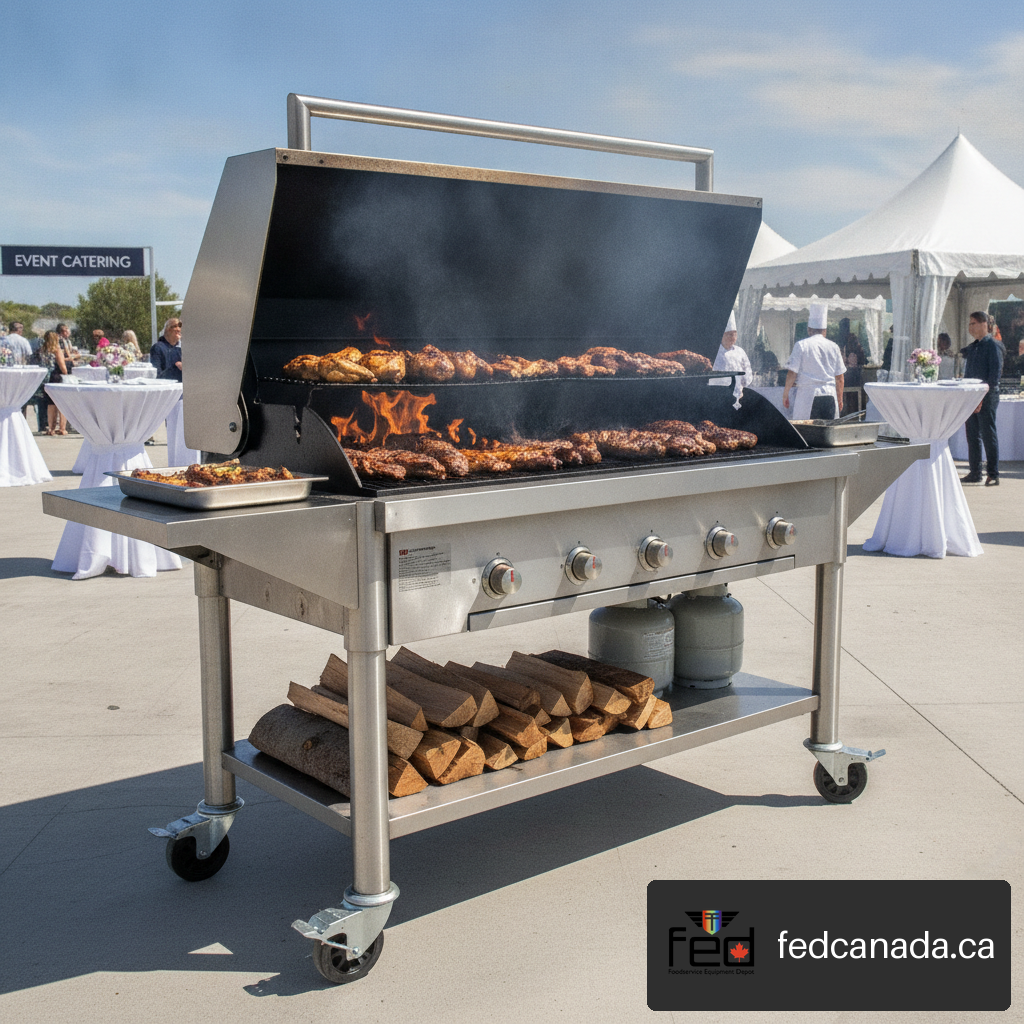
Mobile equipment must endure the physical stresses of road transport and rough event grounds. As detailed by Kohn-Megibow Company's commercial barbecue equipment analysis, commercial barbecue grills may use charcoal or propane, and wheeled five- or six-foot units can support relocation for catering.
• **Pneumatic Tires vs. Heavy-Duty Casters**: Towable trailer-mounted grills handle highway speeds for off-site events, whereas heavy-duty swivel casters with dual locking brakes are ideal for patio service and smooth catering surfaces.
• **Reinforced Chassis Framing**: Look for fully welded tubular steel frames. Bolted sheet-metal frames tend to loosen over time when subjected to transport vibration.
### Mobile Fuel Safety: Propane Storage and Charcoal Transport Constraints
Operating barbecue equipment off-site requires strict adherence to fuel safety protocols:
• **Propane Safety**: Transport propane cylinders upright in secure, ventilated racks. Use dual-stage regulators to maintain stable burner pressure in outdoor environments.
• **Charcoal Containment**: Ensure solid-fuel mobile units feature lockable lid latches and sealed ash pans to prevent hot embers from spilling during transit.
### Weather Protection, Temperature Stability, and On-Site Setup
Outdoor environments present unique thermal challenges. Wind strips heat from open flat-bed grills, slowing cooking times and increasing fuel use.
• **Insulated Hoods**: Dual-wall insulated hoods retain internal cooking temperatures during cold or windy conditions.
• **Wind Deflector Shields**: Side and rear wind guards help maintain steady flame combustion on propane burners.
• **Workstation Leveling**: Event grounds are rarely flat. Screw-adjustable leveling legs or heavy-duty locking shims ensure oil and grease drain evenly toward collect drawers rather than pooling on grate edges.
## Equipment Commissioning: Pre-Opening Performance and Acceptance Testing
Before opening your doors for service, run your commercial barbecue equipment through a formal commissioning process to identify potential operational issues early.
### Thermal Mapping and Hot-Spot Identification
Every grill surface exhibits temperature variations. Perform a thermal mapping test before your first service day:
1. **The Bread Test**: Cover the entire grate surface with standard white bread slices laid side by side.
2. **Heat Application**: Run the grill at standard operating power for 3 to 5 minutes.
3. **Flip and Inspect**: Flip each slice simultaneously. Dark brown slices indicate hot spots; pale slices indicate cold zones.
4. **Document Thermal Map**: Map these zones so line cooks know where to sear, cook, and hold proteins during high-volume rushes.
+-----------------------------------------------------------------------------------------+
| THERMAL MAP (BREAD TEST MATRIX) |
| |
| [COLD ZONE] [HOT SPOT] [HOT SPOT] [MEDIUM ZONE] |
| (Slice: Pale) (Slice: Dark Brown) (Slice: Dark Brown) (Slice: Med Gold) |
| |
| [MEDIUM ZONE] [OPTIMAL SEAR] [OPTIMAL SEAR] [COLD ZONE] |
| (Slice: Med Gold) (Slice: Rich Brown) (Slice: Rich Brown) (Slice: Pale) |
+-----------------------------------------------------------------------------------------+
### Heat Recovery Testing Under Peak-Load Conditions
Test how quickly the equipment recovers thermal energy when fully loaded:
• Stabilize the grill at target operating temperature (e.g., 600°F / 315°C).
• Load the cooking grate to 80% capacity with chilled water-soaked sponges or test protein cuts.
• Monitor surface temperature recovery using a surface thermocouple probe.
• **Acceptance Benchmark**: A commercial-grade unit should recover to target cooking temperature within 3 to 5 minutes of loading.
### Exhaust Flow and Draft Verification
Validate ventilation system integration under realistic operational loads:
• Fire up all line equipment simultaneously to maximum heat output.
• Perform smoke pencil or tissue paper draft tests along the hood perimeter to verify zero smoke spillage into the kitchen air volume.
• Confirm makeup air units engage automatically without creating uncomfortable drafts across the cooking surface.
## Frequently Asked Questions
### What type of barbecue equipment is best for a restaurant?
It depends on your menu focus. High-volume smoked meats (brisket, pork shoulder) require dedicated, insulated cabinet smokers or offset pit smokers. Fast-casual dining and steak-heavy menus requiring rapid sear lines benefit from a direct-heat commercial charbroiler or heavy-duty open-pit grill.
### Should a barbecue restaurant use a smoker, charbroiler, grill, or all three?
Most high-volume barbecue restaurants use a combination. A smoker handles low-and-slow overnight cooking. Low-temperature holding cabinets keep smoked proteins safe until service. Finally, a gas or solid-fuel charbroiler sears, crisps, and re-therms meat portions during ticket assembly.
### Is charcoal or gas better for commercial barbecue cooking?
Charcoal provides authentic smoky flavor, distinct smoke rings, and high surface radiant heat, but demands higher labor for fire management, ash disposal, and specialized solid-fuel exhaust systems. Gas offers instant ignition, precise temperature control, lower labor requirements, and simpler ventilation integration, though it lacks wood-smoke flavor without add-on smoker boxes.
### Can a commercial barbecue grill be used indoors?
Yes, provided it is installed beneath an appropriately rated commercial kitchen exhaust hood. Gas and electric models require standard Type I hoods. Solid-fuel charcoal or wood equipment requires dedicated Type I exhaust ducts, specialized spark arrestors, and independent fire suppression systems to comply with commercial building and fire codes.
### How do I calculate the required grate size for high-volume service?
Determine your target portions per hour, multiply by the square-inch footprint of each portion, and multiply by the total cooking time in minutes. Divide by 60 minutes and by a 0.80 loading efficiency factor. Finally, divide by 0.80 to account for usable versus nominal surface area.
### What is the difference between a commercial charbroiler and a barbecue grill?
A commercial charbroiler uses gas burners or electric coils under metal radiants or ceramic stones to transfer high radiant heat to heavy grates, making it ideal for quick-turn indoor cooking lines. A commercial barbecue grill typically features a larger surface, open-bed design, or insulated hood designed for direct coal cooking or indirect convection smoking.
### What equipment is necessary for mobile catering and event service?
Mobile service requires heavy-duty wheeled chassis or trailer mounts, reinforced welded frames, insulated hoods to counteract wind, secure fuel storage mounts (for propane or charcoal), and level-adjustable legs. Ensure equipment can handle transport vibration and variable weather conditions.
## Sources and References
• KaTom Restaurant Supply + “So You Want to Start a Barbeque Restaurant?”
• Kohn-Megibow Company + “Here’s Everything You Need to Start a Barbecue Restaurant”
• Eurotec Australia + “Commercial Barbecue Grills & Chargrills for Indoor Kitchens”
• M KAYN + “Commercial Charbroilers”
• Cater-Kwik + “Catering Commercial Barbecue Grills”
Recent Posts
Ice Maker Machine Guide: Commercial vs Residential Perf...
31st October, 2026
Santoku Knives: What They Are and How to Choose
31st October, 2026
Restaurant BBQ Equipment: Choosing a Commercial Barbecu...
31st October, 2026
Atosa Freezer Settings, Temperature Controls, Reset & T...
31st October, 2026
Leave a Comment
Your email address will not be published. Required fields are marked *