



Santoku Knives: What They Are and How to Choose
Selecting the right general-purpose knife is one of the most critical decisions for any commercial or home kitchen. While the Western chef’s knife has long been the default workhorse in European and North American prep stations, the Japanese santoku knife has earned an equally prominent place on the cutting board. Characterized by its flatter edge profile, downward-curving tip, and lightweight balance, the santoku excels at precision prep work. Understanding how this tool operates under the hood—from its structural geometry to its steel chemistry—enables culinary operators and enthusiasts to select, maintain, and master the ideal blade for their specific workflows.
## Table of Contents
• [Key Takeaways for Selecting and Using a Santoku Knife](#key-takeaways-for-selecting-and-using-a-santoku-knife)
• [Anatomy and Mechanics of the Santoku Knife](#anatomy-and-mechanics-of-the-santoku-knife)
• [Comparative Analysis: Santoku vs. Chef's Knife, Gyuto, and Nakiri](#comparative-analysis-santoku-vs-chefs-knife-gyuto-and-nakiri)
• [Blade Materials, Construction, and Fluted Edges](#blade-materials-construction-and-fluted-edges)
• [Practical Selection Criteria for Buying a Santoku Knife](#practical-selection-criteria-for-buying-a-santoku-knife)
• [Sharpening, Maintenance, and Avoiding Damage](#sharpening-maintenance-and-avoiding-damage)
• [Frequently Asked Questions About Santoku Knives](#frequently-asked-questions-about-santoku-knives)
• [Sources and References](#sources-and-references)
## Key Takeaways for Selecting and Using a Santoku Knife
• **Core Purpose**: As Shun Cutlery notes, a santoku is a general-purpose knife intended for slicing, dicing, and chopping across a wide spectrum of kitchen preparation tasks.
• **Cutting Mechanics**: The flatter belly and downward-curving tip favor push-cutting, vertical chopping, and tap-chopping over the wide rocking motion typical of Western chef's knives.
• **Ingredient Range**: According to manufacturers, Victorinox describes santoku as a three-virtues knife for slicing, dicing, and chopping meat, fish, and vegetables.
• **Steel Trade-offs**: Harder Japanese steels (such as VG-10 or high-carbon alloys) offer superior edge retention but carry a higher risk of chipping if subjected to twisting, bones, or frozen products.
• **Fluted Edges**: Hollow scallops (Granton edges) reduce sliding friction and air seal on dense produce, though blade grind and surface finish play an equally significant role in food release.
• **Maintenance Rules**: Hand-washing and immediate drying are mandatory for high-carbon and layered steel blades to preserve edge integrity and prevent oxidation.
## Anatomy and Mechanics of the Santoku Knife
To understand why the santoku knife performs so effectively on the prep bench, we must examine its physical structure. Originating in post-World War II Japan, the santoku (literally translated as "three virtues" or "three uses") was designed as a hybrid tool. It merged the vegetable-chopping efficiency of the traditional rectilinear *nakiri* with the meat-slicing capability of the pointed *gyuto*.
### The Sheep's Foot Blade Profile and Flat Cutting Edge
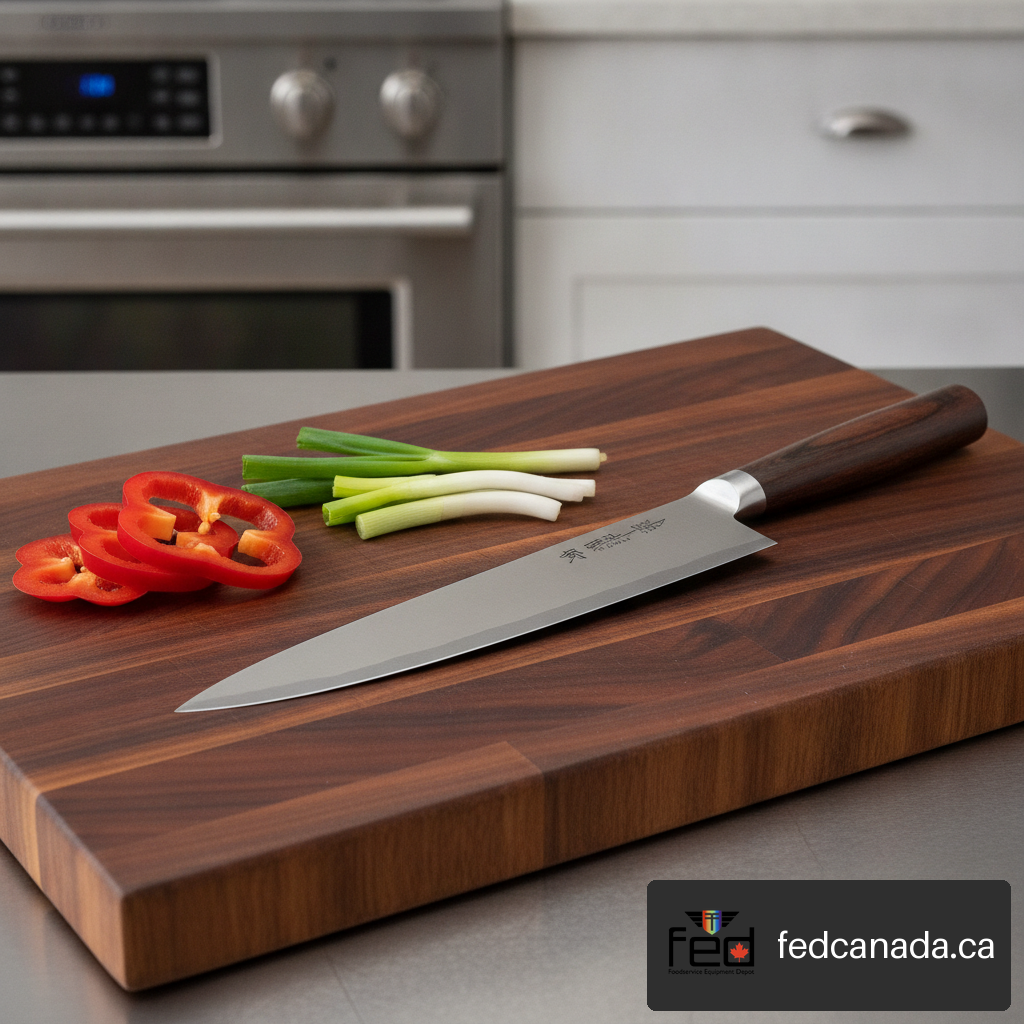
The defining visual characteristic of a santoku is its blade geometry. Unlike a Western chef's knife, which curves upward gracefully from the heel to a centralized point, a santoku features a relatively flat cutting edge paired with a spine that curves downward sharply near the front. This top curve is known as a "sheep's foot" tip.
Because the edge line remains straight for the majority of its length, the contact patch between the knife and the cutting board is substantially larger during a vertical stroke. The low, downward-oriented tip provides excellent control for precision scoring, decorative vegetable work, and fine dicing, reducing the wrist elevation required to align the tip with the working surface.
### How Geometry Dictates Cutting Technique: Push-Cutting vs. Rocking
The physical profile of a knife directly dictates how force is transmitted from your hand to the food item. Understanding this mechanism prevents technique errors that dull or damage the edge:
1. **Push-Cutting**: The flatter edge of the santoku is optimized for a forward-and-downward push-cut. As the blade glides forward, the entire flat section meets the board evenly, creating clean, complete cuts through skin, fibers, and membranes without leaving "accordion" strips attached at the bottom.
2. **Tap-Chopping**: For high-speed vegetable prep, the straight edge allows rapid vertical chopping (up-and-down movement) without requiring the heel to lift high off the board.
3. **Rocking Motion Limitations**: A classic French or German chef's knife relies on a curved belly to pivot smoothly back and forth while maintaining constant contact with the cutting surface. If you attempt a high-pivot rocking cut with a flat santoku, the heel or flat midsection strikes the board early, creating a jarring motion that can dig the tip into the wooden surface or chip a brittle edge.
### Weight Distribution and Board Clearance
Santokus are typically shorter and thinner than standard European chef's knives, generally measuring between 5.5 and 7 inches (14 to 18 cm) in length. This reduced length, combined with a thin blade stock, shifts the center of gravity closer to the user's hand.
Despite the shorter blade length, the santoku retains a relatively tall heel profile. This height provides ample knuckle clearance against the cutting board, preventing fingers from slamming into the surface during rapid chopping strokes. The high blade face also acts as a natural guide against the knuckles of your off-hand when using the claw grip.
## Comparative Analysis: Santoku vs. Chef's Knife, Gyuto, and Nakiri
Choosing the right cutting tool requires matching the knife's geometry to your primary prep tasks. While marketing claims often present the santoku as a universal replacement for all kitchen knives, clear structural trade-offs exist between different blade styles.
### Santoku vs. French and German Chef's Knives
Western chef's knives are built around versatility, mass, and durability. A standard 8-inch German chef's knife features a thick spine, a heavy bolster, and a pronounced belly curve. This design provides momentum when breaking down dense ingredients like winter squash or splitting poultry joints.
In contrast, the santoku is significantly lighter and shorter. Its primary advantage lies in maneuverability and speed during detail-oriented vegetable and boneless protein prep. However, it lacks the raw leverage and wedge-cleaving power of a heavy Western knife. When slicing large roasts or working through oversized watermelons, the shorter length of a santoku requires multiple strokes where an 8- to 10-inch chef's knife completes the task in a single fluid draw.
### Santoku vs. Gyuto and Nakiri
When evaluating Japanese blade designs, the santoku sits precisely between the *nakiri* and the *gyuto*:
• **Nakiri**: A specialized double-bevel vegetable knife with a completely rectangular blade, flat cutting edge, and square tip. It is unmatched for high-volume vegetable preparation but lacks a pointed tip for puncturing skin or scoring protein.
• **Gyuto**: The Japanese interpretation of the Western chef's knife. It features a long, slender profile with a gentle belly curve and a sharp tip. It excels at draw-slicing meats and handling broad prep work but requires a larger cutting board footprint.
• **Santoku**: The compromise. It retains enough tip control from the gyuto to pierce raw meats and score fish, while incorporating enough edge flatness from the nakiri to make vegetable prep rapid and uniform.
### Comprehensive Kitchen Knife Comparison Matrix
The following table outlines the mechanical differences across these common blade styles to guide your kitchen selection:
| Feature / Dimension | Santoku Knife | Western Chef's Knife | Japanese Gyuto | Nakiri Knife |
| :--- | :--- | :--- | :--- | :--- |
| **Typical Blade Length** | 5.5 – 7.0 inches | 8.0 – 10.0 inches | 8.0 – 10.5 inches | 5.5 – 7.0 inches |
| **Primary Cutting Motion** | Push-cut, tap-chop | Rocking-cut, push-cut | Draw-cut, push-cut | Vertical push/chop |
| **Tip Style** | Sheep's foot (downward) | Central sharp point | Low sharp point | Square / blunt |
| **Edge Angle (Per Side)** | 12° – 16° | 18° – 22° | 12° – 15° | 12° – 15° |
| **Weight Profile** | Light to medium | Heavy / forward-balanced | Light to balanced | Light / middle-balanced |
| **Ideal Ingredients** | Boneless meats, herbs, root vegetables | Large proteins, hard squash, bones | Slicing proteins, fine prep | Vegetables exclusively |
| **Risk of Chipping** | Moderate (steel-dependent) | Low (softer, tougher steel) | High (harder, thin edge) | Moderate (thin edge) |
## Blade Materials, Construction, and Fluted Edges
The raw cutting performance, edge retention, and maintenance burden of a santoku knife are dictated by its metallurgy and forging methods. Buyers must look beyond surface aesthetic features like decorative Damascus patterns to evaluate structural steel properties.
### High-Carbon vs. Stainless Steel and Rockwell Hardness (HRC)
Kitchen cutlery steel represents a continuous trade-off between edge retention (hardness) and toughness (resistance to chipping). This property is measured on the Rockwell C scale (HRC):
1. **Western-Style Stainless Steels (55–58 HRC)**: Commonly formulated with chromium-heavy alloys (such as X50CrMoV15). These steels are softer and more ductile. They dull more quickly under continuous friction but rarely chip when striking small bones or hard boards. They are easily restored with a standard steel honing rod.
2. **High-Performance Japanese Steels (60–64 HRC)**: Utilizing advanced alloys such as VG-10, SG2/R2, or traditional carbon steels (White Paper / Blue Paper steel). For example, Le Creuset specifies a VG-10 steel core, 64 Damascus layers, a stated hardness of 61 HRC, and hand-wash care instructions for its premium model. Higher HRC ratings mean the edge remains razor-sharp through extensive slicing sessions, but the micro-structure is more brittle.
Fair warning: high HRC values do not automatically guarantee a superior knife. A blade hardened to 62 HRC with poor heat treatment or overly thin grind geometry will chip under normal board impacts. Steel hardness is only one variable in overall blade performance.
### The Reality of Fluted and Granton Edges: Anti-Sticking Performance
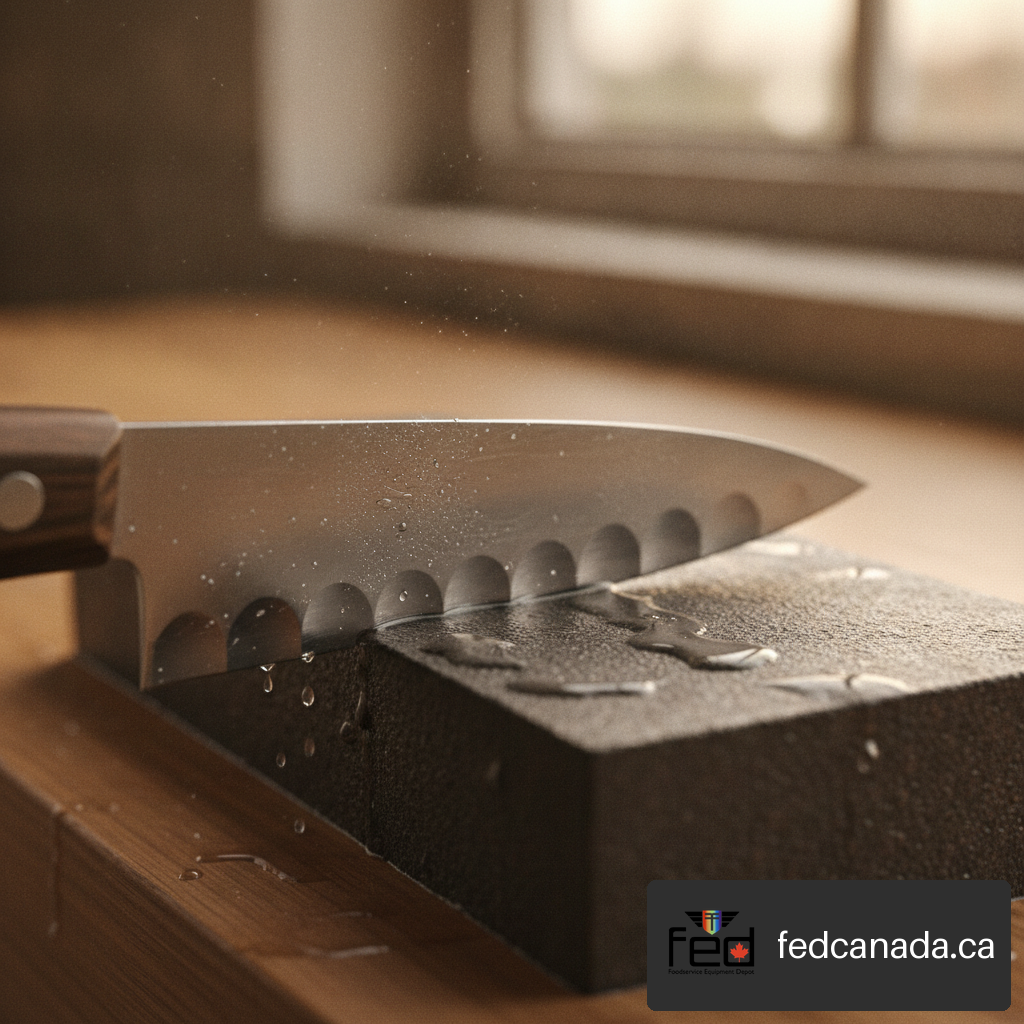
Many commercial santoku blades feature a series of oval indentations ground into the sides of the blade above the cutting edge. Often referred to as a fluted edge or Granton edge, this design feature is heavily marketed as a non-stick solution.
For example, Victorinox's Swiss Classic Santoku features a 6.7-inch blade, weighs 3.8 ounces, uses a fluted edge, and is listed as dishwasher safe. The engineering principle behind these hollow scallops is that they trap pockets of air between the steel face and the sliced food, breaking the vacuum seal created when wet produce (such as potatoes, cucumbers, or raw meat) clings to a smooth blade face.
In practical kitchen operations, the effectiveness of fluting varies:
• **Starchy Produce**: When slicing moist potatoes or zucchini, deep fluting noticeably reduces lateral drag and prevents slices from stacking up on the blade face.
• **Dense/Hard Ingredients**: On carrots, onions, or hard cheeses, fluting offers minimal anti-sticking benefit because the rigid vegetable structure does not flex into the hollow scallops.
• **Blade Geometry Impact**: A plain-edge knife with a convex grind or a hammered (*tsuchime*) finish often releases food just as effectively as a fluted blade by physically pushing the slice away from the blade center.
### Monosteel vs. Clad and Damascus Construction
Modern santoku knives are manufactured using one of three primary structural configurations:
• **Monosteel**: The entire knife—from tang to edge—is stamped or forged from a single homogeneous piece of alloy. Monosteel blades are consistent, durable, and generally more cost-effective.
• **San Mai (Clad) Construction**: A hard inner core steel (such as VG-10 or SG2) is sandwiched between two outer layers of softer, corrosion-resistant stainless steel. The hard core forms the cutting edge, while the soft cladding absorbs lateral shocks and protects the brittle core from breaking.
• **Damascus Cladding**: Multiple alternating layers of soft stainless alloys are welded over a hard core steel, then etched in acid to reveal a wavy pattern. While visually striking, Damascus patterning is strictly decorative; it does not enhance the cutting capability or structural hardness of the core steel.
## Practical Selection Criteria for Buying a Santoku Knife
Selecting the right santoku involves matching the physical specifications of the knife to your hand size, work surface, and daily preparation volume.
### Choosing the Ideal Blade Length (5-Inch to 8-Inch Range)
While 7 inches (18 cm) is the industry standard for santoku blades, manufacturers offer options ranging from 5 to 8 inches:
• **5.0 to 5.5 Inches (Compact)**: Excellent for smaller hands, tight prep stations, or detail work like hulling, trimming, and small-vegetable garnishes. It functions almost like an oversized utility knife.
• **6.5 to 7.0 Inches (Standard)**: The optimal balance for general prep work. It provides enough edge length to slice full-sized onions, peppers, and medium poultry fillets in a single pass while retaining effortless maneuverability.
• **7.5 to 8.0 Inches (Extended)**: Suitable for high-volume commercial production stations where long slicing strokes across broad proteins are required, though it sacrifices a portion of the agile feel native to the santoku shape.
### Handle Style: Traditional Japanese (Wa) vs. Western (Yo)
The handle geometry significantly alters the weight balance and grip mechanics of the knife:
1. **Western Handles (Yo-Bocho)**: Constructed with full-tang steel extending through two handle scales secured by rivets. These handles are heavier, contoured to fit the fingers, and shift the balance point backward toward the palm. They suit users who prefer a solid, heavy hand-feel or utilize a traditional handle grip.
2. **Japanese Handles (Wa-Bocho)**: Crafted from lightweight wood (such as ho wood, walnut, or pakkawood) with an octagonal, D-shaped, or round cross-section. The steel tang is glued into a lightweight ferrule. This construction dramatically lightens the handle, shifting the balance point forward onto the blade face. This forward balance encourages a proper pinch grip (holding the blade spine between thumb and index finger) for superior precision.
### Price Tiers and Value Propositions
When evaluating market pricing, kitchen knives generally fall into three distinct practical tiers:
• **Budget / Utility Tier ($30 – $60)**: Stamped stainless steel blades with molded polymer handles. These tools offer high corrosion resistance and high toughness at the expense of frequent sharpening needs. Ideal for commercial line stations where durability and dishwasher resilience are prioritized.
• **Mid-Range Workhorse Tier ($70 – $160)**: Forged high-carbon stainless steels or entry-level Japanese san-mai construction with composite or hardwood handles. This tier offers the best performance-to-cost ratio, delivering sharp edges, stable HRC ratings (58–61), and solid ergonomic balance.
• **Premium / Artisan Tier ($170 – $350+)**: High-end powder metallurgy steels (SG2/R2, ZDP-189) or hand-forged carbon steels crafted by master blacksmiths. These blades display exceptional edge retention, thin grinds, and detailed fit-and-finish, but require careful handling to avoid chipping.
## Sharpening, Maintenance, and Avoiding Damage
Because of their thinner edge bevels and harder steel compositions, santoku knives demand specific maintenance protocols. Treating a thin Japanese blade like a heavy Western cleaver will lead to rapid edge degradation or severe physical damage.
### Edge Angles, Waterstones, and Honing Realignment
Western chef's knives are typically ground to a factory angle of 18° to 22° per side, creating a broad, robust wedge. Santokus feature a narrower edge angle, usually ground between 12° and 16° per side.
To maintain this acute angle:
• **Use Synthetic Waterstones**: Sharpening hard Japanese steel requires whetstones (such as 1000-grit for routine edge setting and 4000 to 6000-grit for polishing). Mechanical pull-through sharpeners exert destructive lateral pressure and should be strictly avoided.
• **Honing Steel Caution**: Standard grooved steel honing rods can micro-chip ultra-hard edges (60+ HRC). If edge alignment is needed between sharpening sessions, use a smooth ceramic rod or a leather strop coated with diamond paste.
• **Understanding Community Performance Reports**: In professional kitchen discussions, community members discussing knives like the Tojiro DP describe thinner Japanese-style santokus as sharp and easy to sharpen, while noting that thinner construction can render them more fragile under heavy-handed use.
### Task Restrictions: What a Santoku Should Never Cut
The thin cross-section of a santoku edge makes it vulnerable to chip failure under lateral torque. To protect your investment, establish clear operational rules for what the blade can and cannot touch:
• **Approved Tasks**: Boneless poultry, raw or cooked meats, boneless fish, soft-to-medium root vegetables, leafy greens, herbs, citrus, and cooked grains/crusts.
• **Prohibited Tasks**: Splitting chicken bones, cutting through frozen foods, hacking dense lobster shells, slicing hard aged cheeses with high lateral drag, or prying open cans.
• **Twisting Motion Warning**: Never twist or rock the knife sideways when the edge is firmly embedded in dense produce like winter squash. Lateral shearing forces are the primary cause of large edge chips.
### Cleaning, Drying, and Safe Board Storage Protocols
Proper sanitation and storage directly extend the working life of the knife edge:
1. **Hand Washing Only**: Even if a knife is marketed as dishwasher safe, dishwashers present major hazards. High-pressure water spray bounces light blades into plastic racks, caustic detergents corrode fine cutting edges, and extreme thermal cycles loosen handle adhesives.
2. **Immediate Drying**: Wash the blade with warm water and mild dish soap immediately after use. Dry completely with a cloth before storage to prevent pitting corrosion on carbon or stainless steels.
3. **Safe Board Materials**: Cut strictly on end-grain or edge-grain wood, bamboo, or high-density rubber prep boards. Avoid glass, granite, ceramic, or stainless steel worktops, which instantly roll fine cutting edges.
4. **Magnetic Strip or Sayas**: Store blades on wooden magnetic strips, inside protective wooden sheaths (*sayas*), or in dedicated wooden knife blocks to prevent edges from colliding with other metal tools in drawers.
## Frequently Asked Questions About Santoku Knives
### What does the term "santoku" mean?
"Santoku" translates to "three virtues" or "three uses" in Japanese. This name refers to the knife's core design goal: excelling at three primary cutting tasks (slicing, dicing, and chopping) across three major ingredient categories (meat, fish, and vegetables).
### Can a santoku knife completely replace a traditional chef's knife?
For most daily vegetable prep and boneless protein cutting, a santoku can fully replace a traditional chef's knife. However, it cannot replace a heavy chef's knife when butchering dense proteins, cutting through bone, splitting large hard squashes, or using a fast, high-pivoting rocking stroke.
### Can a santoku knife cut meat and chicken?
A santoku handles boneless meat and poultry exceptionally well. Its flat edge glides through raw protein, while the sharp tip makes precise cuts around connective tissue. However, it should never be used to cut through chicken bones, beef joints, or frozen poultry fillets.
### Is a Granton or fluted edge necessary on a santoku?
A fluted edge is not mandatory. While hollow scallops help break the surface tension when slicing wet produce like potatoes, overall cutting performance depends far more on the blade's primary grind, steel quality, edge thinness, and sharpening maintenance.
### How often does a santoku knife require sharpening?
Sharpening frequency depends on usage volume, board material, and steel hardness. In high-volume professional environments, a santoku may need light touch-ups on a fine stone every 1 to 2 weeks. For home cooks, sharpening every 2 to 4 months on a 1000-grit whetstone is usually sufficient to maintain optimal cutting performance.
### Why do vegetables still stick to the side of my santoku blade?
Vegetables cling to knife blades due to surface tension created by moisture. Even on fluted models, thin slices of high-moisture vegetables (like cucumber or potato) can create a tight vacuum against flat steel. To minimize sticking, utilize a fluid forward-gliding push-cut rather than straight down-pressure, allowing the slice to curl away naturally.
## Sources and References
1. Shun Cutlery / Kai USA — Precision & Beauty with Santoku Knives: https://shun.kaiusa.com/santoku.html
2. Victorinox — Swiss Classic Santoku Knife: https://www.victorinox.com/en-US/Products/Cutlery/Chef%27s-Knives/Swiss-Classic-Santoku-Knife/p/6.8523.17B
3. Victorinox — Prepared to be a cut above: https://www.victorinox.com/en-CH/Prepared-to-be-a-cut-above/cms/prepared-to-be-a-cut-above/
4. Le Creuset — Santoku Knife, Olive Wood Handle: https://www.lecreuset.com/santoku-knife-olive-wood-handle-gk201/43002013001001.html
5. Reddit — Is this a good knife? Santoku: https://www.reddit.com/r/chefknives/comments/fhu266/is_this_a_good_knife_santoku/
Recent Posts
Ice Maker Machine Guide: Commercial vs Residential Perf...
31st October, 2026
Santoku Knives: What They Are and How to Choose
31st October, 2026
Restaurant BBQ Equipment: Choosing a Commercial Barbecu...
31st October, 2026
Atosa Freezer Settings, Temperature Controls, Reset & T...
31st October, 2026
Leave a Comment
Your email address will not be published. Required fields are marked *