




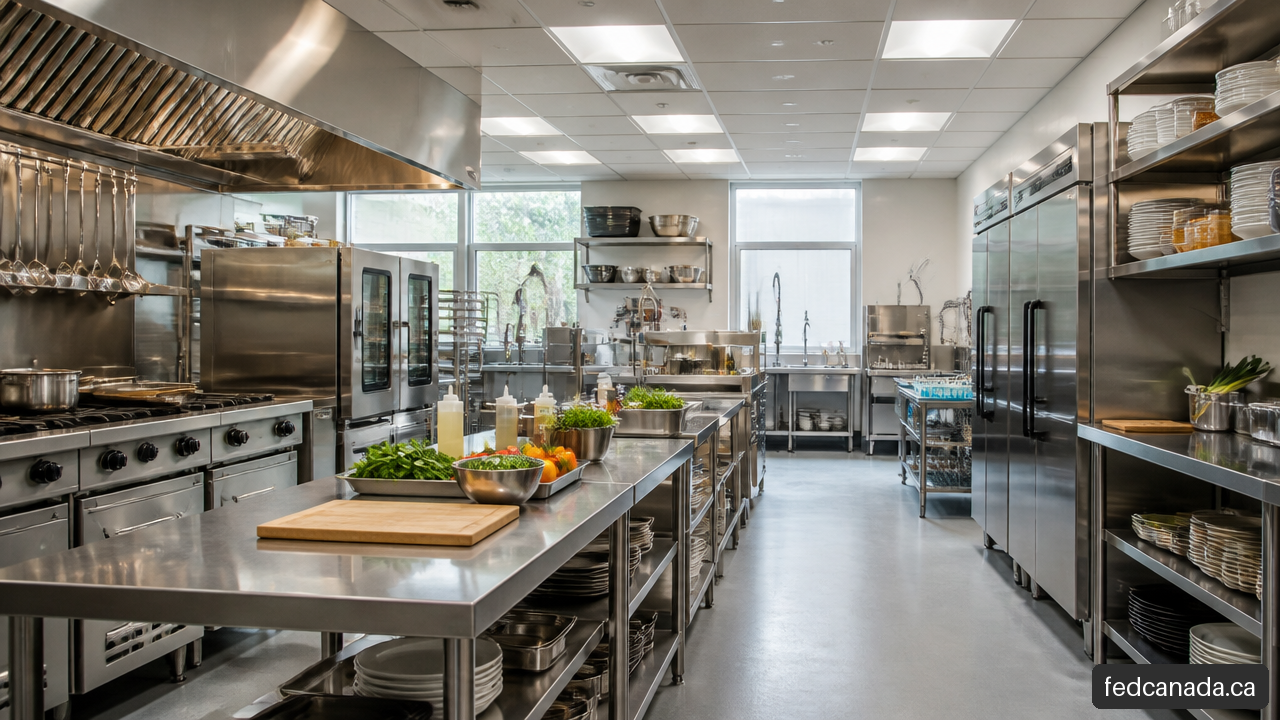
Canada Food Equipment: A Practical Buying Guide
Canada Food Equipment can mean more than filling a cart with ranges, coolers, and prep tools. For a restaurant, café, bakery, catering operation, or institutional kitchen, the equipment decision affects food safety, daily labor, utility costs, production capacity, and the ability to recover when a critical unit fails.
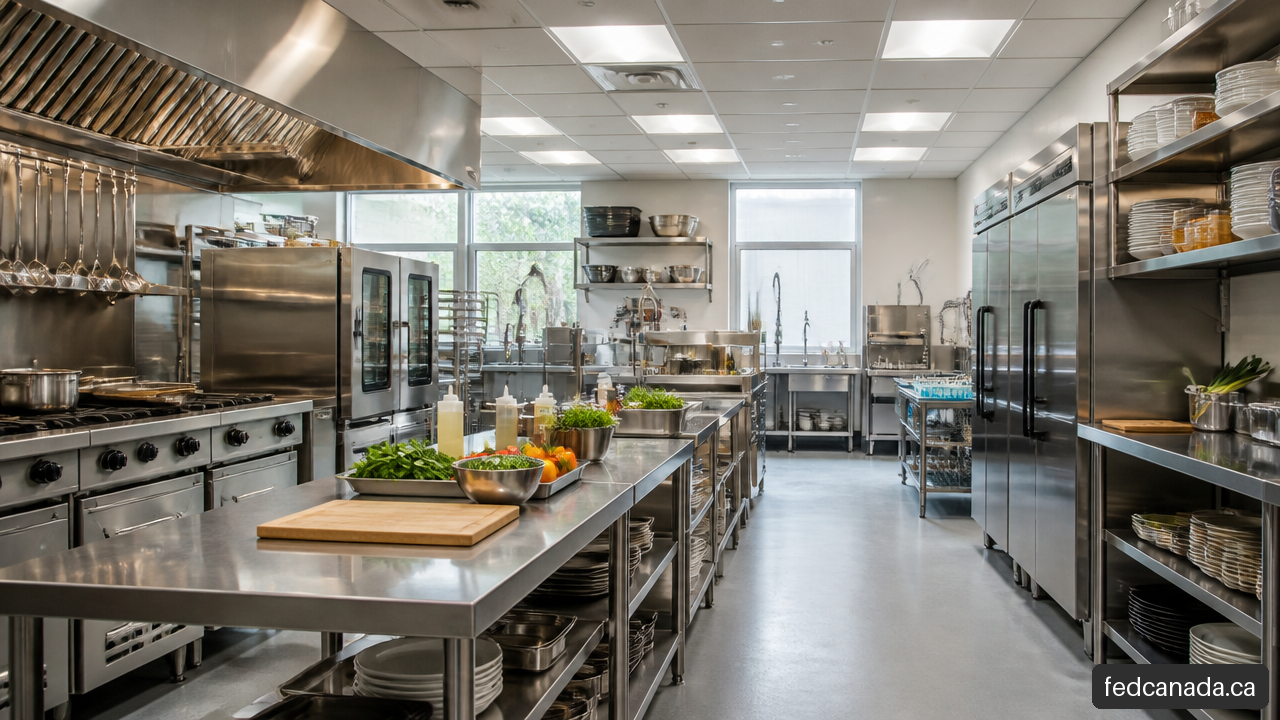
The right purchase starts with the workflow, not the product category. I recommend defining what the kitchen must produce during its busiest hour, then working backward through storage, preparation, cooking, holding, washing, and service. That approach makes it easier to compare new and used equipment, prevent installation surprises, and spend where performance matters most.
Table of Contents
- Key Takeaways
- Build the Equipment List Around Your Workflow
- Food Safety, Cleanability, and Utility Checks
- New, Used, and Total Ownership Cost
- Frequently Asked Questions
- Sources
Key Takeaways
Start with production, not product names
A commercial kitchen works as a connected system. A high capacity fryer does little good if cold storage cannot hold the prep volume, the hood cannot support the cooking line, or the dish area cannot keep up with plates and utensils. Before comparing models, identify peak covers, menu complexity, batch sizes, available floor area, and the staff assigned to each station.
For example, a small café serving pastries, sandwiches, and espresso may need more refrigerated prep space and undercounter storage than heavy cooking capacity. A bakery may need to prioritize proofing, baking, cooling, and ingredient storage. A quick service restaurant with a short menu may benefit from a focused cooking line built around repeatable throughput.
Verify the physical and regulatory fit before ordering
The most expensive equipment mistake is often not buying the wrong brand. It is buying a unit that cannot clear the doorway, connect to available utilities, sit safely under the ventilation system, or be cleaned properly after installation.
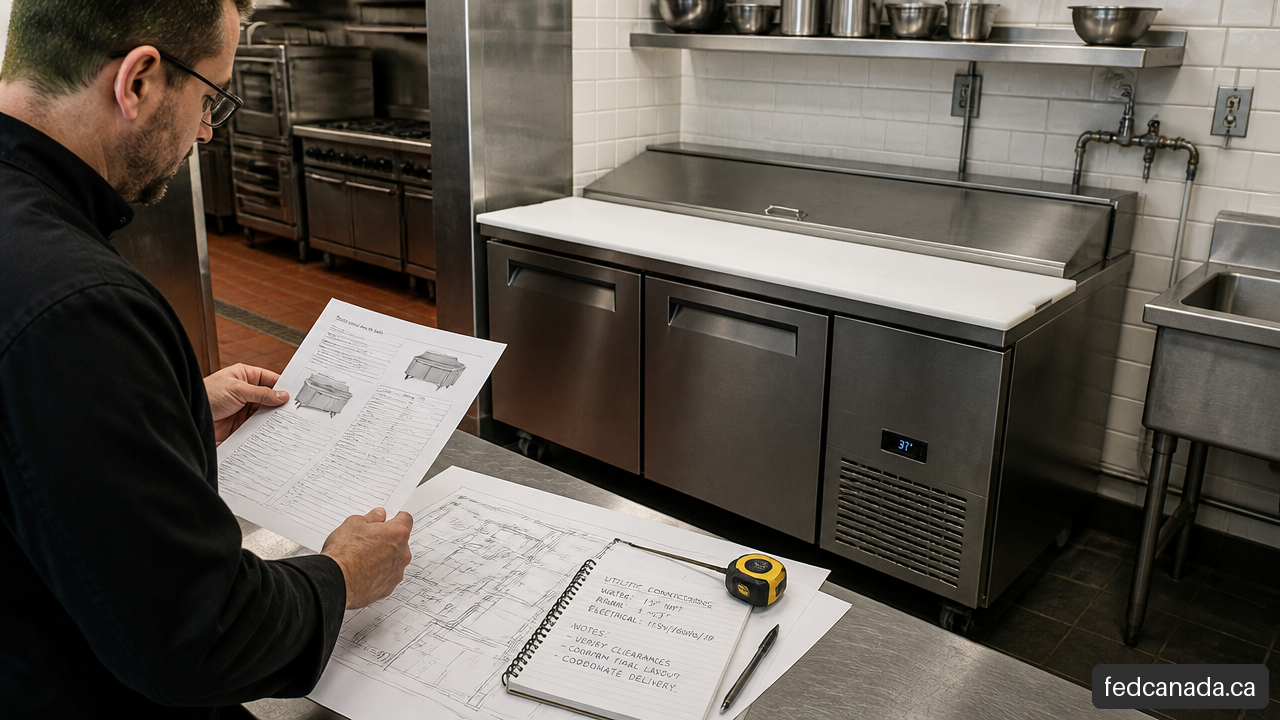
Treat the specification sheet as a construction document, not a marketing brochure. Dimensions, voltage, gas type, drainage, ventilation, and clearance requirements should be checked before the purchase is finalized.
Compare total cost, not just the ticket price
A lower purchase price can be valuable, particularly for a startup, but it is only one part of the decision. Installation, electrical work, gas piping, ventilation changes, water connections, consumables, repairs, energy use, and downtime may affect the real cost more than a modest difference in upfront price.
Build the Equipment List Around Your Workflow
Map the food path from receiving to service
A useful equipment plan follows the path food takes through the premises. I suggest drawing that path on a simple floor plan before creating a shopping list. Include receiving, dry storage, refrigeration, preparation, cooking, holding, dishwashing, waste, and service.
This reveals bottlenecks that category based shopping can hide. Consider a sandwich shop that receives bulk produce, prepares ingredients in the morning, assembles orders at lunch, and closes with a heavy dishwashing load. It may need a receiving cart, shelving, a reach in refrigerator, prep table, food processor, hand sink access, sandwich station, and warewashing capacity. Buying only the visible front line equipment would leave gaps in the actual process.
Match capacity to the busiest hour
Equipment capacity should be based on the peak period, with enough margin for normal variation, not on an average day. A kitchen that serves 25 meals per hour for most of the day but 90 meals during a short lunch rush must be designed around the rush.
| Decision area | What to measure | Why it matters |
|---|---|---|
| Refrigeration | Ingredient volume, delivery frequency, pan count | Prevents overcrowding and weak air circulation |
| Cooking | Portions per hour, batch time, recovery time | Helps avoid ticket delays during peak service |
| Food preparation | Prep pounds, cuts, mixes, or batches per shift | Determines whether manual tools create labor bottlenecks |
| Dishwashing | Racks, plates, glasses, and utensils per hour | Prevents cleanware shortages and sanitation delays |
| Dry storage | Case sizes and delivery intervals | Reduces clutter in prep and circulation areas |
Commercial cooking equipment is typically selected around menu technique and production volume. Canada Food Equipment Ltd. states that it supplies commercial cooking equipment for cafés, restaurants, sports bars, and patisseries. The practical question is narrower: which cooking method earns its footprint on your menu?
A six burner range may suit a menu with sauces, sautés, and made to order cooking. A countertop griddle may be a better use of limited space for breakfast items or burgers. A convection oven can produce consistent baked items in batches, but it requires room for loading, unloading, and cooling. Avoid choosing a large appliance merely because it seems versatile if the menu rarely uses its core function.
Choose refrigeration for the way inventory moves
Refrigeration is both a food safety system and an operational system. The best configuration depends on where ingredients are received, how often prep happens, whether staff need immediate line access, and how inventory is rotated.
Reach in refrigerators are often suitable for back of house storage. Refrigerated prep tables keep ingredients close to assembly work. Undercounter units can add cold storage at a compact station. Walk in refrigeration may be appropriate when inventory volume and available space justify it, but it also introduces planning needs related to access, panel placement, flooring, drainage, and service clearance.
The critical mistake is treating listed cubic capacity as usable capacity. Shelving layout, pan sizes, airflow, door opening frequency, and product packaging all reduce practical storage space. If a cooler is packed so tightly that air cannot circulate, temperatures may become uneven. A slightly larger unit can sometimes protect food quality and reduce the time staff spend rearranging stock.
Plan bakery, prep, and smallwares as a connected station
Bakery equipment should be selected as a production chain: mixing, dividing, proofing when required, baking, cooling, decorating, holding, and cleaning. Canada Food Equipment Ltd. indicates that its commercial bakery equipment is supplied to restaurants, bakeries, and cafés. That broad use case matters because a café making a limited number of muffins has very different needs from a bakery producing bread throughout the day.
Food preparation equipment deserves the same discipline. A food processor can reduce repetitive chopping, but only if the bowl size, blade options, cleaning time, and daily batch volume suit the task. For a low volume operation, a simple manual process may be adequate. For repeated high volume preparation, choosing a unit that is too small can force multiple batches and erase the expected labor savings.
Food Safety, Cleanability, and Utility Checks
Make cleanability a purchasing requirement
Food service equipment must be practical to clean, not merely attractive on delivery day. In Ontario, food premises rules address equipment and utensils used for preparing, processing, packaging, serving, transporting, manufacturing, handling, selling, or displaying food. The requirement is relevant to food contact surfaces, storage equipment, work tables, sinks, and any item used in the food handling process.
I recommend looking for smooth, accessible surfaces; sealed or manageable seams; removable components where needed; and enough clearance to clean beneath, behind, and around the equipment. Crumbs, grease, moisture, and food debris tend to collect at joints, hinges, gaskets, drain areas, and hard to reach undersides. If staff cannot reasonably access those points, the unit creates a maintenance problem from day one.
A stainless steel work table may seem straightforward, yet even that purchase needs scrutiny. Check the edge construction, shelf placement, leg adjustment, wall clearance, and whether the table blocks access to a hand sink or floor drain. Cleanability is a daily operating requirement, not a one time inspection item.
Confirm utilities before selecting a model
Every major unit should be reviewed against the building conditions. Do this before ordering, not when the shipment arrives.
- Confirm the electrical supply, including voltage, phase, amperage, plug configuration, and dedicated circuit needs.
- Confirm the fuel type for gas equipment and whether licensed installation or building modifications may be required.
- Review ventilation requirements for cooking equipment, especially heat, grease laden vapors, and clearance from combustible materials.
- Check water supply, drainage, floor drain access, and water treatment needs for dishwashers, ice machines, steam equipment, and similar units.
- Measure all delivery routes, including parking access, curbs, elevators, corridors, turns, door openings, stairs, and final placement clearances.
Fair warning: an equipment dimension is not the same as a delivery path dimension. A refrigerator may technically fit through a 36 inch doorway but still fail to clear because of handles, packaging, a tight corner, or an uneven approach. Measure the narrowest point and account for the moving angle, not only the final room size.
Treat ventilation and drainage as operating systems
Cooking equipment affects more than the line itself. Heat and vapor change room comfort, and grease producing appliances can require ventilation arrangements appropriate to the equipment and local requirements. The exact requirements may vary by municipality, building type, appliance, and the work being performed. When in doubt, verify the plan with qualified local professionals and the relevant authorities before committing to a layout.
Drainage creates similar constraints. A dishwasher or ice machine may require a properly planned connection and may not work safely with an improvised drain arrangement. Equipment that produces condensation, wastewater, or melted ice needs a route for that water. If the route is not considered early, the cost and disruption of adding it later can be substantial.
New, Used, and Total Ownership Cost
When new equipment makes the most sense
New commercial kitchen equipment can be the simpler choice when uptime, warranty coverage, exact specifications, and predictable installation are priorities. It may be especially appropriate for core refrigeration, high use cooking equipment, warewashing, or any unit whose failure would stop service.
New does not automatically mean right, however. A large startup purchase can tie up capital that is also needed for permits, inventory, payroll, rent, and opening contingencies. The better question is whether the equipment is central to revenue and whether a breakdown would create an immediate business interruption.
How to inspect used equipment responsibly
Used equipment can reduce initial spending, but its condition must be evaluated unit by unit. There is no reliable general rule that used equipment is either a bargain or a risk. The result depends on age, maintenance, prior workload, repair history, installation quality, and the availability of parts and service.
Use this inspection sequence before purchasing a used unit:
- Verify the model and serial information, then confirm the unit matches the required utility and dimensions.
- Inspect doors, hinges, gaskets, latches, shelves, casters, legs, controls, and exterior panels for wear or damage.
- Ask for operational verification where feasible, including temperature pull down and recovery for refrigeration equipment.
- Check for corrosion, leaks, unusual vibration, damaged wiring, gas connection concerns, or missing components.
- Estimate installation, cleaning, repair, and replacement part costs before comparing the final price with a new alternative.
For a used refrigerator, a door gasket that does not seal can allow warm air into the cabinet, increasing compressor workload and making temperature control harder. For a used range, uneven burner performance or damaged controls can create service delays. These issues may be repairable, but the purchase decision should include the repair path rather than assume a low price solves the problem.
Calculate ownership cost in plain terms
A practical comparison includes both predictable costs and uncertainty. I recommend putting the alternatives into one worksheet rather than comparing sticker prices alone.
| Cost category | New equipment question | Used equipment question |
|---|---|---|
| Purchase price | Does the budget support the model needed? | Is the savings meaningful after repairs? |
| Installation | Are electrical, gas, water, drainage, or ventilation changes needed? | Does the unit require additional adaptation? |
| Operating cost | What are the expected energy and consumable needs? | Could age or condition increase operating costs? |
| Downtime exposure | What happens if the unit fails during service? | Are parts and qualified repairs likely to be available? |
| Cleaning and maintenance | Can staff access filters, drains, gaskets, and service points? | Is deferred maintenance already visible? |
No verified public data in the available material establishes specific failure rates, energy savings, repair response times, or customer outcomes for Canada Food Equipment purchases. For that reason, I would avoid treating broad promises about savings or reliability as a substitute for model specific specifications, warranty terms, and an installation plan.
Delivery, receiving, and installation planning
Canada Food Equipment Ltd. states that it offers delivery across Canada, including Toronto, Vancouver, Halifax, Montreal, and Ottawa. Delivery coverage is useful, but receiving logistics still need to be confirmed for the individual order.
Ask whether the quoted service is curbside freight, dock delivery, inside placement, or another arrangement. Remote locations, stairs, narrow access routes, construction sites, and locations without loading docks can change what is required. The receiving team should know the shipment dimensions, weight, packaging condition to inspect, and where each unit will be staged.
Frequently Asked Questions
What does Canada Food Equipment sell?
Canada Food Equipment is associated with commercial kitchen categories such as cooking equipment, refrigeration, food preparation tools, bakery equipment, dishwashing equipment, food warmers, sinks, faucets, work tables, storage, and smallwares. The right category depends on the operation’s workflow rather than the business label alone.
Does Canada Food Equipment sell new and used restaurant equipment?
Canada Food Equipment Ltd. states that it offers both new and used restaurant equipment. Buyers should compare condition, utility compatibility, cleaning needs, repair exposure, and installation cost before deciding which option has the better value.
Which equipment is needed to open a small restaurant in Canada?
Most small restaurants need a tailored combination of refrigeration, prep surfaces, handwashing access, cooking equipment, dry storage, dishwashing or warewashing capacity, smallwares, and safe waste handling. Start with the menu and peak service volume. A pizza focused operation, café, and noodle shop may have similar square footage but require very different equipment priorities.
How should a café choose refrigeration and food preparation equipment?
Choose refrigeration based on ingredient volume, prep frequency, service access, and available clearance. Select food preparation equipment based on repeated labor intensive tasks. A café making blended drinks may prioritize a commercial blender and refrigerated ingredient storage, while a café producing sandwiches in volume may need a prep table with pan storage and a food processor.
What should be checked before buying used commercial kitchen equipment?
Check identity, dimensions, utilities, physical condition, operating controls, seals, moving parts, service history when available, and the likely cost of repairs. For refrigeration, confirm that the unit can operate and recover temperature appropriately before relying on it for perishable inventory.
How can a buyer confirm equipment will fit through the premises?
Measure the item, shipping packaging when known, doorways, corridors, turns, elevators, stairwells, and the final installation space. Also account for handles, casters, wall clearances, door swing, and the movement path needed to position the unit. If the route is complicated, confirm the delivery approach before shipment.
What electrical, gas, ventilation, and drainage requirements should be checked?
Confirm voltage, phase, amperage, plug type, fuel type, shutoff access, ventilation needs, water supply, drain route, and floor conditions. Local building and fire requirements may apply differently based on the appliance and premises, so a qualified local review is prudent before installation.
Sources
Canada Food Equipment cooking equipment category
canadafoodequipment.com — https://fedcanada.ca/category/heating-it-up
Canada Food Equipment bakery equipment category
canadafoodequipment.com — https://fedcanada.ca/catalog?subcategory=dough-equipment
Canada Food Equipment food preparation category
canadafoodequipment.com — https://fedcanada.ca/category/prepping-for-perfection
Recent Posts
Leave a Comment
Your email address will not be published. Required fields are marked *