



Chef Knives: How to Choose, Use, and Maintain the Right One
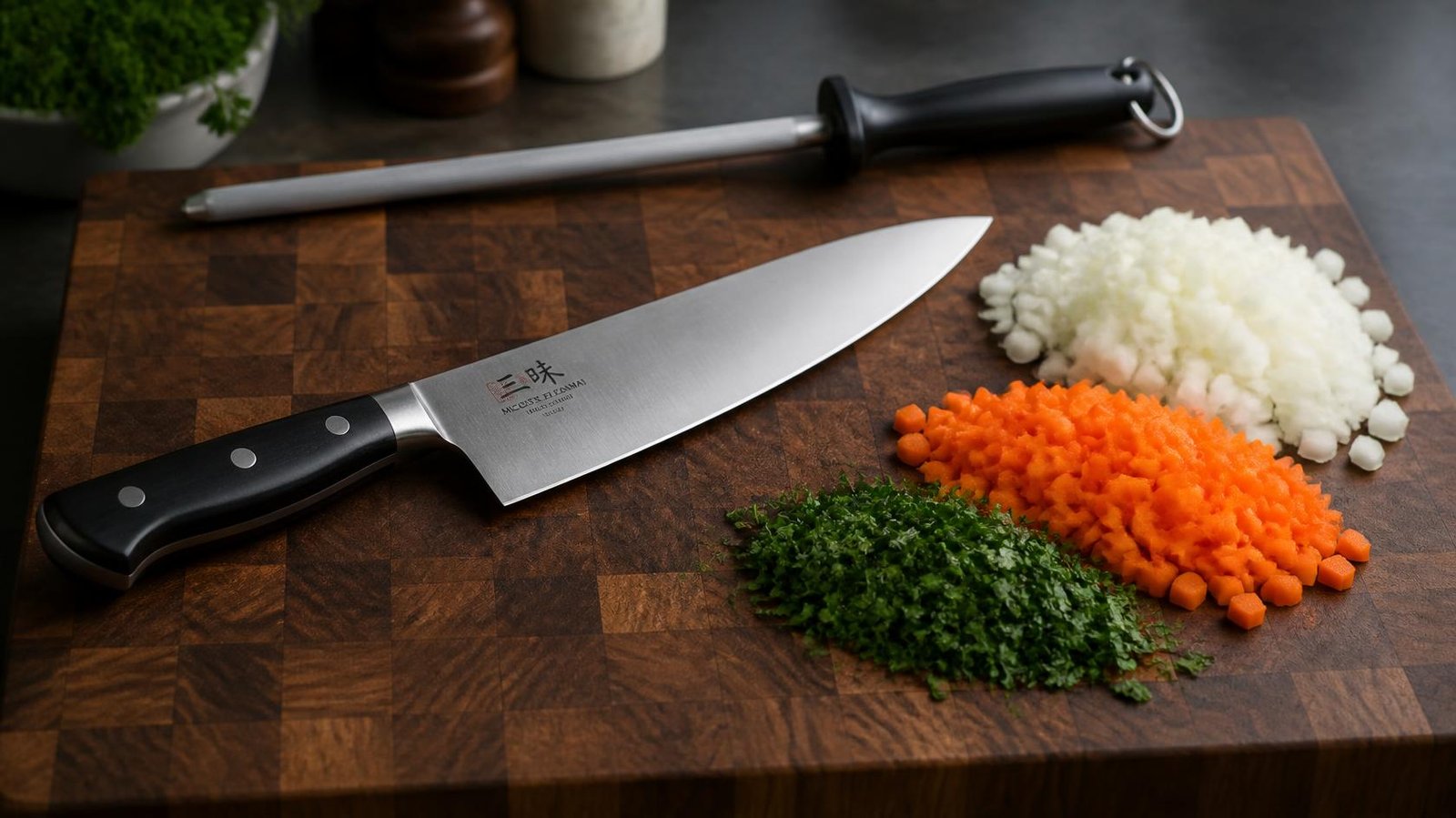
Chef knives are the central prep tool in most kitchens. I recommend choosing one based on your cutting motion, ingredient volume, hand fit, and maintenance habits rather than price or country of origin alone. A well matched knife should feel controlled through an onion, steady on firm carrots, and precise enough for herbs and boneless proteins without asking you to fight the blade.
Table of Contents
- Key Takeaways
- How to Choose Chef Knives
- How Blade Geometry Changes Performance
- Safe Use, Care, and Maintenance
- Frequently Asked Questions
- Sources
Key Takeaways
- I would start most cooks with an 8 inch chef knife, but a 6 inch blade can be a better fit for smaller hands, compact workspaces, and lighter prep.
- Blade profile matters as much as knife style. A curved edge favors rocking cuts, while a flatter section supports push cutting and precise slicing.
- Western chef knives are often heavier and more robust. Japanese gyuto knives are commonly thinner and lighter, which can improve precision but calls for gentler technique.
- A knife that feels awkward during a short test will usually feel worse after a long prep session. Check pinch grip space, knuckle clearance, balance, and wrist comfort before buying.
- Honing realigns an edge. Sharpening uses abrasion to remove metal and create a new edge. They solve different problems.
- Chef knives are not bone cleavers, frozen food tools, screwdrivers, or pry bars. Twisting through hard food and striking hard surfaces are common routes to rolling or chipping an edge.
How to Choose Chef Knives
A chef knife is a broad purpose kitchen knife designed for slicing, dicing, chopping, and mincing. Its versatility is valuable, but no single model suits every hand, board, or menu. I suggest treating the purchase as a fit decision first and a materials decision second.
Start With Blade Length and Workspace
For many people, an 8 inch blade is the practical middle ground. It reaches across a cabbage, handles a large onion comfortably, and still offers enough tip control for garlic and herbs. WIRED’s chef knife guide notes that 6 to 8 inch blades are commonly versatile choices and that curved edges support rocking cuts.
That does not make 8 inches mandatory. Chef knife lengths commonly range from about 6 to 12 inches, as shown in WÜSTHOF’s chef knife size range. The right size depends on your board, available clearance, food volume, and reach.
| Blade length | Best fit | Advantages | Tradeoffs |
|---|---|---|---|
| 6 inch | Small boards, smaller hands, detail work | Nimble, easy to control, less intimidating | Less reach for large produce and high volume prep |
| 8 inch | Most everyday cooking | Broadly capable for vegetables, herbs, and boneless proteins | May feel long in tight kitchens or shallow sinks |
| 10 inch or longer | Larger boards and batch prep | Long slicing stroke and more capacity | Requires more clearance and confident control |
Consider a practical scenario. If you regularly prep several cases of produce or slice large roasts, a longer blade can reduce the number of strokes needed. If you cook in a condo kitchen with a narrow board, a long tip may repeatedly run into bowls, walls, or countertop equipment. In that case, the extra length becomes friction rather than an advantage.
Western Chef Knife or Japanese Gyuto?
I would avoid treating this choice as a simple durability contest. A Western or German style chef knife often has a heavier feel and a thicker, more robust blade. A Japanese gyuto is commonly lighter and thinner, particularly behind the edge. Good Housekeeping’s comparison of chef knife styles explains that Western knives are generally heavier, while Japanese gyuto knives tend to be lighter, thinner, and more precision oriented.
That difference changes how the knife behaves in food.
| Style | Usually suits | Choose it when | Avoid it when |
|---|---|---|---|
| Western chef knife | Rock chopping, dense vegetables, all purpose prep | You prefer weight, a curved profile, and a more forgiving feel | You want a very light blade for fine slicing |
| Japanese gyuto | Push cuts, clean vegetable slices, boneless proteins | You value thin cuts, lower resistance, and precise tip work | You routinely twist through hard foods or use careless storage |
| Santoku | Compact vegetable prep and downward cuts | You prefer a shorter, flatter profile | You rely heavily on a pronounced rocking motion |
A thinner knife often moves through carrots, onions, and boneless meat with less wedging because it displaces less food as the blade passes through. The tradeoff is that a fine edge has less tolerance for lateral force. Do not force it through a squash by twisting the handle, strike it against a hard board, or cut through joints. A robust Western knife is not invincible either, but it may be more forgiving when prep technique is imperfect.
Check Fit Before You Focus on Steel
Fit affects control, fatigue, and confidence. I recommend holding a knife in a pinch grip before deciding whether its steel, brand, or tang construction is right for you. Place the thumb and index finger on the blade just ahead of the handle, then close the remaining fingers around the handle. Consumer Reports’ safe chef knife handling guidance describes this pinch grip and the claw position used to keep the guiding hand’s fingertips protected.
Ask four questions while holding the knife:
- Can I grip the blade comfortably? A crowded bolster or thick handle junction can limit pinch grip space.
- Does the handle fill my hand without forcing a squeeze? A handle that is too large can tire a smaller hand. One that is too narrow can make the hand clamp down.
- Does the balance suit my work? Some cooks like blade forward weight for chopping. Others prefer neutral balance for frequent tip work.
- Does my wrist stay neutral? If the heel catches the board or the handle pushes your wrist into an awkward angle, the knife may not suit your cutting style.
A full tang, where blade steel extends through the handle, may contribute to a substantial feel and can be useful in many designs. Still, it is not proof that a knife will cut better or last longer. Handle material, rivet quality, blade heat treatment, edge geometry, and daily use matter too. A well designed stamped knife can outperform a poorly fitted forged one for a particular user.
How Blade Geometry Changes Performance
Country of origin is a shortcut. Geometry is the more useful lens. The cutting edge, blade thickness, profile, tip shape, and grind determine how a knife travels through food and how it responds to misuse.
Match the Profile to Your Cutting Motion
A blade profile is the shape of the edge from heel to tip. A strongly curved belly allows the edge to stay in contact with the board while the handle rises and falls. This supports rocking cuts for herbs, garlic, and repeated chopping. A flatter profile spends more of its length close to the board, which can favor forward and downward push cuts.
Neither is objectively better. Think about the work.
| Ingredient or task | Useful chef knife approach | What to avoid |
|---|---|---|
| Herbs and garlic | Curved profile with controlled rocking | Excessive rocking that drags the edge sideways |
| Onions and carrots | Push cuts or short rock chops | Lifting the blade so high that control is lost |
| Cabbage and leafy greens | Long, smooth slicing strokes | Sawing aggressively through a dull edge |
| Boneless chicken or beef | Stable board contact and deliberate slices | Cutting through bones or joints |
| Sweet potatoes and squash | Split the cut with measured pressure | Twisting the blade to force the food apart |
| Frozen food and bones | Use an appropriate specialized tool | Using a chef knife as a cleaver |
A flatter bellied knife can be particularly useful for thin vegetable or meat slices. Wirecutter’s discussion of a relatively flat bellied chef knife identifies that profile as well suited to fine cuts and thin slices. It is a useful example of why profile deserves attention beyond the Western versus Japanese label.
Steel, Edge Retention, and the Real Ownership Cost
Steel choice influences corrosion resistance, toughness, sharpening behavior, and edge retention, but it does not produce a universal winner. A stainless blade generally lowers the risk of staining when a busy kitchen delays washing. A harder, finer edged blade may hold a keen edge well in appropriate use, yet it can be less tolerant of impact or twisting. The actual result depends on the steel formulation, heat treatment, edge angle, board surface, and cutting habits.
I recommend judging ownership cost through the whole maintenance cycle:
- Initial cost: The purchase price is only the first number.
- Edge retention: A knife that stays functional longer may reduce interruptions, but only if it is used on an edge friendly board and stored correctly.
- Sharpening access: A knife that needs professional repair after chips can cost more to maintain than one that simply needs routine sharpening.
- Replacement risk: Thin tips and fine edges may be economical until one hard drop or twisting cut causes damage.
- Downtime: In a foodservice setting, a knife out for sharpening is unavailable. Keeping a backup prep knife can be more practical than waiting on emergency service.
There is no reliable universal schedule for sharpening. A cook who breaks down boxes of vegetables every day will wear an edge differently from someone who prepares dinner a few times a week. Instead, watch performance. If the knife slips on tomato skin, crushes herbs instead of cutting them, or needs excess downward force, maintenance is due.
Know the Difference Between Rolling, Chipping, and Dulling
These failures look similar from a distance but require different responses.
| Edge problem | What is happening | Typical cause | Practical response |
|---|---|---|---|
| Edge rolling | Fine edge bends slightly out of alignment | Hard board contact, pressure, normal wear | Hone if the edge is otherwise intact |
| Dulling | The apex has worn down and no longer cuts efficiently | Extended use, abrasive surfaces, poor storage | Sharpen to create a new edge |
| Edge chipping | Small pieces break away from the edge | Twisting, bone contact, frozen food, hard impact | Sharpen carefully or seek professional repair |
A rolled edge can sometimes respond to honing because the metal has shifted rather than disappeared. A chipped edge needs more than a few passes on a rod. It may require controlled abrasive sharpening to remove enough material to restore a continuous edge. Fair warning: repeatedly trying to hone out a chip can waste time and create frustration without fixing the damage.
Safe Use, Care, and Maintenance
Chef knives stay safer and more useful when technique, cleaning, storage, and edge maintenance work together. A sharp blade is not harmless, but it usually cuts with less force and more predictability than a dull one.
Use Control Instead of Force
Start on a stable board. If it slides, place a damp towel underneath it. Use a pinch grip with the knife hand and curl the fingertips of the other hand into a claw. Keep the blade moving in a controlled path, rather than pushing straight down with a raised elbow or forcing a stalled cut.
A dull knife often requires more force, and that can increase the chance of slipping. The safer response is not to grip harder. Stop and assess the edge.
A chef knife should separate food cleanly. When it starts crushing, skidding, or demanding extra force, treat that as a maintenance signal rather than a reason to push harder.
For dense food such as a hard squash, make a stable initial cut. If the blade binds, withdraw it carefully and change the approach. Do not torque the handle sideways to pry the food open. Lateral stress is especially risky for thin edges and fine tips.
Hone, Sharpen, or Repair?
Honing and sharpening are often confused because both can make a knife feel better. They work differently. Honing helps realign a slightly rolled edge. Sharpening uses an abrasive surface to remove steel and create a fresh apex. Consumer Reports explains that sharpening removes material, while honing restores alignment, and repeated abrasive sharpening should not be treated as a substitute for routine honing.
I suggest this decision process:
- Inspect the edge. Look for visible chips, flat spots, and a bent tip.
- Test the cut. If the knife is intact but feels slightly less clean, gentle honing may help.
- Sharpen when honing no longer restores cutting performance. Use a sharpening stone, a suitable controlled sharpener, or a qualified sharpening service.
- Seek repair for major chips, bent tips, or cracks. Repair may remove more metal than normal sharpening, so it is worth preserving the knife before the damage grows.
Avoid treating an abrasive pull through sharpener as daily maintenance. It can remove material rapidly, and it may not suit every blade geometry. The exact sharpening angle should match the knife’s intended edge and the sharpening system being used. There is no single angle that is best for every chef knife.
Wash, Store, and Transport Without Ruining the Edge
Hand wash the knife promptly with mild soap and dry it thoroughly. Avoid leaving it submerged in a sink, where someone can reach into opaque water and contact the edge. Dishwashers combine heat, detergent, hard contact, and motion that can damage both handles and cutting edges.
For storage, I recommend one of these options:
- A magnetic strip mounted securely away from traffic and moisture.
- A knife block that does not force the edge to scrape against hard material.
- A drawer insert with separated slots.
- A blade guard or knife roll for transport and compact storage.
Avoid loose drawer storage. The edge can strike other utensils, dull prematurely, or create a hand injury when someone searches for a spoon. A wood or quality plastic cutting board is generally a more edge considerate choice than glass, ceramic, stone, or metal surfaces. When a knife becomes dull unusually fast, the board is one of the first things I would check.
Frequently Asked Questions
What is a chef knife used for?
Chef knives handle most everyday prep: slicing, dicing, chopping, mincing, and cutting boneless meat. They work well for onions, carrots, herbs, cabbage, and many proteins. They are not the right tool for bones, frozen food, or prying apart hard produce.
What size chef knife is best for most home cooks?
An 8 inch chef knife is often the most flexible choice because it balances reach and control. Choose 6 inches if you have smaller hands, a compact board, or prefer a lighter, more maneuverable blade. Choose 10 inches only when you have sufficient board space and regularly process larger ingredients or batches.
Is an 8 inch chef knife better than a 6 inch knife?
Not automatically. An 8 inch blade offers more cutting length for cabbage, large onions, and roasts. A 6 inch knife can feel faster and more controlled for smaller produce and tight workspaces. Fit and task volume matter more than the number stamped on the blade.
Should I choose a German style chef knife or a Japanese gyuto?
Choose a Western or German style knife if you prefer a heavier feel, a curved edge for rocking cuts, and a more robust profile. Choose a Japanese gyuto if you value a lighter knife, thin slicing, and precise cuts. Use a gyuto carefully around bones, frozen food, and twisting cuts.
What is the difference between a chef knife and a santoku?
A chef knife usually has a more pointed tip and more curve along the edge, which supports rocking motion. A santoku often has a shorter, flatter profile that can work well for downward and forward cuts. The best option depends on how you naturally move the knife across the board.
How often should I hone or sharpen a chef knife?
There is no dependable calendar rule because usage, steel, board material, and technique vary. Hone when an intact edge feels slightly out of alignment. Sharpen when honing does not restore clean cutting. If the knife chips or the tip bends, consider professional repair instead of repeated home honing.
Why does my chef knife chip or become dull quickly?
Common causes include cutting on glass or ceramic, storing the knife loose in a drawer, running it through a dishwasher, twisting through hard food, and contacting bones or frozen ingredients. A very thin edge may also require more careful handling than a thicker one. Change the cutting surface and storage method before assuming the steel is defective.
Sources and References
Recent Posts
Leave a Comment
Your email address will not be published. Required fields are marked *