



Commercial Kitchen Equipment Shipping Canada: A Practical Guide
Commercial kitchen equipment shipping Canada requires more than choosing the lowest freight quote. A combi oven, walk in cooler component, stainless worktable, or refrigerated display case can arrive safely only when the shipment, receiving site, and delivery responsibilities are planned as one operation.
Table of Contents
- Plan the shipment before you buy
- Choose the right freight and delivery service
- Prepare the receiving site and protect the equipment
- Account for imports, compliance, and landed cost
- Key Takeaways
- FAQ: Commercial Kitchen Equipment Shipping Canada
Plan the Shipment Before You Buy
Start with the equipment’s actual shipping profile
The first useful answer is simple: request shipping details before placing the order. Product price alone does not tell you what delivery will require. Freight planning depends on the packed dimensions, shipment weight, number of pallets, freight class, pickup location, destination postal code, and access conditions at the delivery address.
A 36 inch gas range may look manageable on a product page, but its crate, pallet, protective foam, and straps can make it much larger and heavier than the appliance itself. The same issue applies to ice machines, commercial refrigeration, dishwashers, ventilation components, and bakery equipment.
Equipment that cannot safely move through a doorway, elevator, hallway, or kitchen entrance is not truly delivered just because it has reached the curb.
Before ordering, we recommend confirming these details in writing:
- Packed length, width, height, and total shipping weight
- Number of pallets or crates in the order
- Origin warehouse or manufacturer location
- Estimated dispatch date and carrier service level
- Whether the shipment is parcel, LTL freight, dedicated freight, or white glove service
- Delivery point included in the quote
- Liftgate, appointment, inside delivery, uncrating, and placement charges
- Whether installation, utility connections, and packaging removal are excluded
This information makes quotes comparable. Without it, two freight prices may cover very different services.
Separate product lead time from transit time
Delivery timing has two parts: the time needed to release the equipment and the time required to transport it. An in stock countertop appliance may leave a warehouse quickly, while a made to order hood system, specialty refrigeration unit, or custom fabrication package can take substantially longer before a carrier is even booked.
Ask for a timeline with distinct milestones:
| Shipment stage | What it means | Why it matters |
|---|---|---|
| Order confirmation | Supplier accepts the order | Confirms the commercial terms, not necessarily inventory availability |
| Ready to ship | Equipment is packaged and available for pickup | This is the point at which transit planning becomes realistic |
| Carrier pickup | Freight carrier receives the shipment | Tracking may begin, but delivery may still require an appointment |
| Terminal transfer | Freight moves through carrier facilities | Can add time for long distance, rural, or interprovincial routes |
| Delivery appointment | Consignee confirms a receiving window | Essential for sites with limited staff or shared loading areas |
A delivery estimate should be treated as a planning range, not a promise, particularly when freight crosses several carrier terminals or requires a local final mile provider. This matters when opening a restaurant, replacing failed refrigeration, or coordinating with electricians and plumbers. A unit that arrives late can delay more than one task.
Decide whether new or used equipment changes the shipping decision
New and used equipment can both be practical choices, but shipping risk is different. New equipment generally arrives in manufacturer packaging, often with designed pallet points, corner protection, and documentation. Used equipment may have less uniform packaging, more exposed edges, or a different condition standard.
Ask how it will be secured for transport and whether photographs of the item before dispatch are available.
Used equipment can still make financial sense when the savings remain meaningful after freight, liftgate service, possible refurbishment, and installation. Avoid comparing only the purchase prices. A lower priced used freezer located far from the destination may cost more overall than a new in stock unit from a closer warehouse.
Choose the Right Freight and Delivery Service
Match the service to the item and site
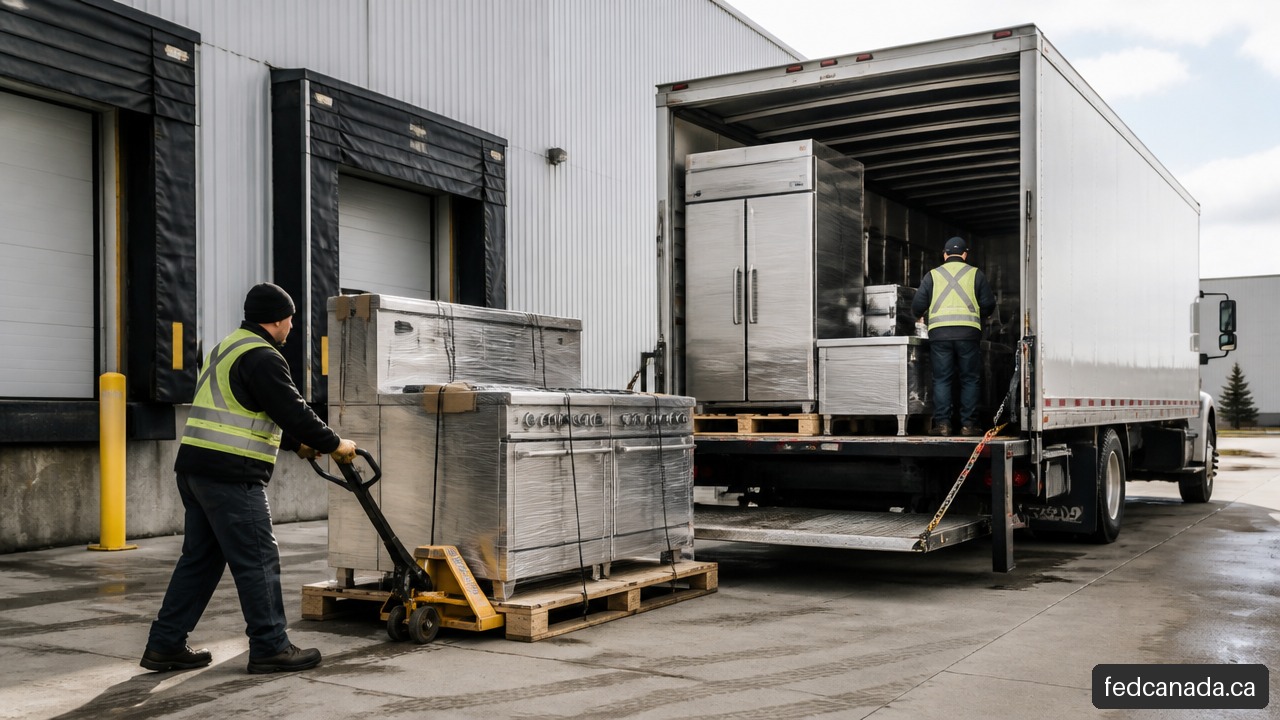
Small accessories, replacement parts, and some countertop equipment may move by parcel carrier. Large commercial appliances usually travel by LTL freight, meaning less than truckload freight shared with other shipments. LTL is often economical for palletized equipment, but it includes more handling points than a dedicated vehicle. More handling creates more opportunities for carton damage, missed appointments, or delivery restrictions.
The right service depends less on the item category than on the final delivery conditions.
| Delivery option | Best fit | Main limitation |
|---|---|---|
| Dock delivery | Sites with a usable raised loading dock and trained receiving staff | Freight is generally delivered to the dock, not installed in the kitchen |
| Liftgate delivery | Ground level sites without a dock or forklift | The carrier lowers freight to ground level, but may not move it indoors |
| Inside delivery | Businesses with a clear, accessible route from entrance to receiving area | Coverage and placement limits vary by carrier and location |
| White glove delivery | Heavy, fragile, or difficult equipment requiring unpacking and positioning | Usually costs more and must be defined carefully in advance |
| Dedicated freight | High value, oversized, or time sensitive equipment | Can be less economical for a single standard pallet |
White glove service is worth considering when the cost of staff injury, damaged equipment, blocked access, or missed installation time exceeds the added delivery charge. It is particularly useful for glass front refrigeration, heavy cooking equipment, and equipment moving through a retail storefront rather than a dock.
Still, do not assume that white glove means full installation. Grand Valley Restaurant Equipment & Supplies describes white glove delivery as potentially including uncrating and placement, while drop shipped equipment may be left for the buyer to move and install. The difference is crucial: placement is not the same as connecting gas, water, drainage, electrical service, ventilation, or fire suppression systems.
Understand what the freight quote includes
The cheapest way to ship restaurant equipment in Canada is usually the service that fits the receiving site without creating a failed delivery. A dock delivery quote may appear less expensive than a liftgate quote, but it is not a bargain if the location has no dock, forklift, or safe way to unload a 700 pound pallet.
Ask suppliers and carriers to itemize accessorial charges. These can include:
- Residential or limited access delivery
- Liftgate use
- Delivery appointment scheduling
- Inside delivery or final placement
- Re delivery after an unsuccessful attempt
- Remote area or ferry service charges
- Storage after freight reaches a terminal
- Disposal of crates, pallets, and packaging
For a job site, identify the legal delivery address, on site contact, receiving hours, construction status, and surface conditions. A truck may reach the address but still be unable to use a muddy access road, tight alley, low clearance entrance, or unfinished loading area.
Expect split shipments when inventory is distributed
One order does not always mean one delivery. A supplier can source equipment from separate warehouses, manufacturers, or distribution partners. That may be efficient for availability, but it complicates scheduling, receiving, and installation sequencing.
Chef Stop notes that items may ship from multiple facilities and can arrive separately; it also identifies remote locations as a situation where delivery fees can apply.
For a restaurant opening, that means the refrigeration may arrive before the shelving, or smallwares may arrive while a large appliance remains in transit. Ask whether the order is consolidated, how many shipments are expected, and which items are tied to a manufacturer lead time. If equipment must be installed in a strict sequence, such as a hood before a gas range, confirm that sequence before authorizing shipments.
Prepare the Receiving Site and Protect the Equipment
Treat delivery access as an engineering question
A carrier needs enough room to approach, unload, and leave safely. Your team needs a route from the truck to the final equipment location. Measure both.
For each large item, compare the packed dimensions with every pinch point:
- Loading dock or curbside unloading area
- Exterior doors and vestibules
- Corridors, turns, ramps, and stair landings
- Elevators, including door opening and weight capacity
- Kitchen doors, service passages, and final placement area
A unit can fit through a 36 inch doorway in theory but fail in practice when the crate is wider, the turn is tight, or the pallet jack cannot clear a threshold. Basement kitchens and second floor spaces require special attention. Standard LTL drivers are not typically responsible for carrying freight down stairs or through difficult interiors.
Fair warning: a delivery failure can trigger re delivery, storage, labor, and equipment damage costs. Confirm access before the truck arrives, not while the driver is waiting.
Specify packaging that matches the equipment’s risks
Packaging should protect both the equipment and its sensitive components. Stainless steel can dent. Refrigeration cabinets can suffer from impacts that affect doors, hinges, or panels. Glass fronts and control panels need protection from punctures and compression.
Moisture is also a concern when freight sits on docks, crosses wet weather, or moves through varying temperatures. For large equipment, reasonable protective measures may include a stable pallet or skid, stretch wrap, corner boards, edge protection, rigid carton walls, straps, and a crate when the item is especially fragile or high value.
Refrigeration equipment should remain upright unless the manufacturer specifically permits another orientation. If it has been tilted or laid down, follow the manufacturer’s instructions before energizing it.
Ask the supplier whether packaging is manufacturer original, reinforced for freight, or newly crated. This is not a minor detail. A countertop mixer in a molded carton has different protection needs than a glass door merchandiser moving through several freight terminals.
Inspect before signing and preserve your claim options
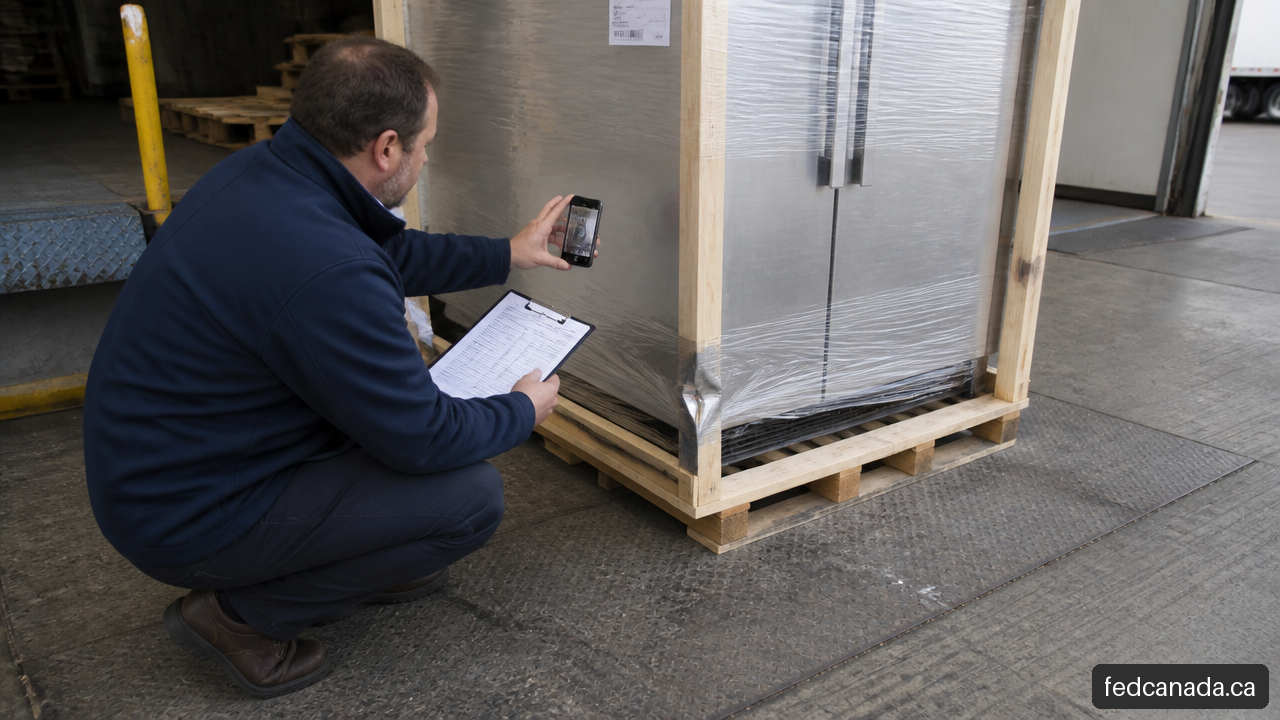
Damage claims are much easier when the receiving team records problems immediately. Do not rush this step because the driver is waiting. Inspect the pallet, crate, shrink wrap, corners, and visible surfaces before signing the delivery receipt.
If you see damage, note it specifically on the paperwork. “Damaged” is less useful than “right side crate crushed, stainless panel dented” or “glass door appears cracked.” Take dated photos from several angles, including the shipping label, pallet, packaging, and affected area.
Use this sequence:
- Compare the shipment count with the bill of lading or packing list.
- Photograph any puncture, crushing, wet packaging, broken straps, or tipped freight.
- Open accessible packaging promptly, where safe and permitted, to check concealed damage.
- Record exceptions before signing whenever damage is visible.
- Keep all packaging, pallet materials, labels, and delivery documents until the claim is resolved.
- Notify the seller and carrier quickly using the reporting method in the shipment terms.
A clean signature can make it harder to demonstrate that damage happened in transit. If the driver will not wait for a full inspection, record that the shipment was accepted subject to inspection, where the paperwork and carrier process allow it. Then inspect the equipment as soon as possible.
Account for Imports, Compliance, and Landed Cost
Know whether the shipment is domestic or cross border
“Ships across Canada” does not always mean the equipment is physically stocked in Canada. Some orders are dispatched from a Canadian warehouse. Others may be shipped from a manufacturer or distributor outside Canada. The delivery experience, paperwork, tax treatment, brokerage charges, and timing can differ significantly.
Before payment, ask these direct questions:
- Is the item shipping from inventory already in Canada?
- Who is the importer of record for a cross border shipment?
- Is customs brokerage included in the quote?
- Which taxes, duties, and fees are estimated or excluded?
- What happens if customs clearance requires additional documentation?
- Which party bears the risk of loss at each point in transit?
For imported commercial kitchen equipment, the Harmonized System, or HS, code helps classify the product for customs purposes. Duty treatment can vary by item, country of origin, and applicable trade rules. Canada Border Services Agency requirements, tax obligations, and accounting treatment can also depend on the importer’s business structure and the transaction terms.
There is no reliable one size fits all landed cost percentage for kitchen equipment. Consider a U.S. made oven shipped into Canada: the product may qualify for one treatment depending on origin and documentation, while an imported refrigeration unit sold through a U.S. distributor may have a different origin profile and freight path. Confirm the classification and import responsibilities with the seller, customs broker, or qualified trade adviser before relying on a budget figure.
Verify foodservice suitability before installation
Shipping safely does not guarantee that equipment is ready for legal or practical use in a foodservice operation. Installed equipment may need to meet local health authority, building, electrical, gas, fire, ventilation, and sanitation requirements. Rules can differ by municipality, province, facility type, and intended use.
Food contact surfaces should be durable, cleanable, and appropriate for the foodservice environment. Equipment also needs the right electrical characteristics, utility connections, clearance requirements, and certification markings for the jurisdiction where it will operate. A shipped appliance with the wrong voltage or plug configuration can become an expensive delay.
Before ordering, provide the supplier with the intended use, available utilities, installation location, and any project specifications from your contractor or designer. For equipment under a hood, verify dimensions, gas requirements, clearances, and fire suppression coordination. For refrigeration, verify doorway clearance, ambient operating conditions, drainage needs, and floor loading where relevant.
Build a landed cost instead of a freight only budget
A useful budget combines every cost required to make the equipment operational. Use this framework:
| Cost category | Typical question to resolve |
|---|---|
| Equipment price | Does the listed price include accessories or only the base unit? |
| Freight | Is the quote based on the final destination postal code and actual shipment dimensions? |
| Delivery services | Are liftgate, appointment, inside delivery, and uncrating included? |
| Import costs | Who handles brokerage, duties, taxes, and customs documentation? |
| Site preparation | Are electrical, gas, plumbing, ventilation, or structural changes required? |
| Installation | Who positions, connects, tests, and commissions the equipment? |
| Disposal | Who removes old equipment, pallets, crates, and protective materials? |
The best shipping choice is not necessarily the lowest transportation line item. It is the option that delivers the correct equipment to a workable location, in usable condition, with costs and responsibilities understood before the order is released.
Key Takeaways
What to confirm before approving an order
- Get a written freight quote tied to the actual postal code, packed dimensions, weight, and requested delivery level.
- Confirm whether the price covers dock delivery, liftgate service, inside delivery, uncrating, placement, or only curbside receiving.
- Measure the entire route from truck to final location, including turns, doors, elevators, ramps, and stairs.
- Ask whether the order may arrive in split shipments from separate facilities.
What protects your budget and equipment
- Build a landed cost that includes freight, accessorial charges, installation, site preparation, taxes, import costs, and packaging disposal.
- Verify domestic versus cross border fulfillment before assuming customs or brokerage is not relevant.
- Check utility requirements, foodservice suitability, and local installation requirements before delivery day.
- Inspect freight before signing, document visible damage precisely, and retain packaging for any claim.
FAQ: Commercial Kitchen Equipment Shipping Canada
How much does commercial kitchen equipment shipping cost in Canada?
Cost depends on shipment size, weight, freight class, origin, destination postal code, carrier service, and site access. A pallet delivered to a commercial dock is usually less complex than a heavy unit requiring liftgate, appointment scheduling, and indoor placement. Request an itemized quote so accessorial charges are visible rather than appearing after dispatch.
Do I need a freight dock or liftgate for large kitchen equipment?
You need a dock when standard freight delivery assumes the receiver can unload at truck height. If your location has no dock or forklift, a liftgate can lower the pallet to ground level. Liftgate service does not automatically include moving freight over thresholds, into a building, or through the kitchen.
How long does delivery usually take across provinces?
Timing depends on inventory status first, then route distance, carrier capacity, terminal transfers, appointment availability, and destination access. Ask separately for the ready to ship date and the freight transit estimate. For remote or northern destinations, allow more flexibility because final mile service can be less frequent.
Can bulky equipment be delivered to rural or remote Canadian addresses?
Often yes, but service conditions can differ. The carrier may require a reachable commercial address, a meeting point, a local terminal pickup, ferry coordination, or additional charges. Confirm the exact delivery point and equipment handling method before ordering, especially where roads, docks, or receiving staff are limited.
Is white glove delivery worth it for restaurant equipment?
Choose white glove delivery when the item is heavy, fragile, difficult to maneuver, or costly to damage, and when the service clearly includes the needed placement tasks. Avoid assuming it includes utility connections or commissioning unless those services are separately stated. For a simple palletized worktable at a dock, standard delivery may be sufficient. For a glass door refrigerator entering a finished café, white glove handling may reduce risk.
What should I do if equipment arrives damaged?
Photograph the damage, note specific exceptions on the delivery paperwork before signing when possible, keep all packaging, and notify the seller and carrier promptly. Do not discard a crushed carton or pallet until claim instructions are clear. The condition of the packaging can help show how damage occurred.
Can suppliers deliver equipment to a job site instead of a storefront?
Yes, but a job site should be treated as a specialized receiving location. Confirm construction access, truck approach, unloading surface, delivery hours, site contact, weather protection, and secure storage. If utilities or final flooring are incomplete, the equipment may need temporary storage or later repositioning.
Do I need installation, setup, or uncrating service?
That depends on the equipment and the site. Uncrating removes packaging. Placement moves the item into position. Installation connects utilities and may require qualified trades. Startup or commissioning verifies correct operation. Ask for each service by name because they are not interchangeable.
Recent Posts

Leave a Comment
Your email address will not be published. Required fields are marked *