



Steam Table Buying Guide: Wells, Sizing and Hot Holding
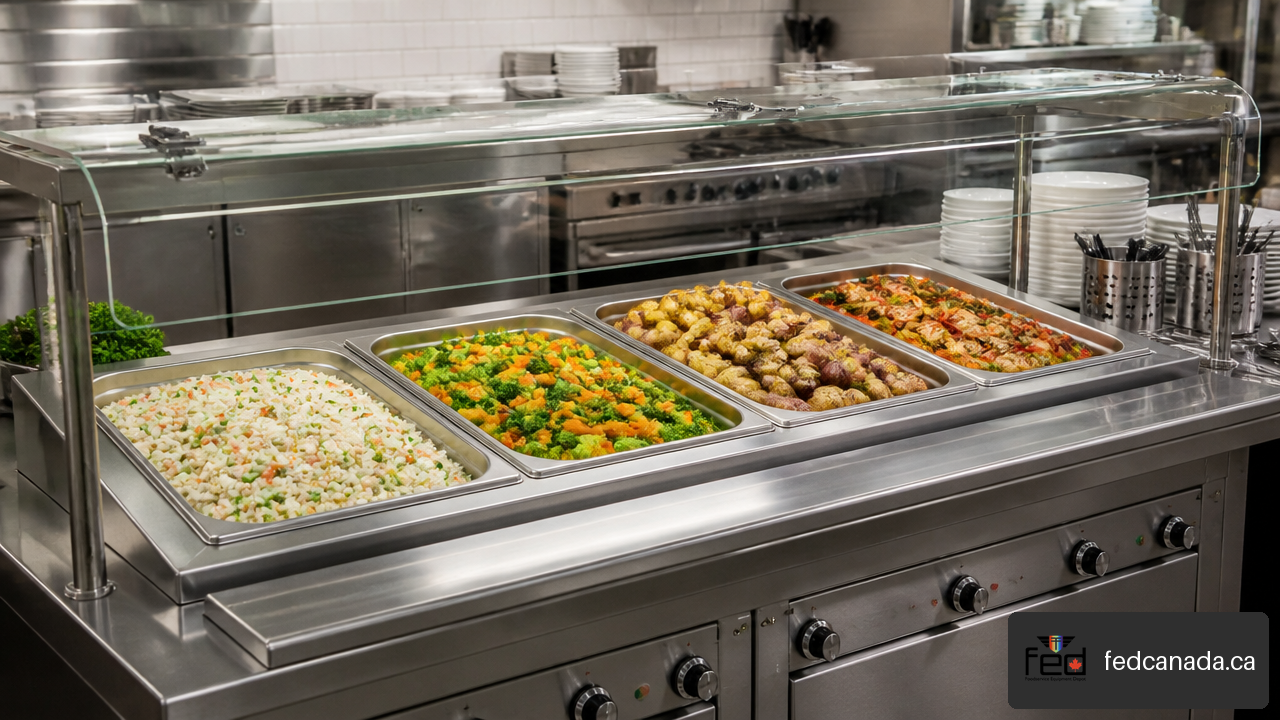
Steam tables keep prepared food ready for service, but the right unit is not simply the one with the most wells. This Steam Table Buying Guide: Wells, Sizing and Hot Holding explains how to match pan capacity, heating style, controls and physical footprint to the way your operation actually serves food.
Table of Contents
- Key Takeaways
- Understand Steam Table Wells and Pan Capacity
- Size a Steam Table for Peak Service
- Choose Wet, Dry, Open or Sealed Wells
- Set Up Reliable Hot Holding
- Frequently Asked Questions
- Sources
Key Takeaways
The short buying answer
Choose a steam table around peak simultaneous demand, not the total number of items on your menu. A three well unit may be sufficient for a compact lunch service with fast replenishment, while a six well unit may still be too small for a self serve cafeteria if several pans must remain available at once.
Count the food pans needed at the busiest moment, including a practical replacement pan for fast moving items.
Confirm the table accepts your preferred full size and fractional hotel pans, plus the adapter bars needed to support smaller pans.
Select wet holding for moist foods such as sauces, braises and mashed potatoes; consider dry holding for breaded, roasted or crisp foods.
Treat the thermostat as an equipment setting, not proof of food safety. Check actual food temperatures with a sanitized probe thermometer.
Measure the complete service footprint, including sneeze guards, tray slides, doors, staff clearance and the space needed to remove pans safely.
What a steam table does and does not do
A steam table is commercial hot holding equipment. Its job is to maintain the temperature of food that has already been cooked and brought to a safe service temperature. It is not designed to cook raw food or quickly reheat cold pans from refrigeration.
A steam table protects service flow only when hot food enters the well hot enough and the unit can maintain that food through the busiest part of service.
That distinction affects both food safety and capacity. Loading a cold, dense pan of chili into a preheated well can pull down the temperature of the food and slow the recovery of the surrounding service line. Reheat food with appropriate cooking or reheating equipment first, then transfer smaller batches into the steam table for service.
Understand Steam Table Wells and Pan Capacity
Start with the full size pan position
A well is the recessed pan position in a steam table. Manufacturers commonly describe capacity by well count because each full size well generally accommodates one full size hotel pan, typically measuring 12 by 20 inches across its top rim.
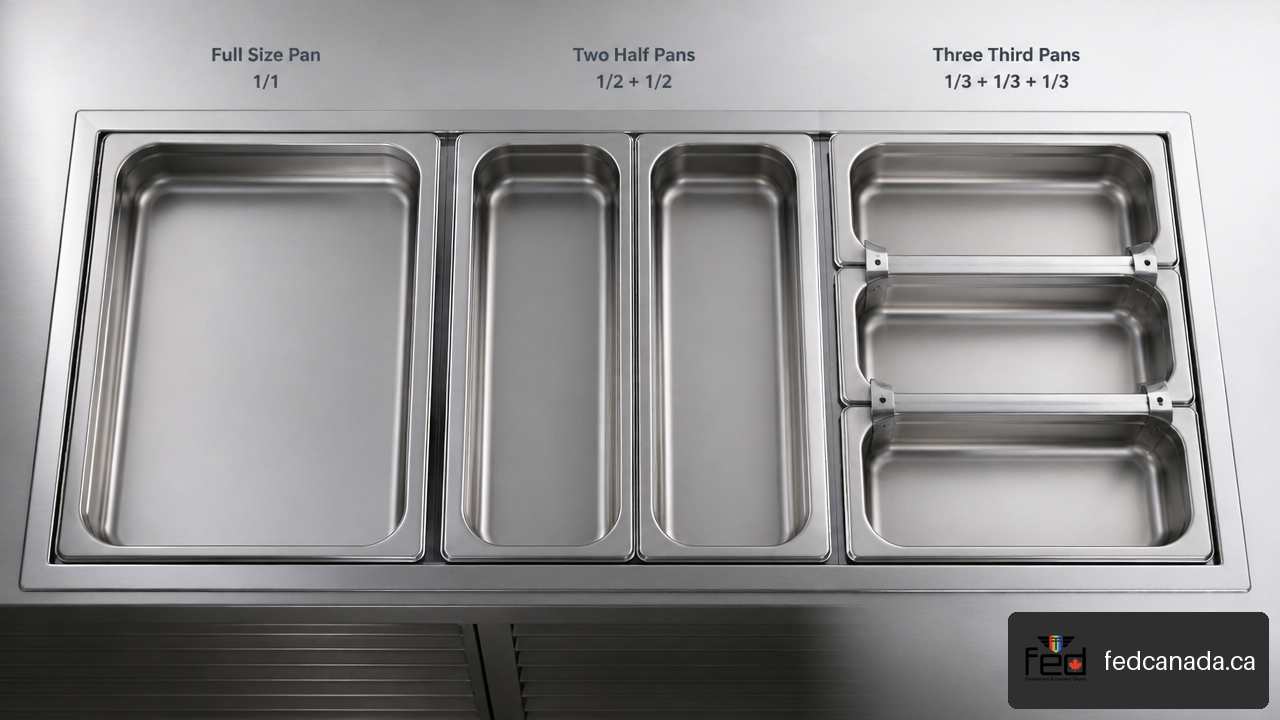
That footprint is the starting point, not the final capacity calculation. A full size well can also hold combinations of fractional pans when they are properly supported. Adapter bars span the opening so half, third, quarter, sixth or ninth pans sit securely instead of dropping into the well.
| Pan arrangement in one full size well | Best suited to | Operational consideration |
|---|---|---|
| One full size pan | High volume entrées, soups, rice or potatoes | Simple service, but one menu item occupies the entire well |
| Two half pans | Two medium volume sides or proteins | Useful when demand is balanced between two items |
| Three third pans | Toppings, vegetables, sauces or smaller sides | More menu variety, but more utensils and refilling activity |
| Smaller fractional pans | Condiments, garnishes or limited batch items | Requires correct adapter bars and close temperature monitoring |
Do not assume every fractional arrangement will work with every pan brand or well design. Pan rims, bar placement and well dimensions can vary. Confirm compatibility before purchasing a large set of pans.
Pan depth changes the service rhythm
Two pans with the same 12 by 20 inch footprint can hold very different amounts of food. Shallow pans make sense when an item moves quickly, must be stirred often or loses quality when held too long. Deeper pans reduce refill trips, but they can create a different problem: a large amount of slow moving food stays on the line for too long.
For example, a shallow pan of roasted vegetables may be refilled frequently but can look fresher through a lunch rush. A deeper pan of soup may be practical because the product remains moist and is easy to stir. There is no universal best depth because product texture, turnover and serving utensil size all matter.
When choosing pan depth, ask three questions:
How many portions will this item sell during the busiest service period?
How long can the product remain attractive after it reaches the line?
Can staff replenish it safely without crowding customers or disrupting the rest of the service line?
Well count is not usable service capacity
A five well table has five physical pan positions. It may not have the usable capacity of five comfortably served menu items.
A sneeze guard can limit utensil angle. A tray slide takes floor space. A narrow aisle can make it difficult for staff to replace a hot pan while customers are serving themselves. Even the order of menu items matters: placing a popular entrée after a bottleneck side can create a queue that makes the whole line feel undersized.
For self service, leave enough clearance for guests to reach pans without touching adjacent utensils. For attended service, allow staff a clear side or rear access route. Measure the unit with all planned accessories, not just the cabinet body.
Size a Steam Table for Peak Service
Use a peak demand method instead of menu counting
The most reliable sizing method is to identify how many pan positions you need at the same time during the busiest service period. This is more useful than counting every menu item offered across an entire day. KaTom’s steam table capacity guidance similarly recommends selecting capacity based on the full size compartments required during the busiest period.
Use this simple planning sequence:
List the foods that must be visible and available at the same time.
Assign each food a full size or fractional pan footprint.
Identify fast moving products that need a replacement pan staged nearby.
Decide whether a product can rotate in after another item sells down.
Add the real space required for access, serving utensils, guards and tray handling.
Consider a quick service operation that serves rice, chicken, vegetables, gravy, soup and two toppings. That is not automatically seven wells. Rice, chicken and vegetables may need dedicated high volume pans. Gravy and soup may need separate wells. The toppings might share one well as fractional pans if they are replenished often and the arrangement leaves enough utensil space. The result could be five wells, but only if the service pattern supports it.
Match table length to the room, not just the menu
Before choosing a well count, map the line from the customer and staff perspectives. Measure wall length, aisle width, nearby doors, refrigeration access and the path used to transport replenishment pans.
A larger unit can create more problems if it blocks a prep route or forces staff to carry hot food around customers. Conversely, a compact table may work well when replenishment is close, batches are smaller and service is attended.
| Operating situation | Often a practical starting point | Watch for |
|---|---|---|
| Small café or limited menu counter | Two to three wells | Running out of space when specials are added |
| Quick service restaurant | Three to five wells | High demand items requiring extra staging pans |
| Buffet, cafeteria or hotel breakfast line | Four to six wells or multiple units | Guest flow, guard clearance and tray slide footprint |
| Catered or mobile service | Compact electric unit | Power availability, transport security and refill access |
These are planning ranges, not fixed rules. A three well table with high turnover can outperform a larger unit holding too many slow moving pans.
Choose individual controls when foods behave differently
Separate thermostats are worth considering when one line holds very different products. A pan of sauce, for example, may respond differently than roasted potatoes or a breaded entrée. Independent controls let you adjust each well rather than forcing every product into one shared setting.
The practical implication is straightforward: buy shared controls for a simple, consistent menu; pay for individual zones when product mix and holding behaviour vary enough to justify them.
Electric or gas: decide from installation reality
Electric steam tables are often easier to place where suitable electrical service is available. Gas units can suit facilities already designed for gas equipment, but installation requirements, ventilation needs and local code requirements must be reviewed before purchase.
Avoid choosing fuel type solely on a broad assumption about operating cost. Available utility connections, installer requirements, service support and the unit’s location will usually drive the better decision. If the table is going into a remodel or a tight serving area, confirm utility locations before finalizing the model.
Choose Wet, Dry, Open or Sealed Wells
Wet wells support moisture, with a trade off
Wet wells use water or a water pan to transfer heat and add humidity around the food pan. This gentler environment can help reduce drying in foods that benefit from moisture, including sauces, stews, mashed potatoes and cooked grains.
However, humidity is not always desirable. Chef & Beyond’s wet and dry holding comparison notes that wet operation favors moisture sensitive foods, while dry operation can better preserve the texture of breaded and roasted foods. Fried chicken, roasted potatoes and crisp toppings can soften when humid air condenses around them.
Choose wet holding when moisture retention matters more than a crisp exterior. Avoid assuming it will improve every item on the menu.
Dry and sealed wells simplify water management
Dry wells operate without a water bath. They can reduce filling, draining and spill related tasks, but direct heat may be less forgiving for foods that dry out or scorch along the bottom edge. Stirring, pan rotation and smaller batches may be necessary for sensitive products.
Sealed wells have protected or closed construction that can make cleanup more straightforward and reduce direct exposure to water. Open wells may use a water or spillage pan. Neither style is automatically superior; the right choice depends on menu, cleanup workflow and drainage access.
Drainage is a purchase decision, not an afterthought
For wet operation, find out exactly how water leaves the unit. Some tables may have individual drains, while others use shared drainage arrangements. Ask where valves are located, whether staff can access them safely and where drained water can go without crossing customer paths.
A wet table placed far from a floor drain can still work, but it may create a slower closing routine and more opportunities for spills. In a high volume cafeteria, drain design can affect labour almost as much as the heating method does.
Review these details before installation:
Water fill method and approximate operating level specified by the manufacturer
Drain valve location and clearance for a container, if one is used
Access to a floor drain or approved disposal point
Cleaning access around wells, undershelves and guard supports
Procedures for cooling, emptying and sanitizing the unit after service
Set Up Reliable Hot Holding
Keep food at safe temperatures
Hot food must be maintained at 135°F or above, as stated in the Institute of Child Nutrition hot holding fact sheet. Local rules can add requirements, so your health authority remains the final reference for your operation.
The steam table’s dial measures or controls equipment conditions. It does not prove that the centre of every pan is at the target temperature. Food density, pan depth, stirring, lid use and the temperature of food when loaded all influence the result.
Use a sanitized probe thermometer to check food directly. Take readings at the centre and in areas most likely to cool, such as near the surface or pan edges. Record checks according to your food safety plan.
Build a preheat and loading routine
A consistent routine reduces the chance of loading food into a line that is not ready. A practical sequence is:
Inspect wells, controls, drains and pan supports before turning on the unit.
Fill wet wells only as directed by the manufacturer, or prepare dry wells for operation.
Preheat the empty table fully before service.
Load food that has already been properly cooked or reheated.
Verify food temperature with a probe after loading and at scheduled intervals.
Replenish in smaller batches rather than continually topping off an old pan.
The last point matters. Combining a fresh hot batch with food that has been sitting for a long period makes it harder to manage time, temperature and quality. When possible, replace a nearly empty pan with a clean pan of fresh hot food, then remove the old pan for appropriate handling.
Commission the unit before relying on it for a busy service
New equipment should be checked under conditions close to real use. There is limited standardized public data on recovery times because performance changes with pan depth, food mass, starting temperature and room conditions. That uncertainty is exactly why a simple in house commissioning check is useful.
Test the table before a major service:
Note how long the empty wells take to preheat.
Load representative pans at normal serving depth.
Measure food temperatures at the surface and centre after loading.
Check whether the unit recovers after lids are removed repeatedly or a pan is replaced.
Confirm that water levels, drainage and controls are manageable for staff.
If a dense product drops below the desired holding temperature after loading, the answer may be smaller batches, hotter transfer temperatures within safe procedures, more preheating time or a different service arrangement. It should not be assumed that turning the dial higher will solve every problem.
Know when holding time has become a discard issue
Louisiana Open Textbooks’ guidance on holding food explains that hot holding equipment is for cooked food and that food held below 135°F for more than four hours should be discarded. Establish a documented corrective action procedure so staff know what to do when temperature checks reveal a problem.
Frequently Asked Questions
How many wells should a steam table have?
Choose the number of wells based on peak simultaneous pan demand, not your entire menu. Count dedicated items, fractional pan combinations, staged replacement pans and the space required to serve them safely. A compact menu with fast refills may need fewer wells than a buffet with the same number of menu items.
Is one well always equal to one full size hotel pan?
Usually, one standard full size well is designed around one full size 12 by 20 inch pan position. It can often be divided for fractional pans, but proper adapter bars are required and exact compatibility should be confirmed with the table and pan specifications.
Should I buy wet or dry wells?
Choose wet wells for foods that benefit from humidity, such as sauces, braises and moist sides. Choose dry operation when texture is the priority for breaded, fried or roasted foods. Mixed menus may benefit from a configuration that gives you flexibility across different products.
Can a steam table reheat cold food?
No. Use suitable cooking or reheating equipment to bring food to the proper temperature before transferring it to the steam table. Steam tables are intended to maintain hot, prepared food during service.
What temperature should food be held at in a steam table?
Maintain hot food at 135°F or above, and verify the food itself with a sanitized probe thermometer. Do not rely only on the equipment dial because it does not show the temperature at the centre of the food pan.
Are individual thermostats worth paying for?
They are most useful when the table holds products with different moisture, texture and heat retention needs. For a simple line of similar foods, shared controls may be adequate. For mixed menus, independent controls provide more practical adjustment and can reduce compromises between pans.
How deep should steam table pans be?
Choose depth based on sales volume, refill frequency and food quality. Deep pans can reduce replenishment trips for soups and moist foods. Shallow pans are often better for products that need frequent rotation or lose quality when held in a large batch.
What accessories should I plan for?
Plan for adapter bars, compatible lids, serving utensils, sneeze guards, tray slides and possibly cutting board or undershelf options. For self service, include these accessories in your layout measurements because they affect reach, traffic flow and usable service capacity.
Sources
Verified references
Institute of Child Nutrition — Food Safety Fact Sheet: Holding Hot Foods: https://theicn.org/resources/521/food-safety-fact-sheets/107118/food-safety-holding-hot-foods.pdf
Louisiana Open Textbooks — Holding Food at Proper Temperatures: https://louis.pressbooks.pub/foodsafety/chapter/9-2/
KaTom Restaurant Supply — Steam Table Buyers’ Guide: https://www.katom.com/learning-center/hot-bars-buyers-guide-2.html
Chef & Beyond — How to Choose Your Steam Table: https://www.chefandbeyond.com/guides/how-to-choose-your-steam-table
Recent Posts
Leave a Comment
Your email address will not be published. Required fields are marked *