



Restaurant Equipment Leasing and Financing in Canada: Lease vs Buy
Restaurant Equipment Leasing and Financing in Canada: Lease vs Buy, Costs and What to Ask is not really a question of whether monthly payments are convenient. It is a decision about cash flow, ownership, risk, and how long the equipment will remain useful in your operation. I would compare the full installed cost and the complete contract before focusing on any advertised payment.

Table of Contents
- How leasing, loans, and buying differ
- How to calculate the real cost
- How I would choose lease versus buy
- Questions to ask before signing
- Key Takeaways
- FAQ
How leasing, loans, and buying differ
The label on the agreement matters less than the actual obligations. A contract called a lease may function much like financing if you are expected to buy the equipment at the end. A rental may offer genuine return flexibility, while a lease to own arrangement may leave little practical ability to exit early.
Outright purchase: the simplest ownership path
When you buy equipment with cash, your business owns it immediately. The purchase is a capital expenditure, or CapEx. You control maintenance, resale, replacement timing, and modifications, subject to warranty conditions and local code requirements.
The main advantage is economic: there is no financing charge. If a $12,000 reach in refrigerator lasts for years and remains serviceable, a cash purchase can be cheaper than a multi year financing agreement. You may also recover some value through resale when you replace it.
The drawback is concentration of cash. A new restaurant can spend heavily before opening on deposits, construction, ventilation, utilities, smallwares, opening inventory, and payroll. Using all available cash for a combi oven may create a worse problem if the first slow month leaves insufficient funds for rent or food orders.
Equipment loan: ownership now, debt over time
With an equipment loan, the business generally purchases the asset while repaying borrowed funds over a set period. The lender may hold a security interest in the equipment. In practical terms, you own the unit, but missed payments can create enforcement risk under the agreement.
A loan is often worth considering when all of the following are true:
You expect to use the equipment through most or all of its useful life.
The unit has reliable service support and available parts.
You want eventual resale value to remain with the business.
Your cash flow can support the payment even in a slow season.
A loan does not eliminate upfront costs. Deposits, taxes, freight, installation, insurance, and site work may still require cash unless specifically included in the approved amount.
Lease, lease to own, and rent to buy
A lease gives you use of equipment for scheduled payments. At the end, your choices might include returning it, renewing, buying it for a fixed amount, buying it at fair market value, or making a prearranged nominal purchase. Those are radically different outcomes.
A lease to own arrangement is designed to end in ownership, but I would not assume the purchase price is insignificant. Read the buyout clause. A low monthly payment can be paired with a substantial final payment, or the total of all payments can be much higher than the cash price.
A rental or Rent Try Buy structure can make sense when demand is uncertain. For example, a café considering a premium espresso program may want proof that sales volume justifies the footprint, labour, cleaning requirements, and service costs before committing to ownership. The SilverChef supplier profile published by Restaurants Canada describes a Rent Try Buy program that permits upgrades or purchases and states that equipment may be returned after 12 months without penalty under that program. That is a provider specific feature, not a universal lease right.
Why the installed project cost changes the decision
The equipment sticker price is only one part of the project. A gas range may require delivery, positioning, gas connection, electrical work, hood adjustments, fire suppression coordination, commissioning, and permits. A walk in cooler may require site preparation and assembly. A used ice machine may need water treatment and drain work before it is ready for service.
TFI Food Equipment Solutions states that shipping and installation may be included in the financed amount rather than paid entirely upfront. The option to finance those items can help preserve cash, as noted in this equipment financing overview, but it also means you may pay financing costs on work that has no resale value.
A financed project should be compared as a complete installed system, not as a monthly payment attached to a single piece of equipment.
How to calculate the real cost
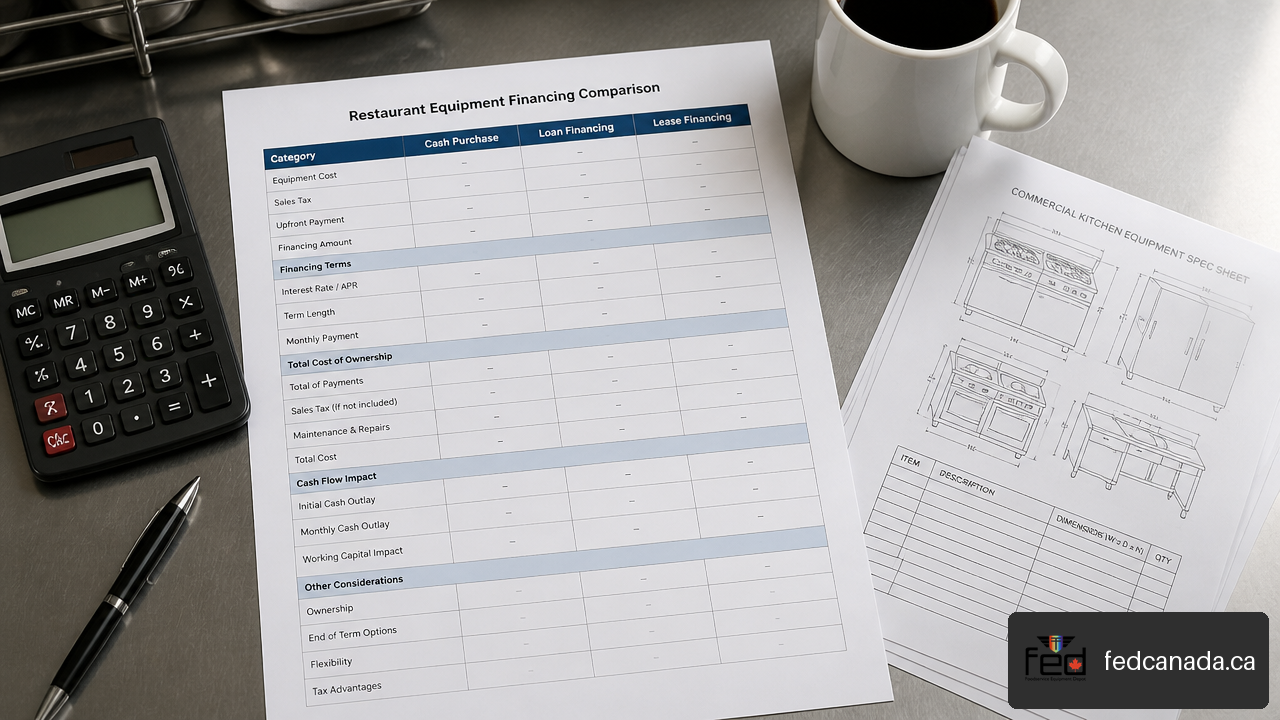
The reliable comparison is between total economic cost, not the smallest payment. I would request a written schedule before accepting a quote, then put cash purchase, loan, and lease figures beside each other.
Build a total cost of financing worksheet
Use this calculation for each option:
Total contract cost = deposit + scheduled payments + administration fees + documentation fees + taxes + insurance + buyout or return cost + any unpaid installation or maintenance cost.
For a cash purchase, use:
Total ownership cost = equipment price + tax + freight + installation + site work + maintenance + repairs + insurance less expected resale value.
The numbers will not always be known precisely. That is normal. The point is to make uncertainty visible instead of ignoring it.
| Cost item | Cash purchase | Equipment loan | Lease or lease to own |
|---|---|---|---|
| Equipment price | Paid at purchase | Usually financed or partly financed | Reflected in payment structure |
| Deposit | Sometimes none | May be required | May be required |
| Interest or financing charge | None | Usually applies | Built into payments or disclosed separately |
| Freight and installation | Often paid upfront | May be financeable | May be financeable if contract permits |
| Repairs and maintenance | Business responsibility | Business responsibility | Usually business responsibility, but confirm |
| End of term cost | None | Loan balance should be zero | Buyout, return, renewal, or extension may apply |
| Resale value | Business keeps it | Business keeps it | Business may not receive it unless it buys the unit |
A simple comparison example
Consider a $20,000 cooking line addition. Assume the business can either pay cash or enter a 48 month arrangement with a $3,000 deposit, 48 payments of $475, a $500 documentation fee, and a $1,500 end of term buyout. Ignore taxes and repair costs for simplicity.
Deposit: $3,000.
Scheduled payments: 48 × $475 = $22,800.
Documentation fee: $500.
Buyout: $1,500.
Total paid to acquire the equipment: $27,800.
The monthly payment may look manageable, but the financing and contract cost above the $20,000 equipment price is $7,800 before taxes and operating costs. That does not automatically make the arrangement wrong. It may still protect critical working capital. It does mean the decision should be intentional.
A community discussion in r/SmallBusinessCanada illustrates the risk of judging by payment alone: one poster alleged a 25% deposit and eventual payments above $30,000 for equipment valued at roughly $15,000. That individual report is not verified market evidence, but it is a useful warning to request the cumulative repayment figure in writing.
Test the payment against slow season cash flow
Seasonal payment schedules are sometimes offered, but they should be tested against actual cash availability. The question is not whether revenue peaks in summer or during holiday catering. The question is whether the fixed obligation remains affordable during January, a construction disruption, or a two week equipment related closure.
Build a conservative monthly test:
Start with expected sales in a slow month, not your best month.
Subtract food cost, labour, rent, utilities, delivery fees, debt payments, and planned maintenance.
Leave a cash buffer for repairs, tax remittances, and delayed receivables.
Add the proposed equipment payment only after those obligations.
If the result is thin or negative, a longer term or lower payment does not solve the underlying affordability issue. It simply extends the commitment. A smaller purchase, used equipment with a warranty, a phased menu launch, or more working capital may be safer.
Revenue claims need a margin test
Some suppliers market beverage, soft serve, coffee, or frozen drink equipment with strong gross profit and rapid payback claims. Gross profit is sales less direct product cost. It is not net profit, and it does not include labour, rent, utilities, service, waste, payment processing, or financing.
Suppose a specialty beverage machine is expected to add $1,500 of monthly gross profit. If added labour, consumables, waste, cleaning time, equipment service, and financing payment total $1,250, the incremental contribution is only $250. A promised six month payback may then become much longer.
I would calculate the break even sales volume this way:
Required monthly units = monthly equipment related cost ÷ contribution per unit.
If monthly equipment related cost is $900 and each sale contributes $3 after product cost, you need 300 additional sales every month merely to cover that cost. Test whether that volume is realistic for your location, menu, hours, and staffing.
How I would choose lease versus buy
There is no universal winner. Buying usually favours durable, essential equipment with a long usable life. Leasing or financing can be sensible when preserving cash has a clear operating value and the repayment fits a conservative budget.
Choose buying when control and long life matter most
I would lean toward buying, with cash or a conventional equipment loan, when the equipment is foundational and likely to remain in service for many years. Examples can include stainless work tables, shelving, durable refrigeration from a serviceable brand, or a properly specified range for a stable menu.
Buying is especially compelling if the business has adequate reserves after the purchase. Paying cash is not a victory if it drains funds needed for opening inventory or emergency repairs.
Buying may be less attractive when technology changes quickly, demand is unclear, or the unit is specialized for a short term event. A large seasonal frozen dessert machine, for instance, needs a sales case that survives weather variability and staffing constraints.
Choose a lease when flexibility has measurable value
A lease can be reasonable when the contract provides useful flexibility that you would otherwise have to pay for through downtime, replacement risk, or premature ownership. This is most relevant when equipment demand is unproven, product offerings are being tested, or a business expects a near term expansion.
The key word is measurable. A right to upgrade has value only if the process, costs, timing, and condition requirements are written into the agreement. An early return option has value only if it does not trigger an expensive settlement balance.
Terms, rates, and approvals can vary materially by provider and the business profile, as KitchenEquipment.ca notes in its financing guidance. I would treat any verbal promise about flexibility as incomplete until it appears in the signed documents.
Used equipment deserves a different risk calculation
Used, demo, and refurbished equipment can reduce acquisition cost, but the savings need to outweigh reliability uncertainty. A used convection oven at a favourable price can become expensive if it fails before a busy weekend and parts are unavailable.
For used equipment, ask for:
Model and serial number, manufacture date where available, and condition report.
Service records, known repairs, and details of any inspection performed.
Warranty length, exclusions, response process, and whether labour is covered.
Confirmation that replacement parts and qualified service are available in your area.
Utility requirements and confirmation that the unit suits the intended installation.
The best value is not always the lowest purchase price. It is the option with acceptable downtime risk and a realistic lifecycle cost.
Questions to ask before signing
A contract review does not need to be adversarial. It needs to be specific. I would ask for the agreement, payment schedule, and end of term options before committing to an order or paying a deposit.
Questions about price and payment
What is the cash price of every item, including freight, installation, and taxes?
What deposit is due, when is it due, and is any portion refundable?
What is the sum of every scheduled payment over the full term?
Which fees apply for documentation, administration, missed payments, returned payments, amendments, or renewals?
Is tax charged on each payment, on the entire amount upfront, or both in different components?
What is the total amount I will pay if I keep and buy the equipment?
Questions about ownership and exit rights
| Contract question | Why it matters |
|---|---|
| Who owns the equipment during the term? | It determines whether you can sell, modify, or move it freely. |
| What is the exact end of term buyout? | A fair market value formula and a fixed nominal amount can produce very different outcomes. |
| Can I return the equipment? | Return rights may include cleaning, packaging, freight, condition, and timing obligations. |
| What happens if I end early? | Early termination can require accelerated payments, fees, or a settlement amount. |
| Can I upgrade or assign the agreement? | Expansion, relocation, or a business sale may require consent and fees. |
| What happens after a missed payment? | Default clauses can add costs and affect access to essential equipment. |
Questions about maintenance, insurance, and installation
Most commercial equipment agreements place routine care and repair responsibility on the operator. Confirm who pays for preventive maintenance, emergency service, parts, replacement equipment, and damage caused during transport or installation.
Ask whether insurance is required, what coverage is required, and whether the lessor must be named on the policy. Clarify the equipment delivery point as well. A curbside freight delivery is not the same as placement, assembly, connection, testing, and commissioning.
For material commitments, I would consider having an accountant assess cash flow and tax implications and asking a commercial lawyer to review unfamiliar terms. That review costs money, but it can be inexpensive compared with discovering an unexpected buyout or early exit balance after signing.
Key Takeaways
The practical decision rule
Restaurant equipment financing is useful when the cash preserved will protect operations or generate more value than the financing cost. Buying is often stronger when the equipment has a long, reliable service life and the business can retain a healthy cash reserve after purchase.
What I would compare before choosing
The complete installed cash price.
Deposit, payment frequency, total scheduled payments, and every fee.
Buyout, renewal, return, and early termination obligations.
Maintenance, insurance, warranty, and downtime exposure.
Expected useful life, resale value, and parts availability.
Slow season affordability, not just peak season sales.
The most common mistake
The most common mistake is treating an affordable monthly payment as proof that the equipment is affordable. A payment can fit this month while the total obligation, buyout, and repair responsibility make the transaction poor value over time.
FAQ
Is it better to lease or buy restaurant equipment in Canada?
Buy when you expect long term use, can keep adequate working capital after the purchase, and want ownership and resale value. Lease or finance when preserving cash is more valuable than the added financing cost, or when contract flexibility genuinely reduces uncertainty. The better option depends on total cost and the business's downside cash flow, not on the label alone.
What is the difference between a restaurant equipment lease, loan, rental, and lease to own agreement?
A loan generally funds a purchase, with the business owning the equipment while repaying debt. A lease provides use rights and may or may not include a practical purchase option. A rental is usually more temporary and may permit return. Lease to own typically aims toward ownership, but the buyout and total paid must be checked in writing.
How much does restaurant equipment financing cost in Canada?
There is no reliable single national figure for restaurant equipment financing costs. Pricing depends on credit profile, time in business, equipment type and condition, term length, deposit, provider, collateral, and contract structure. Ask for a full payment schedule and calculate the total paid, rather than relying on a monthly payment or an advertised rate.
Can a new restaurant qualify without a long operating history?
Some providers consider start ups, but approval requirements can be stricter and may involve a deposit, personal guarantee, stronger credit review, or more documentation. Do not treat prequalification as final approval. Confirm the approved amount, conditions, equipment restrictions, and whether installation costs are included before placing orders.
Can used or refurbished restaurant equipment be financed?
It may be possible, but eligibility varies by provider and condition. Used equipment can offer value if there is a clear inspection record, appropriate warranty, service support, and parts availability. A lower price does not offset frequent downtime in a kitchen that depends on the unit daily.
Can freight, taxes, and installation be included in financing?
Sometimes. TFI Food Equipment Solutions states that shipping and installation can be included in the financed amount, but this must be confirmed for your specific transaction. Ask for an itemized financed amount covering equipment, delivery, installation, site work, taxes, and any excluded costs.
What happens at the end of a restaurant equipment lease?
The contract controls the outcome. You may return the equipment, renew, extend the lease, buy it for a fixed amount, buy it at fair market value, or have another prescribed option. Ask for the exact amount or formula, return condition standards, notice deadlines, and who pays return freight before signing.
What warning signs suggest a financing agreement is too expensive?
Warning signs include a provider declining to show total repayment, unclear buyout language, unexplained fees, a payment that only works in peak season, severe early termination wording, or a total cost far above the cash price without a clear flexibility benefit. Pause and compare alternatives if the agreement cannot be explained plainly on one page.
Sources/References
sparleasing.com — https://sparleasing.com/
tficanada.com — https://www.tficanada.com/category/services
restaurantscanada.org — https://www.restaurantscanada.org/supplier/silverchef/
Recent Posts
Leave a Comment
Your email address will not be published. Required fields are marked *