



Commercial Kitchen Food Safety Temperature Guide
Commercial kitchen food safety temperature control is the practical system that keeps food out of conditions where harmful bacteria can multiply. It is not just about cooking chicken correctly. It includes receiving deliveries, refrigerator recovery after busy service, cooling soups safely, checking buffet pans, reheating leftovers, and documenting what happened when a reading fails.
A kitchen can have clean counters and skilled cooks yet still create risk if food spends too long between 4°C and 60°C. That range is commonly called the danger zone. The strongest temperature-control programs make safe choices easier during the rush: calibrated thermometers within reach, clear check times, shallow cooling containers, and corrective-action rules staff can follow without guessing.
Table of Contents
- Key Takeaways
- The Core Commercial Kitchen Temperature Rules
- Build Temperature Control Into Every Food Flow
- FAQ: Commercial Kitchen Food Safety Temperature
Key Takeaways
- Keep refrigerated food at 4°C or lower and frozen food at minus 18°C or lower.
- Keep hot-held food at 60°C or higher. A steam table holds safe hot food; it is not designed to rapidly reheat cold food.
- Use a probe thermometer to verify the internal temperature of food, not its surface temperature or appearance.
- Cook poultry pieces, egg dishes, leftovers, and many mixed dishes to 74°C. Ground meat and meat mixtures need 71°C; whole poultry requires 85°C under Health Canada guidance.
- Cool cooked food in small portions, shallow pans, or other rapid-cooling setups. Record both temperature and time so staff can prove the cooling process stayed under control.
- Treat receiving, prep-table staging, delivery transfer, and service-line replenishment as critical control points. Food can warm up before it ever reaches the dining room.
- A temperature log is only useful when it includes the response to a failure. “Cooler at 8°C” is incomplete without a documented action.
The Core Commercial Kitchen Temperature Rules
Temperature standards work because they slow, stop, or destroy pathogens at different points in the food process. Refrigeration slows bacterial growth. Freezing stops growth but does not reliably kill bacteria already present. Cooking targets internal temperatures that reduce pathogens. Hot holding keeps cooked food out of the growth range.
Start with the danger zone and storage limits
The danger zone is 4°C to 60°C. Within this range, bacteria can grow quickly, particularly in moist, protein-rich foods such as cooked rice, poultry, sauces, ground meat, dairy-based dishes, seafood, and prepared sandwiches.
Health Canada’s national guidance provides the basic operating limits: cold food should remain at 4°C or lower, while hot food should remain at 60°C or higher. Those thresholds are summarized in Health Canada’s general food safety guidance.
For frozen storage, keep products at minus 18°C or lower. As CCOHS kitchen hygiene guidance explains, freezing stops bacterial growth but does not destroy every bacterium already in the food. That matters when thawing: a product that was mishandled before freezing does not become safe simply because it is frozen solid.
| Food stage | Target temperature | What the target achieves | Common failure point |
|---|---|---|---|
| Refrigerated storage | 4°C or lower | Slows pathogen growth | Overloaded shelves blocking airflow |
| Frozen storage | Minus 18°C or lower | Stops bacterial growth and protects quality | Warm door areas and frequent opening |
| Cold holding | 4°C or lower | Keeps prepared food cold during service | Prep tables left open during rushes |
| Hot holding | 60°C or higher | Keeps cooked food outside the danger zone | Steam-table pans running low or uncovered |
| Reheating for hot holding | 74°C | Returns cooked, cooled food to a safe serving temperature | Using holding equipment as a reheater |
A display thermometer on a refrigerator door is useful, but it is not a complete verification method. It reports the unit’s air temperature near one location, while food temperatures can vary across shelves. Warm spots develop near doors, overloaded fan areas, and pans stacked before they have cooled. Place an independent thermometer in the warmest likely location and verify actual product temperature during routine checks.
Cook to the internal temperature that fits the food
Food safety temperature and culinary doneness are related, but they are not always the same decision. A steak can be cooked to a preferred degree of doneness because it is an intact cut; contamination is generally most likely on the exterior, which receives direct heat. Ground meat is different because grinding can distribute surface contamination throughout the mixture.
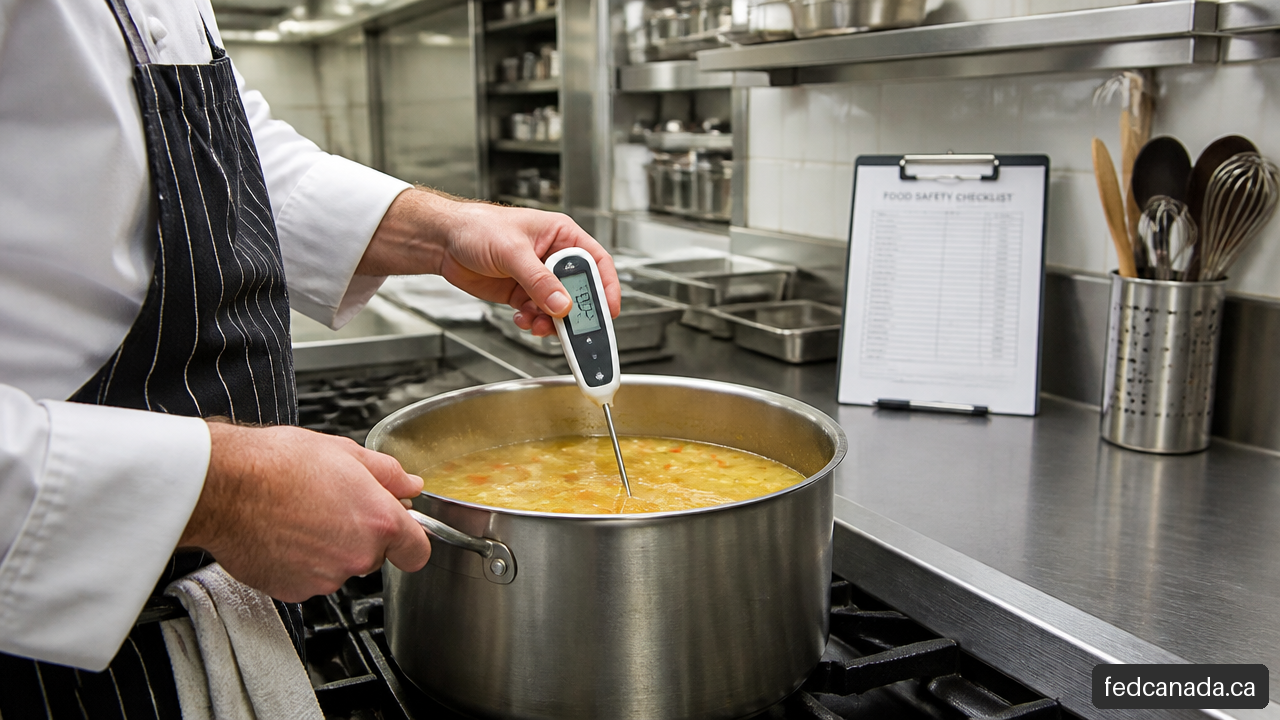
Use a clean, sanitized digital probe thermometer and measure the thickest portion. Avoid bone, pan surfaces, and large pockets of fat. For patties, meatballs, casseroles, and sauces with chunks, take readings in more than one location. The coldest spot controls the decision.
Health Canada’s safe cooking temperature chart sets out the specific internal targets for common foods. The operational summary below helps translate those targets into a commercial kitchen routine.
| Food category | Internal cooking temperature | Practical decision rule |
|---|---|---|
| Ground meat and meat mixtures | 71°C | Use for burgers, sausages, meatballs, and similar mixtures |
| Poultry pieces | 74°C | Check the thickest portion, away from bone |
| Whole poultry | 85°C | Verify the thickest part of the bird, not just surface browning |
| Egg dishes | 74°C | Applies to dishes such as quiche, strata, and baked egg mixtures |
| Leftovers, stuffing, hot dogs | 74°C | Treat as ready-to-serve only after the center reaches target |
Mixed dishes deserve extra attention because one pan may contain several risk profiles. A casserole containing poultry, cooked rice, sauce, and vegetables should be managed to the higher applicable target rather than the lowest-risk ingredient. The same principle applies to stuffed poultry and dishes containing ground meat.
Hold and reheat without creating a weak link
Hot holding is for food that is already fully cooked. If a soup is cooled overnight and will return to a steam table for lunch service, reheat it rapidly using equipment intended for reheating, then transfer it to the holding unit once it reaches the required temperature.
The BC Centre for Disease Control states that cooked and cooled leftovers reheated for hot holding should reach 74°C before service. Its HACCP food safety guidance also includes 63°C for 15 seconds for certain immediately cooked and served foods, including shell eggs and certain fish or meat preparations. That distinction is useful, but kitchens should align their routine procedures with local public-health requirements and the food being served.
If hot-held food falls below 60°C, the correct response depends on the actual food temperature, how long it has been below control, and your local rule. Start by identifying the time of failure, not just the temperature at discovery. Reheat promptly if the food is still within your approved corrective-action window and quality remains acceptable; otherwise, discard it. Guessing how long a pan sat at 48°C is not a corrective action.
Build Temperature Control Into Every Food Flow
A reliable system follows food from delivery to service. This is the practical version of HACCP, or Hazard Analysis and Critical Control Points: identify where control can fail, set a measurable limit, monitor it, and act when the limit is missed.
Use a receiving-to-service workflow
Temperature abuse often happens during transitions. A delivery may arrive cold, then sit beside the receiving door while staff unload other supplies. A cooked roast may leave the oven safe, then wait on a prep table while the service line is rearranged. These are short moments, but repeated delays can become a pattern.
Use this workflow for time/temperature-controlled foods:
- Receive: Check representative product temperatures before accepting delivery. Inspect packaging, date labels, vehicle conditions, and signs of thawing or leakage.
- Store: Move refrigerated and frozen food into appropriate storage immediately. Keep raw animal products below ready-to-eat food to prevent drips and cross-contamination.
- Prep: Work in manageable batches. Return backup pans to refrigeration rather than filling every prep-table slot at once.
- Cook: Verify the internal temperature at the coldest likely point. Record the result for higher-risk batches or where your food safety plan requires it.
- Hold or serve: Maintain hot food at 60°C or above and cold food at 4°C or below. Stir hot liquids and rotate pans where needed because heat can be uneven.
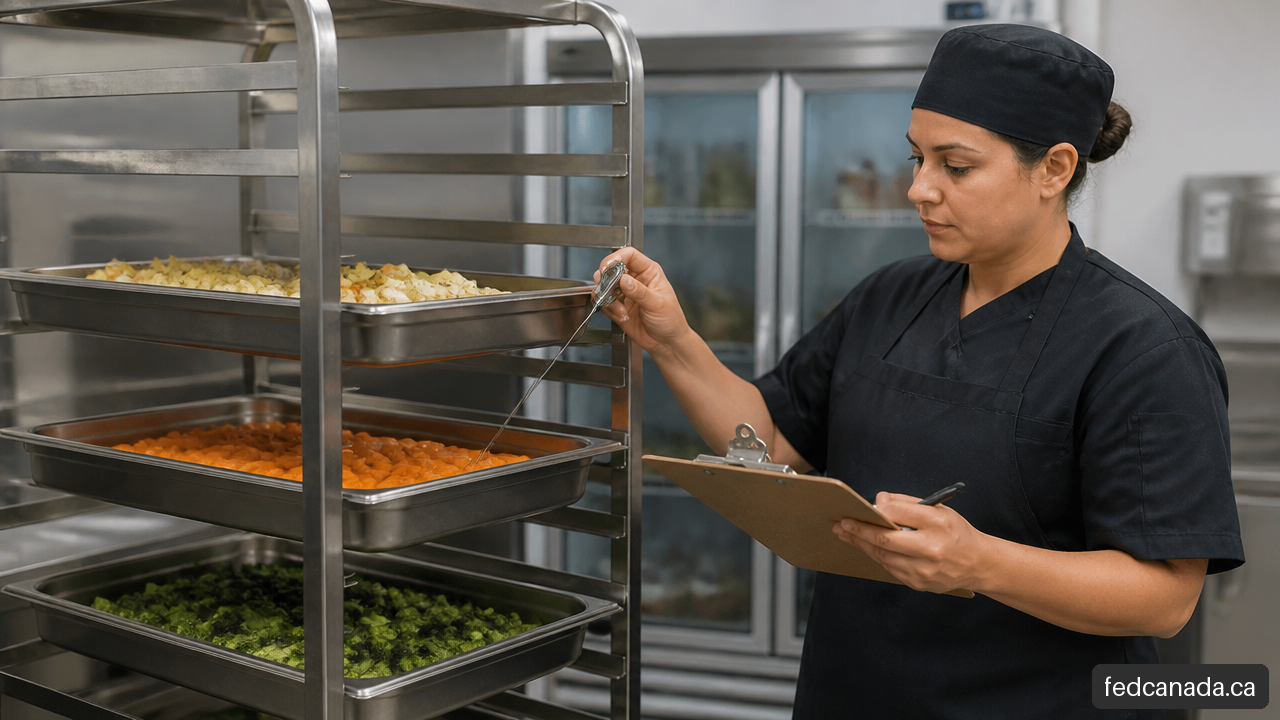
- Cool: Divide large batches into shallow containers, use ice baths where appropriate, leave adequate airflow around pans, or use rapid-cooling equipment. Never cover deep, hot containers tightly and expect the refrigerator to solve the problem.
- Reheat: Reheat cooled foods to 74°C before hot holding. Verify the center, then move food to the service equipment.
- Document and correct: Record readings at defined intervals and write down what happened when a limit was missed.
A useful rule: Equipment temperature tells us whether the machine appears to be operating. Food temperature tells us whether the food is actually controlled. Verify both.
Cool large batches with measurable checkpoints
Cooling is one of the most difficult stages because the food begins hot, the batch is often dense, and busy kitchens may need the same refrigerator space for raw ingredients, prepared food, and service backups.
The solution is not simply “put it in the cooler.” A deep stockpot of chili can stay warm at its center long after the outside feels cold. Instead, reduce the thickness of the food and increase surface area. Portion soups, sauces, curries, and cooked grains into shallow pans. Use cooling paddles, ice baths, or blast chilling when volume justifies the equipment. Leave space around containers so cold air can circulate.
Cooling requirements and record formats can vary by province and local public-health authority, so the food safety plan should use the checkpoints required in your jurisdiction. What should never vary is the need to track both time and temperature. A cooling log that says “cooled” provides no evidence that the center of the food moved safely through the danger zone.
For example, if a six-litre batch of sauce is still warm after refrigeration, do not assume the container is safe because its lid is cold. Measure the center. If the product is not cooling as expected, split it into smaller containers, use an approved rapid-cooling method, and assess whether the elapsed time permits recovery. Manitoba guidance notes that food held above 4°C for less than two hours can be returned to refrigeration; beyond that, the situation needs a more cautious assessment under the applicable procedure.
Verify thermometer accuracy and make logs useful
A digital probe thermometer is one of the most important food safety tools in a commercial kitchen, but it can create false confidence if it is inaccurate or used incorrectly. Probe placement matters as much as the display reading. A practical verification routine can include these actions:
- Check each active probe against a known reference method on a scheduled basis and whenever it is dropped, damaged, or gives a surprising reading.
- Follow the manufacturer’s instructions for calibration. Many models support an ice-water check, but the method and acceptable tolerance depend on the thermometer design.
- Clean and sanitize probes between foods, especially when moving from raw proteins to cooked or ready-to-eat food.
- Keep separate labeled probes, or clearly controlled cleaning procedures, for raw and cooked tasks during high-volume prep.
- Replace equipment that cannot be calibrated or repeatedly reads outside the acceptable tolerance set in your food safety plan.
There is not one universally published Canadian schedule for calibration frequency across all commercial kitchens. That is why the safest operational choice is a written schedule based on volume, equipment type, manufacturer instructions, and local inspection expectations. A high-volume kitchen using probes continuously may need more frequent verification than a low-volume café using them for a few batches daily.
Temperature logs should answer four questions: what was checked, when, what was the reading, and what action was taken? A useful corrective-action entry is specific: “Walk-in cooler measured 7°C at 10:15 a.m.; food temperatures checked; food moved to alternate cooler; maintenance called; recheck at 10:45 a.m. measured 3°C.” That record shows control, not merely a problem.
Match your controls to high-risk guests and provincial rules
Federal guidance provides a national safety baseline, but food premises are inspected and regulated through provincial, territorial, and local systems. Ontario guidance, for example, requires refrigerated food and cold food on service or display to stay at 4°C or lower. Other jurisdictions may specify monitoring records, cooling procedures, equipment standards, or corrective actions differently.
Before finalizing your procedures, confirm the rules that apply to your food premise, municipality, and menu. This matters especially for caterers, food trucks, long-term-care settings, hospitals, child-care operations, and buffets, where transportation, limited refrigeration, or vulnerable guests can raise the consequences of a failure.
When serving older adults, young children, pregnant people, or people with weakened immune systems, take the conservative route. Avoid relying on undercooked or temperature-sensitive menu items unless the operation has a clearly compliant process. A small temperature margin can become a large risk when the guest is more susceptible to foodborne illness.
FAQ: Commercial Kitchen Food Safety Temperature
What temperature should a commercial fridge be set to?
Set refrigerated storage to maintain food at 4°C or lower. In practice, the equipment setpoint may need to be lower than 4°C so food remains compliant during door openings, loading, and busy service. Confirm with an independent thermometer and product checks rather than relying only on the unit display.
What temperature should hot-held food stay at in a commercial kitchen?
Keep hot-held food at 60°C or higher. Check food in the pan, not only the steam-table setting. Stir soups and sauces before measuring because the top or edge may not reflect the coolest area.
What internal temperature does chicken need to reach?
Chicken pieces need to reach 74°C internally. Whole poultry requires 85°C under Health Canada guidance. Measure the thickest part and avoid touching bone, which can produce a misleading reading.
What temperature should ground beef be cooked to?
Ground beef and other ground meat mixtures should reach 71°C internally. This includes burgers, sausages, meatballs, and similar products because grinding can distribute bacteria throughout the food.
What is the safe reheating temperature for leftovers?
Reheat cooked and cooled leftovers to 74°C when they will be hot-held or served hot. Reheat with equipment that can raise temperature quickly, then move the food to the steam table or other holding equipment.
How long can food stay in the danger zone?
The answer depends on the food, its starting temperature, the time involved, and local food-premises rules. The danger zone is 4°C to 60°C, so kitchens should minimize exposure and record timing whenever temperature control fails. If the duration is unknown, treat that uncertainty seriously rather than assuming the food is safe.
How often should food temperatures be checked in a restaurant?
Check at critical points: receiving, opening, during hot or cold holding, cooling, reheating, and closing. The exact frequency should be written into the food safety plan. Fixed times such as opening, mid-shift, and close improve consistency, while high-risk service lines may need more frequent checks.
Which thermometer is best for a commercial kitchen?
A fast, accurate digital probe thermometer is the practical standard for internal food temperatures. Choose one that can be cleaned and sanitized, has a suitable temperature range, responds quickly, and can be verified or calibrated according to manufacturer instructions.
Recent Posts
Leave a Comment
Your email address will not be published. Required fields are marked *