




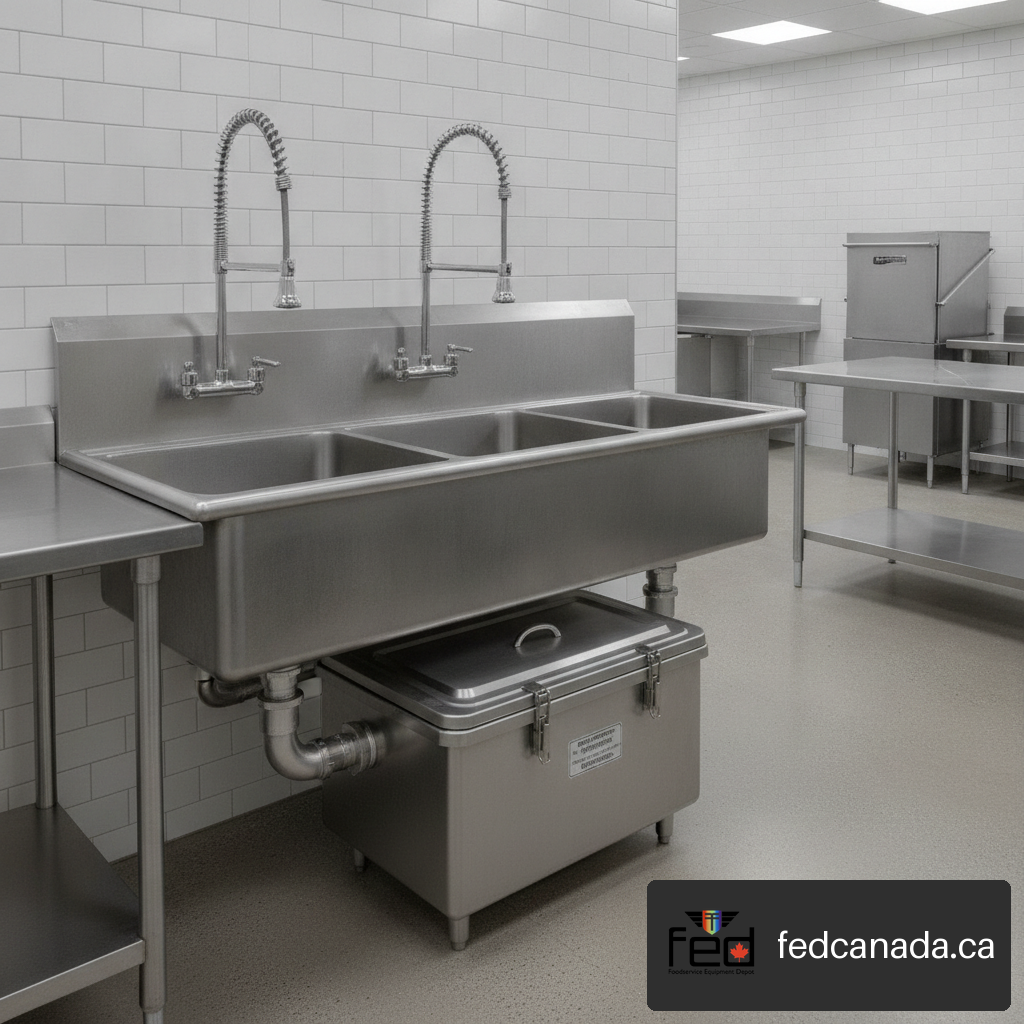
Grease Trap & Grease Interceptor Guide (Sizing, Install, Alberta Rules)
Managing fats, oils, and grease (FOG) is one of the most critical operational requirements for any commercial kitchen, cafeteria, bakery, or food processing establishment. Installing and maintaining a high-performance grease trap ensures smooth wastewater flow, protects municipal sewer infrastructure, and prevents costly emergency plumbing backups. In this comprehensive guide, we examine how passive and hydromechanical interceptors operate, how to accurately size equipment for your kitchen fixture load, key regulatory expectations in Alberta, and practical protocols for diagnosing drainage and odor issues.
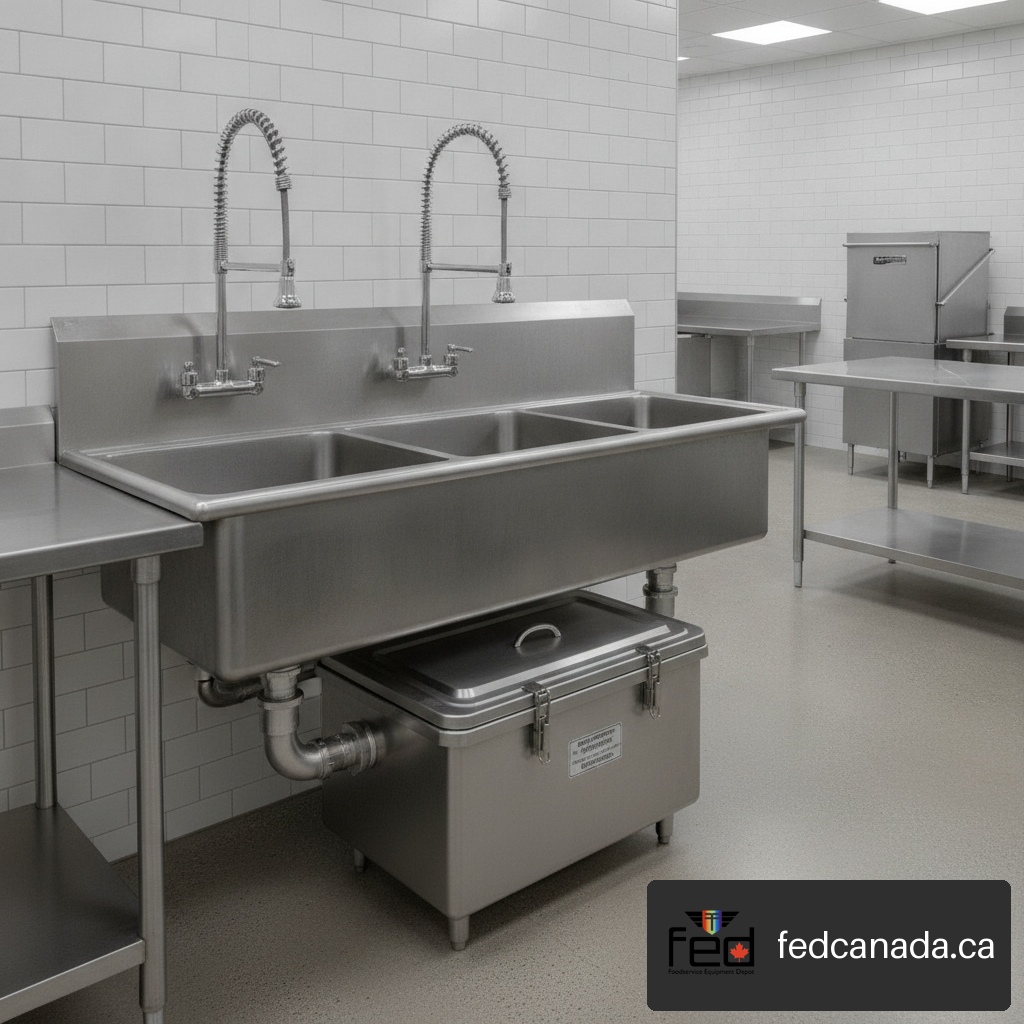
Table of Contents
- Understanding Grease Traps vs. Grease Interceptors
- Commercial Kitchen Sizing, Hydraulic Loading, and Alberta Regulatory Rules
- Step-by-Step Maintenance, Service Schedules, and Cleaning Protocols
- Troubleshooting Failure Modes: Odors, Backups, and Overflows
- Frequently Asked Questions About Grease Traps
- Sources and References
Key Takeaways
Specific Definition and Capacity: Smaller point-of-use units rated at 50 gallons per minute (GPM) or less are technically defined as grease traps, whereas high-capacity outdoor units are classified as gravity grease interceptors.
Gravity Separation Physics: Separation relies on buoyancy, thermal cooling, and fluid velocity reduction. Fats float to the top while heavy food solids settle in a dedicated sludge compartment.
Solids Block First: Starchy food particles, eggshells, and coffee grounds cause pipe and baffle obstructions far faster than pure grease accumulation.
Alberta Code Compliance: Municipal bylaws and provincial plumbing codes mandate approved flow control devices, proper venting, and strict logkeeping for scheduled pump-outs.
Systematic Diagnostics: Recurring backups after a fresh pump-out usually point to downstream line restriction, fixture vent failure, or internal component corrosion rather than an overfilled tank.
Understanding Grease Traps vs. Grease Interceptors
To manage commercial wastewater compliance effectively, operators must understand the technical distinction between point-of-use grease traps and large-scale grease interceptors. While both serve to protect sanitary drainage networks, their internal geometry, hydraulic flow rates, and maintenance demands differ substantially.
According to the City of Tampa wastewater guidelines, a grease trap is formally defined as an interceptor rated at 50 gallons per minute (GPM) or less, typically located indoors directly under or adjacent to kitchen fixtures across restaurants, schools, and care facilities.
Separation Mechanisms Under the Hood
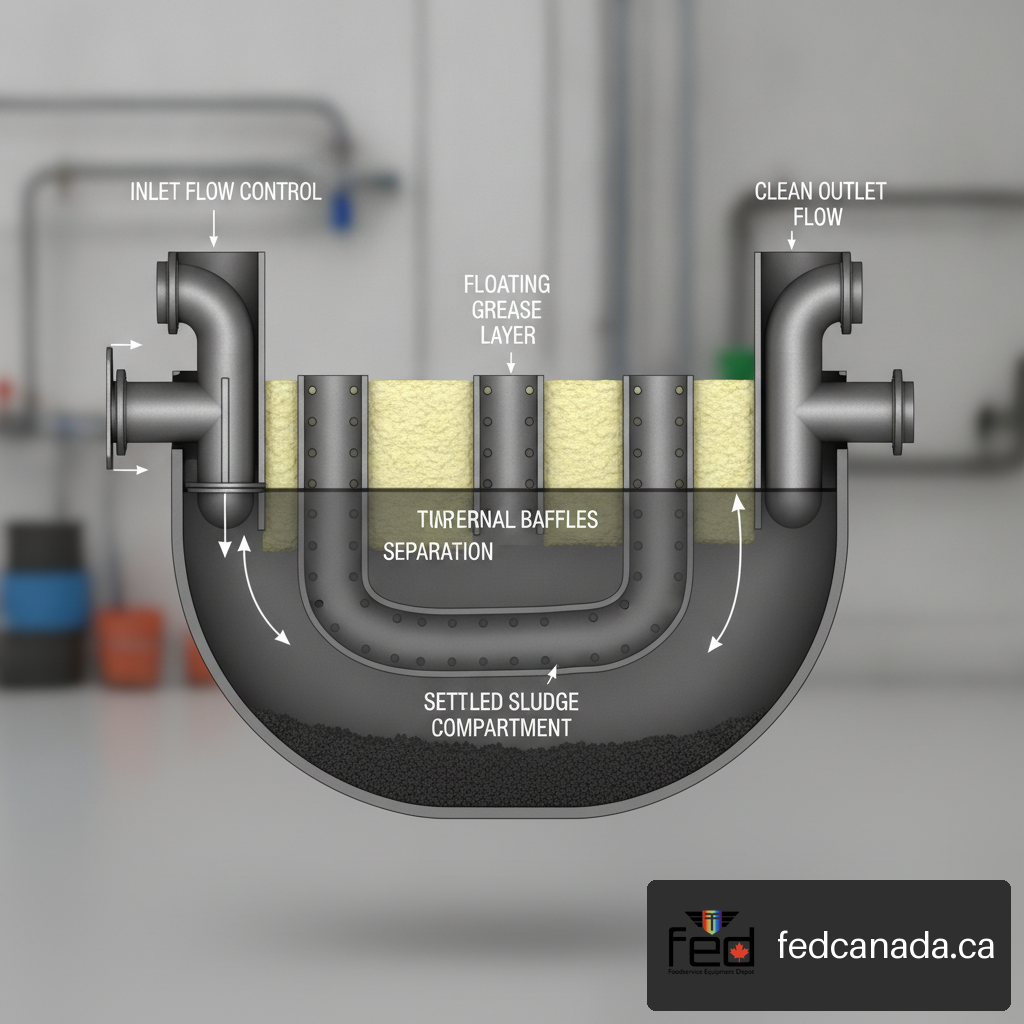
At its core, a grease trap functions as a passive physical separation chamber. When hot, greasy dishwater drains from a kitchen sink, it enters the unit at high velocity. As detailed in the Food and Environmental Hygiene Department's grease trap reference guide, effluent enters a multi-chamber tank where fluid velocity decreases rapidly, allowing lighter grease particles to float upward while dense waste settles to the floor.
Three primary physical principles enable this separation:
- Specific Gravity Difference: Animal fats and vegetable oils are less dense than water (typically having a specific gravity of 0.88 to 0.93 compared to water's 1.00). Given sufficient retention time, grease droplets naturally buoy to the liquid surface.
- Thermal Coagulation: As hot water cools down upon entering the larger fluid volume of the trap, molten grease solidifies into semi-solid crusts, making mechanical capture much easier.
- Laminar Velocity Control: Flow controls and internal baffles prevent turbulent currents from stirring up already separated grease layers or re-suspending settled solids.
As explained in DYKA's technical specifications for HDPE grease traps, modern interceptor designs incorporate dedicated sludge retention zones to hold heavy food waste at the bottom while clean wastewater flows underneath the downstream outlet baffle.
Key Operational Differences (Trap vs. Interceptor)
Choosing between an under-sink grease trap and an exterior gravity interceptor depends on kitchen volume, available floor space, and municipal discharge regulations. The table below outlines the major operational parameters separating these two equipment categories:
| Technical Parameter | Under-Sink Hydromechanical Grease Trap | Outdoor / Underground Gravity Grease Interceptor |
|---|---|---|
| Flow Rate Capacity | 10 to 50 Gallons Per Minute (GPM) | 75 to 500+ Gallons Per Minute (GPM) |
| Liquid Retention Capacity | 20 to 100 Gallons total volume | 500 to 2,500+ Gallons total volume |
| Primary Separation Force | Hydromechanical turbulence reduction & flow control | Long hydraulic retention time (25-30+ minutes gravity delay) |
| Installation Location | Indoors, directly beneath sink or in floor recess | Outdoors underground, under parking lots or service alleys |
| Typical Construction | Stainless steel, high-density polyethylene (HDPE), coated cast iron | Precast concrete, fiberglass, heavy structural polyethylene |
| Cleaning Protocol | Manual cleaning or frequent vacuum extraction (weekly to monthly) | Heavy-duty pump truck vacuum servicing (every 60 to 90 days) |
| Capital & Install Cost | Lower initial equipment cost; simple plumbing hookups | Higher civil engineering, excavation, and contractor costs |
Internal Baffles, Flow-Control Devices, and Solids Interceptors
A complete grease management assembly consists of more than just a hollow reservoir. Three internal components dictate whether the unit achieves its rated retention efficiency:
Flow-Control Fitting: Positioned on the inlet piping upstream of the trap, this vented fitting restricts incoming flow rate to match the trap's rated GPM capacity. Without an operational flow control device, a sudden discharge from a fully drained three-compartment sink will overwhelm the chamber, pushing unseparated grease directly into the building drain line.
Baffle Plates: Vertical partitions inside the tank force incoming wastewater into a downward path, creating a calm retention zone. The outlet baffle extends deep into the middle layer of clear water, ensuring neither floating grease nor bottom sludge escapes into the discharge piping.
Upstream Solids Interceptors: Fine food residues, rice, batter scrapings, and coffee grounds sink rapidly. If introduced directly into a standard grease trap, heavy solids combine with grease to form a dense, cement-like mass. Installing an independent strainer bucket or solids collector upstream of the grease trap prevents early clogging and preserves fluid volume.
Commercial Kitchen Sizing, Hydraulic Loading, and Alberta Regulatory Rules
Sizing a grease trap requires accurate calculation of fixture discharge rates and strict adherence to regional building and environmental codes. Installing an undersized trap leads to rapid overflow and frequent regulatory fines, while an oversized unit can suffer from stagnant wastewater, anaerobic sulfur emissions, and pipe corrosion.
Sizing Calculations and Hydraulic Capacity
Hydromechanical grease traps are sized based on maximum peak flow rate measured in GPM or liters per second (L/S). To select the right size for standard three-compartment warewashing sinks, operators use the fixture volume calculation formula:
- Measure Internal Sink Dimensions: Multiply length × width × depth (in inches) of all sink compartments combined.
- Convert Volume to Gallons: Divide the total cubic inches by 231 to obtain the total capacity in liquid gallons.
- Determine Actual Operational Fill: Sinks are rarely filled to the top brim; calculate liquid volume at 75% capacity (multiply total gallons by 0.75).
- Apply Drain-Down Time: Standard plumbing standards assume a 1-minute or 2-minute sink drain period. Divide the 75% volume figure by the target drain time (1 or 2 minutes) to derive the required GPM rating.
- Factor in Auxiliary Equipment: Add 5 GPM for every additional connected fixture, such as pre-rinse sinks, vegetable washing stations, or wok tables.
For example, consider a 3-compartment sink with basin dimensions of 18" × 18" × 12":
Single compartment volume = 18 × 18 × 12 = 3,888 cubic inches.
Three compartments combined = 3,888 × 3 = 11,664 cubic inches.
Total capacity in gallons = 11,664 / 231 = 50.5 gallons.
Operational 75% liquid volume = 50.5 × 0.75 = 37.8 gallons.
Recommended rating for a 1-minute drain time = 40 GPM grease trap (with matching flow control valve).
Provincial and Municipal Plumbing Code Compliance in Alberta
In Alberta, commercial foodservice establishments are regulated under the National Plumbing Code of Canada (as adopted provincially), alongside municipal sewer service bylaws enforced by local authorities such as the City of Calgary, the City of Edmonton, and regional municipalities.
Key compliance requirements for Alberta food operations include:
Mandatory Point Interception: Any fixture discharging oil, fat, or grease—including pot sinks, dishwashing stations, combi ovens, and floor drains in food prep zones—must pass through an approved interceptor before entering the public sanitary sewer.
Prohibition of Unapproved Waste Streams: Garbage disposals (solids grinders) and sanitary blackwater (toilets, urinals) must never discharge into a grease trap.
Venting Requirements: Each hydromechanical interceptor must feature a dual-vent arrangement. The flow control fitting requires an air intake vent to prevent siphonage, while the outlet side must connect to the building stack to safely vent sewer gases outdoors.
Temperature and Chemical Limits: Commercial dishwasher lines emitting high-temperature water (above 60°C / 140°F) or heavy chemical detergents should generally bypass small under-sink traps unless the interceptor is explicitly rated for thermal separation. High heat emulsifies captured fats, driving liquefying grease downstream into cold municipal mains where it hardens into thick obstructions.
Equipment Selection Criteria for Restaurants and Institutions
When specifying a grease interception system for new construction or kitchen remodels, match the equipment design to your facility's specific menu and operational workflow:
Quick-Service Coffee Shops & Bakeries: Low grease loads but high dairy, milk solids, and batter waste. Compact 15 to 25 GPM stainless steel or HDPE under-sink traps fitted with fine mesh solids basket strainers are ideal.
Full-Service Restaurants & Steakhouses: High grease volume combined with heavy solid debris. Require high-capacity indoor hydromechanical units (50 GPM) or dedicated outdoor exterior gravity interceptors (750 to 1,500 gallons).
Institutional Cafeterias & Hospitals: Continuous high-volume washing operations requiring continuous-duty automatic grease recovery devices (AGRD) or multi-tank subterranean interceptor banks.
Food Trucks & Mobile Catering Units: Space-constrained environments requiring low-profile, leak-proof 10 to 20 GPM compact interceptors with sealed, gasketed lids to prevent spills during vehicle transit.
Step-by-Step Maintenance, Service Schedules, and Cleaning Protocols
No matter how well designed an interceptor is, its effective separation efficiency drops sharply as captured grease and solids accumulate. Establishing routine maintenance schedules and strict post-servicing verification ensures long-term operational performance.
Cleaning Frequency vs. Device Capacity
A widely accepted standard across municipal wastewater management is the 25% Rule. This rule dictates that when the combined volume of floating grease crust and bottom settled sludge occupies 25% or more of the grease trap's total liquid depth, the unit is considered full.
Beyond the 25% threshold, hydraulic retention time drops significantly. Fast-moving wastewater creates narrow channels through the accumulated solids, washing newly introduced grease directly past internal baffles and out into the municipal sewer system. Increasing pumping frequency is essential, but operators must remember that frequent cleaning cannot correct underlying issues like undersized equipment, blocked discharge pipes, or missing flow control valves.
Complete Servicing vs. Partial Automatic Strainer Maintenance
Different grease removal systems require distinct daily and monthly maintenance workflows:
- Manual Hydromechanical Traps: Must undergo a complete pump-out and scraping service on a pre-scheduled rotation (typically every 1 to 4 weeks depending on kitchen volume). Skimming only the top grease layer while leaving bottom sludge intact reduces working capacity and rapidly causes foul septic odors.
- Automatic Grease Removal Devices (AGRD): These motorized units feature internal heating elements and rotating wheels or belts that continuously skim floating liquid oil into an external collection container. Kitchen staff must empty the skimmed oil container daily and clean top strainer baskets. However, complete periodic tank pump-outs are still required to flush out settled floor sediment and inspect heating elements.
Post-Cleaning Verification Protocol and Logkeeping
Following any service event—whether performed by kitchen staff or a licensed vacuum truck contractor—operators should run a quick post-cleaning verification check:
Visual Inspection of Internal Baffles: Confirm that inlet and outlet baffles, flow control tees, and internal divider walls are intact, securely mounted, and free of structural cracks.
Gasket and Seal Verification: Clean the lid sealing channel thoroughly. Inspect rubber gaskets for dry rot, swelling, or tearing. Replace worn gaskets immediately to maintain an airtight seal.
Flow Restoration Test: Fill the upstream sink with clean water and perform a full discharge test. Verify that water drains rapidly without gurgling, backed-up water in floor drains, or liquid seepage around the interceptor cover.
Regulatory Recordkeeping: Municipal inspectors in Alberta frequently conduct unannounced audits. Maintain an on-site service log detailing cleanout dates, measured grease/sludge thickness, volume removed, waste haul disposal destination, and technician sign-offs.
Troubleshooting Failure Modes: Odors, Backups, and Overflows
When a kitchen experiences slow drainage or noxious odors, staff often assume the grease trap is simply due for a pump-out. However, diagnostic evidence demonstrates that plumbing failures stem from several distinct sources along the drainage network.
Symptom-to-Cause Decision Matrix
Use the structured decision matrix below to isolate root causes and initiate appropriate corrective action based on specific visual and operational symptoms:
| Primary Symptom | Observed Conditions | Most Likely Root Cause | Immediate Diagnostic & Corrective Action |
|---|---|---|---|
| Sinks Back Up Right After Service | Trap is completely empty, yet upstream fixtures drain slowly or overflow. | Upstream fixture clog or downstream main line obstruction. | Snak/hydro-jet drain lines downstream of the trap; inspect fixture P-trap for food scrap buildup. |
| Persistent Foul Odors Near Trap | Tank was cleaned, but strong rotten-egg (H2S) smells persist around lid. | Perished lid gasket, loose cover bolts, or unvented flow control device. | Replace lid gasket rubber; verify air-intake tee is installed on inlet flow control fitting. |
| Rapid Re-Clogging Within Days | Trap fills with heavy solids shorting out retention space within 5–7 days. | High food scrap loading; missing upstream strainer; broken internal baffle. | Install food scrap basket strainers in sink basins; inspect internal baffle wall for collapse. |
| Grease Bypassing to Sewer Line | Effluent entering building drain carries thick grease sheen or floating chunks. | Missing flow control valve; thermal overload from high-temp dishwasher. | Install correct GPM flow control fitting; reroute hot dishwashing discharge around small trap. |
| Water Leaking Around Base | Liquid pooling around outdoor concrete pad or floor pit housing. | Body corrosion, cracked polyethylene wall, or failed inlet seal. | Perform hydrostatic leak test; rehabilitate concrete coating or replace cracked trap housing. |
Diagnosing Upstream, Downstream, Venting, and Trap Failures
When troubleshooting system failures, follow a systematic isolation sequence to identify the exact point of restriction:
- Check the Fixture P-Trap: Disassemble or inspect the P-trap directly beneath the sink basin. Potato peels, rice, and dense starches frequently collect in fixture elbows long before reaching the main interceptor tank.
- Inspect the Inlet Flow-Control Fitting: Remove the air vent cap on the flow control tee. Food debris can block the small orifice, preventing smooth air intake and creating a vacuum seal that slows sink drainage.
- Examine the Interceptor Chamber: Open the access lid. If water level rests normal (at the invert level of the outlet pipe), the trap is functioning properly. If liquid overflows over the top rim when sinks run, the blockage lies downstream in the building drain or main sewer line.
- Verify Plumbing Vents: Gurgling sounds during drainage point to a blocked roof vent stack. Negative pressure siphonage can pull water out of fixture P-traps, allowing sewer gas to vent directly into work spaces.
Corrosion, Structural Degradation, and Seal Failures
Grease traps operate in aggressive chemical environments. As trapped organic material decomposes anaerobically, bacteria produce hydrogen sulfide gas ($H_2S$), which converts to sulfuric acid ($H_2SO_4$) on damp internal surfaces. This biological acid attack causes distinct material failure modes:
Coated Carbon Steel Traps: Acid rapidly strips interior epoxy coatings, exposing metal walls to rust perforation and pinhole leaks along the waterline.
Precast Concrete Interceptors: Sulfuric acid eats away structural concrete matrix above the liquid line, exposing rebar reinforcement, eroding interior baffles, and causing wall collapse over time.
Synthetic Traps (HDPE/Polypropylene): Completely immune to acid corrosion, but remain vulnerable to mechanical damage, lid warping, or gasket deterioration under thermal stress.
Seal & Gasket Degradation: Gasket materials absorb vaporized fats over time, swelling, softening, and breaking the airtight seal. Replacing damaged lid seals quickly resolves persistent odor complaints after an overflow or pump-out event.
Frequently Asked Questions About Grease Traps
What is a grease trap, and how does it work?
A grease trap is a plumbing device designed to intercept fats, oils, grease, and food solids from commercial kitchen wastewater before it enters the sanitary sewer system. It works through gravity separation: incoming warm wastewater slows down inside the tank, allowing lighter grease particles to rise to the top surface while heavier food waste settles to the bottom, letting clarified water flow out underneath an outlet baffle.
What is the primary difference between a grease trap and a grease interceptor?
The primary differences lie in flow capacity, liquid volume, and installation style. A grease trap is generally a smaller indoor unit rated at 50 gallons per minute (GPM) or less, installed directly under sinks. A grease interceptor is a much larger unit—often rated over 75 to 500+ GPM with liquid volumes ranging from 500 to 2,500+ gallons—typically installed outdoors underground.
Do I need a grease trap under every commercial kitchen sink?
Not every single sink requires its own dedicated trap, but all fixtures discharging grease, oil, or food waste—such as 3-compartment pot sinks, pre-rinse sinks, wok lines, and floor drains in cook zones—must route to an approved grease interceptor. Standard handwashing sinks and clean water condensate drains do not require grease separation.
How often should a commercial grease trap be cleaned or pumped?
Cleaning frequency depends on kitchen volume and unit capacity, but most commercial facilities operate on a 1- to 4-week service interval for small under-sink traps, and a 60- to 90-day cycle for large exterior gravity interceptors. Under standard municipal guidelines, units must be fully pumped whenever the combined thickness of floating grease and bottom sludge exceeds 25% of the total liquid depth.
Why does my sink back up even though the grease trap was recently serviced?
If sinks back up immediately after a complete pump-out, the problem is usually located outside the trap. Common causes include a clogged fixture P-trap upstream, a heavy grease block in the main drainage pipe downstream of the interceptor, or a blocked plumbing vent stack causing severe air locking.
Can food scraps and starches clog a grease trap faster than grease?
Yes. Dense food particles, raw starches (like potato, pasta, or rice waste), and coffee grounds sink rapidly to the tank floor, building up heavy sludge beds. This sludge consumes effective fluid retention space far faster than floating grease, driving liquid velocities up and forcing unseparated grease straight into the discharge line.
What should never be poured into a grease trap system?
Never pour concentrated deep fryer oil, chemical drain openers, biological enzyme emulsifiers, motor oil, coffee grounds, or heavy trash down drains connected to a grease trap. Used cooking oil should always be collected separately in yellow grease recycling drums rather than dumped down sinks.
Sources and References
City of Tampa — Grease Trap Guidelines & Sizing Regulations
Food and Environmental Hygiene Department — Technical Guide to Grease Traps
DYKA — HDPE Commercial Grease Trap Technical Manual
Recent Posts



Leave a Comment
Your email address will not be published. Required fields are marked *