




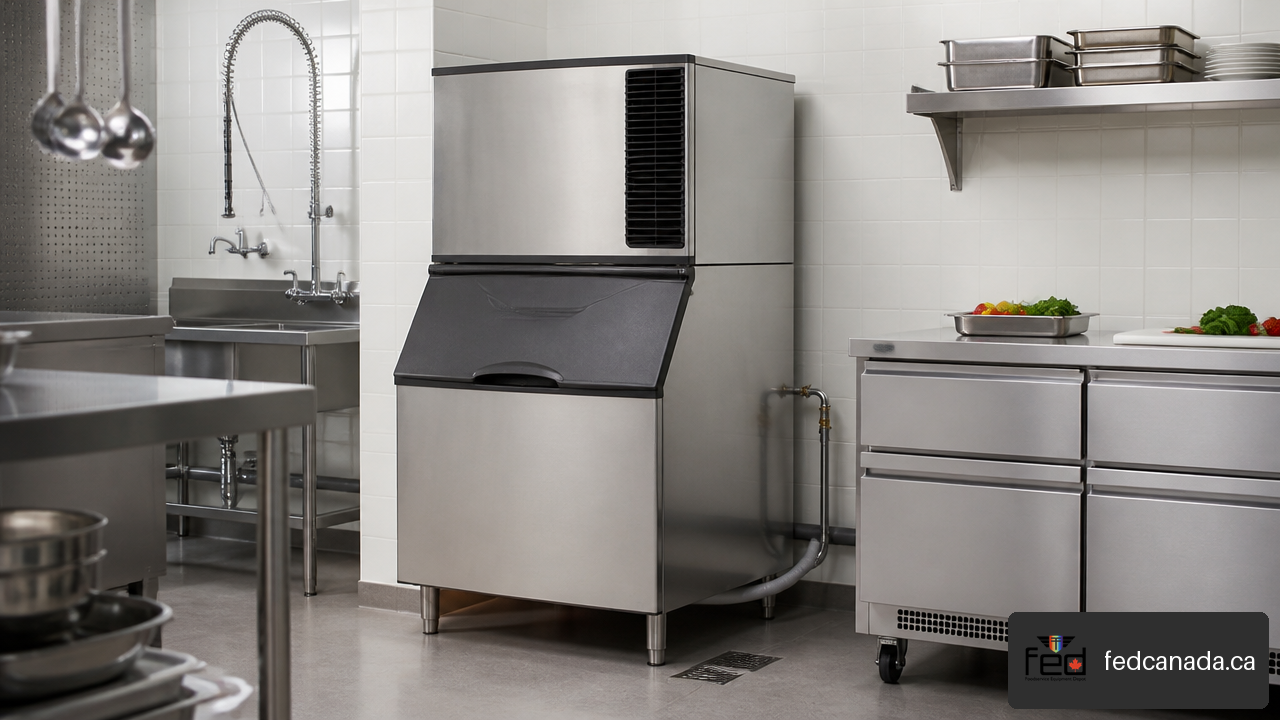
Hoshizaki Ice Machines and Refrigeration Buying Guide
Hoshizaki Ice Machines and Refrigeration: Settings, Troubleshooting and Buying Guide starts with one practical rule: use the exact model manual before changing settings or replacing parts. Hoshizaki equipment is built across several ice and refrigeration families, and a setting, error indicator, water-flow value, or harvest adjustment that applies to one unit may be incorrect for another.
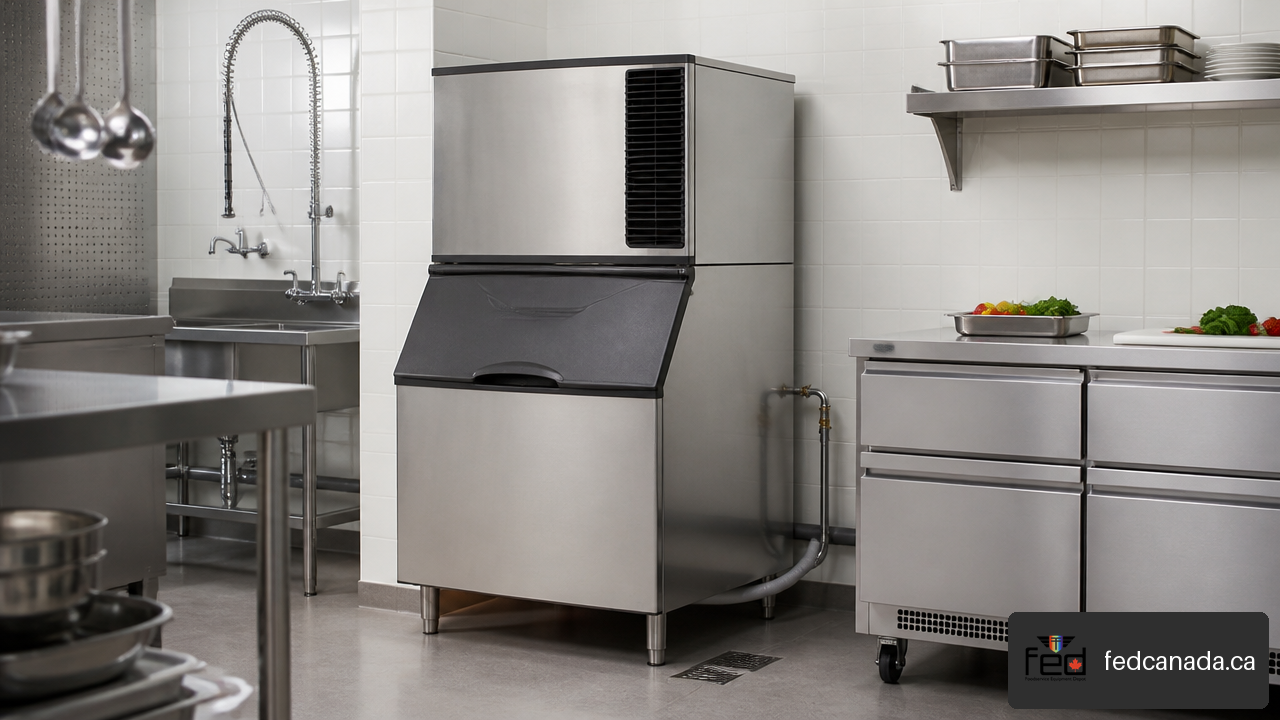
For day-to-day operation, we recommend separating what operators can safely inspect and clean from tests that require a qualified refrigeration technician. That approach protects the machine, reduces avoidable downtime, and avoids common mistakes such as adjusting dip switches before confirming water flow, voltage, or condenser conditions.
Table of Contents
- Set Hoshizaki equipment correctly
- Troubleshoot by cycle stage
- Choose the right Hoshizaki model
- Key takeaways
- Frequently asked questions
- Sources and references
Settings That Protect Ice Production and Food Storage
Start with the exact model and serial number
The model number is the starting point for every setting and service decision. It identifies the equipment family, electrical configuration, refrigerant system, ice type, production rating, control-board design, and approved maintenance procedures.
Hoshizaki’s Product Manuals & Guides database allows users to locate the applicable documentation with the complete model number, including dashes, or the serial number. Use that documentation before interpreting an alarm, changing a control, or ordering a replacement part.
This matters because two machines can look similar while using different controls. A modular KM cuber, for example, does not necessarily share the same water circuit, sensor logic, or dip-switch configuration as another Hoshizaki unit. Refrigerated cabinets have the same issue: controller settings, defrost arrangements, and probe locations can differ by series.
Refrigerator and freezer temperature settings
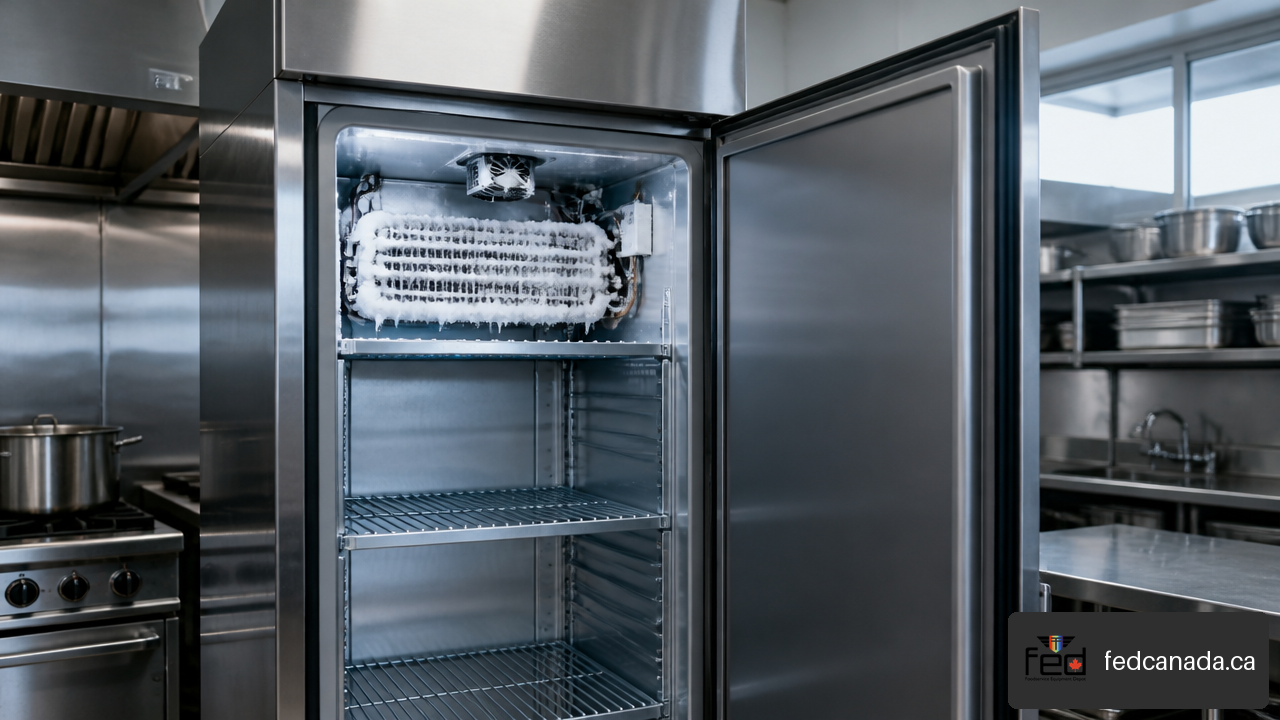
For Hoshizaki refrigerated equipment, the controller setpoint is not the same thing as the product temperature at every location inside the cabinet. Door openings, warm food loading, airflow blockage, dirty condensers, and a packed evaporator cover can all make stored product warmer than the display suggests.
Hoshizaki’s Commercial Series service manual lists a refrigerator setting of 36°F (3°C) and a freezer setting of minus 4°F (minus 20°C) for the covered equipment. The manual also states that technicians should review the applicable service documentation before maintenance. Treat those settings as series-specific reference points, not universal values for every Hoshizaki refrigerator or freezer.
A sensible operating check includes three observations:
Compare the controller display with a calibrated thermometer placed in a product-simulating medium, not directly in the air stream.
Confirm that pans, boxes, and packaging are not blocking evaporator airflow.
Check whether temperature rise happens after door openings, during busy service periods, or continuously.
If a cabinet reaches setpoint overnight but warms during lunch service, the problem may be loading practice or airflow rather than a failed refrigeration component. If it cannot recover even with doors closed and proper clearance, a technician should evaluate the refrigeration system.
Ice machine settings: avoid universal adjustments
Ice-machine controls govern the freeze cycle, harvest cycle, refill behavior, safety shutdowns, and sometimes configuration options. Settings may be adjusted by control-board programming, jumpers, or dip switches depending on the model. That is why there is no safe universal dip-switch table for Hoshizaki equipment.
Do not lengthen harvest time simply because ice is slow to release. A longer harvest may conceal a dirty evaporator, restricted water distribution tube, weak hot-gas valve, incorrect water level, or refrigeration fault. It can also reduce production because the machine spends less time freezing ice.
Fair warning: a setting is only a correction when the exact manual identifies it as appropriate for the machine and symptom. Otherwise, it is an uncontrolled variable added to an already unclear diagnosis.
Water, drainage, and condenser conditions
Water delivery affects cube thickness, formation consistency, and harvest performance. Hoshizaki training guidance gives example incoming-water-flow requirements of 3 gallons per minute for selected KM-250 through KM-800 models and 5 gallons per minute for selected KM-1200 through KM-2400 models. Those figures are useful only for the stated ranges; other models must be checked against their own documentation.
The manufacturer’s training and technical guidance also notes that diagnostic measurements must be compared with model-specific data. For applicable water-cooled machines, it references condenser outlet-water adjustment between 100°F and 110°F, subject to the unit’s technical specifications.
Do not overlook drainage. Some Hoshizaki designs use overflow-style water filling. A blocked standpipe, drain route, or check valve can change reservoir behavior and lead to symptoms that resemble a fill or float-switch issue.
Troubleshoot by Cycle Stage, Not by Guesswork
A measurement-first workflow
When an ice machine stops producing, begin by identifying when it fails. Does it fail to fill, freeze, harvest, refill, or restart? Mapping the failure to a cycle stage is more useful than replacing the component most commonly blamed online.
Use this sequence before authorizing major repairs:
Record the exact model and serial number, room temperature, water condition, error lights or beeps, and the point where the cycle stops.
Inspect operator-safe items: water shutoff position, visible leaks, drain flow, ice-bin level, air intake clearance, exterior condenser cleanliness, and obvious scale.
Measure basic conditions against the model documentation: supply voltage, water flow where specified, cabinet temperature, and cycle timing.
Check the component related to the failed stage, such as float switch and pump during water-system faults or condenser fan operation during heat-related production loss.
Escalate live electrical, refrigerant-pressure, sealed-system, control-board, or hot-gas-valve work to a qualified technician.
This method reduces unnecessary part changes. A machine with low water flow and a dirty float switch may produce thin or uneven ice even when the compressor is operating normally. Replacing a compressor in that situation does not solve the water-side restriction.
Symptom-to-cycle-stage diagnostic map
| Cycle stage or symptom | Likely area to inspect first | Operator-safe response | Technician-level follow-up |
|---|---|---|---|
| Unit does not fill | Water supply, inlet screen, float switch, reservoir drain path | Confirm valve is open, inspect visible restrictions, clean as manual permits | Test inlet valve, float-switch operation, control signals |
| Water is present but ice forms poorly | Distribution tubes, pump, scale, incoming flow | Clean and align water-contact parts per manual | Verify pump performance and model-specific flow requirements |
| Ice forms but will not release | Scale, evaporator condition, harvest transition | Complete approved cleaning and inspect for visible obstruction | Test harvest controls, hot-gas valve, sensors, and refrigeration performance |
| Production falls in hot weather | Airflow, condenser coil, fan, room temperature | Clear approved airflow space and clean accessible condenser surfaces | Test fan motor, pressures, charge, and heat-rejection performance |
| Machine shuts down or alarms | Model-specific error code, voltage, water level | Record indicators and reset only if manual directs it | Diagnose board inputs, safety circuit, motor, or sealed system |
Water-system faults: what the symptoms are telling you
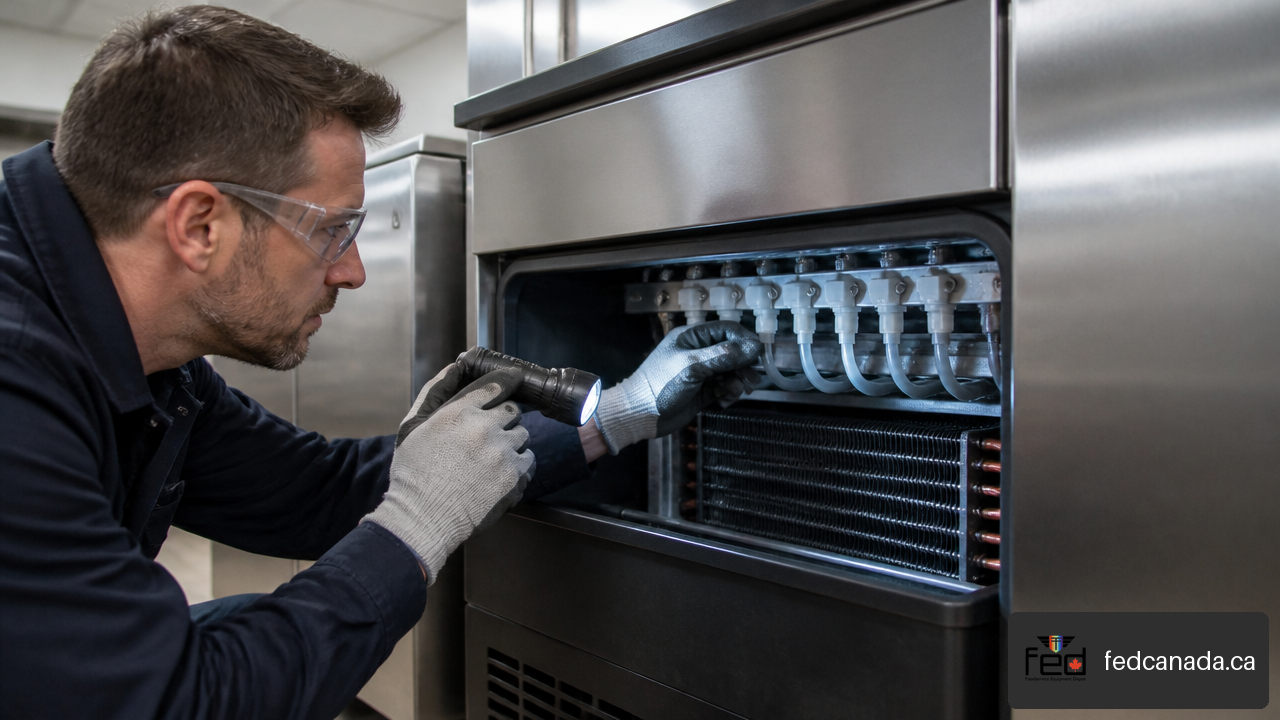
Blocked distribution tubes can create small, hollow, uneven, or missing cube sections because water is no longer spreading evenly across the evaporator. Mineral scale is a frequent underlying cause. It can restrict tubes, interfere with water-level sensing, burden pumps, reduce heat transfer, and make ice release less predictable.
That chain reaction is worth understanding. A visible scale deposit is not merely a sanitation concern. It can become a production concern because it changes how water moves and how ice forms. On auger-style equipment, practitioner discussions have also associated heavy mineral buildup with increased resistance and abnormal squealing. That is a diagnostic clue, not a universal conclusion; the model manual and a professional inspection remain necessary.
For operator-safe maintenance, shut the unit down as directed, remove ice, use the manufacturer-approved cleaning process, rinse thoroughly, and reassemble distribution components carefully. A tube that is clean but misaligned can still leave dry areas on the evaporator.
Refrigeration, electrical, and heat-related faults
A machine that performs normally in cool conditions but loses production during hot weather needs an installation and heat-rejection review. Start with ambient temperature, clearance, coil cleanliness, and condenser-fan operation. Air-cooled machines reject heat into the surrounding room; when that air is hot or blocked, the refrigeration system works under greater load.
The possible causes may include a dirty condenser, a weak fan, restricted ventilation, or a sealed-system issue. These causes overlap in appearance, which is why pressure guesses are unreliable. Hoshizaki guidance for some diagnostics calls for checking high-side and low-side pressures approximately five minutes into the freeze cycle and comparing results with the exact model’s performance data.
Do not add refrigerant based on a symptom alone. A confirmed leak requires proper repair and charging by weight to the nameplate specification. Likewise, voltage must match the equipment nameplate. Hoshizaki’s VSR27A and VSR48A service documentation identifies correct installation and voltage verification as part of troubleshooting.
Buying a Hoshizaki Ice Machine or Refrigerated Cabinet
Choose by operating constraints, not daily rating alone
A production rating is useful, but it is not a complete buying decision. Ice output is affected by incoming water temperature, room temperature, condenser type, maintenance condition, and installation quality. A unit selected only for its nominal daily output can become undersized in a hot kitchen or oversized for a low-volume operation with limited bin space.
Use the buying matrix below to compare the constraints that determine whether equipment will work reliably in the intended location.
| Buying factor | Choose this when | Avoid or reconsider when |
|---|---|---|
| Higher production capacity | Peak service demand is concentrated, such as a busy bar or banquet operation | Ice demand is modest and the space cannot support the equipment, bin, and ventilation needs |
| Air-cooled condenser | Water use is a concern and the room has adequate airflow and clearance | The location is exceptionally hot, dusty, enclosed, or unable to reject heat properly |
| Water-cooled condenser | The installation supports water supply and drainage requirements and heat rejection through air is difficult | Water consumption, plumbing cost, or local operating restrictions make it impractical |
| Remote condenser | Noise and heat need to be moved away from the service area and installation planning is available | There is no practical route, approved location, or service access for remote components |
| Larger ice bin | Demand arrives in bursts and staff need reserve ice during peak periods | Floor space is limited or ice is likely to sit too long before use |
| Refrigerated cabinet with more capacity | Product volume, pan layout, and recovery needs justify it | The larger footprint reduces workflow space or creates airflow restrictions |
Match ice type and bin capacity to service patterns
Start with the product being served. Cube size and shape affect presentation, melt rate, dispensing, and packing. A cocktail-focused bar may prioritize clear, consistent cubes. A quick-service beverage station may need fast, high-volume dispensing. Seafood display, healthcare, blended beverages, and self-service applications can have different ice-form requirements.
Then calculate the service pattern, not just average daily use. Consider a café that needs 120 pounds of ice across a day but uses half of it from 11 a.m. to 2 p.m. A machine with adequate daily production but too little bin storage may fall behind during that peak. Conversely, a large bin may be unnecessary for a venue with steady production and lower surge demand.
Plan utilities before ordering
Before purchase, confirm five items at the installation location:
Electrical supply: Voltage, phase, frequency, breaker capacity, and receptacle or hardwire requirements must match the nameplate.
Water supply: Verify shutoff access, water quality, pressure, and model-specific flow requirements.
Drainage: Confirm gravity drain or approved pump arrangement, drain routing, and floor conditions.
Ventilation and clearance: Air-cooled units need enough space to reject heat and permit cleaning.
Service access: Leave room to remove panels, inspect water components, clean condensers, and perform future repairs.
A compact installation may look efficient on opening day but become expensive when a technician cannot access a side panel or a condenser cannot be cleaned. Plan for maintenance from the beginning.
New, used, open-box, or clearance equipment
Budget matters, especially during an opening or urgent replacement. New equipment generally offers the clearest warranty and installation path. Used, open-box, scratch-and-dent, or clearance equipment can reduce upfront cost, but the buyer should verify model number, electrical requirements, condition, included accessories, warranty coverage, and delivery details.
We recommend treating a lower purchase price as only one part of the comparison. A value-priced machine that does not match available voltage, drainage, or ventilation can cost more after installation changes. For used equipment, ask whether cleaning, testing, ice bin components, water fittings, and service access have been considered before delivery.
Key Takeaways
Use the complete model and serial number before changing settings, interpreting alerts, or ordering parts.
Treat refrigerator and freezer setpoints as model-specific references, then verify actual product temperature and airflow.
Diagnose ice machines by cycle stage: fill, freeze, harvest, refill, or shutdown.
Clean scale and inspect water distribution before assuming a refrigeration failure.
Do not generalize dip-switch positions, pressure values, water-flow requirements, or harvest timing across models.
Buy for peak demand, utilities, drainage, ventilation, bin storage, and future service access, not production rating alone.
Frequently Asked Questions
How do I find the correct Hoshizaki service manual?
Use the complete model number, including dashes, or the serial number on the equipment nameplate. The exact document matters because settings, wiring, diagnostics, and component layouts vary by model family.
What temperature should a Hoshizaki refrigerator or freezer be set to?
For the Hoshizaki Commercial Series manual referenced above, the listed settings are 36°F for refrigeration and minus 4°F for freezing. Confirm the setting in the manual for your exact model, then verify actual product temperature with an appropriate thermometer.
Why has my Hoshizaki ice machine stopped making ice?
First determine the failed stage: no fill, no freeze, no harvest, no refill, or shutdown. Check water supply, drainage, visible scale, bin condition, airflow, and alarms before requesting service. A technician is needed for live electrical checks, refrigeration pressures, leaks, and control-board diagnosis.
Why is the machine making less ice than its rated capacity?
Production ratings depend on specified test conditions. Hot ambient air, warm incoming water, restricted condenser airflow, scale, poor water distribution, low water flow, and high service demand can all reduce real-world output. Compare actual site conditions with the model specifications before concluding that the unit is defective.
Can blocked distribution tubes cause uneven cubes?
Yes. Restricted or misaligned distribution tubes can leave parts of the evaporator with insufficient water, resulting in uneven or incomplete ice formation. Clean and reinstall these components only as directed in the machine manual.
Can I adjust Hoshizaki dip switches to make harvest longer?
Only if the service manual for the exact model calls for that adjustment and the diagnosis supports it. Do not use a setting from another Hoshizaki model. First rule out scale, water distribution problems, sensor issues, and refrigeration faults.
How often should a Hoshizaki ice machine be cleaned?
The cleaning interval depends on water quality, usage, installation conditions, and the model’s instructions. Hard water or visible scale usually calls for more frequent attention. Follow the manufacturer’s cleaning procedure rather than relying on a calendar interval alone.
When should I call a qualified technician?
Call for service when the repair involves refrigerant, pressure testing, leak repair, electrical measurements under power, compressor or fan diagnosis, hot-gas valves, control boards, or recurring alarms. Operators can generally handle approved cleaning, basic visual checks, and documented sanitation tasks.
Sources and References
Hoshizaki America — Product Manuals & Guides: https://www.hoshizakiamerica.com/support/manuals/
Hoshizaki America — Training & FAQs: https://www.hoshizakiamerica.com/support/training/
Hoshizaki — Commercial Series Service Manual: https://secure.hoshizakiamerica.com/docs/manuals/Commercial_Series_serv.pdf
Hoshizaki — VSR27A/VSR48A Service Manual: https://www.hoshizaki.com/docs/manuals/VSR27A_VSR48A_serv.pdf
Recent Posts
Leave a Comment
Your email address will not be published. Required fields are marked *