



New Restaurant Equipment Checklist for a Smooth Opening
New Restaurant Equipment Checklist
A new restaurant equipment checklist should do more than list ovens, refrigerators, and utensils. It should connect your menu, projected volume, kitchen workflow, utility capacity, sanitation requirements, delivery access, and service plan before you commit to a purchase order. I recommend treating equipment selection as an operations decision, not a shopping task. A powerful range is not useful if the hood cannot support it. A large reach-in refrigerator does not solve a prep bottleneck if staff still lack enough refrigerated work surface. And a dishwasher can become a nightly crisis if its cycle capacity does not match the rush-period volume.
Table of Contents
- Key Takeaways
- Build the Checklist Around Your Actual Operation
- Choose Equipment by Production Bottleneck
- Confirm Utilities, Code Requirements, and Clearances First
- Plan Delivery, Installation, and Long-Term Support
- FAQ: New Restaurant Equipment Checklist
Key Takeaways
The most reliable equipment plan starts with what must happen during your busiest 15 to 30 minutes of service. From there, work backward through storage, prep, cooking, holding, warewashing, and cleanup.
- Buy for the menu and peak demand, not for a generic restaurant template. A sandwich shop, bakery, ramen bar, steakhouse, and cocktail-forward restaurant can occupy similar square footage while needing very different equipment.
- Validate utilities before ordering. Every gas appliance, electric appliance, ice machine, dishwasher, and hood system has installation requirements that can affect permits, construction scope, and opening timing.
- Separate opening-day essentials from phase-two purchases. Refrigeration, handwashing, prep capacity, cookline equipment, warewashing, food safety tools, and core smallwares usually belong in the first order. Specialty equipment should earn its place through actual menu demand.
- Plan for cleanability and service access. The quoted footprint is only the equipment body. Your layout also needs clearance for doors, filters, drains, cleaning, repairs, and staff movement.
- Treat support as part of the equipment specification. Warranty terms matter, but local service availability, parts lead times, manuals, and serial-number records matter when a refrigerator fails on a Friday afternoon.
A restaurant opening can be delayed by a missing drain connection or incorrect electrical service just as easily as by a missing oven. The equipment list and the construction plan must move together.
Build the Checklist Around Your Actual Operation
Start with the menu, production method, and service model
I would begin with a menu matrix rather than a catalog. List every menu item, then identify where it is stored, prepped, cooked, held, plated, and washed. This exposes the equipment that supports revenue rather than simply filling a kitchen.
For example, a breakfast-and-lunch café may rely on griddle space, refrigeration under the line, a high-capacity coffee setup, and rapid dish turnover. A limited-service pizza concept may need dough refrigeration, a mixer, prep rails, a pizza oven, and sheet-pan storage more than a broad cookline. A restaurant with a compact menu built around braises may need more holding and reheating capacity than frying capacity.
For each item, record:
- Daily projected sales volume
- Peak-period orders or batches
- Prep method and prep time
- Required cold, hot, or ambient holding
- Cook time and recovery time between batches
- Plating and packaging needs
- Required pans, utensils, containers, and serviceware
This process is more useful than asking, “What equipment does every restaurant need?” The better question is, “What process limits my ability to produce the menu safely and consistently?” Electrolux Professional’s commercial kitchen planning guidance emphasizes matching equipment to projected volume, available utilities, workflow, warewashing demand, maintenance access, and future expansion. Those factors should be reviewed as one system, because changing one often affects the others.
Build a station-based inventory, not one long shopping list
A single inventory sheet can hide expensive omissions. Break the list into stations so each work area has everything needed to complete its task without unnecessary cross-traffic.
| Station or area | Primary equipment | Often-missed supporting items | Decision point |
|---|---|---|---|
| Receiving and storage | Shelving, dunnage racks, scales, carts | Labels, thermometers, ingredient bins | Size for delivery frequency and dry inventory volume |
| Cold storage | Reach-ins, freezers, walk-in cooler | Pan slides, shelving, door alarms where suitable | Account for prepared food, raw product, and backup stock separately |
| Prep | Prep tables, sinks, mixers, processors | Cutting boards, food pans, cambros, portion tools | Ensure raw and ready-to-eat workflows can stay separated |
| Cookline | Range, oven, fryer, grill, griddle, combi oven | Landing tables, heat-resistant utensils, splash guards | Match output and recovery time to the peak period |
| Holding and pass | Heated holding, heat lamps, warming cabinets | Ticket rail, trays, plating tools | Use only when food quality survives the holding window |
| Warewashing | Dishwasher, three-compartment sink, drainboards | Racks, sanitizer test tools, drying shelves | Plan for the busiest dish return period, not average volume |
| Front of house | POS hardware, beverage equipment, shelving | Trays, glass racks, bus tubs, napkin dispensers | Align with table service, counter service, or takeout flow |
Separate equipment from smallwares and consumables
Equipment generally refers to major appliances and durable machinery: refrigeration, cooking equipment, dishwashers, prep tables, shelving, ice machines, and ventilation systems.
Smallwares are the moveable tools that make those machines useful: sheet pans, hotel pans, knives, tongs, ladles, measuring tools, cutting boards, storage containers, and mixing bowls.
The distinction matters for purchasing control. Major equipment tends to have a long lead time, utility dependencies, and installation costs. Smallwares are less complex individually but can create substantial opening costs when multiplied across stations, shifts, and backup inventory.
Avoid buying one of everything. Instead, calculate a practical par level. If a menu requires six sheet pans per batch and you expect three prep-and-service cycles before dishwashing catches up, six pans is not enough. Add capacity for cooling, staging, cleaning, and an occasional damaged item.
Define your opening-day minimum viable set
The first version of your kitchen should safely execute the launch menu during expected demand. It does not have to include every future menu idea.
Opening-day priorities typically include:
- Commercial refrigeration and freezer capacity for inventory and daily prep
- Approved handwashing, food-prep, and warewashing arrangements
- The cookline appliances required for the core menu
- Ventilation and fire protection tied to applicable cooking equipment
- Prep surfaces, shelving, food pans, containers, and temperature tools
- Basic serviceware, packaging, cleaning equipment, and waste handling
Phase-two candidates may include:
- Specialty appliances supporting only one low-volume item
- Extra display equipment beyond the initial merchandising plan
- Additional batch-production equipment for anticipated growth
- Secondary beverage stations or duplicate prep stations
- Premium automation that does not solve the current bottleneck
This staged approach protects cash flow without underbuilding the core operation. Fair warning: do not defer a piece of equipment that is necessary for sanitation, food safety, permit approval, or the launch menu. That is not a phase-two item; it is a critical-path item.
Choose Equipment by Production Bottleneck
Find the slowest point before choosing the largest machine
A menu bottleneck is the step that constrains output. It may be grill space, cold prep space, oven recovery time, dishwashing capacity, or the ability to hold finished food without quality loss. Adding equipment outside that bottleneck may increase capital cost without raising throughput.
Consider a quick-service concept that sells fries, burgers, and sandwiches. If orders slow because cooks wait for fryer baskets during the rush, a larger refrigerator will not fix the service line. If tickets pile up because clean plates run out, another grill may not help either. The constraint is warewashing or dish inventory.
Use this simple review for every high-volume menu item:
- Identify the longest production step during peak service.
- Estimate how many portions or batches that equipment can produce in one cycle.
- Compare that capacity with expected orders during the same period.
- Check whether upstream prep or downstream holding creates another constraint.
- Purchase capacity where the queue forms, not where the catalog looks most impressive.
Select commercial-grade equipment with total ownership in mind
Commercial-grade equipment is built for professional workloads, sanitation needs, and repairability, but specifications still vary widely. The lowest purchase price can be expensive if energy use is high, components are difficult to service, or replacement parts are slow to arrive.
7shifts’ equipment selection checklist recommends evaluating commercial-grade build quality, warranty coverage, physical fit, ease of cleaning, total cost, and supplier support. That framework is useful because it moves the decision beyond sticker price.
| Purchase factor | Choose the stronger option when | Avoid overbuying when |
|---|---|---|
| Capacity | Peak demand is proven or the menu depends on batch output | Forecasts are uncertain and production can be staggered |
| Automation | It removes a repeatable labor-heavy task without creating complex maintenance | Staff can complete the task quickly with simpler equipment |
| Energy efficiency | The unit runs continuously or has a large heating or cooling load | Savings do not reasonably offset a much higher purchase cost |
| Specialty function | It supports a signature, high-margin, high-volume menu item | It serves an occasional item that can be produced another way |
| New equipment | Reliability, warranty, certification, and precise specifications are essential | A well-documented used unit has been inspected and is serviceable |
New equipment is usually the safer choice for refrigeration, ice production, high-use cooking equipment, and any appliance where a failure would stop service or create food-safety exposure. Used equipment can be reasonable for stainless tables, shelving, carts, and some non-powered items, provided condition, dimensions, and sanitation are verified. The right answer depends on risk, not simply budget.
Design for sanitation instead of adding sanitation later
Sanitary design starts with the equipment itself. Look for smooth, durable, nonabsorbent food-contact surfaces; accessible corners; removable components where cleaning is necessary; sealed or protected controls; and enough room around units to clean floors, walls, and grease-prone areas.
Raw proteins, produce, cooked foods, allergen-sensitive preparation, and dish return should not force staff to cross paths unnecessarily. A prep table beside raw-protein storage may be efficient for one task but unsuitable for ready-to-eat garnish preparation. Where space is tight, use separate containers, distinct cutting boards, time separation, and disciplined cleaning procedures—but do not rely on labels alone to correct a poor physical flow.
Temperature verification belongs in this design. Include calibrated food thermometers, refrigerator and freezer monitoring, sanitizer testing tools where applicable, and a process for checking that hot- and cold-holding equipment reaches the required operating range before opening. A holding cabinet that has not been verified is a liability, not capacity.
Confirm Utilities, Code Requirements, and Clearances First
Create a utility schedule before placing orders
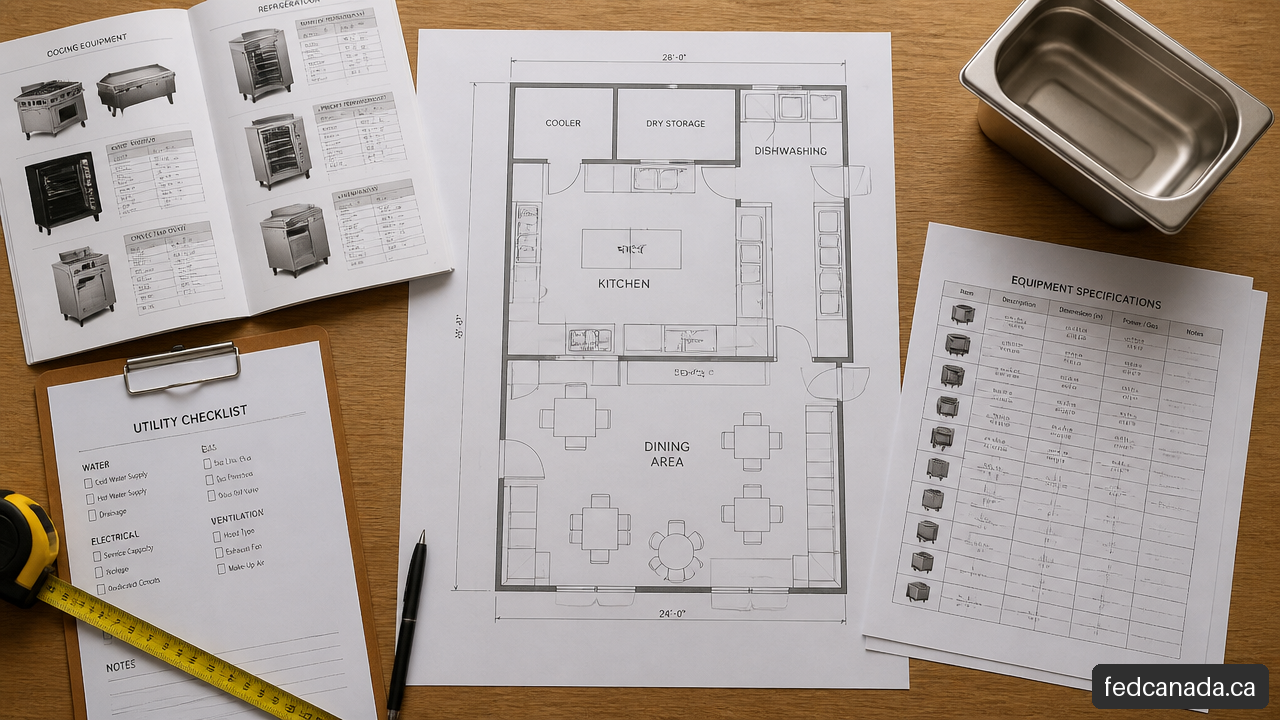
The utility schedule is the bridge between your equipment list and your site. For every appliance, capture the manufacturer’s required electrical, gas, water, drainage, ventilation, and clearance specifications. Then have qualified local professionals confirm what the space can provide.
| Utility or constraint | What to verify before purchase | Common failure if skipped |
|---|---|---|
| Electrical | Voltage, phase, amperage, breaker capacity, plug or hardwire requirement | Equipment arrives but cannot be connected safely |
| Gas | Fuel type, line sizing, pressure requirements, shutoff location | Appliance performance is poor or installation is delayed |
| Water | Cold or hot water needs, filtration, pressure, backflow requirements | Ice machines and dishwashers operate unreliably |
| Drainage | Floor drain location, gravity drain or pump requirement, drain capacity | Dishwashers or ice machines cannot discharge correctly |
| Ventilation | Hood type, exhaust volume, make-up air, fire suppression compatibility | Cookline cannot pass inspection or runs poorly |
| Physical access | Door widths, hallways, turns, elevators, loading access | Equipment cannot reach the kitchen without costly changes |
Do not assume an existing hood supports every appliance placed beneath it. Cooking equipment can have different ventilation and fire-suppression requirements based on fuel, grease production, heat output, and local jurisdiction. Similarly, a make-up air system must replace air removed by the hood; without proper balance, doors may become difficult to open, conditioned air may be pulled out of the dining area, and kitchen comfort can suffer.
For Canadian operators, equipment conformity marks and installation requirements should be checked against the rules enforced in the province or municipality where the restaurant operates. The exact accepted certification marks, gas approval process, electrical requirements, and inspection sequence can differ by jurisdiction. I would confirm these details with the local authority having jurisdiction and qualified installers before equipment is ordered, particularly for gas appliances, ventilation, and electrical upgrades.
Sequence permits and inspections around the equipment plan
Equipment should not be delivered first and investigated second. A practical sequence usually looks like this:
- Finalize the menu, service model, and preliminary kitchen workflow.
- Prepare equipment cut sheets showing dimensions, utilities, ventilation needs, and clearance requirements.
- Review the layout with building, health, fire, plumbing, electrical, and gas stakeholders as required locally.
- Complete required permits and construction work for utility rough-ins, hood systems, fire suppression, drains, and electrical service.
- Confirm equipment lead times against construction and inspection milestones.
- Schedule delivery after the site is weather-tight, accessible, and ready for staging.
- Install, connect, commission, and test equipment before final inspections and staff training.
The exact order varies. A second-generation restaurant space may already have useful infrastructure, while a new build may require significant mechanical work. In either case, treating equipment specifications as part of permit documentation reduces late surprises.
Leave room for people, cleaning, and repairs
An appliance’s listed width and depth are only the starting point. Staff need safe walking paths; doors, drawers, and oven racks need swing space; technicians need access to panels and filters; and cleaning teams need room to move equipment or reach behind it. A compact line can look efficient on a floor plan yet become frustrating in service.
Consider a reach-in refrigerator with a full door swing directly into a busy aisle. It may technically fit, but every opening interrupts traffic. A better choice might be a different door orientation, undercounter refrigeration, a relocated unit, or a revised station layout.
Accessibility should also be considered in front-of-house pathways, service counters, and circulation routes. Requirements depend on the applicable building code and the space’s use, so verify clearances locally rather than copying dimensions from another project.
Plan Delivery, Installation, and Long-Term Support
Run a receiving-readiness check one week before delivery
A delivery date is not the finish line. It is the point at which a scheduling problem can become a storage, damage, or access problem. Confirm the route from truck to final location, including loading zones, curb access, doors, corridors, stairs, elevator weight limits, and tight turns. Use this receiving checklist:
- Confirm delivery appointment, site contact, and delivery conditions.
- Measure every access point against packaged dimensions, not only equipment dimensions.
- Reserve a clean, dry staging area that does not block construction or emergency exits.
- Confirm floor protection, casters, brakes, and equipment leveling needs.
- Inspect cartons and equipment for damage before signing final paperwork.
- Match model and serial numbers to the purchase order and specification sheet.
- Keep all manuals, accessories, racks, legs, filters, cords, and installation hardware together.
- Do not discard packaging until the unit has been inspected and accepted.
Commission every critical appliance before the first service
Installation is not complete when the equipment is in place. Commissioning verifies that it performs as intended under operating conditions. Refrigeration should pull down and hold temperature. Ovens should heat consistently. Dishwashers should fill, drain, and sanitize correctly. Ice machines should have proper filtration and drainage. Hood systems and fire suppression should be tested and approved through the required process.
Create a short opening-day verification record for each critical unit:
- Model and serial number
- Installed location
- Utility connection confirmation
- Startup date and installer contact
- Target operating temperature or performance check
- Cleaning procedure and filter schedule
- Warranty information and service contact
Cambridge College’s pre-opening food business checklist recommends keeping warranties, equipment information, and service-agent details together for later reference. Store a digital copy as well as a labeled onsite binder so a manager can act quickly during a breakdown.
Make maintenance and parts availability a buying criterion
A restaurant can often work around a broken cart. It may not be able to work around a failed walk-in cooler, dishwasher, exhaust component, or primary cookline appliance.
Before purchase, ask who services the brand locally, whether common parts are stocked regionally, how warranty labor is handled, and whether preventive maintenance is available. This is especially important for remote locations, specialty imported equipment, and units with electronic controls. A feature-rich machine can be an excellent fit, but only if support is realistic for your market.
When downtime risk is high, consider backup procedures: extra refrigeration capacity, a temporary holding method, alternate cooking capacity, or an approved service plan.
FAQ: New Restaurant Equipment Checklist
What equipment do I need for a new restaurant kitchen?
At minimum, most new kitchens need refrigeration, food-prep surfaces, required sinks, warewashing capacity, dry storage, cooking equipment that supports the menu, safe ventilation where applicable, thermometers, cleaning tools, and core smallwares. The exact mix should be based on menu items, expected volume, service style, and local requirements.
How do I build a restaurant equipment checklist from scratch?
Start with the menu. Map each item from receiving through storage, prep, cooking, holding, service, and dish return. Identify the required station, then list the primary appliance, supporting smallwares, utilities, cleaning needs, and service clearance. Finally, separate launch-critical purchases from equipment that can wait.
What is the difference between kitchen equipment and smallwares?
Kitchen equipment includes durable appliances and large fixtures such as ovens, refrigerators, dishwashers, prep tables, shelving, and ice machines. Smallwares are movable tools such as pans, knives, tongs, food containers, cutting boards, and measuring tools. Budget for both; smallwares are frequently underestimated.
Which equipment is essential for opening day?
Opening-day essentials are the items necessary to prepare, store, cook, serve, and clean the launch menu safely. This commonly includes cold storage, handwashing and warewashing systems, primary cooking appliances, required hood and fire systems, prep capacity, food-safety tools, and enough serviceware or packaging for expected demand.
What equipment can wait until after launch?
Specialty machines, duplicate stations, display upgrades, and equipment intended for future menu expansion can often wait if they are not required for the initial menu or local approval. Do not delay equipment tied to food safety, required sanitation, ventilation, or your core production bottleneck.
What utilities do I need before ordering equipment?
Confirm electrical capacity and configuration, gas availability, water supply, drainage, ventilation, make-up air, fire suppression compatibility, and physical access. Use manufacturer cut sheets for each model. If any requirement is unclear, pause the order until qualified local professionals and relevant authorities confirm the installation path.
How do I know if equipment will fit through doorways and hallways?
Measure the packaged dimensions, not just the appliance dimensions. Check every part of the path: truck access, loading area, doors, hallways, turns, elevators, thresholds, and final kitchen location. Also verify that the unit can be serviced and cleaned after it is installed.
Should I buy new or used restaurant equipment?
Buy new when warranty coverage, reliability, precise specifications, sanitation condition, or certification confidence is especially important. Used equipment can work for durable non-powered pieces and some inspected appliances, but factor in condition, remaining life, utility compatibility, available parts, and the cost of a failure during service.
Recent Posts


Leave a Comment
Your email address will not be published. Required fields are marked *