



Saucepan Guide: Sizes, Materials, Uses, and Care
A saucepan is one of the most useful pieces of cookware for sauces, grains, reheating, soups, syrups, and small batches of food. The right choice is less about buying the most expensive pan and more about matching its capacity, material, base, and shape to how you cook.
Table of Contents
- Key Takeaways
- Choose the Right Saucepan Size and Shape
- Compare Saucepan Materials and Cooktop Compatibility
- Use, Maintain, and Troubleshoot a Saucepan
- Saucepan FAQ
- Sources
Key Takeaways
A 1 to 1.5 quart saucepan is practical for melting butter, warming milk, heating a single serving of soup, or making a small sauce.
A 2 to 3 quart saucepan is often the most versatile household size because it can handle grains, sauces, reheating, and modest batches of soup.
Stainless steel is a durable all purpose option, while non-stick is useful for delicate foods that tend to adhere. Copper and aluminum respond quickly to heat but need careful construction and use.
For induction, do not assume a metal pan will work. Check the manufacturer’s induction compatible label and confirm that a magnet grips the base.
A thick, flat base supports more even heat distribution and can reduce the risk of hot spots, scorching, and distortion over time.
I recommend treating warping, a loose handle, a sharp rim, or a lid that no longer seats properly as functional problems worth investigating, not merely cosmetic flaws.
A saucepan performs best when the cooking task, pan geometry, burner size, and heat level work together. A large burner under a small pan can create trouble even when the pan itself is well made.
Choose the Right Saucepan Size and Shape
What a saucepan is designed to do
A saucepan is a deep pan with one long handle and usually a saucepan lid. Its walls are generally taller than those of a skillet, helping contain liquids during simmering and stirring. It is well suited to tasks where control matters: reducing a pan sauce, cooking oatmeal, heating custard, simmering rice, or reheating soup without spreading it across a wide surface.
Capacity affects both convenience and results. An oversized saucepan can make a small amount of sauce spread too thinly, which can increase evaporation and leave food exposed to concentrated heat at the base. A pan that is too small, however, can boil over or make whisking awkward.
A practical size guide
| Capacity | Best uses | Usually avoid it for |
|---|---|---|
| 1 to 1.5 quarts | Butter, chocolate, milk, syrups, single portions, small sauces | Pasta, family sized soup, large batches of grains |
| 2 to 3 quarts | Rice, oatmeal, gravies, sauces, vegetables, soup for one or two people | Large stock, batch cooking, full pasta meals |
| 3.5 to 4 quarts | Soup, potatoes, larger grain portions, family sauces | Tiny quantities that may evaporate too quickly |
| 5 quarts and larger | Batch soups, large sauces, blanching, catering prep | Fine sauce work or small portions without careful heat control |
For one or two people, I would generally start with a 2 quart or 3 quart saucepan. It offers enough headroom for simmering while remaining light enough to pour from one hand when filled sensibly.
Saucepan versus saucier
A saucepan and saucier overlap in purpose, but the shape changes the workflow. Le Creuset Canada’s saucepan and saucier comparison describes a saucier as having rounded sides and a rounded bottom, while a saucepan has taller, straighter sides.
That distinction matters most for sauces. A saucier’s curved interior gives a whisk continuous contact with the pan, so thick custards, cheese sauces, and gravies are easier to reach in the corners. A straight sided saucepan is more useful when you want depth, controlled pouring, or less exposed surface area during a longer simmer.
| Feature | Saucepan | Saucier |
|---|---|---|
| Interior shape | Straighter sidewalls and more defined base | Rounded sides and curved base |
| Best for | Grains, reheating, soup, reductions, boiling liquids | Whisked sauces, custards, risotto, emulsions |
| Stirring access | Good, but corners need attention | Excellent for whisking and scraping |
| Evaporation control | Often better for deeper liquid cooking | Often better for active sauce work |
Test stability before buying
A saucepan should sit flat and feel balanced before it ever reaches a burner. Put it on a level surface, place the lid on top, and lightly press around the base. It should not rock. Then hold the handle as though you were pouring: the pan should feel controllable rather than handle heavy.
Stability can change on a gas range because the support comes from grate geometry rather than a flat glass or ceramic surface. In one community discussion about saucepan balance, users noted that handle orientation and the shape of a stovetop grate could affect whether an empty saucepan tipped. That does not make every angled handle unsafe, but it does mean the pan should be checked on the cooktop where it will be used.
Look for these practical details:
A handle that is firmly attached, without movement at the rivets or joint.
A flat cookware base that contacts the cooktop evenly.
A lid that sits securely without excessive wobble.
A rim that pours cleanly and does not feel sharp to the touch.
Enough handle clearance to keep your hand away from steam and the burner.
Compare Saucepan Materials and Cooktop Compatibility
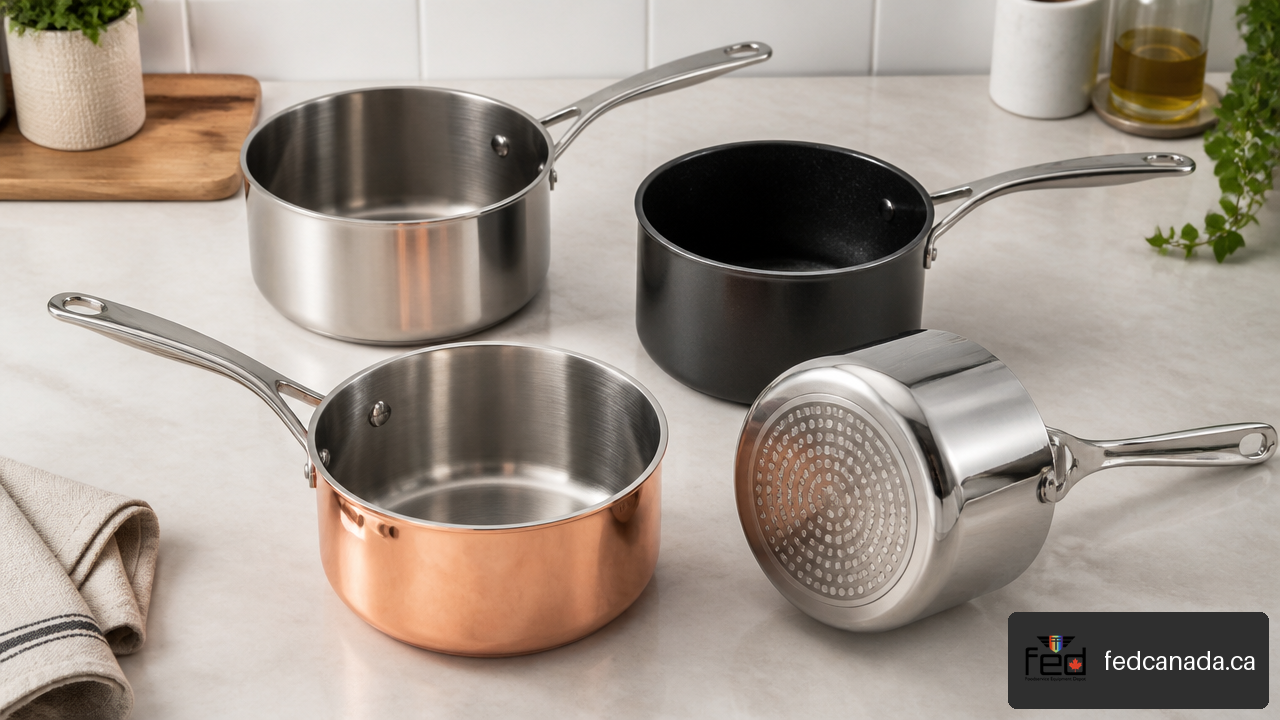
Stainless steel, non-stick, aluminum, copper, and cast iron
No saucepan material is universally best. The useful question is: What will you cook most often, and how much attention can you give the pan while it heats?
| Material | Cooking properties | Choose it when | Avoid it when |
|---|---|---|---|
| Stainless steel | Durable, nonreactive, often paired with an aluminum or copper core for better heat distribution | You want one versatile pan for sauces, grains, soups, and frequent use | You need the easiest possible surface for delicate eggs or fish |
| Non-stick | Low food adhesion and simple cleanup at moderate heat | You cook milk based sauces, oatmeal, or delicate foods and want easy release | You regularly use high heat, metal utensils, or abrasive cleaning tools |
| Aluminum | Lightweight and responsive to heat changes | You value quick heating and manageable weight | The pan has a very thin base or will face rough thermal treatment |
| Copper | Highly responsive and visually distinctive, usually lined with another metal | You need close temperature control for specialized sauce work | You want low maintenance or a budget focused everyday pan |
| Cast iron | High thermal mass and steady heat retention | You cook slow simmered foods and do not mind weight | You need quick temperature changes or easy one handed pouring |
Stainless steel is often the practical default because it is durable and adaptable. Still, stainless steel is not inherently non-stick. Food may adhere when the pan is overheated, when moisture has not cooked off, or when a thick sauce sits still too long at the bottom.
Non-stick saucepans are useful, but they need gentler treatment. Use silicone, wood, or other coating safe utensils, and avoid heating an empty non-stick pan aggressively. If the coating is deeply scratched, flaking, or visibly deteriorated, follow the manufacturer’s replacement guidance rather than trying to restore it with abrasive tools.
Understanding heat distribution
Heat distribution depends heavily on the base and wall construction. A thin pan can heat quickly, but it may develop localized hot spots. A heavier clad saucepan usually changes temperature more gradually because it has more thermal mass and a layered structure that spreads heat across the base.
This is especially noticeable with dairy, sugar, and starch. Consider a cheese sauce: as it thickens, it becomes less mobile and more likely to sit against the hottest portion of the pan. A pan with uneven heat distribution can create a scorched spot before the rest of the sauce is fully hot.
For foodservice applications, a standard saucepan is useful for cooking, but it is not always the right holding tool. Once a sauce is finished, equipment such as a Double Sauce Pot Warmer can help maintain serving temperature without relying on direct burner heat.
Confirm induction compatibility
Induction cooktops heat cookware through magnetic coupling at the base. Stainless steel cookware may be induction compatible, but not all stainless steel is magnetic enough to work. Aluminum and copper pans typically need a bonded magnetic layer on the base.
Use this verification workflow:
Read the manufacturer’s label for an induction compatible symbol or explicit statement.
Hold a small magnet to the center of the pan’s exterior base. A firm grip is a useful preliminary sign, though it is not a full performance test.
Compare the pan’s flat magnetic base with the minimum cookware diameter specified by your cooktop manufacturer.
Test the empty pan briefly on a low to medium setting, then add food or liquid as appropriate for the pan material.
Stop use if the cooktop repeatedly displays errors, loses detection, makes unusual noises beyond normal operating sounds, or trips electrical protection. Seek guidance from the appliance and cookware manufacturers.
A magnetic base alone does not guarantee perfect performance. Base diameter, flatness, and the cooktop’s sensor layout also matter.
Use, Maintain, and Troubleshoot a Saucepan
Preheat gradually and prevent scorching
For most saucepan tasks, moderate heat is more effective than maximum heat. A small pan heats quickly, and the liquid inside may not redistribute fast enough to protect food at the base. Start lower than you think you need, especially with milk, cream, sugar, tomato products, and thickened sauces.
A Reddit discussion about sauce sticking during thickening included a participant who managed the issue by reducing heat and stirring. It is community advice rather than controlled testing, but the mechanism is sensible: lower heat gives a thickening sauce more time to circulate before residue burns onto the pan.
Use this response sequence when a sauce begins sticking:
Reduce the burner setting immediately.
Move the pan briefly off the heat if the sauce is actively scorching.
Stir across the full base and up the sidewalls, paying attention to corners.
If appropriate for the recipe, loosen the sauce with a small amount of compatible liquid.
Transfer the unburned portion to a clean pan if a dark, bitter layer has formed. Do not aggressively scrape burnt residue into the sauce.
A wooden spoon or silicone spatula can be useful because it reaches the bottom without damaging a non-stick surface. Whisks are better for smooth emulsions and custards, especially in a rounded saucier.
Avoid thermal shock and warping
Warping is permanent distortion of the cookware base or body. It can make a pan rock on a smooth cooktop, reduce contact with an induction surface, alter heat distribution, or stop a lid from seating correctly.
The available evidence does not establish one universal warping threshold or a guaranteed prevention method. Still, gradual heating and cooling are sensible precautions. In a community report on a saucepan that changed shape, uneven heating and repeated thermal cycling were discussed as possible causes, alongside a lid that no longer fit properly.
I recommend this practical thermal shock prevention routine:
Match the burner to the pan base rather than allowing flames or intense heat to extend far beyond it.
Begin at low or medium heat, then increase gradually if needed.
Avoid moving an empty, very hot pan directly onto a cold wet surface.
Let the pan cool before washing it, particularly before exposing it to cold water.
Dry the base fully before returning it to a glass, ceramic, or induction cooktop.
If the pan rocks slightly but still heats evenly, it may be usable on some gas ranges. If it rocks significantly, spins, has a visibly domed base, loses stable contact with an induction cooktop, or no longer accepts its lid, replacement is usually the more practical option.
Inspect quality and clean according to construction
Inspect a new saucepan under bright light before discarding packaging. Check the interior for deep scratches, the rim for rough or sharp sections, the handle attachment for looseness, and the lid for chips or poor fit. A cookware quality control discussion documented a user report of repeated spiral scratches and a sharp feeling rim bevel on replacement pans. That is one customer report, not a broad product finding, but it illustrates why an early inspection is worthwhile.
For routine care:
Wash after the pan has cooled enough to handle safely.
Use nonabrasive sponges for non-stick interiors.
Soak stubborn residue instead of using sharp tools that can damage the surface.
Dry cookware thoroughly, especially around rivets and the underside of the base.
Check handles and lids periodically, since a pan can remain visually attractive while a loose fitting component becomes a safety concern.
Professional kitchens may need a broader equipment plan than a collection of saucepans alone. Elevate Your Culinary Experience outlines how specialty cooking equipment can complement core cookware, while the Importance of Food Preparation Equipment is relevant when planning efficient prep capacity at a larger scale.
Saucepan FAQ
What is a saucepan used for?
A saucepan is used for liquids and smaller volume cooking: sauces, gravies, oatmeal, rice, soup, syrup, melted butter, reheating leftovers, and simmered vegetables. Its depth helps limit splashing and makes it easier to work with liquids than a shallow skillet.
What size saucepan is best for one or two people?
A 2 to 3 quart saucepan is usually the most flexible size for one or two people. It can make rice or pasta sauce without feeling oversized, while still holding enough soup or vegetables for a modest meal. A 1 quart pan is best treated as a companion pan for very small jobs.
What is the difference between a saucepan and a saucier?
A saucepan has straighter walls and is better suited to deeper simmering and general liquid cooking. A saucier has rounded walls and a curved base that make it easier to whisk sauces and reach every part of the interior. Choose a saucepan for versatility; choose a saucier when emulsions, custards, and thick sauces are frequent tasks.
Is stainless steel or non-stick better for a saucepan?
Stainless steel is usually better for long term versatility, durability, and higher heat cooking. Non-stick is better when easy release is the priority, particularly for delicate or sticky foods cooked at moderate heat. The right choice depends on cooking habits, not a universal winner.
How can I tell whether a saucepan works on induction?
Check for an induction compatible marking, then test the exterior base with a magnet. A magnet that grips firmly suggests the pan may work, but the flat base must also be large enough for the cooktop’s sensor. Verify performance on the actual cooktop before relying on the pan for daily use.
Why does food scorch in my saucepan?
Scorching usually develops when food sits against an overheated section of the base, especially as sauces thicken or liquid evaporates. Lower the heat earlier, stir more often, use a pan with better heat distribution, and do not leave dairy, sugar, or starch based mixtures unattended during the final stages of cooking.
Can I put a hot saucepan in cold water?
It is better to let it cool first. Rapid temperature changes can stress the metal and may contribute to warping, particularly in thinner cookware. If food is stuck, soak the pan after it has cooled rather than shocking it with cold water immediately after cooking.
Sources
Le Creuset Canada — Complete Guide to the Saucier: https://www.lecreuset.ca/en_CA/blog/complete-guide-to-saucier.html
Reddit r/Cooking — Saucepan Changed Shape?: https://www.reddit.com/r/Cooking/comments/1i2dgzg/saucepan_changed_shape/
Reddit r/Cooking — Making Sauce in a Saucepan: https://www.reddit.com/r/Cooking/comments/1h64bbz/making_sauce_in_a_saucepan/
Reddit r/cookware — De Buyer saucepan: https://www.reddit.com/r/cookware/comments/1hvsdy/de_buyer_saucepan/
Reddit r/cookware — Made In sauce pan QC issue?: https://www.reddit.com/r/cookware/comments/1u48895/made_in_sauce_pan_qc_issue/
Recent Posts

Leave a Comment
Your email address will not be published. Required fields are marked *